The Neuroscience of Introspection: Why the Most Common Way We Look Inward Keeps Us Stuck
Replaying, analysing, asking “why am I like this”, it feels like self-work. The brain imaging says it is often the opposite.
The Neuroscience of Introspection: Why the Most Common Way We Look Inward Keeps Us Stuck
Replaying, analysing, asking “why am I like this”, it feels like self-work. The brain imaging says it is often the opposite.
When most people sit down to reflect, they do the same thing. They replay the situation. They analyse why they feel bad. They ask “why am I like this.” Then they run the loop again.
It feels like working on yourself. Like getting to the bottom of something. The brain imaging tells a different story.
That style of introspection has a name, rumination, and it is one of the most reliable drivers of anxiety and depression we have. The cruel part is that it does not feel like a problem. It feels like insight. And that is exactly why people do more of it when they feel worse, deepening the very groove they are trying to climb out of.
To understand why, you have to know that your brain has two completely different ways of relating to your own inner life, and they run on two different circuits.
The narrative self
This is the “me” you think about. The story, the running commentary, the verbal “why did I do that, what if, what does this say about me.”
It runs on the default mode network, primarily the medial prefrontal cortex and posterior cingulate cortex. This network is essential for memory, planning, and making sense of your life. But when it dominates, it loops. Research consistently shows that depression involves overactive default mode connectivity, and the more a person broods, the more that network strengthens, and the harder it becomes to switch out of it.
In other words, the machinery of self-analysis, run too hard, becomes the machinery of getting stuck.
The experiential self
This is the you that is simply here, sensing, right now. The feeling of your breath, your body, the present moment, before any story attaches to it.
It runs on a different circuit entirely, the insula and the salience network, the hub of interoception, the brain’s reading of the body’s internal state. This is the self that observes rather than narrates. It does not explain your experience. It inhabits it.
The reframe almost nobody is told
When most people try to “look inward,” they crank up the narrative self. More analysis, more story, more words about themselves. And for a brain already prone to anxiety or low mood, that does not resolve anything. It deepens the groove.
You cannot think your way out of a loop that thinking is generating.
The introspection that actually works does the opposite. It shifts you out of the story and into direct sensing, out of the narrative loop and into the experiential mode. This is precisely what mindfulness training does at the neural level. It quiets the runaway default mode network, strengthens the experiential circuit, and restores your ability to switch between the two instead of being trapped in one. People who train this over time physically change the connectivity between these networks.
Why this matters so much in chronic illness and mental health
When you feel bad, the narrative self often starts instantly: “why is this happening, what did I do, what does this mean for my future.” That is a rumination spiral running on top of a body that already feels terrible, and in chronic illness it is relentless.
Learning to drop out of the story and into present, direct sensing is not avoidance, and it is not denial. It is switching off the circuit that amplifies the suffering and switching on the one that can actually settle it.
So what does good introspection actually look like?
Not more thinking about yourself. It is a trainable skill of changing how you attend to yourself.
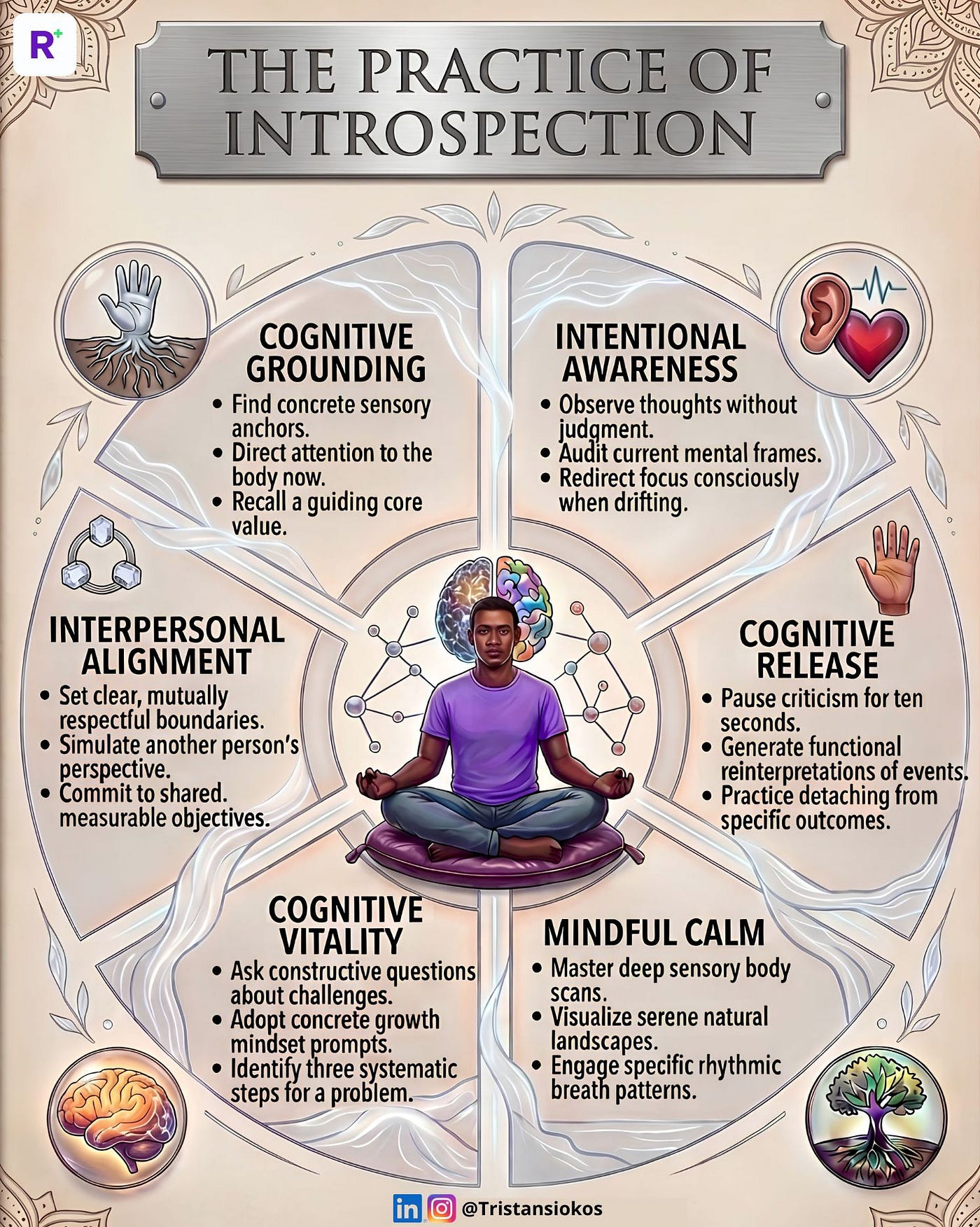
Grounding attention in the body and the present. Observing thoughts without climbing inside them. Pausing the judgment and the story before you react. Using breath and sensory focus to drop out of the loop. The goal is not to analyse yourself harder. It is to change which part of your brain is holding you.
You were never going to think your way to peace. The mind generating the spiral cannot be the one that ends it. Real introspection is learning to step out of the story and back into the moment, and your brain can be trained to do exactly that.
I write about neuroscience, chronic health, and the nervous system, from the research and from lived experience. 13.5k followers on Linkedin.
I’m also building Recalibrate, a neuroscience and chronic health platform, at recalibratepain.com.
메타데이터
- post_id
- 24416bb8ffdb
- slug
- the-neuroscience-of-introspection-why-the-most-common-way-we-look-inward-keeps-us-stuck-24416bb8ffdb
- url
- https://medium.com/@tristan.siokos/the-neuroscience-of-introspection-why-the-most-common-way-we-look-inward-keeps-us-stuck-24416bb8ffdb
- canonical_url
- https://medium.com/@tristan.siokos/the-neuroscience-of-introspection-why-the-most-common-way-we-look-inward-keeps-us-stuck-24416bb8ffdb
- author_url
- https://medium.com/@tristan.siokos
- status
- ok
- fetched_at
- 2026-06-16 20:05:23