The Space Between Painting and Drawing: A Charcoal Matter Painting Experiment
AI Art exploring how charcoal dust transforms paint into a hybrid medium of pigment, particles, and mark-making.
The Space Between Painting and Drawing: A Charcoal Matter Painting Experiment
AI Art exploring how charcoal dust transforms paint into a hybrid medium of pigment, particles, and mark-making.
While experimenting with various paint and matter combinations, I stumbled upon something unexpected. Most of the materials I tested changed the texture and physical character of the artwork, but the results still felt firmly rooted in painting.
Charcoal dust was different.
When embedded within the medium, it did not simply add another texture. It began pulling the artwork toward something else. The images no longer felt like ordinary paintings, but they did not become drawings either.
Instead, they occupied a strange space between the two.
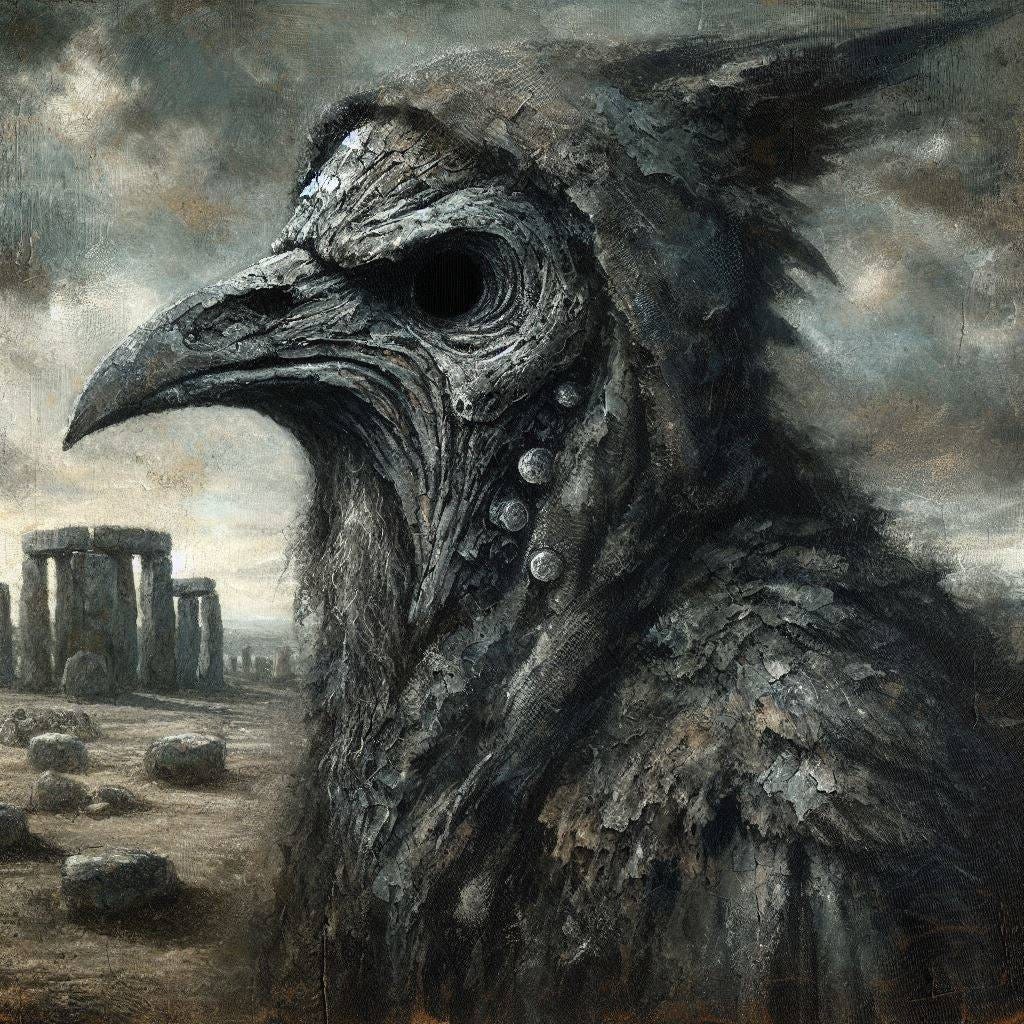
The Raven Druid: Charcoal dust embedded in casein paint gives the weathered raven mask qualities of both painting and drawing, illustrating the hybrid medium explored throughout this article. AI art.
Because the results were so different from my previous experiments, I set them aside for further exploration.
Matter painting is based on incorporating physical substances directly into the paint. Rather than sitting on the surface, fibers, particles, and fragments become mixed into the medium, allowing the material to influence the finished piece.
With this approach, that relationship changed. The particles introduced drawing-like characteristics: deep shadows, soft transitions, erased edges, and expressive marks.
It began behaving less like a conventional painting and more like a charcoal drawing preserved inside its layers.
What began as another test became a new question:
Can a material transform not just the texture, but the medium itself?
The Space Between Painting and Drawing
What makes this process compelling is not simply the texture it creates. It is the uncertainty of what the artwork actually is.
A traditional painting is built through color, layers, and accumulated pigment. A charcoal drawing relies on marks, contours, and tonal transitions. When charcoal dust is embedded into paint, these two visual languages begin sharing the same surface.
The result belongs completely to neither.
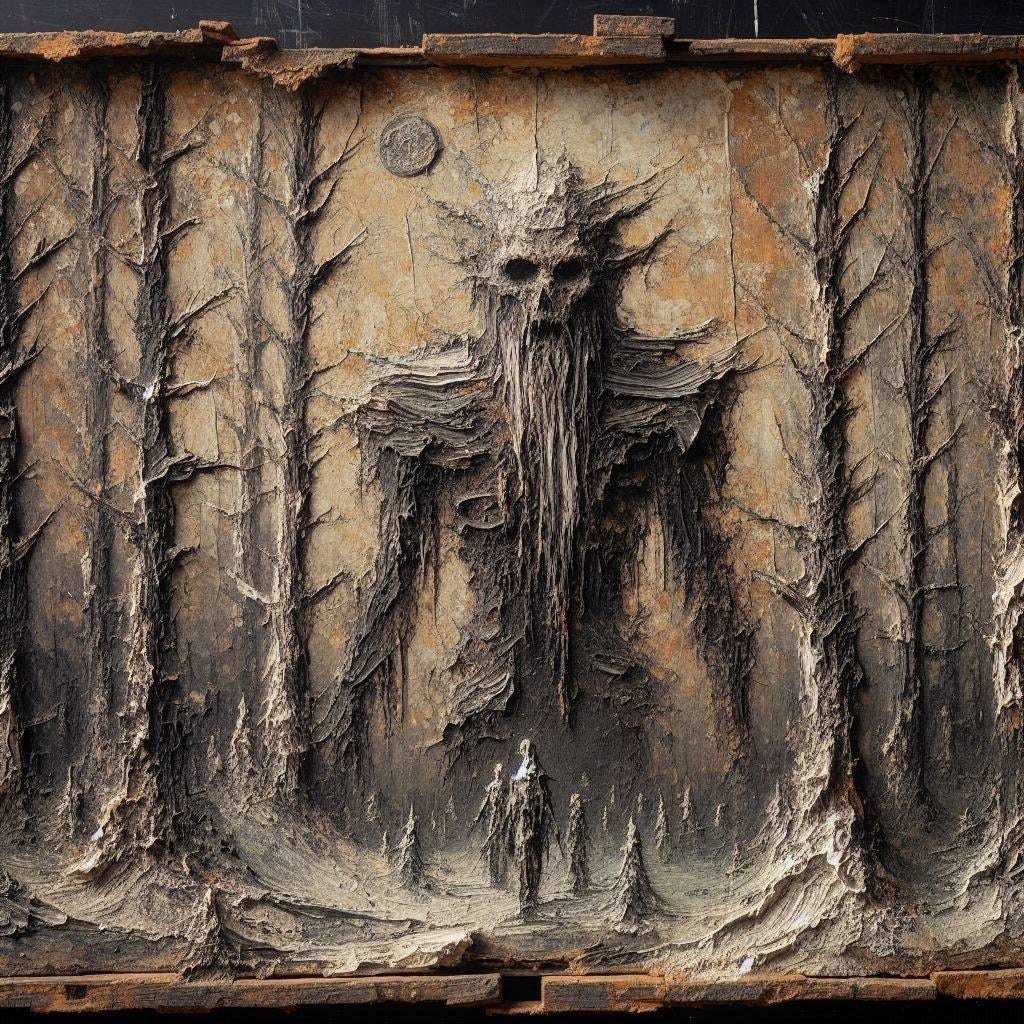

Forest Relics: Charcoal matter paintings where heavy sediment and caked textures replace digital smoothness with a weathered physical surface. Dust settles into the cracks, creating an appearance that feels closer to ancient plaster, mud, and charcoal drawing. AI art.
When a Painting Starts to Behave Like a Drawing
Charcoal is unusual because it already carries the visual language of drawing. Unlike most materials added to paint, its qualities remain active within the image rather than simply changing the surface.
These characteristics remain visible throughout the composition:
- expressive marks
- soft shadows
- smudged transitions
- sharp contours
Edges become less like painted boundaries and more like charcoal marks. Shadows appear smudged rather than blended, and forms seem to emerge from darkness instead of being built solely through layers of paint.
The Appeal of the Hybrid Medium
This uncertainty is part of what makes the images compelling.
Rather than belonging completely to one or the other, the artwork invites the eye to move constantly between painted surface and drawing.
From Texture to Identity
Most matter painting materials primarily change the physical character of the paint. Fibers add structure, sand introduces grain, stone adds weight, and paper produces a fibrous surface
Charcoal goes further. Because its drawing qualities remain active, it does not simply add texture. The medium begins carrying them as part of its own identity.
Why the Result Feels Ancient and Unfamiliar
There is also a symbolic quality to charcoal that reinforces this hybrid appearance.
Connected to some of the earliest forms of human image-making, it carries associations with:
- soot
- ash
- fire
- primitive markings
- traces left behind
Combined with a weathered surface, these associations make the images feel less like modern illustrations and more like discovered artifacts. The figures seem not to have been painted onto the canvas, but uncovered from within it.
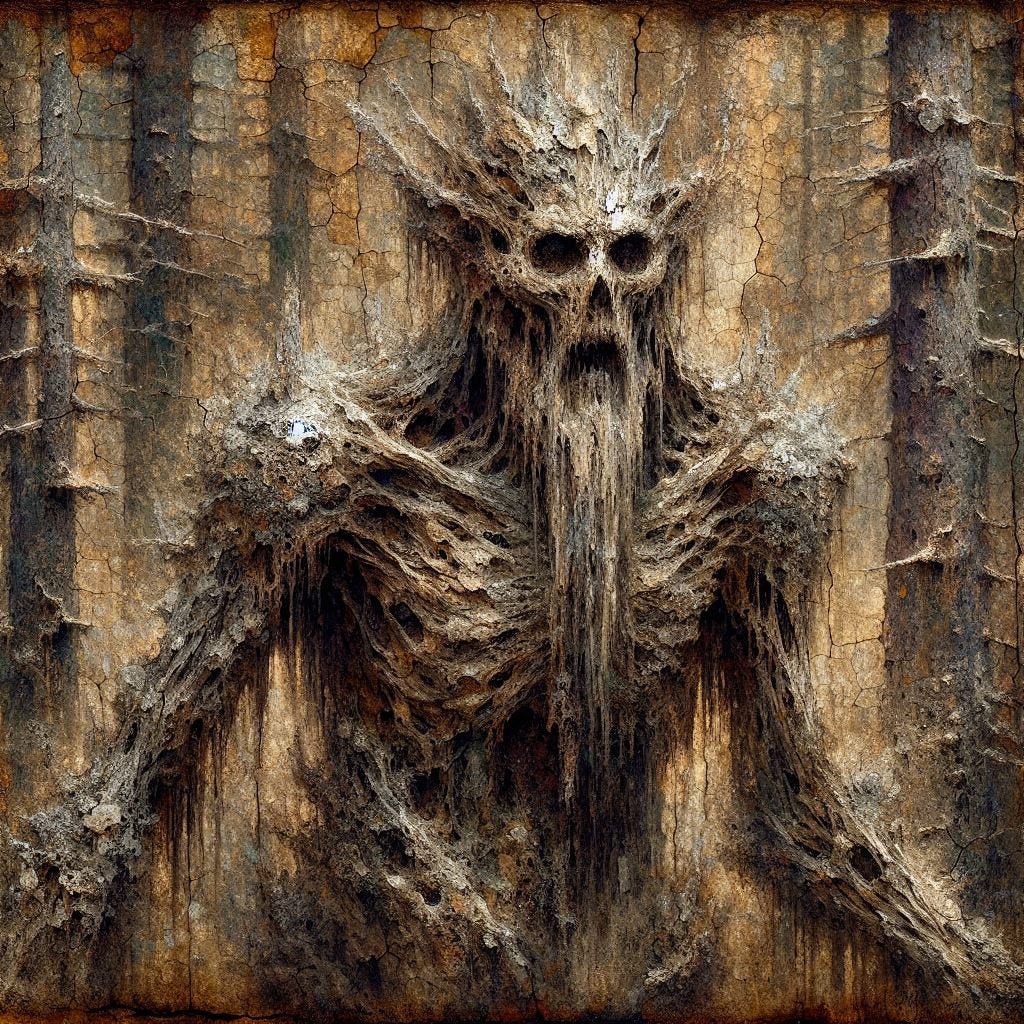
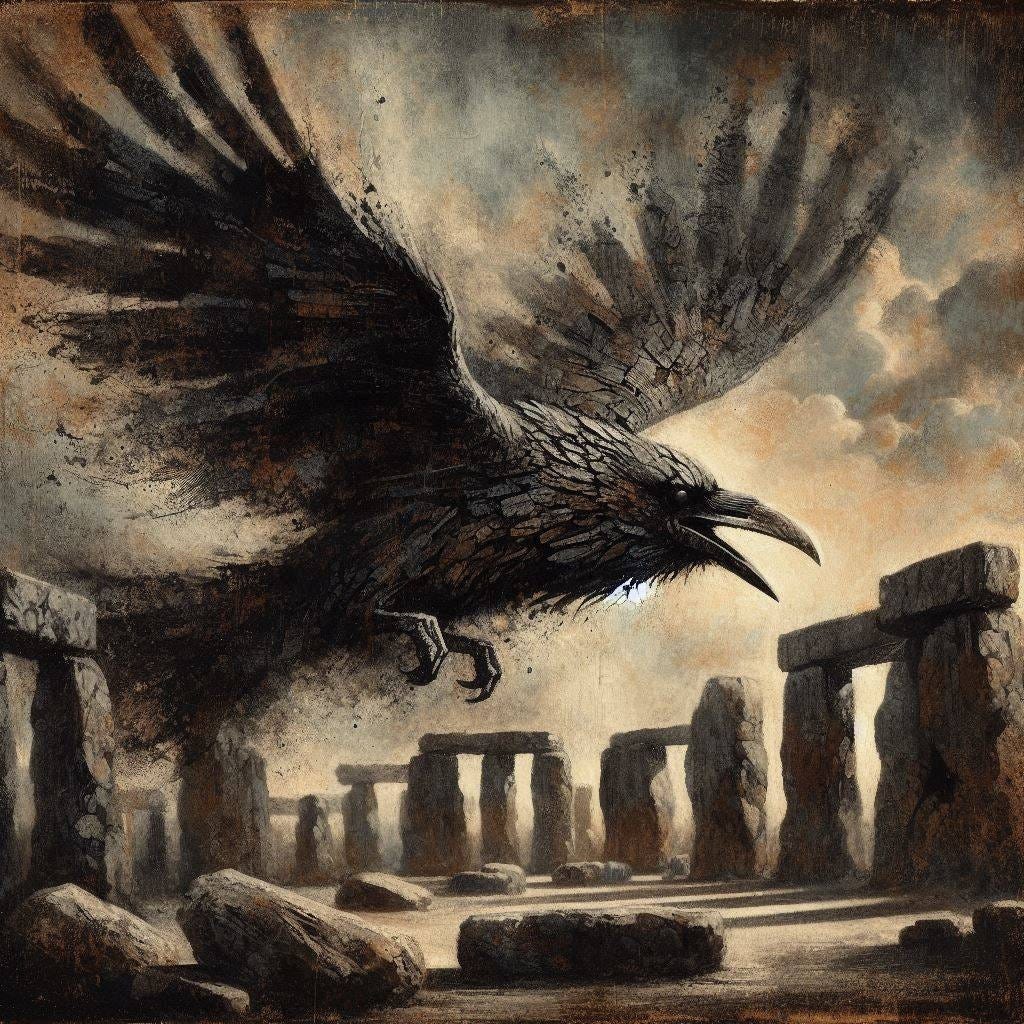
Forest Spirit and Raven: The same charcoal matter painting process produces two distinct results. The forest spirit pushes charcoal toward its most physical expression, where cracked surfaces and layered sediment blur the boundary between painting and drawing. The raven scene uses it more subtly, allowing soft dust, deep shadows, and atmospheric haze to carry the image while preserving the same tactile character. AI art.
When Materials Transform the Medium: Whitewash as Erosion and Contrast
Once I understood how charcoal could transform the character of a painting, I began asking a different question:
What happens when another material does not add to the painting, but pushes against it?
Whitewash created one of the most interesting contrasts because it introduced a substance with the opposite visual behavior. Charcoal builds through darkness, accumulation, and mark-making. Whitewash works through covering, fading, and interruption.
Instead of simply adding another texture, whitewash changed the relationship between the dark areas and the surrounding space.
Whitewashed Surface: The Erosion of the Image
When whitewash was applied broadly, it behaved like a historical layer covering an older image.
Rather than creating a clean contrast, the whitewash softened and buried the charcoal underneath. Dark forms became faded remnants, as if the painting had been exposed to time, weather, or repeated restoration attempts.
The effect resembled:
- charcoal drawings partially erased by hand
- old murals disappearing beneath layers of pigment
- archaeological surfaces where previous images remain visible beneath newer layers
It was still present, but no longer dominated, becoming part of a process of fading and erosion.
This produced a different kind of hybrid: not only between painting and drawing, but between creation and erosion.
Whitewashed Features: Using Absence to Define Form
A contrasting result appeared when whitewash was used more selectively. Instead of covering the charcoal image, the white areas began defining it.
By placing white areas around key features, the negative space became an active part of the composition. The whitewash acted almost like a stencil, cutting into the charcoal mass and revealing the structure of the figure.
The effect was closer to:
- reverse drawing
- carved negative space
- stencil-like separation
- highlights created through removal rather than addition
The drawing was no longer just made from charcoal marks. It was defined by the boundary between what remained and what was covered.
The Unexpected Role of Whitewash
My whitewash experiments revealed another layer of this process.
Substances do not only contribute their own texture. They also change how other materials are perceived.
Charcoal by itself pushes toward drawing. Whitewash changes this balance by either softening the drawing-like characteristics and turning the artwork into a weathered artifact, or framing those qualities and making the forms more defined.
The same process can either hide the image or reveal it.
Whitewash expanded the original question beyond the boundary between painting and drawing. The result became about the tension between materials — the way one substance can reveal, obscure, or transform another.
The final image exists because of the interaction between charcoal and whitewash:
one creates the mark, the other determines what survives.


“Ghosts in White” — AI art matter paintings explore two ways of reducing the charcoal’s natural dominance. On the left, whitewashed features erode the darkness, creating the appearance of faded pigment worn away by time. On the right, white pastel dust settles across the surface, softening the heavy charcoal into a powdery veil. Both preserve the tactile, cracked character of the medium while shifting the mood toward something quieter and more spectral.
When the Subject Supports the Material
One unexpected discovery was that the subject itself influenced how strongly the charcoal effect appeared.
The mixture remained the same, but the choice of subject determined whether its characteristics were amplified or muted. Some gave the charcoal room to dominate, while others pushed the result back toward a more conventional painted image.
This revealed that the material does not exist independently from the image. The subject determines how much opportunity it has to influence the final piece.
Building the Charcoal Matter Painting Prompt
The effect depends on more than simply adding charcoal to paint. The surrounding elements of the prompt determine whether the material remains visible or becomes only a subtle supporting detail.
The foundation prompt I used was:
Antique matter painting of an eerie forest spirit, casein paint containing charcoal dust, paint mixed with charcoal dust particles, integrated into layers of paint, material dispersed evenly within the paint, unrefined primitive art, on a weathered canvas.
While every part of the prompt plays a role in the result, some variables have a much greater influence than others.
Start With Subjects That Support Charcoal
Subjects with natural texture, deep shadows, and atmospheric forms give the material room to express its own visual language.
Forest spirits, ravens, ancient faces, weathered trees, and forgotten ruins consistently produced the most compelling results because they naturally reinforce charcoal’s soft transitions, rough textures, and dark tonal relationships.
Cleaner or brighter subjects often push the image back toward a more conventional painted illustration, where charcoal becomes a supporting texture rather than the defining feature.
This revealed an important characteristic: charcoal does not influence every subject equally. Bright scenes and conventional portraits often reduced the effect, making the transformation much more subtle. However, this also revealed where it had the greatest influence.
Charcoal naturally reinforces atmosphere, age, shadow, and ambiguity, making it especially well suited to subjects where those qualities are already part of the image.
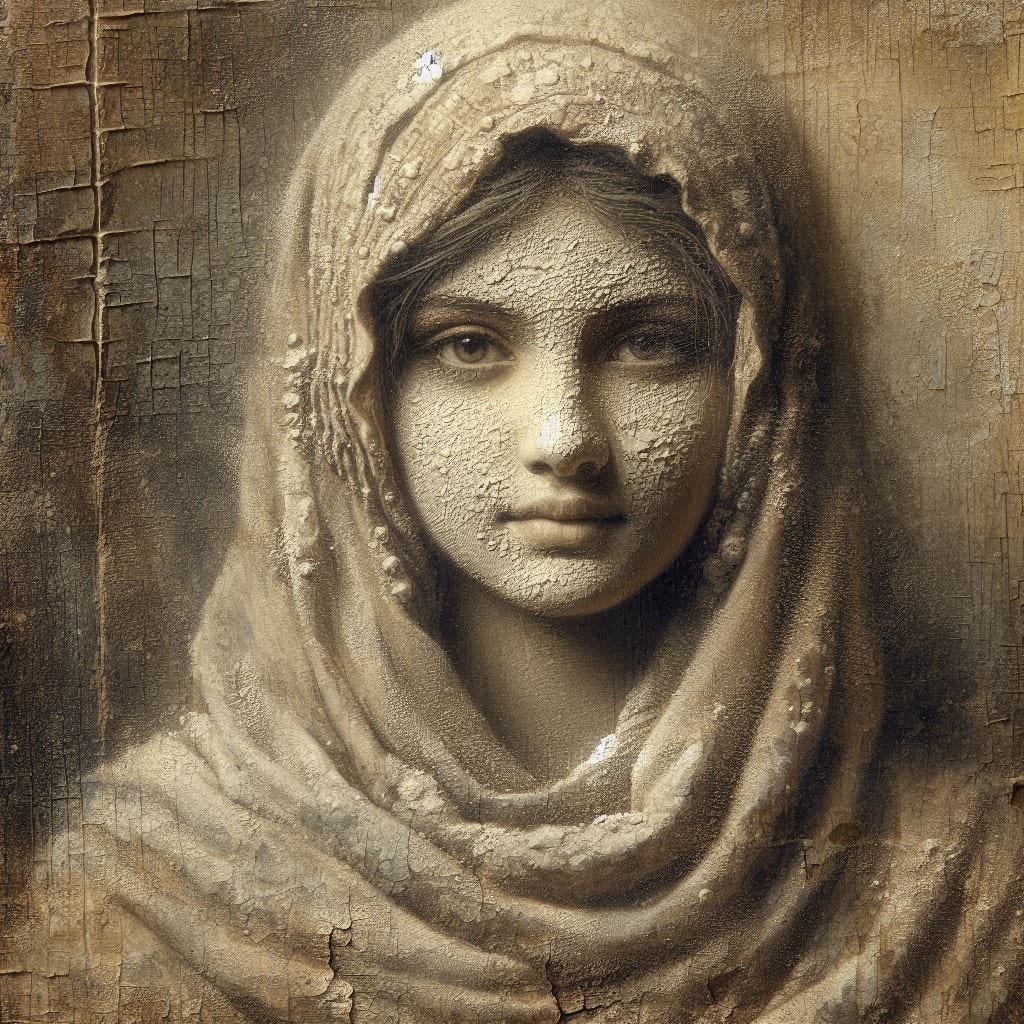
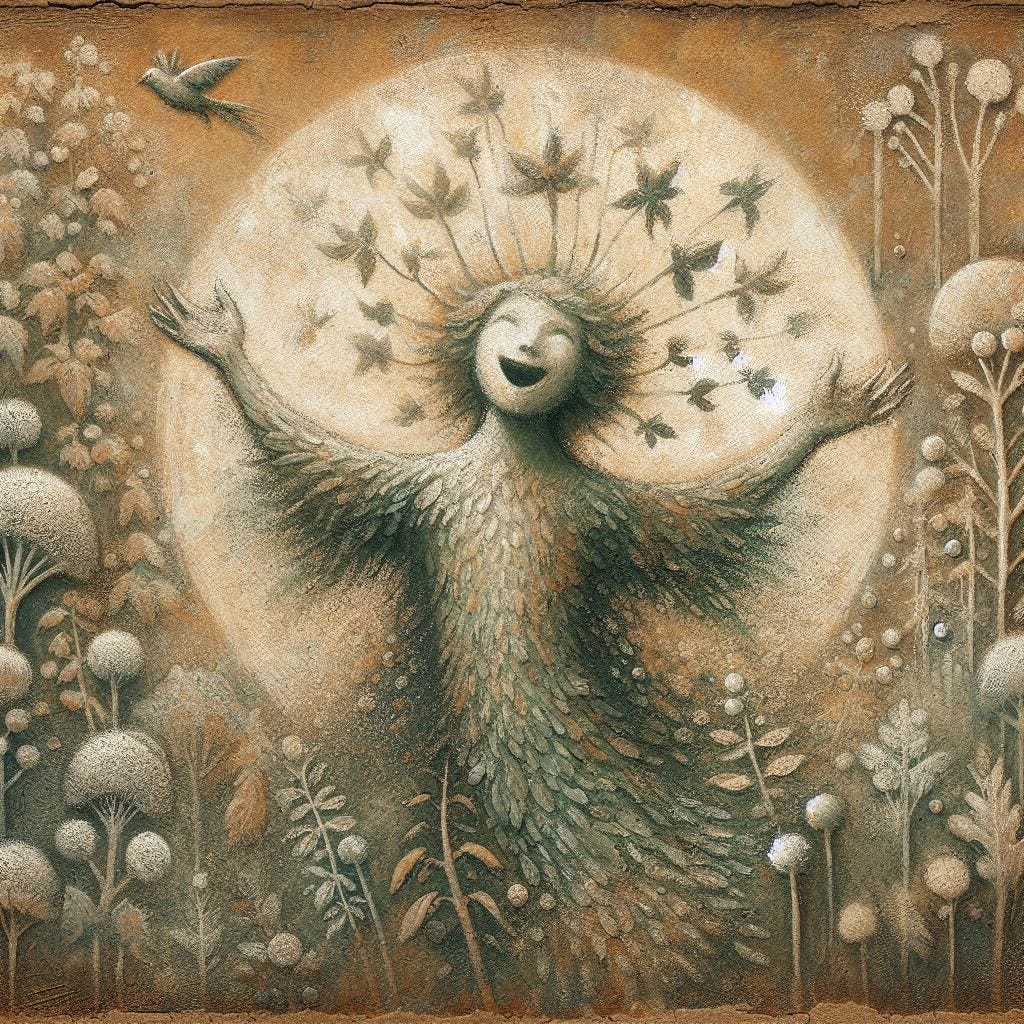
These AI art experiments demonstrate that charcoal does not transform every subject equally. A restrained portrait and a bright forest spirit show how lighter moods and cleaner forms can reduce charcoal to a supporting role instead of allowing it to reshape the image’s identity.
Mood Controls the Visibility of the Material
The atmosphere of the image determines how strongly charcoal asserts itself.
Words such as eerie, ancient, mysterious, weathered, primitive, and archaeological naturally reinforce charcoal’s darker characteristics, encouraging deeper contrast, aged textures, and more ambiguous forms.
Brighter or cleaner moods often shift the artwork toward illustration or fantasy art, where it becomes less dominant.
The Canvas Is More Important Than Expected
One of the most useful discoveries was the role of the surface.
A phrase such as “on a weathered canvas” gives the charcoal a physical environment where roughness, age, and irregularity texture feel natural.
The surface helps unify the two mediums: the paint provides the physical structure, the charcoal introduces the drawing qualities, and the aged support connects them into a single artifact-like object.
Without that context, the same mixture can drift toward a smoother, less tactile image.
Paint Type: A Secondary Variable
Changing the paint type influences the outcome, but usually less than the subject, mood, or support.
Casein works particularly well because its matte, absorbent appearance complements charcoal’s dusty qualities. Oil and acrylic create different surface behaviors, but once the drawing influence becomes dominant, those differences become secondary.
The base medium affects the character of the overall result, while charcoal determines much of the shift between painting and drawing.
Modifying the Prompt
When adjusting the base prompt, the most effective changes are not simply adding more texture words. They involve controlling the relationship between the substance and the rest of the image.
The most useful modifications are:
- Describe how the charcoal interacts with the paint.
- Introduce secondary materials deliberately.
- Consider where the material appears within the image.
Small wording changes can determine whether the added matter becomes part of the background, the surface, or the identity of the subject itself.

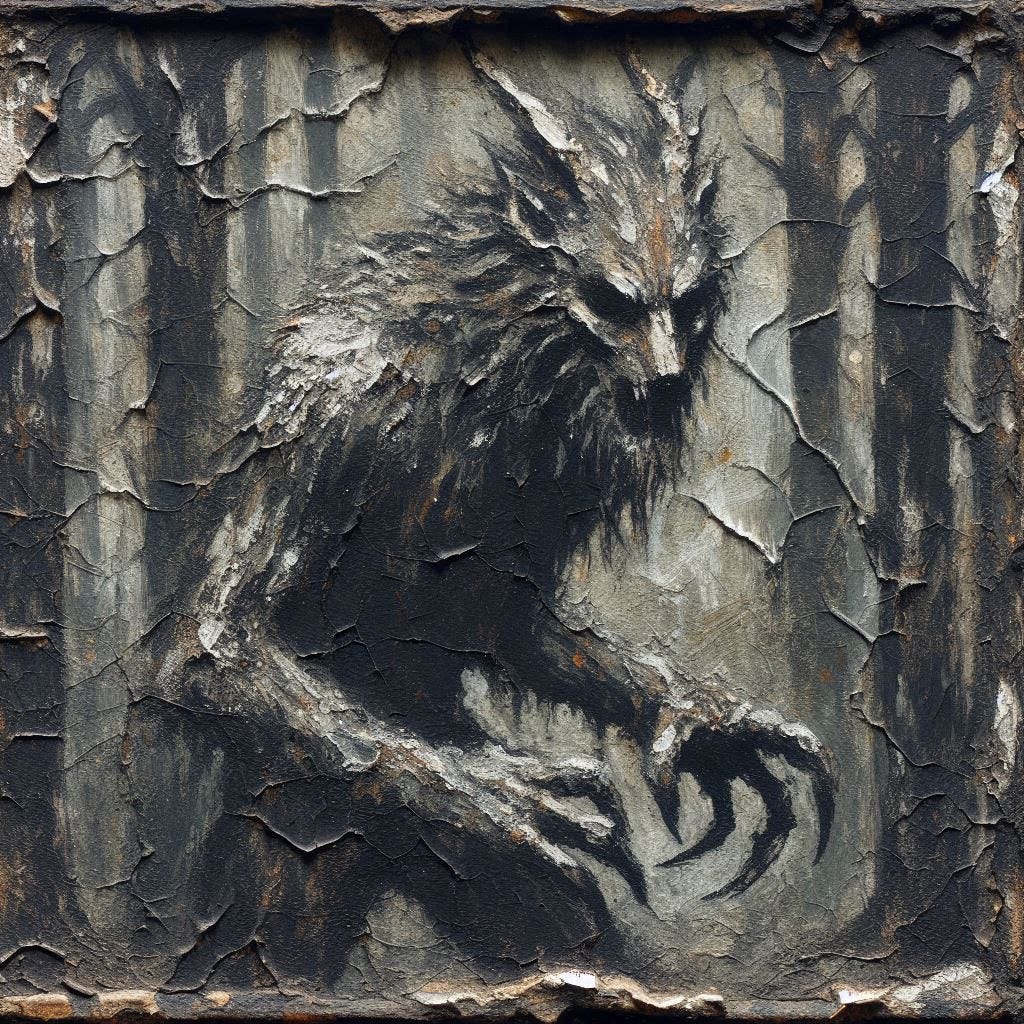
Beasts of Bark & Shadow: When the subject supports the material, charcoal can become more than a surface effect. Winged and predatory forms push the medium toward fractured textures, dense sediment, and splintered contours until the creatures appear constructed from charcoal itself. AI art.
Beyond Charcoal: Exploring Other Materials
While charcoal remained the most successful for creating this hybrid effect, I wanted to see whether other traditional mark-making materials could produce related transformations.
Some revealed unexpected variations, suggesting that this middle ground can be explored through more than one substance.
Graphite Powder
Graphite powder was the most consistent alternative.
Where charcoal emphasized atmosphere, soft shadows, and primitive mark-making, graphite introduced smoother tonal transitions and a cleaner, more controlled drawing quality. The results often felt closer to pencil work while still maintaining the physical qualities of embedded particles.
Rather than replacing it, graphite created a more refined and controlled version.
White Pastel
Combined with charcoal dust, white pastel revealed another interesting variation.
Instead of simply brightening the image, the white pastel often behaved like highlights added to a charcoal drawing. The combination increased contrast while preserving the interaction between the two substances.
General descriptions such as “white pastel” tended to influence the entire surface, while more targeted phrases such as “white pastel features” directed the effect toward specific parts of the subject.
This revealed that materials can be controlled not only by what they are, but also by where they are assigned within the image.
Crushed Charcoal Fragments
The larger fragments were much less predictable.
Most generations lost the expressive qualities that made the dust distinctive, shifting back toward heavily textured matter paintings. However, the successful results were among the most interesting.
Larger fragments occasionally combined these atmospheric characteristics with a more pronounced physical presence, resulting in a balance between painted structure and drawn qualities.
Although inconsistent, these experiments suggest that particle size may be another important variable. A substance’s effect is influenced not only by what it is, but also by its physical form.


Expressive vs. Sculptural: AI art matter paintings reveal two distinct behaviors. On the left, charcoal splatters, whitewash, and exposed drawing lines create a figure that feels as though it is dissolving into the surface. On the right, dense charcoal and layered matter consolidate into a cracked, bark-like guardian whose form appears built from the material itself.
Preserving the Tension Between Two Mediums
The most successful images are not those where charcoal takes over completely, but those where the relationship between the two mediums remains visible.
If charcoal dominates, the artwork shifts toward drawing; if paint dominates, the hybrid quality begins to disappear.
The goal is not to choose between the two, but to preserve the interaction between them. That unstable middle ground is where the most interesting results appear.
Final Thoughts
When I began experimenting with matter painting, my goal was to see how different substances could change the texture and physical character of the surface. Materials like fibers, sand, and paper each gave the piece a distinct character, expanding what it could become.
Charcoal revealed something much broader.
Rather than simply altering the texture, it began changing the identity of the artwork itself. Instead of only altering the appearance, charcoal began influencing what type of piece emerged.
Throughout these experiments, one pattern became clear: the most compelling images came when every part of the prompt supported the matter. Atmospheric subjects, weathered surfaces, and carefully chosen elements gave the medium more opportunity to express itself.
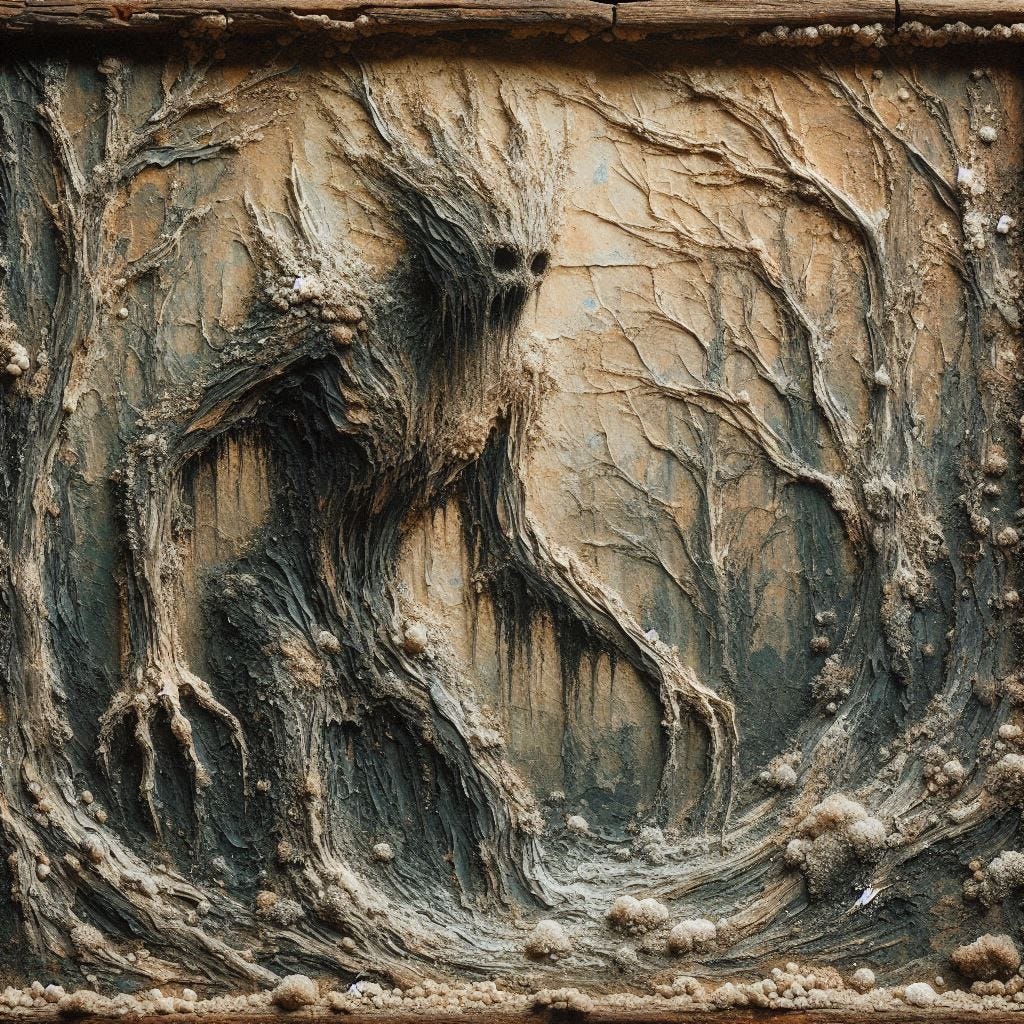
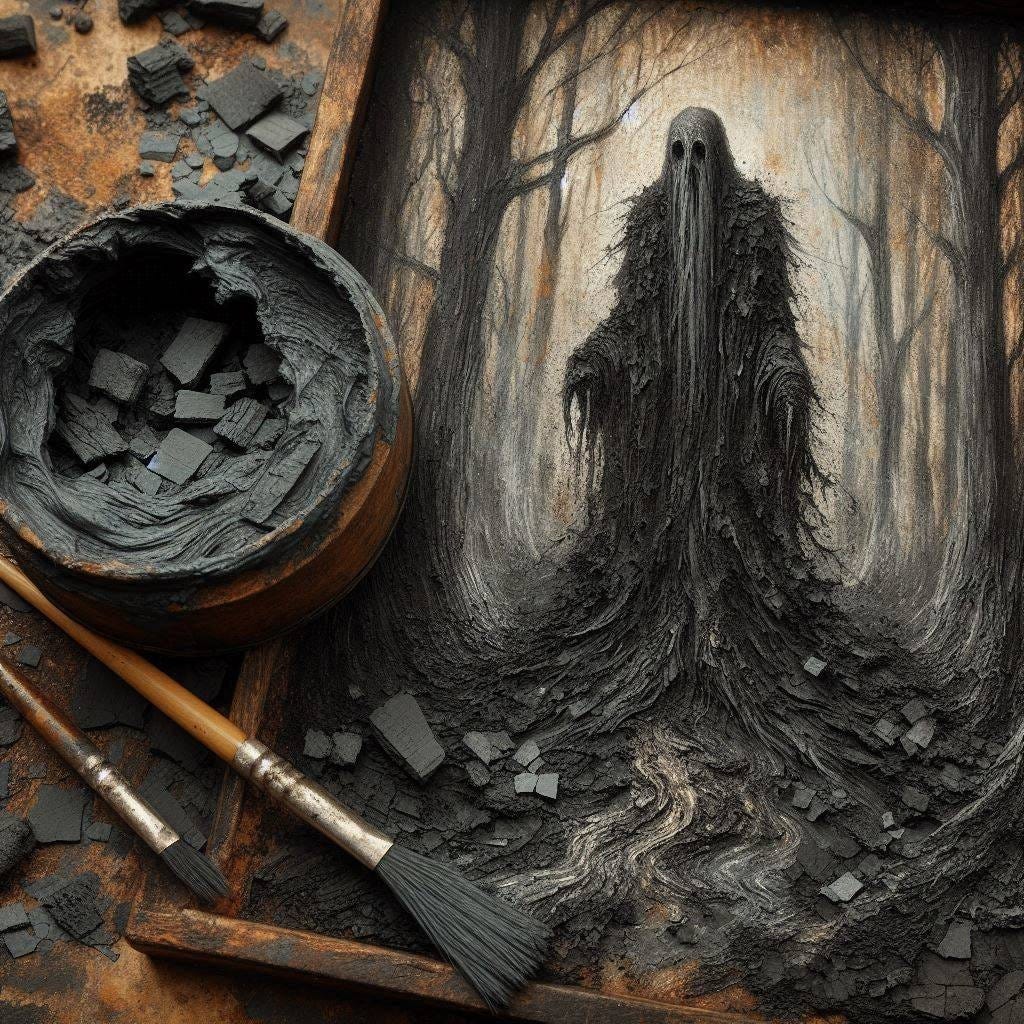
Material & Manifestation: These final images return to the source of the experiment: the matter itself. On the left, charcoal and other embedded elements build a forest creature through dense, sculptural texture. On the right, the finished image sits beside charcoal blocks, brushes, and scattered dust, reminding us that the character of the work begins with the physical substance behind it. AI art.
While charcoal dust remained the most promising for creating this effect, experiments with graphite powder, white pastel, and other materials suggest that this approach is far from fully explored. There are likely many more combinations waiting to be discovered.
If you’ve experimented with AI-generated textures before, try embedding physical materials into the paint rather than simply describing their appearance.
None of these prompts explicitly asked for a drawing. The hybrid appearance emerged from adding charcoal to it.
You may find, as I did, that what you mix into the paint does not simply change the surface — it changes what kind of artwork it becomes.
Do you think charcoal should enhance the subject, or should it become powerful enough to redefine the artwork entirely?
Clap or comment to share your thoughts.
For more inspiration, check out one of my articles below or the full series, *Real 3D Art with AI.*
***Visit my profile*** to follow, or subscribe by email if you prefer updates in your inbox.
If this technique sparked ideas for your own AI art, repost it so others can discover it!
메타데이터
- post_id
- 246a4448c5c2
- slug
- the-space-between-painting-and-drawing-a-charcoal-matter-painting-experiment-246a4448c5c2
- url
- https://medium.com/real-ai-art/the-space-between-painting-and-drawing-a-charcoal-matter-painting-experiment-246a4448c5c2
- canonical_url
- https://medium.com/real-ai-art/the-space-between-painting-and-drawing-a-charcoal-matter-painting-experiment-246a4448c5c2
- author_url
- https://medium.com/@hadwen
- status
- ok
- fetched_at
- 2026-07-18 00:43:05