You Can’t Break New Orleans’ Feisty Spirit
It’s why the city survives
You Can’t Break New Orleans’ Feisty Spirit
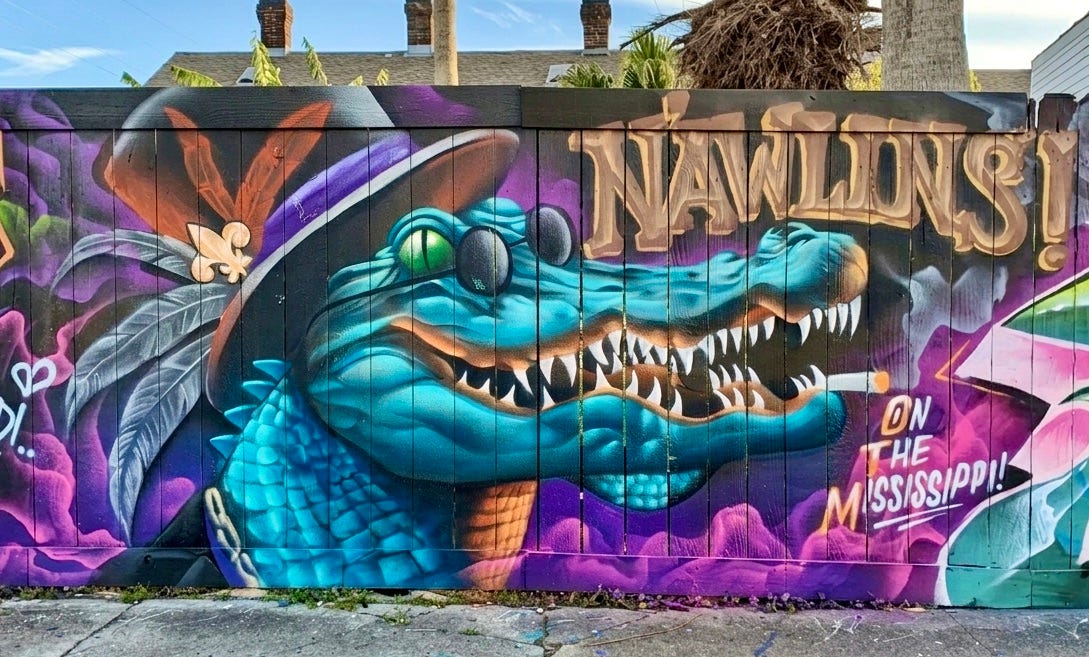
(all photos by author)
The air was thick. Dense. Walking through felt more like trudging against water than strolling down a street. Should the humidity be any higher, I imagined a backstroke could carry me the rest of the way.
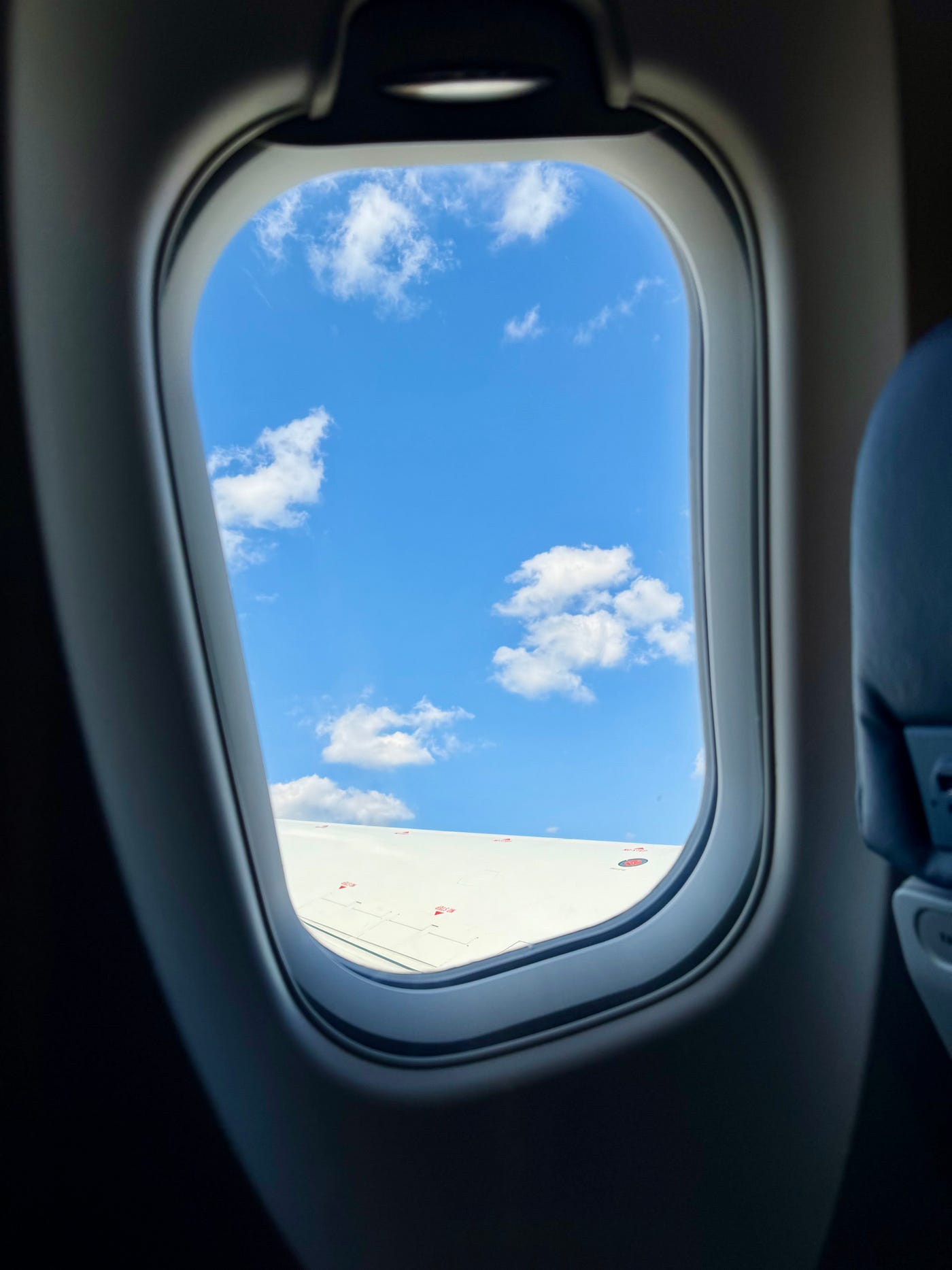
Above, the sky crumbled into thunder. A tectonic surge of clouds began to steal away my sight of the blue beyond them. There’d be another downpour, the third of the day. And the rain would share the air’s sweaty temperature. So I pointed my only means of defense at it: a polka-dotted umbrella with a broken button that worked all the time, some of the time.
“Welcome to New Orleans,” my host, Charles, would later say back at his home when I told him what I’d survived. His tone was matter-of-fact, as certain as if I’d asked him his name.
I found his relaxed mindset curious. Charles was just the latest example of a recurring theme I’d been noticing. To him, this was only another Tuesday, routine for the month of June. Hardly something to disturb him from running errands outside, or even his tendency to sleep late into the morning. Me? I needed earplugs to doze off. And two showers a day.
By the end of my trip, though, I’d rethink the weather with its suffocating humidity and terrifying thunderheads. What I noticed in Charles’ own mentality, and would continue to witness throughout the city, actually came to help me see them for what they truly are.
Charles was one of the locals I’d be staying with until then. He was the most active user I’d ever encountered on the Couchsurfing travel app, boasting over five hundred positive references from adventurers around the world. I was only the latest to stay in his shotgun-style home, so named because a bullet fired from the front could exit out the back.
His cool attitude toward the city’s smothering June heat wasn’t unique to him. New Orleanians simply accepted the 80% humidity and 90-degree conditions as reality. They didn’t argue with it. They didn’t complain about it. In fact, despite it, on my hike downtown, I’d even spotted some strutting around in three-piece suits.
They didn’t need polka-dotted umbrellas. When the rain got too heavy, drumming manhole covers with the enthusiasm of a percussionist, they’d simply duck under an awning to wait out the rough patches. Things didn’t even need to let up halfway for them to charge through. Semiaquatic or not, they had schedules to keep.
It’s all what inspired my observation. The one I’d made while talking to Charles:
In New Orleans, people are feisty
An ironically small word with some big ideas, feisty means to be lively. Courageous. It means to have dogged determination in the face of challenge. Feisty folk are fierce fighters and strong-willed, like being able to have a bright attitude in the face of a stormy afternoon.
Charles lived in the heart of the historic French Quarter: a mesmeric landscape of brightly colored buildings of Spanish design. Gas lanterns lit its streets twenty-four hours every day, seemingly burning with the same unwavering determination as the city’s citizens.
I was even witness to this in action. While Charles graciously gave me a driving tour of the neighborhood, I spotted a glaring contrast to the French Quarter’s pink, green, and blue buildings. Pinned to windows on every street were black signs stamped with a demand:
“Keep IV Waste.”
It was a garbage company. As Charles would explain to me, people weren’t happy with a recent mayoral decision to cut ties with it. They believed it did too good a job to get tossed out like the trash they cleared away. So up went the signs, and there they’d stay until it was deemed the local government had cleaned up their act.
Now, garbage isn’t really what one thinks about when picturing New Orleans. Nor is associating any kind of admiration with it. But surprisingly enough, that’s what I felt. Because clearly the protest wasn’t really about one company being better than another. To me, it wasn’t even really about disliking a politician. This was about pride.
Citizens had a standard. A high one. And they weren’t going to easily forget what that standard promised: a clean, beautiful city to live in and visit. One that lived up to its reputation as a world-class destination with a look, feel, and history unlike anywhere else in the country.
There it was: that feistiness. That determination. New Orleanians were ready to take the fight all the way to the bottom, to the stuff most others wouldn’t want to think about. Because nothing was off-limits when it came to protecting their home, no matter how dirty it needed to get.
Charles requested I help him look for a sign to pin outside his home. But with stock freshly out, I was forced to get creative. After a quick trip to a craft store, I had all the materials I needed to make a “Keep IV Waste” sign of my own: a black sheet, plus some sticky letters to spell out the words. It was crude, yes, but at a distance, a passerby couldn’t tell the difference.
That’s how I ended up repaying Charles for his generosity of letting me stay with him — even for a few extra days when plans changed with another host. It was also for a wonderful meal he cooked us one night: a delicious chicken stir fry Charles described as simple, but to me was nothing short of the pinnacle of savory.
Each bite melted away my memories of the heat and humidity that, on my walkabout earlier, had baked me like a chocolate chip cookie.
While my sign was new, its fight was far from the city’s first
As we sat in Charles’ living room one evening, his little white dog Gator sniffing around our feet, he told me about his experience surviving the greatest catastrophe to ever strike the city.
You can’t engage with New Orleans and not hear mention of it. At times, locals would even casually reference the event, like it was as much a conversational reflex to them as “How are you doing?” Being the worst natural disaster in U.S. history, it’s not hard to understand why.
It’s another thing entirely, however, to talk with someone who has personally experienced Hurricane Katrina. To see the cloudiness in their eyes, so much so it suggests less than twenty years have gone by since the terror.
Katrina is the sort of event the “true story” is “based on.” Like the ones that’ve dominated our entertainment culture, so much so it’s carved out a genre for itself: disaster. We dress it up with plot points and heroes, CGI and climactic musical scores; but the reality it’s inspired from, as Charles would explain to me, isn’t so cinematic.
Leaning forward, hands clasped, he told me about how the early morning hours were when he figured it’d be the best time to escape. Less people on the road to slow him down. So he’d grabbed his mother, and together they’d driven into North Louisiana. No destination. No certainty. Just to get away.
The storm hit soon after, slamming the coastal city right into national headlines. Over a hundred billion in damage. Over half a million people displaced. Charles and his mother just kept driving. Further. Longer. All to put as much space between them and the coast as possible.
They’d finally stop in Louisiana’s far north. Exhausted and starving, they’d haul themselves to a dinner table, greeted by an employee who, of course, asked where they were from. After they said New Orleans, she exclaimed:
“Oh, you’re homeless!”
They watched the news coverage from there, like viewers to a movie featuring the destruction of their city as the central plot. From then on, it was months of uncertainty. Where to live? How to pay for food? It was only through being taken in by neighboring Texans that the pair finally found relief from an extended-stay hotel.
Charles smiled at that last part of the story. He told me about how he made good use of their kitchen, putting his years of culinary experience to work. When Charles’ Texan hosts took one bite of his cuisine, they threw their heads back with delight, saying:
“If you always cook like this, you can stay as long as you’d like!”
Eventually, he and his mother found their way back. There’d be a new house, new possessions — a new chapter. And, it would seem to me, a new, more open-minded Charles as well. That aspect of his story about being taken in by others, of being given a home when he was without one, seemed to foreshadow the gift he was offering me: a visitor to his city.
No excuse to feel homeless.
There it was, yet again: that feistiness. That pluck. Charles could’ve bitterly vowed to never return, to live somewhere far inland where hurricanes rivaled fantasy. But nothing could keep him from being where he wanted. New Orleans was his home, damn it. That’s just how it was, as immutable a fact as gravity.
Mother Nature could knock over some buildings, but there wasn’t anything to do about that. He’d return anyway, and surviving her bad side would only make him kinder.
Exploring the French Quarter, I couldn’t find a sign the place had ever weathered such a disaster. The regal iron balconies, with their luscious potted ferns spilling fronds over the edges, burst with vitality. The buildings themselves, a delightful mismatch of pastel hues, looked as fresh as if they’d just been painted.

My photograph of the most-photographed building in the French Quarter
And in those same streets was another of the city’s feisty quirks. If the buildings were New Orleans’ arteries, then this was the blood flowing through. I found it inescapable.
Upon arriving at the airport, it was what I first heard stepping off the plane. There in the French Quarter, you couldn’t turn two corners without stumbling upon someone with a saxophone, dancing to their own tune.
I’m referring, of course, to jazz
After departing Charles, I visited the New Orleans Jazz Museum. There, I wandered their exhibitions chronicling the genre’s birth, reading placards about its origins in the city’s African American communities.
I learned it drew on many musical styles: including blues, hymns, European classical music, even African and slave folk songs. It seemed jazz came from just about everything.
Part of being feisty is courage, and I saw that easily there. Some of those sources of inspiration couldn’t have been more opposite. But people mixed the mismatch into a new kind of sound anyway. More than that, they created a new way to feel. To me, jazz always offered a sense of freedom, even long before I learned it’s what’s needed to even play it.
That was feisty in its own right. And I’d see it myself when my next host, Tyler, invited me to a live show in Preservation Hall. It was a historic venue in the heart of the French Quarter, born seventy years earlier from an art gallery proprietor who despaired on how little music he had in his life.
So, in true New Orleans stubbornness, he made those who could play it come to him.
At the hall, we met with the traveler he’d hosted right before me: Colton, a cross-country roadtripper from North Carolina. He was in the city to visit his friend, Alexander.
The humidity still wasn’t kind. Nor had the temperatures shown mercy. I could’ve stripped naked and still wondered if there was another itchy layer to pull off. But Colton and Alexander? In spite of everything, they’d dressed in true city fashion: long sleeves and cowboy hats.
We packed ourselves in the back of a dark room. Before us, there was a small stage with a handful of performers, each with their instrumental companion: a trumpet, a piano, a trombone. And from those organs, the city’s lifeblood flowed, liquid in its whimsy.
That was because it could go anywhere. There was no sheet music. No preplanned muse. Only an improvisation embodying the city’s spirit by daring to be its own thing, even in the moment.
That’s how jazz is played. It’s an extension of the soul. To me, that takes courage, a feisty requirement, because the performer is opening up the audience to their very essence. It’s more than a unique sound; I see it as a profound act of vulnerability. The musician invites nothing short of a spiritual connection to a room of complete strangers.
My next host, Tyler, lived his life with a similar flow to jazz
He explained to me how he split his schedule between working in a local gallery and giving street art tours. It wasn’t exactly stable income, but Tyler preferred the flexible work-life balance this offered. It allowed him to shed the shackles of a nine-to-five and improvise to the tune of his own interests.
When chatting with him on the day of our first meeting, I found myself quite taken with a costume he’d personally designed. It was meant to resemble a villainous zombie from the TV adaptation of The Last of Us, particularly one of the nastier variants with a face that looked like a blistery fungal growth. To me, its function was two-fold: for parties by day, helping his two cats scare away intruders by night.
Sci-fi horror was his genre, and we’d later talk cinema at a favorite joint of his: Dat Dog. With its searing neon blue-and-yellow exterior, I imagined the place could’ve cut its electric bill by glowing in the dark if it wanted. My vegan-style hot dog gave me a much-needed energy boost there, the will to move having been sapped by the heat. Leaving me panting like a retriever.
Tyler’s workload greatly depended on the time of year. Being the simmering final week of June, clients were sparse, so he offered me a spot on his latest tour. In the free spirit of jazz, I of course said yes. We trekked all throughout the city’s historic Bywater neighborhood, which sits just adjacent to the French Quarter.
Tyler gave an upbeat presentation on a multitude of different artworks. I listened as attentively as I could, deliriously wondering if I could stay hydrated by drinking the humidity from the air.

One of the cheekier examples
I’ll never be able to recall the exact number of pieces he showed me. It amazes me that even Tyler could, never feeling the need to slip in a false fact to fluff out an explanation. At least, that’s what he told me. So many artistic works splashed the buildings’ sides, it was easy to imagine that was their primary purpose: to be public canvases first, places to live second.
What sticks out in memory to me are the Mardi Gras alligators: a collection of festive reptiles adorned with funky hats and bedazzling glasses. There was also a Banksy inside the Habana Outpost, featuring a blonde-haired little boy scribbling on a blackboard a la Bart Simpson. Upon closer inspection, one could actually read the cursive lettering:
“I will not copy what I see on The Simpsons.”
At one point, Tyler pointed out a particular artwork he described as being ground zero for a local graffiti war. Such conflicts were only settled one way: by having rival artists repeatedly paint over each other’s works to assert their dominance.
That was a wild idea to me. All the fixtures I was seeing weren’t really fixed at all. In spite of their detail, their color, the fact each of them was stylistically beyond what I’d personally be able to create, none of it was permanent. There was a feistiness even there, too.
Because they were “alive.”
Like the ever-shifting thunderheads in the sky above, the city’s art scene was in a state of flux all its own. And in the case of the turf war, crackling with its own kind of dramatic energy too.
Later, I again met up with Colton from the jazz show
Before continuing on his two-month road trip around the U.S. (off to see San Diego and the Pacific Ocean for the first time) we attended the New Orleans Museum of Art together. It seemed a natural stop for us, both creative types. Me the writer, and he a pianist.
He was even a fellow thespian, and at one point we talked about a production he did of Noises Off! Its plot revolves around a play within the play, following the antics of a group of actors comedically struggling to keep their show together during a tour. I’d actually auditioned for a local production myself the year before. I’m still waiting to hear back.
Wandering around the museum’s galleries, the two of us took in a wide variety of different pieces. We started far in the past, with Dutch renderings of daily life in the Middle Ages, and ascended to the almost dream-like: a log cabin with every inch of its interior plastered with consumer electronics, from iPads to iPhones. All of them coated in gold.

This definitely puts the “i” in fireplace
A personal favorite of mine was a coffin styled like an Incredible Hulk lunchbox. That’s what I call a last meal.
I also found myself quite absorbed in the 19th-century depictions of the Louisiana swamplands. They’re the closest things to windows we have from that bygone era of the bayou. Muddy rivers, tall grass, and trees dripping with Spanish moss surrounded the lonely wooden shacks depicted in them.
I could’ve made my entire museum visit about the paintings, mentally transporting myself to that alien world free of GPS, internet, and apps to help connect travelers. In those days, it must’ve been all about having a good memory on how to get around, and a strong sixth sense to determine the honesty of a stranger’s intentions.
It’s an arena I’m skeptical I’d get far in.
Then there’d be the humidity with its inescapable, unbearable stickiness. That’s not even mentioning the alligators people would risk having as bathmates should they chance one in a river.
I began to realize something staring at those old paintings: the region’s locals needed to be feisty even all the way back then.
Maybe that was the root of it all, and why its knobby tendrils reached all the way to the present day. Why, like the roots I’d seen cracked through the sidewalks, the city’s feistiness defied the layering centuries since those first explorers set eyes on the untamed jungle. The swampland, teeming with mud and musk and mosquitoes, demanded it.
What would the people have been like without them to rally against? Would they even be an echo of what I’d come to admire? Or would they be more like me: soft, tender, more accustomed to my laid-back ways than sweaty days? Someone who’d found themselves window shopping not to buy, but to have an excuse to bask in the ice-cold air gushing from shops’ open doors.
Colton and I later attended a ghost tour led by his friend
Dressed in white long sleeves and beige trousers, with a cane he’d use to point with, Alexander reminded me a great deal of Jurassic Park’s very own John Hammond.
He too served as gatekeeper to a world that defied our imaginations. Alexander whisked us between streets in the French Quarter, spinning us tales about the restless souls who insisted on continuing to call the city home. Death be damned.
It’s difficult to miss the spiritual side of New Orleans on a visit. Walking the French Quarter will expose a visitor to countless palm readers, mediums, and tarot card shufflers ready to warn of your life’s trials to come. For a price.
Same goes for Louisiana Voodoo, another cultural cornerstone of the city. I actually made it a point to visit Marie Laveau’s House of Voodoo on Bourbon Street. There, I bought a pocket-sized pink doll for a hefty $25, its tag promising I’d purchased a beacon for positive energies.
I can’t pretend I left New Orleans an expert on Louisiana Voodoo. However, what I picked up was enough to know the pink doll did more for supporting the tourist industry than my soul’s well-being. What’s true to the belief system did still resonate with me, because it relates to travel.
It goes like this: Louisiana Voodooists believe we’re surrounded by spirits. They’re insightful entities, bursting with knowledge that can guide a person’s daily life. Even souls who have passed away are part of this unseen world, and they too can be called upon for wisdom.
I say that’s like cities, because to me they have souls too. Personalities, even. I know this because every one I’ve traveled to is so different from the last. From Portland to San Diego, Phoenix to Bangor, Maine; each is a world within our world.
New Orleans, in that sense, has a soul too. One equally carved by both the forces of happenstance, and the people who call it home. It’s no different because it is different, and this teaches a visitor another way life can be lived. It imparts knowledge, just like a spiritual guide.
And I was beginning to understand what it wanted to teach me.
On my last full day in the city, I met up with Alexander at Café Du Monde for beignets. Over the powdered fried pastries, we talked about everything: creative writing, ghosts, Alexander’s past growing up in the area. He was a traveler and thespian like Colton, having left to pursue theater, but later found himself called back to the familiar embraces of Southern Louisiana.
There at the cafe, I told him my impression of the city
That it was a feisty place, radiating determination, courage, and life. That it was at equal times a survivor, inventor, and fighter. Alexander’s eyes lit up at that remark. He agreed with me. It was a tough place, able to stand its ground in the midst of even tougher circumstances.
The heat beat down as we walked the French Quarter together, poking our heads into voodoo shops and used bookstores. Same with the humidity. It was as smothering as ever. With June ready to give way to July, neither would go away soon. But for the first time, the thought didn’t exhaust me. I didn’t wish away the weather.
The summer humidity and heat were partly why the city possessed what I so admired. They were some of the sparks helping light the city’s lively flame. Just as overcoming them required feistiness, so too did the feistiness need them to have something to resist against.
That’s a curious truth about life. I’d seen so much to appreciate during my stay. Yet none would exist without the adversities that sparked them into being. From political protests to hurricanes, graffiti wars to sizzling swamplands, New Orleans wasn’t the way it was in spite of it all, but because of them.
It doesn’t change the fact some things in life are truly terrible. What it does, however, is make it a little easier to understand their place. And why it’s okay, after a while, to just let go.
Standing there across the street from Jackson Square, on the bank of the mighty Mississippi River, I wiped my sweaty brow. Welcome to New Orleans, I thought. Then I turned from the warm water and began my journey home.

Me with my trusty umbrella
메타데이터
- post_id
- 24a018f5ce28
- slug
- you-cant-break-new-orleans-feisty-spirit-24a018f5ce28
- url
- https://medium.com/digital-global-traveler/you-cant-break-new-orleans-feisty-spirit-24a018f5ce28
- canonical_url
- https://medium.com/digital-global-traveler/you-cant-break-new-orleans-feisty-spirit-24a018f5ce28
- author_url
- https://medium.com/@nicholasgresiktravel
- status
- ok
- fetched_at
- 2026-08-11 02:06:29