Confidential Computing and the Silent Security Revolution You’re Ignoring
Protecting data during execution. Why “Enclaves” are becoming a standard backend requirement.
Confidential Computing and the Silent Security Revolution You’re Ignoring
Protecting data during execution. Why “Enclaves” are becoming a standard backend requirement.
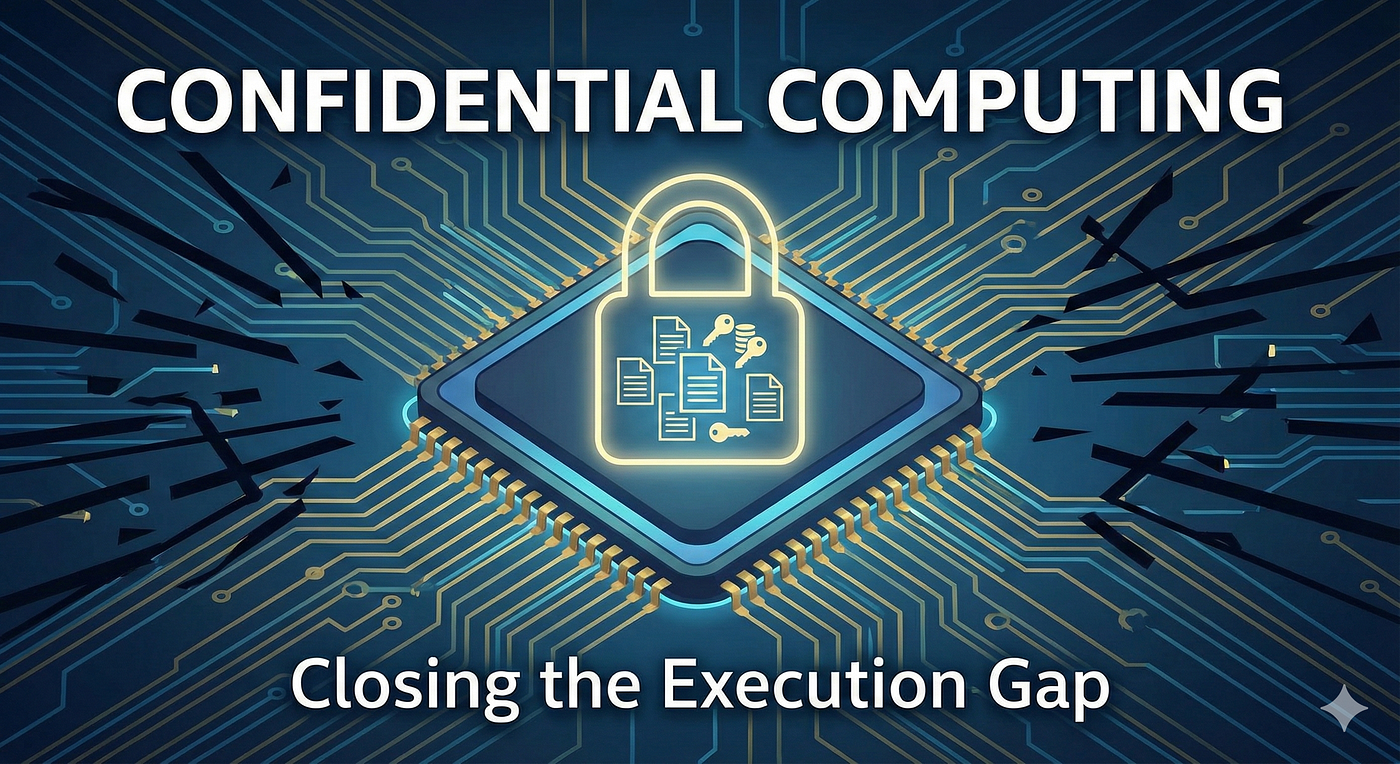
How a secure hardware enclave protects data and keys during processing to close the execution gap
The dashboard loads. Customer PII scrolls past names, payment methods, health records. Your encryption is solid: data at rest, encrypted. Data in transit, TLS everywhere. But right now, in RAM, it’s plaintext. Anyone with root access sees everything.
You already know this gap exists. Most engineers do. We just don’t talk about it in stand-ups.
Why Now
Confidential computing is a protection model that keeps data encrypted while it’s being processed — not just stored or moved. The core mechanism is called a Trusted Execution Environment (TEE), often referred to as an “enclave.” Inside a TEE, code and data remain encrypted even from the host OS, hypervisor, or cloud provider. The promise: you can run workloads on infrastructure you don’t fully trust — and the math holds.
This isn’t new research. Intel SGX shipped in 2015. But — and here’s the thing — in the past two years, adoption has quietly accelerated. Cloud providers now offer TEE-backed VMs as standard SKUs. Regulated industries (healthcare, finance, AI inference) are writing enclave requirements into RFPs. If you’re building multi-tenant platforms or handling sensitive data, this is moving from “nice-to-have” to “explain why you’re not using it.”
The shift happened without fanfare. One day it was academic. Now it’s in your vendor questionnaire.
The gap nobody wants to talk about
Your application decrypts a database row. For a few milliseconds — maybe longer — that data sits in memory, accessible to anything with sufficient privilege. Root users. Kernel modules. The hypervisor. A compromised sysadmin. A nation-state actor with a foothold.
You’ve built defenses: least privilege, audit logs, sandboxing. But those are access controls, not cryptographic guarantees. If someone gets in, the data is readable.
Wait — this isn’t paranoia. Supply chain attacks, insider threats, and cloud breaches don’t require exotic zero-days. They require one misconfigured IAM role or one credential leak. You’ve seen this in a different shape: the Slack thread that starts with “did anyone else get locked out?” and ends with an all-hands.
Confidential computing inverts the model. Even if the attacker owns root, they can’t read memory inside the enclave. The TEE uses hardware-level isolation and encryption. The host can kill the process, but it can’t inspect it.
For workloads where exposure would mean regulatory fines, reputational collapse, or literal patient harm, that distinction matters. Not theoretically. Legally.
Start with one workload and see what breaks
You don’t need to rewrite your stack. (Thank god.) Pick one high-value, low-complexity workload: a model inference endpoint, a key derivation service, a PII transformation step. Most TEE runtimes let you containerize existing code with minimal changes — think Docker-like workflows, but the image runs inside hardware-enforced isolation.
Here’s the smallest repeatable move: deploy a single stateless function to a TEE-backed VM. Use remote attestation to verify the enclave’s identity before sending it secrets. If the attestation fails, the request dies. If it passes, you know — cryptographically — that your code is running in a protected environment, unmodified.
A 2024 survey of cloud security teams found that 40% now evaluate TEE support during vendor selection, up from 11% in 2022. That’s not hype. It’s procurement catching up to architecture. Your competitors are already doing the math.
Try it today: Azure Confidential VMs and Google Confidential Space both offer free-tier experiments. Deploy a “hello world” API. Measure the latency delta. See if the trade-off fits. The part nobody says out loud is that the first deployment is weirdly easy — it’s the organizational buy-in that takes longer.
The trade-offs are real and worth knowing upfront
Confidential computing isn’t free. TEEs add latency — typically single-digit milliseconds, but enough to matter for ultra-low-latency paths. Memory is constrained; older SGX enclaves max out at 256 MB, though newer AMD SEV and Intel TDX implementations scale better.
Debugging is harder: you can’t attach a debugger to inspect enclave state without breaking the security model. This sounds unrelated, but it’s the same failure mode as encrypted backups — you win on security, you lose on visibility. The trade-off is real.
And remote attestation adds orchestration complexity. You’re verifying hardware signatures, managing certificates, handling attestation failures. If your threat model doesn’t include malicious infrastructure — if you run on-prem with strong physical access controls — the overhead might not pay off.
No, that’s not quite it. Let me put that differently: if your threat model does include cloud providers, hypervisors, or privileged access misuse, then the overhead is the point. You’re paying for a guarantee you can’t get any other way.
For teams just starting, focus on workloads where the data’s sensitivity justifies the friction: API keys, model weights, biometric data, financial transactions. Skip it for batch ETL on anonymized logs. Use judgment.
Back to that dashboard where everything sits in plaintext
Back to that dashboard. Customer PII in plaintext, in memory, right now. You’ve encrypted everything else. But until you close the execution gap, you’re trusting every layer of the stack — forever.
You’ve probably seen the meme: “We’re all just hoping nobody checks the logs.” This is the enterprise version of that feeling.
Confidential computing gives you one reliable rule: if you can isolate the sensitive operation, you can cryptographically protect it during execution. The three-step pattern: identify the high-risk data path, containerize the workload, deploy to a TEE with attestation. The first one takes a week. The second takes a day. The third one you’ll reuse everywhere.
It’s not a rewrite. It’s one decision about where the trust boundary actually sits.
Confidential computing particularly TEE-based enclaves shifts the security model from “trust the infrastructure” to “verify the environment, encrypt the execution.” For workloads where data exposure during processing is unacceptable, this is becoming a baseline expectation, not an exotic edge case. The tooling is production-ready. The cloud SKUs exist. The trade-offs are knowable.
You’ve closed the gaps at rest and in transit. The execution gap is next. Start with one workload. Measure the delta. See if it changes how you think about where sensitive data can safely run.
What surprised me was how quickly this went from “interesting research” to “why aren’t you doing this yet?” in customer calls. The window is closing.
What’s the one workload in your stack where a memory dump would be catastrophic?
Follow me for more such content.
메타데이터
- post_id
- 24b2129f4b2f
- slug
- confidential-computing-and-the-silent-security-revolution-youre-ignoring-24b2129f4b2f
- url
- https://medium.com/@ashusk_1790/confidential-computing-and-the-silent-security-revolution-youre-ignoring-24b2129f4b2f
- canonical_url
- https://medium.com/@ashusk_1790/confidential-computing-and-the-silent-security-revolution-youre-ignoring-24b2129f4b2f
- author_url
- https://medium.com/@ashusk_1790
- status
- ok
- fetched_at
- 2026-07-19 18:19:02