Hey AI, Pump the Brakes
When confident answers move faster than verified facts
Hey AI, Pump the Brakes
When confident answers move faster than verified facts
This essay is about a practical failure of trust between a user and an AI system. After relying on confident technical guidance about vehicle brake rotor fitment, I purchased parts that did not fit my car and could not be returned. The issue is not simply that an AI answer was wrong; the issue is that the answer was delivered with enough confidence to move a real-world decision forward before the facts had been properly verified.
What follows is both a specific account and a broader warning. When AI systems are used for technical, financial, mechanical, legal, medical, or safety-adjacent decisions, polished language is not enough. The system must slow down, preserve the user’s actual constraints, separate verified facts from assumptions, and clearly warn when an answer should not be relied on without independent confirmation.
A special kind of frustration
There is a special kind of frustration that comes from realizing you trusted the wrong answer just long enough for it to cost you money.
Not theoretical money. Not imaginary inconvenience. Real money. Real parts. Real tools. Real time. Real annoyance.
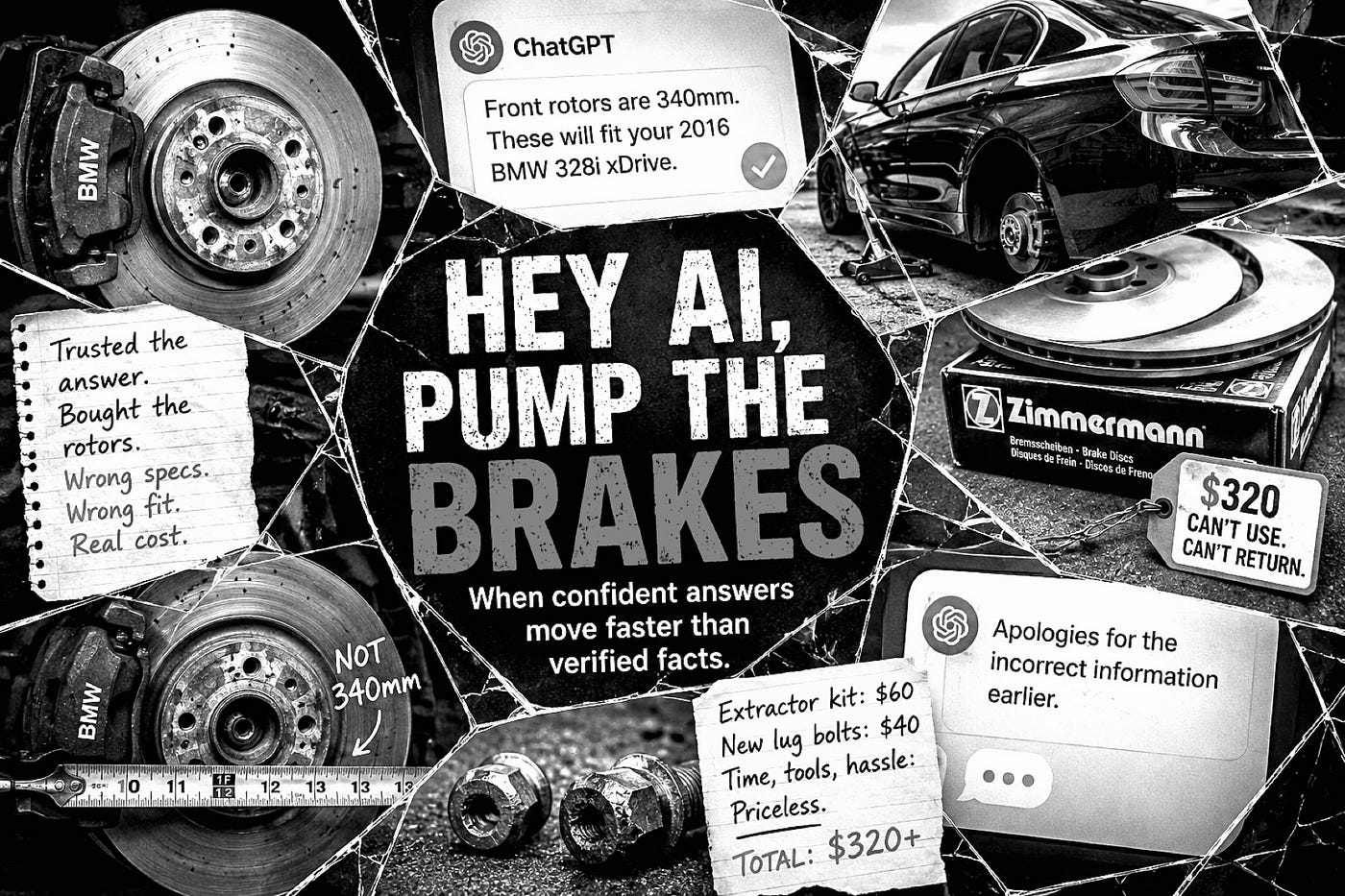
In this case, about $320 worth of rotors and pads I cannot use on my vehicle and cannot return for a refund.
And just to make the whole thing feel even better, I am using a paid version of ChatGPT. So, yes, I apparently upgraded from the free version so I could receive incorrect information with a premium subscription attached to it.
Lucky me.
This is not the first time I have run into this problem. I previously wrote about an AI reliability issue involving BMW lug bolt specifications, where the answer sounded confident, polished, and technically fluent — but still turned out to be wrong. That mistake was not just a typo or a harmless misunderstanding. It affected hardware decisions, created real-world consequences, and exposed a larger issue: AI systems can sound more verified than they actually are.
Now, somehow, here we are again.
Different part of the car. Same type of problem.
This time, the question involved brake rotors.
I had asked about rotor sizes for my vehicle. I had shared details. I had discussed the car, the brake setup, the likely fitment, and at points had even sent photos of the rotors and calipers. The answer I received pointed me toward 312 mm front rotors and 300 mm rear rotors.
So I ordered them.
And they do not fit.
That is the moment where the whole AI reliability conversation stops being abstract. It is one thing to talk about hallucinations, model limitations, confidence levels, and verification gaps. It is another thing entirely to be standing there with parts you paid for, parts you expected to install, and realizing the answer that helped guide the purchase was wrong.
The easy response would be to say, “Well, you should have verified it yourself.”
And honestly? That is not entirely wrong.
At the end of the day, I am the one who clicked the order button. I am the one who trusted the information. I am the one who now gets to eat the cost. I am not writing this to avoid responsibility for my own decision. I am not asking the internet to hold a candlelight vigil for my brake rotors.
But that explanation is also too simple.
Because the entire purpose of using a tool like ChatGPT is to get help sorting through information. That is the product. That is the value proposition. It is not marketed as a toy that might randomly guess at things. It is presented as a capable assistant that can help with practical questions, technical research, writing, troubleshooting, planning, and decision-making.
And when a paid AI tool gives an answer in a direct, confident tone, the average user is not unreasonable for treating that answer as meaningful.
That is the tension.
Yes, the user has responsibility.
But so does the system that presents uncertain information as though it has been verified.
This is where “pump the brakes” becomes more than a car joke. It is the standard AI should apply to itself before answering technical questions with real-world consequences.
Slow down.
Check the constraints.
Do not silently substitute a general answer for a specific one.
Do not make the user feel like the answer is confirmed if it is only likely.
Do not speak with confidence that has not been earned.
Brake rotors are not abstract trivia. Rotor diameter, thickness, hat depth, brake package, caliper type, production variation, and vehicle options all matter. A small mismatch can be enough to make a part unusable. Anyone who has worked on cars knows that “close enough” is not a reliable fitment strategy.
The problem is not that AI failed to know everything. No person, database, or system knows everything. The problem is that the answer did not come wrapped in the caution the situation required.
A better answer would have said something like:
“Based on the information provided, your car may use 312 mm front and 300 mm rear rotors, but BMW F30 brake packages vary. Before ordering, verify by VIN, option code, current rotor measurement, caliper type, or an OEM parts catalog. Photos may help identify the setup, but they are not a substitute for measurement or VIN-based confirmation.”
That would have been useful.
That would have been honest.
That would have slowed me down before I spent money.
Instead, the answer landed with enough confidence to move the decision forward.
And that is the dangerous part about AI fluency. It does not have to sound wild to be wrong. It can sound calm, organized, technically literate, and completely reasonable. That is exactly why people trust it.
A bad answer from a person often comes with tells. They hesitate. They say, “I think.” They admit they are guessing. They tell you to double-check. They point you toward a parts counter, a manual, or a measurement.
AI often does the opposite. It produces clean paragraphs, tidy bullets, and a tone that feels settled. It can create the impression that the uncertainty has already been handled somewhere behind the curtain.
But sometimes there is no behind-the-curtain verification.
Sometimes it is pattern-matching with good grammar.
That is not good enough when the answer affects real decisions.
This is not just about cars. Cars are simply an easy place to see the problem because the consequences are physical and immediate. The wrong part either fits or it does not. The bolt either seats correctly or it does not. The rotor either clears the caliper or it does not.
But the same reliability issue matters in many other areas: home repairs, legal forms, employment decisions, medical questions, financial choices, computer troubleshooting, and anything else where people use AI as a practical guide.
If the system is uncertain, it needs to say so before the user relies on the answer.
Not afterward.
Not after the purchase.
Not after the damage.
Not after the user pushes back.
Before.
That is the minimum standard.
And yes, users need to be cautious. I clearly need to be more cautious. This situation may ultimately be my own fault in the plainest practical sense. I trusted an answer, ordered parts, and now I am the one holding the bag.
But if the final lesson is only “the user should have checked,” then we are letting AI systems off too easily.
Because users are already being asked to do a lot. We are expected to phrase the question correctly, preserve the context, identify when the answer drifts, recognize unsupported confidence, challenge bad assumptions, verify technical claims, and absorb the consequences when the system gets it wrong.
At some point, that stops feeling like assistance and starts feeling like unpaid quality control.
Especially when the user is paying for the product.
That is the part that stings. Paying for a tool creates an expectation of improvement. Maybe not perfection, but something better than confident repetition of incorrect information. When the mistake happens again in the same general category — vehicle hardware, technical fitment, parts that cost real money — it is hard not to feel like the subscription fee is just a little extra seasoning on the bad decision.
A premium mistake, if you will.
The broader issue is not whether AI should be used. I still use it. I still think it can be helpful. I still think it can organize information, improve writing, brainstorm ideas, and make complicated subjects easier to approach.
But usefulness does not erase accountability.
If anything, usefulness increases the need for accountability.
The more people rely on AI, the more important it becomes for these systems to know when to slow down. A model should not answer a constrained technical question as though it is filling in a casual conversation. It should recognize when precision matters. It should understand when a wrong answer can cost the user money, time, safety, or trust.
And in those moments, it should pump the brakes.
It should say:
“I can help narrow this down, but this requires verification.”
It should say:
“Do not order parts from this answer alone.”
It should say:
“There are variations, and your specific vehicle needs to be confirmed.”
That kind of response may feel less impressive in the moment, but it would be more trustworthy.
And that is what this really comes down to.
Trust.
Trust is not built by sounding certain. It is built by being accurate, and when accuracy is not guaranteed, by being honest about the limits.
I would rather receive a cautious answer that saves me from a bad purchase than a polished answer that helps me make one.
I would rather an AI system say, “I am not certain enough for you to spend money based on this,” than confidently hand me the wrong part number in a well-formatted list.
I would rather it be useful than impressive.
This rotor situation is frustrating, but it is also clarifying. It shows the same pattern from the previous lug bolt issue in a new form. The subject changed, but the failure mode did not.
Confident answer.
Specific technical context.
Insufficient verification.
Real-world consequence.
User eats the cost.
That pattern deserves attention.
Not because AI is evil. Not because AI is useless. Not because users have no responsibility. But because a tool powerful enough to influence real decisions should be disciplined enough to distinguish between what it knows, what it assumes, and what the user must verify before acting.
So yes, I should have checked one more source. I should have measured. I should have confirmed by VIN or brake package before ordering. That part is on me.
But the system should not have sounded more certain than it was.
That part is on the design.
Conclusion
This experience left me with two truths at the same time. I should have verified the rotor fitment independently before ordering parts. That responsibility ultimately sits with me because I made the purchase. But the AI system also had a responsibility not to present an uncertain technical answer as though it were settled. When a tool is designed to assist with real-world decisions, especially a paid tool, it should not require the user to constantly detect hidden uncertainty, scope drift, or unsupported confidence.
The broader lesson is not that AI should be avoided. The lesson is that AI needs stronger discipline when the answer can affect real parts, real money, real safety, or real decisions. It needs to slow down before it sounds certain. It needs to distinguish fitment from guesswork, confidence from confirmation, and fluency from verification. When verified facts are not yet in hand, the correct move is not to accelerate. It is to pump the brakes.
메타데이터
- post_id
- 24be25ee6e2e
- slug
- hey-ai-pump-the-brakes-24be25ee6e2e
- url
- https://read.misalignedmag.com/hey-ai-pump-the-brakes-24be25ee6e2e
- canonical_url
- https://read.misalignedmag.com/hey-ai-pump-the-brakes-24be25ee6e2e
- author_url
- https://medium.com/@trail_clown
- status
- ok
- fetched_at
- 2026-06-10 22:22:12