An Impossible Choice Facing US Military Officers
“Civilian Control of the Military” + “an Immune Commander in Chief” + “a Not-Immune Officer Corps” = An Ethical Dilemma
An Impossible Choice Facing US Military Officers
“Civilian Control of the Military” + “an Immune Commander in Chief” + “a Not-Immune Officer Corps” = An Ethical Dilemma

When an architect designs a building with mismatched support beams, it does not matter how beautiful the facade looks or how high the quality of the paint is. The laws of physics dictate that the structure will eventually crack and collapse under stress.
The same truth applies to human institutions, laws, and treaties. When we build systems on top of rules that directly contradict each other, failure is a mathematical certainty. It is never a question of if the system will fall apart, but when.
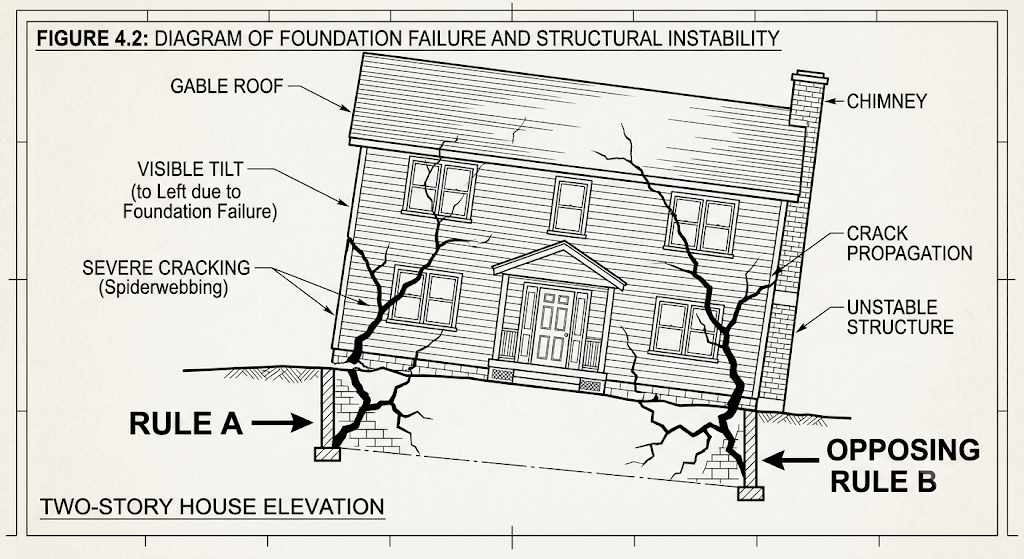
Too often, leaders and observers blame institutional failures on bad luck, poor communication, or individual incompetence. But individuals are hostage to the frameworks they operate within. If a system is designed with a fundamental contradiction at its center, even the most disciplined and well-meaning people cannot prevent a crash.
To understand how these deep flaws inevitably show themselves, we can look at two examples: a short-term diplomatic collision in international relations, and a long-term constitutional crisis developing right now within the United States military.
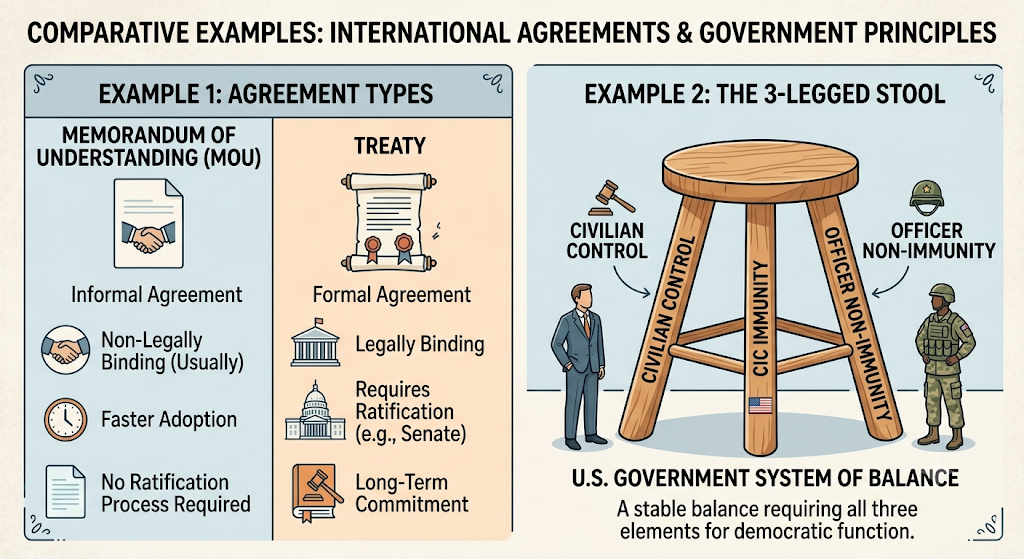
The Diplomatic Collision: The Iran MOU and the Israel-Lebanon Treaty In the summer of 2026, the international community witnessed a perfect example of structural contradiction in real-time diplomacy. On June 17, 2026, the United States signed the Islamabad Memorandum of Understanding (MOU) with Iran. The entire logic of this agreement was built on top-down, regional de-escalation. The goal was to cool down tensions across the Middle East by engaging directly with Tehran, assuming that broad diplomatic understanding would lead to quiet on the various operational fronts.
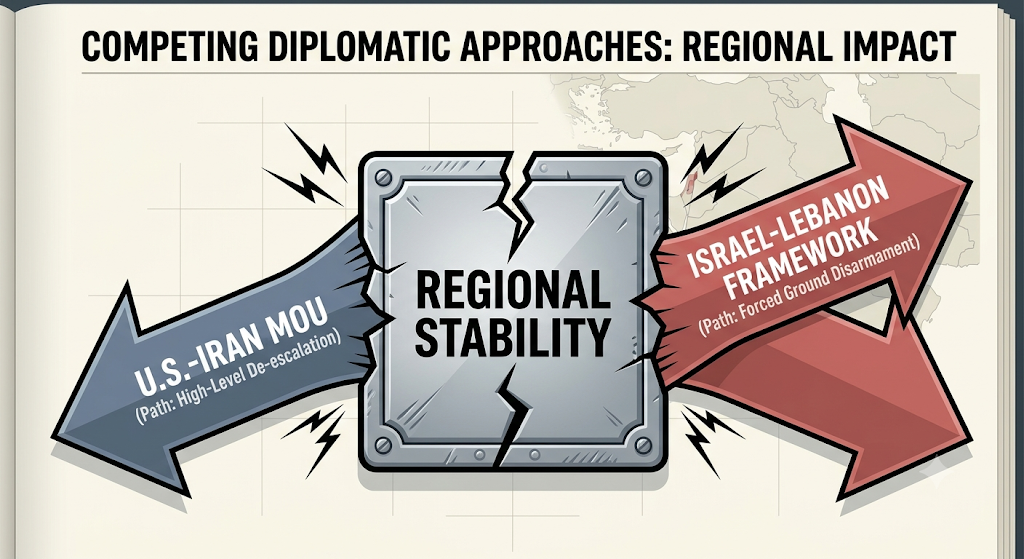
However, just nine days later, on June 26, 2026, a second agreement was brokered: the Israel-Lebanon Trilateral Framework. This treaty introduced a mechanism that ran directly into the teeth of the Islamabad MOU.
The framework made any withdrawal of Israeli forces from southern Lebanon completely conditional on the immediate, verified, and phased disarmament of Hezbollah by the Lebanese Armed Forces (LAF). The structural flaw here was instant and fatal. You cannot achieve regional stability through a high-level de-escalation framework with Iran while simultaneously creating a ground-level rule that forces the weak Lebanese state to pick a fight it cannot win. Demanding that the Lebanese military forcibly disarm a heavily armed political and militant faction is an operational command that would inevitably trigger a domestic civil war.
The two treaties attempted to occupy the exact same geopolitical space using entirely opposite rules. Because the architecture was fundamentally broken, the agreements collapsed almost immediately.

Crisis For US Military Commanders: The Mismatched Stool of Command
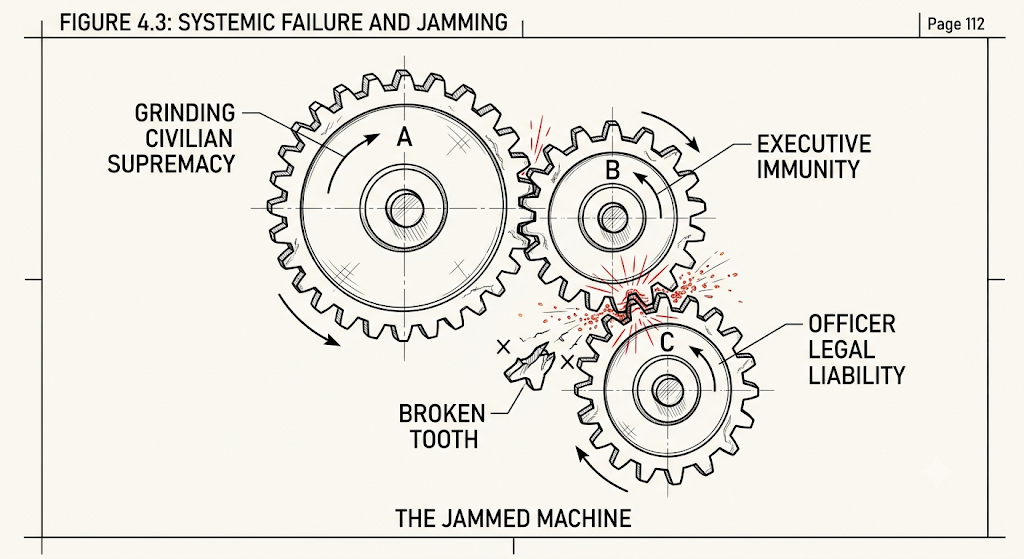
While the diplomatic collision in Lebanon played out rapidly, a much larger and more dangerous structural flaw is hardening inside the domestic architecture of the United States. This structural crisis involves the chain of command, and it can be understood as a three-legged stool built with legs of completely different lengths. The three legs are civilian control of the military, presidential immunity, and individual officer liability. Individually, each rule has a historical purpose. Combined, they create an impossible equation.
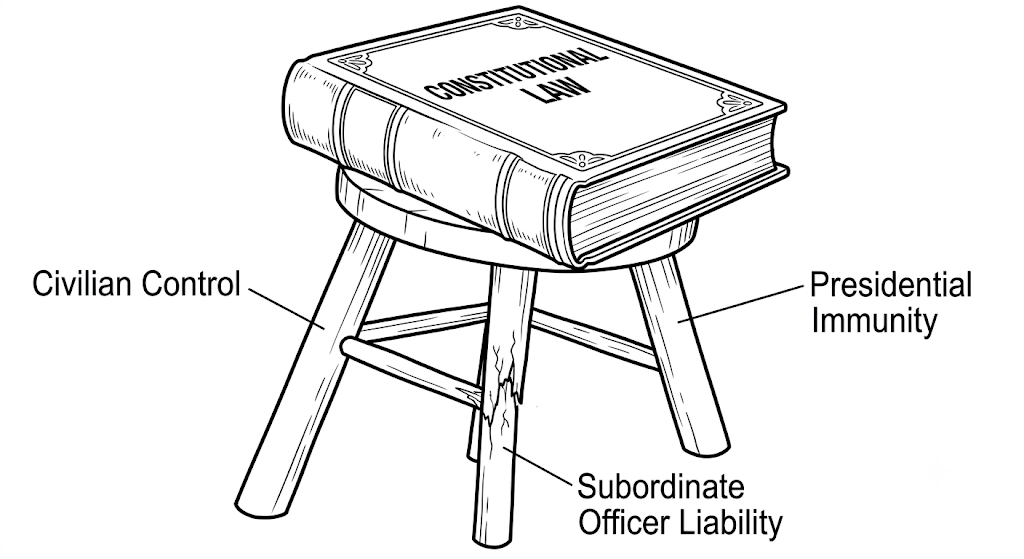
The first leg is the principle of civilian supremacy over the armed forces. This is a foundational democratic value: the military must answer to the elected civilian leader, the President, who serves as the Commander-in-Chief. This prevents the military from becoming a political power or executing a coup.
The second leg is a recent addition to the legal landscape: absolute or presumptive presidential immunity for official acts. Under this rule, the President faces no domestic criminal exposure for directives issued under the umbrella of official executive business.
The third leg is strict officer liability under the Uniform Code of Military Justice (UCMJ). Article 92 states that military service members are strictly liable for their actions and face court-martial and prison time if they execute an illegal order.
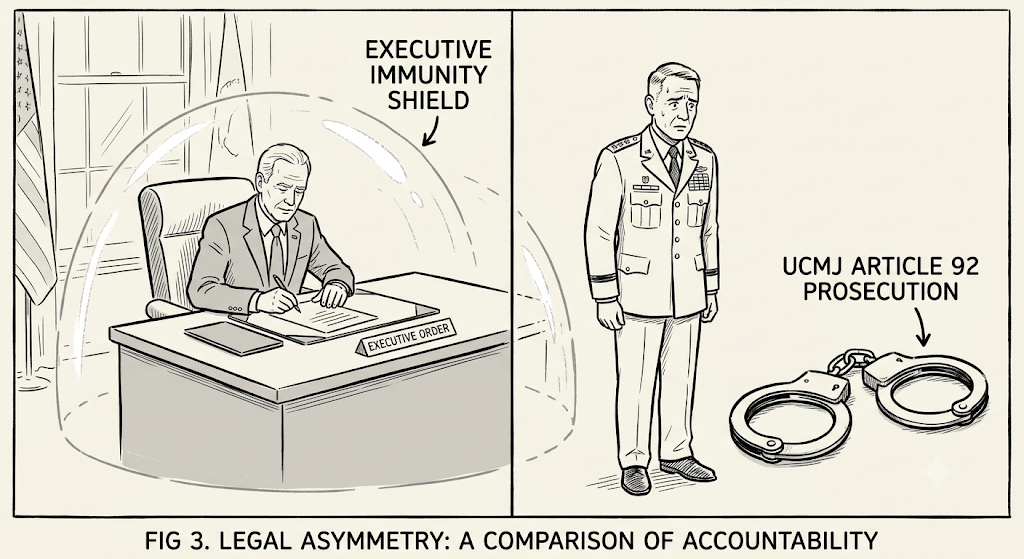
The Broken Symmetry and the Officer’s Trap For more than two centuries, the American system remained stable because these rules operated with a basic legal symmetry. If a President issued an unconstitutional or illegal order to use the military domestically — such as seizing voting machines or weaponizing active-duty troops against political rivals — the threat of criminal prosecution applied to both the person giving the order and the person executing it. This dual-sided brake kept the system balanced.
Now, that symmetry is broken. If an immune Commander-in-Chief decides to issue a highly disruptive or unconstitutional domestic directive under the guise of an official act, the President is legally protected. But the general or colonel who receives that order is completely exposed. The historical lesson of the Nuremberg trials explicitly dismantled the defense of “just following superior orders.” If the order violates the Constitution, the officer cannot use the President’s immunity as a shield. They face the Leavenworth cells.
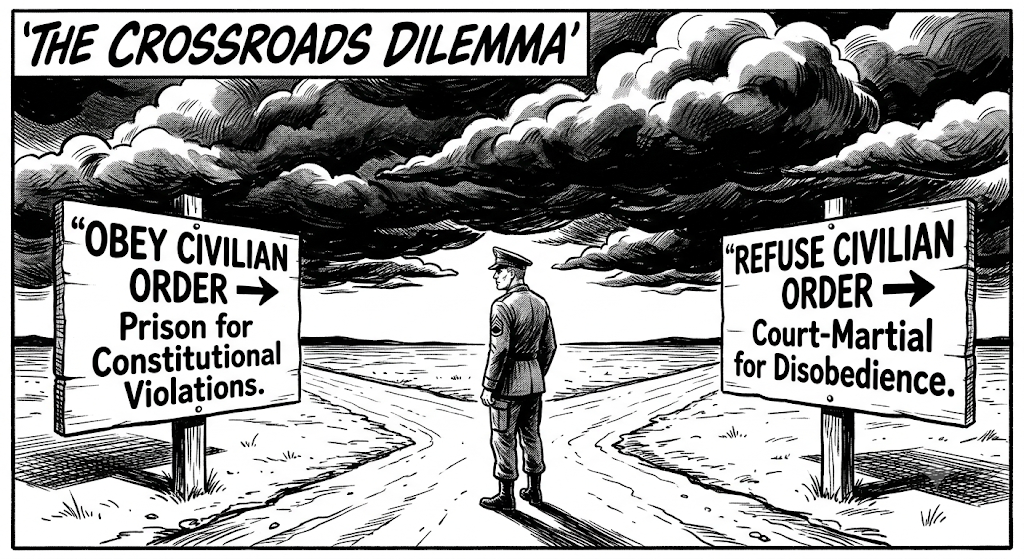
This creates a brutal, systemic impasse. If the officer obeys the directive, they risk prosecution as a criminal perpetrator. If the officer refuses the directive to protect the Constitution, they have overridden the civilian executive — which constitutes a soft military coup.
The architecture of the system has made an apolitical military impossible. Instead of focusing on defense and logistics, every high-ranking officer is forced to act as an independent supreme court justice, guessing which political faction will control the state and the courts five years down the road. When structural contradictions are hard-coded into the center of an institution, individuals cannot fix them through pure willpower or good intentions.
The rules governing the U.S. military command structure have created a trap. Because the three legs of the stool are cut to incompatible lengths, the stool cannot stand. The impasse has arrived, and the system will inevitably fracture unless the underlying architecture is changed.
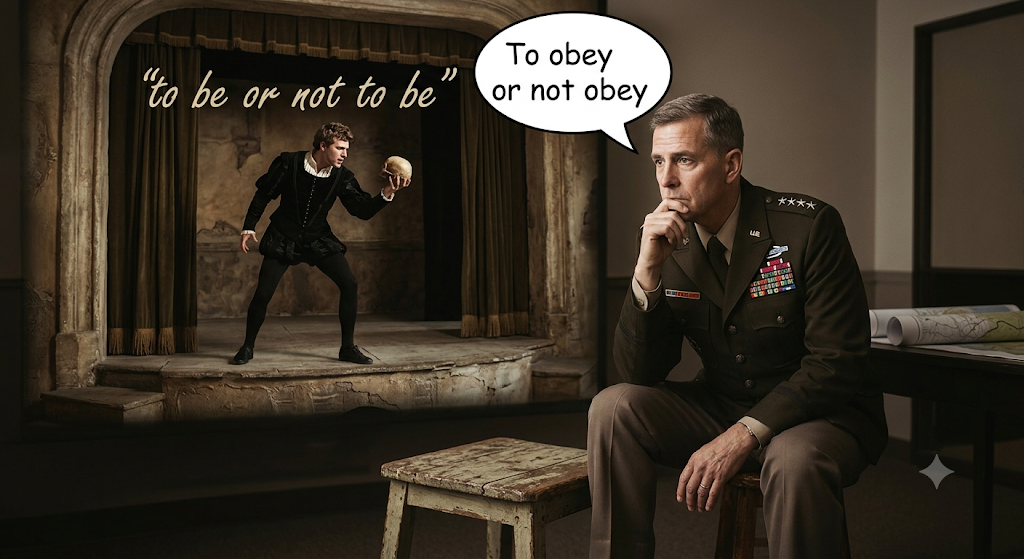
To obey or not obey, this has become the question.
Suggestions for Further Study
(Paste these as prompts into your LLM.)
-The Principle of Symmetric Liability in Hierarchical Systems: An investigation into how asymmetrical legal protections between executives and subordinates disrupt the stability of chain-of-command organizations.
-The 1983 May 17 Agreement: A historical review of the failed security treaty between Israel and Lebanon, showing how previous attempts to impose external enforcement mechanisms onto Lebanese domestic politics collapsed.
*The Yamashita Standard and Modern Command Responsibility: An analysis of post-WWII legal precedents establishing that military officers retain independent criminal liability regardless of superior directives.
*The Curragh Mutiny of 1914: A case study of how structural impasses and politically explosive civilian directives can force an otherwise disciplined officer corps into mass resignation or institutional resistance.
메타데이터
- post_id
- 24e8f5f0c9f4
- slug
- a-problem-facing-us-military-officers-24e8f5f0c9f4
- url
- https://medium.com/@jeffreyduttonsmith/a-problem-facing-us-military-officers-24e8f5f0c9f4
- canonical_url
- https://medium.com/@jeffreyduttonsmith/a-problem-facing-us-military-officers-24e8f5f0c9f4
- author_url
- https://medium.com/@jeffreyduttonsmith
- status
- ok
- fetched_at
- 2026-07-26 17:39:23