Broken Connections: Understanding Multiple Sclerosis
This student blog post is written by Abbegayle M., who wrote all about MS and its relationship to a fatty-protein substance in the brain…
Broken Connections: Understanding Multiple Sclerosis
This student blog post is written by Abbegayle M., who wrote all about MS and its relationship to a fatty-protein substance in the brain called myelin. Have you ever wondered about how MS progresses? Take it away, Abbegayle!
“When will I ever use this in the real world?”
I remember hearing that question constantly in high school, usually said sarcastically and often directed at integral calculus. I remember thinking the same thing myself during early morning classes, memorizing information just long enough to write a test before choosing to forget it. What use would I ever have for it?
I remember learning about multiple sclerosis in biology class, but at the time, it felt like just another topic to get through. I never imagined it would become something personal. When my cousin, someone I grew up alongside, was diagnosed, those facts I once brushed off suddenly carried a completely different weight. Now, instead of studying for a grade, I want to understand what this disease means. I’m taking this as an opportunity to revisit and strengthen my knowledge so that I can truly understand it and gain information with the intention of maintaining it.
Multiple sclerosis (MS) is an autoimmune disease in which the immune system mistakenly attacks the central nervous system (CNS). If that sounds serious, it’s because it is. The CNS acts as the body’s control center, responsible for processing information and coordinating responses (Cleveland Clinic, 2023). It controls your senses: touch, taste, smell, hearing, and sight, as well as memory, movement, reflexes, and more. It’s like a network of communication lines, constantly sending and receiving signals to keep the body working properly. This system depends on specialized cells called neurons, which are designed to transmit signals quickly and efficiently. Think about how fast you instinctively pull your hand away from something hot. That rapid response is the result of a healthy nervous system working exactly as it should.
Neurons are made up of three main parts: dendrites, a cell body, and an axon (Figure 1). The dendrites receive incoming signals, the cell body processes them, and the axon carries the signal to its next destination, whether that’s another neuron, a muscle or a gland. Surrounding many axons is a dense, fatty layer called the myelin sheath, which acts as insulation. This insulation, more specifically, the gaps in that insulation, allows electrical signals to travel quickly and efficiently.
The myelin sheath is not continuous; it has small gaps called nodes of Ranvier. These gaps allow signals to “jump” along the axon in a process that significantly increases the speed of communication. This is what allows the nervous system to respond so quickly under normal conditions.
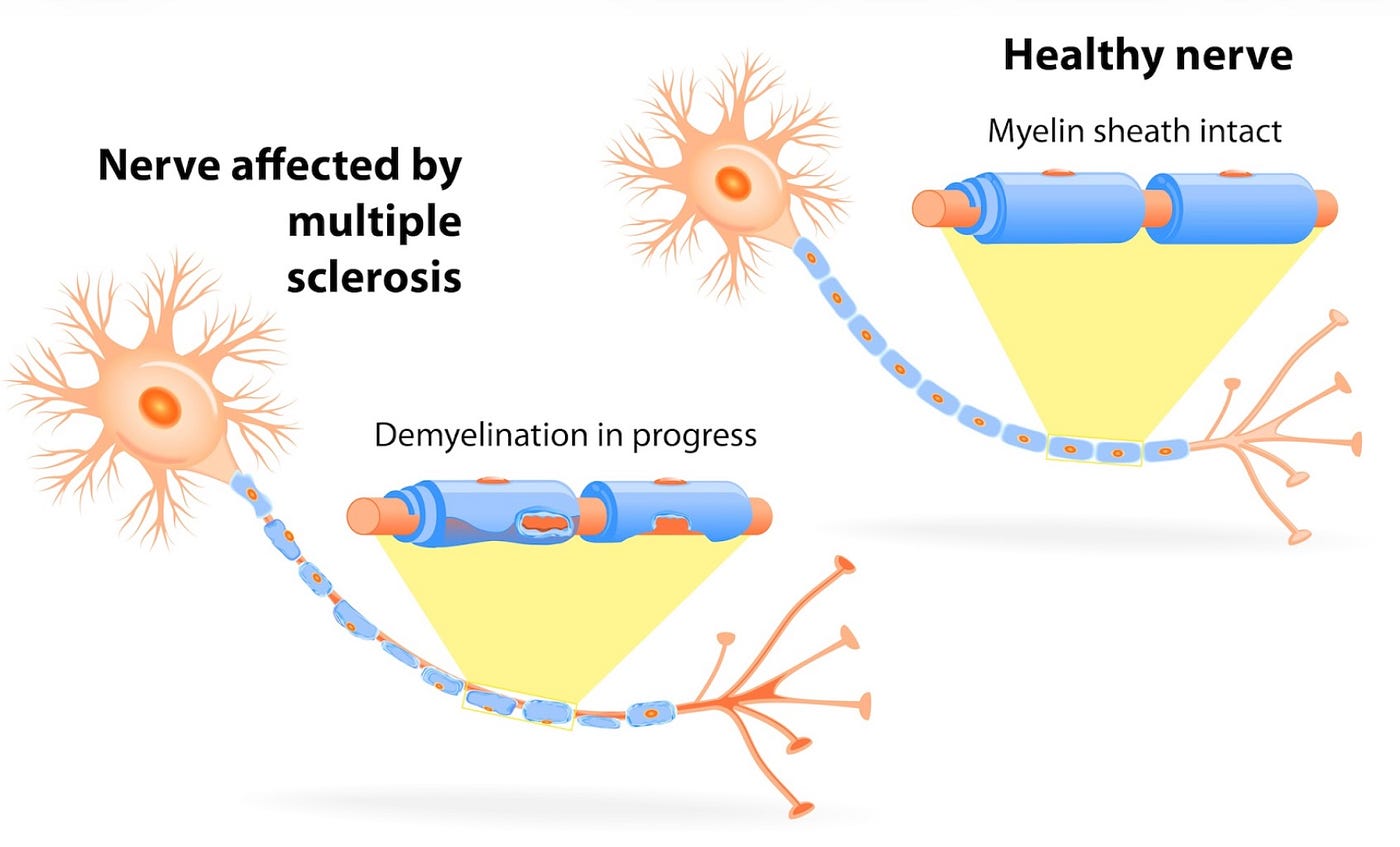
Figure 1: Healthy and Affected Neuron. This diagram depicts how the myelin sheath of a healthy neuron becomes damaged due to Multiple Sclerosis. As demyelination occurs, nerve signals are slowed or disrupted, impairing communications between the brain and the rest of the body. Image by Genentech, Inc. (n.d.)
In multiple sclerosis, the immune system attacks the myelin sheath, gradually damaging or destroying it (Figure 1). Without this protective layer, signals can become slowed, distorted, or even blocked entirely. As a result, communication between the brain and body becomes unreliable.
This disruption leads to a wide range of symptoms. Some are physical, such as numbness, muscle weakness, loss of balance, and vision problems (MS Canada, n.d.) Others affect coordination and reflexes. For example, the body may not react quickly to pain because the signal never reaches the brain in time. What stood out to me most is how unpredictable these symptoms can be, varying not only from person to person but also over time.
Beyond the physical effects, MS can also have significant impacts on mental processes. Because memory and cognition rely on efficient nerve signalling, damage to myelin can lead to difficulties with memory, focus, and processing information. Even hormone regulation can be affected, since the brain relies on signalling pathways to communicate with glands throughout the body. When those signals are disrupted, the body’s internal balance can be affected.
There are also different types of multiple sclerosis (Genentech, n.d), which helps explain why experiences with the disease can vary so widely. The most common form is relapsing-remitting MS (RRMS), where individuals experience episodes of symptoms (relapses) followed by partial or complete recovery. In contrast, primary progressive MS (PPMS) involves a gradual worsening of symptoms from the beginning, without clear periods of recovery. There is also secondary progressive MS (SPMS), which often develops from relapsing-remitting MS and is characterized by a steady progression of symptoms over time. Lastly, and by far the least common, is progressive-relapsing MS (PRMS), which is categorized by bouts of relapses with gradual worsening of symptoms. Understanding these distinctions highlights how complex MS is, and why treatment and prognosis can look very different from one person to another.
There is currently no cure for MS, largely because the exact cause of the immune system’s attack is still not fully understood. However, there have been major advances in treatment. Many therapies focus on reducing inflammation and modifying the immune response to reduce the frequency and the severity of relapses (MS Canada, n.d). These treatments tend to be more effective for relapsing-remitting MS, where controlling inflammation can reduce the frequency and severity of relapses. Progressive forms of MS are often more difficult to treat, as symptoms worsen steadily over time.
I would love to end this post with some hearty declaration where I vow to spend my life dedicated to finding the cure to this disease, but I cannot be a master of one when I desire to be a jack of all. I’m going to spend my years studying all forms of diseases and learning as much as I can today, because I now know that life is unpredictable, and something I did not value yesterday might be worth its weight in gold tomorrow.
Works Cited:
Cleveland Clinic (2023). Central nervous system (CNS): What it is & function. https://my.clevelandclinic.org/health/body/central-nervous-system-cns
Genentech, Inc. (n.d). Multiple sclerosis. https://www.gene.com/patients/disease-education/multiple-sclerosis
MS Canada. (n.d.). Treatments for multiple sclerosis. https://mscanada.ca/managing-ms/treatments-for-multiple-sclerosis
National Center for Biotechnology Information. (2023). Multiple sclerosis . In StatPearls . StatPearls Publishing. https://www.ncbi.nlm.nih.gov/books/NBK499849/
National Multiple Sclerosis Society. (n.d.). Treatments and medications for multiple sclerosis. https://www.nationalmssociety.org/managing-ms/treating-ms/treatments-and-medications
메타데이터
- post_id
- 24edfeda58cc
- slug
- broken-connections-understanding-multiple-sclerosis-24edfeda58cc
- url
- https://medium.com/@jennifer.mcdonald_12106/broken-connections-understanding-multiple-sclerosis-24edfeda58cc
- canonical_url
- https://medium.com/@jennifer.mcdonald_12106/broken-connections-understanding-multiple-sclerosis-24edfeda58cc
- author_url
- https://medium.com/@jennifer.mcdonald_12106
- status
- ok
- fetched_at
- 2026-07-13 06:23:13






