LIFI Intents: What if DeFi intents could be modularized?
Over $80B in volume, 100M+ transfers, and 1000+ integrations have flowed through LI.FI’s infrastructure to date. What is LIFI, what is not…
LIFI Intents: What if DeFi intents could be modularized?
Over $80B in volume, 100M+ transfers, and 1000+ integrations have flowed through LI.FI’s infrastructure to date. What is LIFI, what is not LIFI, and I think it’s also okay to ask, what LIFI is fundamentally offering the market as a key value proposition to drive these numbers.
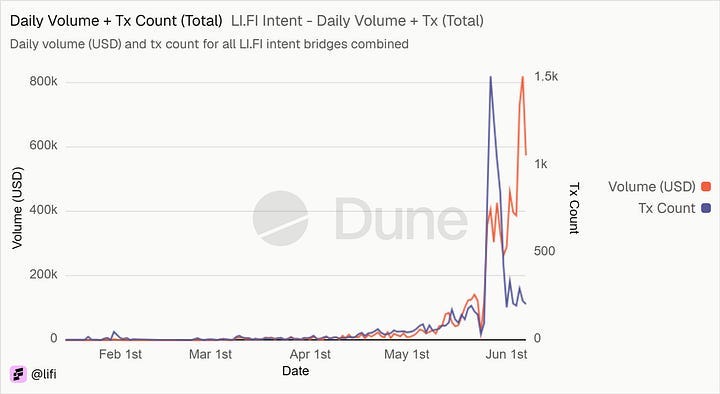
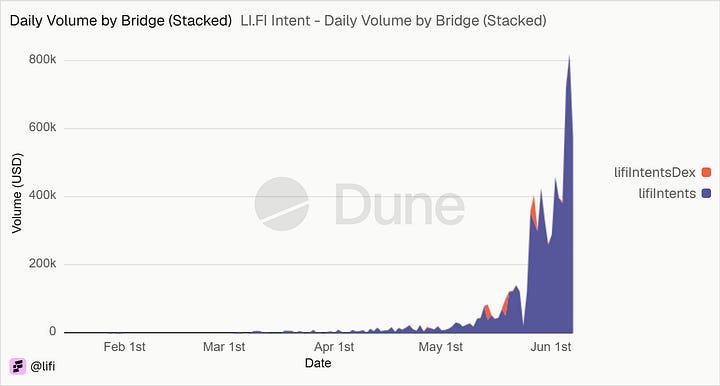
LIFI’s volume and transaction count. Source: https://dune.com/lifi/lifi-intent
While I think the introduction of LIFI might be peculiar to new readers, I believe LIFI is solving a problem that requires more attention than just understanding what it does as a product/solution.
To dabble a bit, at one point, the concept of internet capital markets took over the internet; there was barely anyone I saw talk about this topic with so much explanation on how the infrastructure of blockchain has decentralized the financial market and introduced new primitives to mankind, starting with Ethereum as a supercomputer and cypherpunk.
Intrinsically, this is what we gave much accolades and praise for having a subtle, dysfunctional system within practically. What made the internet capital markets takeover market sentiment was its ability to solve the problems of:
- Indirect Market Access
- Delay in internal settlement of transactions.
- Easy market manipulation.
- Centralized capital market data.
To pay attention to the first 3, if a user decides to get onboarded into stocks in the early 20th century, it’s typical for your request to spend a large, unfriendly amount of time before processing.
The most interesting of them all was the need to submit lots of paperbacks. All processes required of these platforms increased friction, and the intent of the user was met with a poor experience, which unfolded, yet in a different format, on-chain.
This, to a large extent, is due to the primitives created to solve the problems that led to internet capital markets. Oh well, if you very much understand that every problem is a tentative problem, it shouldn’t come as much of a surprise. This primitive exactly is DeFi, and when checked within was the exact primitive of the Automated Market Maker (AMM) Model, which uses the constant product model for price discovery internally and externally, and as a liquidity source.

Before DeFi was introduced, if I was to swap my BTC tokens for USDC, I had better wait and thank my stars that there is a maker on the other side of the order book who would buy my positions with our intents being similar but price discovery wasn’t efficient and AMMs came to stay where price discovery is highly dependent on a curve and the product between two set of tokens in a liquidity pool.
The hurdle to achieve this is high; I want to make a transaction to a fellow, saying I want to send $100 USDC on the Binance Smart Chain (BSC) Network. In many cases, my last transaction may have been on BASE; hence, I have to make 1 click to change the network to BSC. Then the second click is to input the details. The third click is to sign the first transaction, and 4th click is to confirm the transaction and gas state.
Typically how my wallet acts when signing transactions. Up-Down Pop-ups
This is quite the easiest of clicks one has to make, and not the inclusion of slippage. Shouldn’t ever be a surprise that this transaction never lands as $100 but as $99.9, but my initial intent was for $100 to be sent.
Hence, the problem of intent has been evolving, but in different formats.
Here comes the solution of Intents, before LI.FI:
While users currently interact on-chain to sign transactions, interact with specific messages that instruct a state machine to execute state transitions, this process was more complex than usual. DeFi intents emerged to simplify this process. Unlike in transactions which specify a single computational path, intents are signed messages that allow third parties to create transactions on a user’s behalf without giving out full control.
In essence, it represents a person’s desired outcome, and in context, a desired transaction outcome, taking the approach of capturing the intent and then executing the intent.
For execution, which is the purpose of this approach, intent-based protocols exist as different layers, which include:
- Application Layer
- Permission Layer
- Solver Layer
- Settlement Layer

Intent-based protocols that fall under the application layer act as the frontier for which users can interact with the blockchain, and this serves to make the start of users’ intent to be captured. Most of the applications that fall under this layer serve to act as bridges, mostly to aid cross-chain interaction.
For those which fall under the permission layer, it mostly carries out the processes such as account abstraction, key management and policies are carried out, observed, and handled while the settlement layer handles the problem of where finality takes place and every intent-based protocol takes care of this finality which might be through infrastructures like bridges, and oracles, which most times makes use of data availability, liquidity, etc.
To properly state the gap which LI.FI currently solves, I’d prefer to go deeper into the solver layer.
Solvers are the most important segment for intent, as it involves finding the best route and price order, working alongside the fillers for the best price order or complete fulfillment of a user’s intent. This is the main layer of intents because of its mechanism of being able to capture value directly from abstracted transaction objects (ATOs), which captures information relevant to a specific operation, and then solvers get the operations done.
Now LI.FI
LI.FI sits as a modular engine that fulfills orders through a network of professional solvers, competing to provide the best execution, built on the reference contracts of the Open Intents Framework (OIF), which was first implemented by Polymer Labs, and through this partnership, LI.FI can offer this.
While many intent-based protocols exist in any of the above layers, Lifi bridges these layers into one, making it such that its engine presents the layer in a full-stack version for projects to suitably meet their needs or for easy integration.
While several individuals might highlight the greatest problem of intents which LiFi solves falls either under the category of single, shared execution model, or the fact that project teams who desire to grow build their own intent inherit a long list of unsolved sub-problems, such as how to handle fillers or solvers.
These two popular consensuses as a problem of intent is simply squared into the fact that interoperability cannot be enhanced between these protocols. If a protocol decides to handle the problem of fillers and solvers through X route, every certainty, as you might want to bet that another intent-based protocol would want to approach this differently, and the individuality of the stack of these two protocols produces a difference in domain-specific language, which makes integration of apps difficult, increasing the friction of adoption and interoperability.
In intent systems, DSLs are used to express user intents in a structured way that both humans and machines can understand, and instead of raw transaction instructions, a DSL allows a user or application to describe desired outcomes.
This is a hurdle that means solvers would need custom integrations for every application.
LIFI modularizes the experience by aggregating everything into a full-stack engine, which now introduces a high level of flexibility through the OIF contracts. These contracts were created for flexibility to standardize how intents are expressed, settled, and executed across the Ethereum ecosystem.
Through Polymer, individuals can build protocols where intent type, order type, shared solver network, and verification system can be accessed. In essence, it mirrors the OIF.
Understanding the Open Interest Framework (OIF)
Open intent has a variety of frameworks, which include OIF Contracts, OIF Solver, and OIF-Specs.
Since LIFI builds on the OIF contract through its partnership with Polymer, consideration of how this contract works is the most pertinent.
This framework, which follows the standard of ERC-7683, helps with permissionless cross-chain intent interaction by presenting two main parts:
- The Smart Contracts
- Open Source Solver.
Since two chains would be used for this interaction, the contract modularizes its components into an input component and an output component. Between these sub-components is the solver, which exists as an entity to facilitate swaps for users.
The input component consists of the input chain, the input itself, and inputSettler, where this includes the chain from which the user is sending, the assets sent to be released from a lock after the outputs have been proven delivered, and the input collection contract on the input chain
Output components consist of the output chain, the output, and the outputSettler, which includes the chain where the output assets are paid on, the assets that have to be paid to be able to collect inputs from an order, and the output collection contract on the output chain.
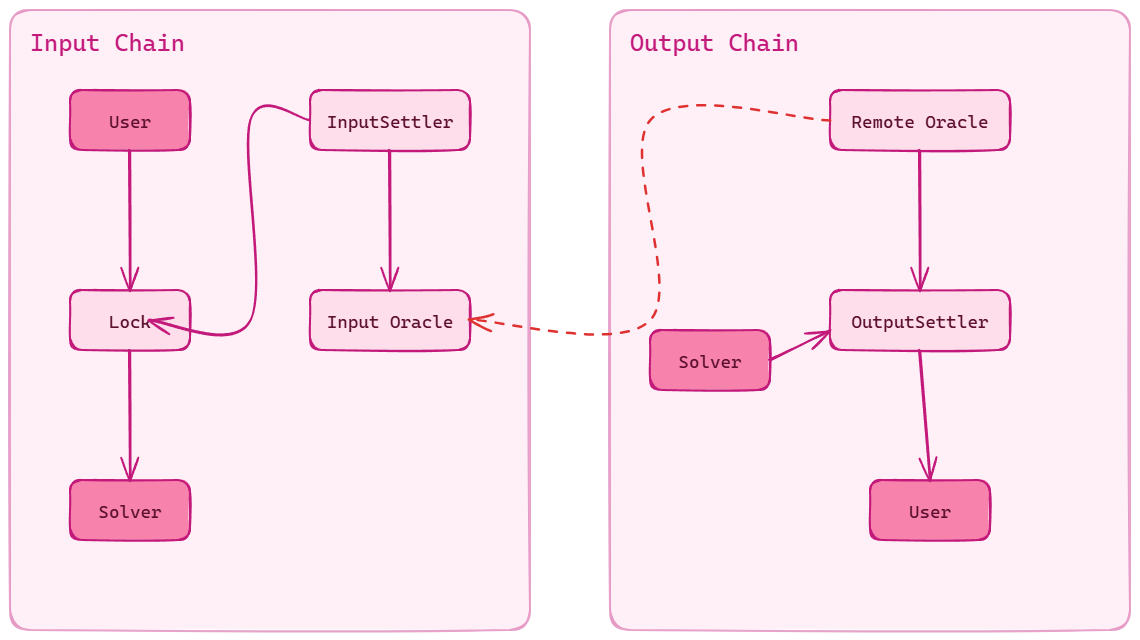
That means the user provides the assets on chain A while getting assets on chain B; A swap from chain A to chain B, and upon sending the input, the solver fills the request to the output chain, and payment is made to the user.
outputSettler verifies this transaction checks fill request and relays fills to the input oracle, which exists as a proof layer that the solver has filled the request before payment is finally made back to the solver. This works bidirectionally.
Also, the output and input chains may be more than 1 for each side of the transaction.
Final thoughts
I see and believe we are about to enter the next level of intent-based interaction while upholding the fact that interop is going to be better than the way it is through LIFI, and this will be mainly effective through narratives through which the crypto space is using to reach the maturation stage, which includes RWAs, Stablecoins, and Payment systems as LiFi modularizes the stack.
At one time, when blockchains were inherently said to be monolithic, throughput and scaling got better when modular blockchains came into view, different layers were stacked for full blockchain efficiency, and this is similar to what we see that would happen through LiFi.
I think you, reading this, might want to dabble into other components of the OIF, which include SDKs, other frameworks, and standards that LiFi isn’t yet plugged to and may be plugged to.
This is your starting point: https://openintents.xyz/.
Till when next I find my way into your mail box! Cheers!
메타데이터
- post_id
- 250c6eb577e2
- slug
- lifi-intents-what-if-defi-intents-could-be-modularized-250c6eb577e2
- url
- https://medium.com/@tim0x/lifi-intents-what-if-defi-intents-could-be-modularized-250c6eb577e2
- canonical_url
- https://medium.com/@tim0x/lifi-intents-what-if-defi-intents-could-be-modularized-250c6eb577e2
- author_url
- https://medium.com/@tim0x
- status
- ok
- fetched_at
- 2026-06-11 05:11:55



