The Stars Await Human Stories
In the age of space telescopes and interstellar dreams, humanity continues to look to the stars — not only to understand the cosmos, but…
The Stars Await Human Stories
In the age of space telescopes and interstellar dreams, humanity continues to look to the stars — not only to understand the cosmos, but to see a reflection of ourselves. From the James Webb Space Telescope’s breathtaking views to the upcoming Nancy Grace Roman Space Telescope, NASA’s missions are as much about science as they are about storytelling. What follows is a complete, detailed exploration of current and future space telescope missions, the technologies that make them possible, and the poetic ambition behind every launch.
NASA’s Upcoming Mission: Nancy Grace Roman Space Telescope
NASA’s next major mission is the Nancy Grace Roman Space Telescope, slated for launch by May 2027, after several delays. Originally targeting a 2026 release, the telescope has encountered technical and scheduling setbacks, including delays in hardware delivery and supply chain challenges. Nonetheless, this observatory promises to revolutionize our understanding of dark energy, exoplanets, and infrared astronomy.
Named after NASA’s first Chief of Astronomy, the Roman Telescope is built to cover 100 times more sky than Hubble in a single snapshot. It’s designed to explore wide-field imaging and carry out a coronagraph technology demonstration, potentially allowing direct imaging of exoplanets.
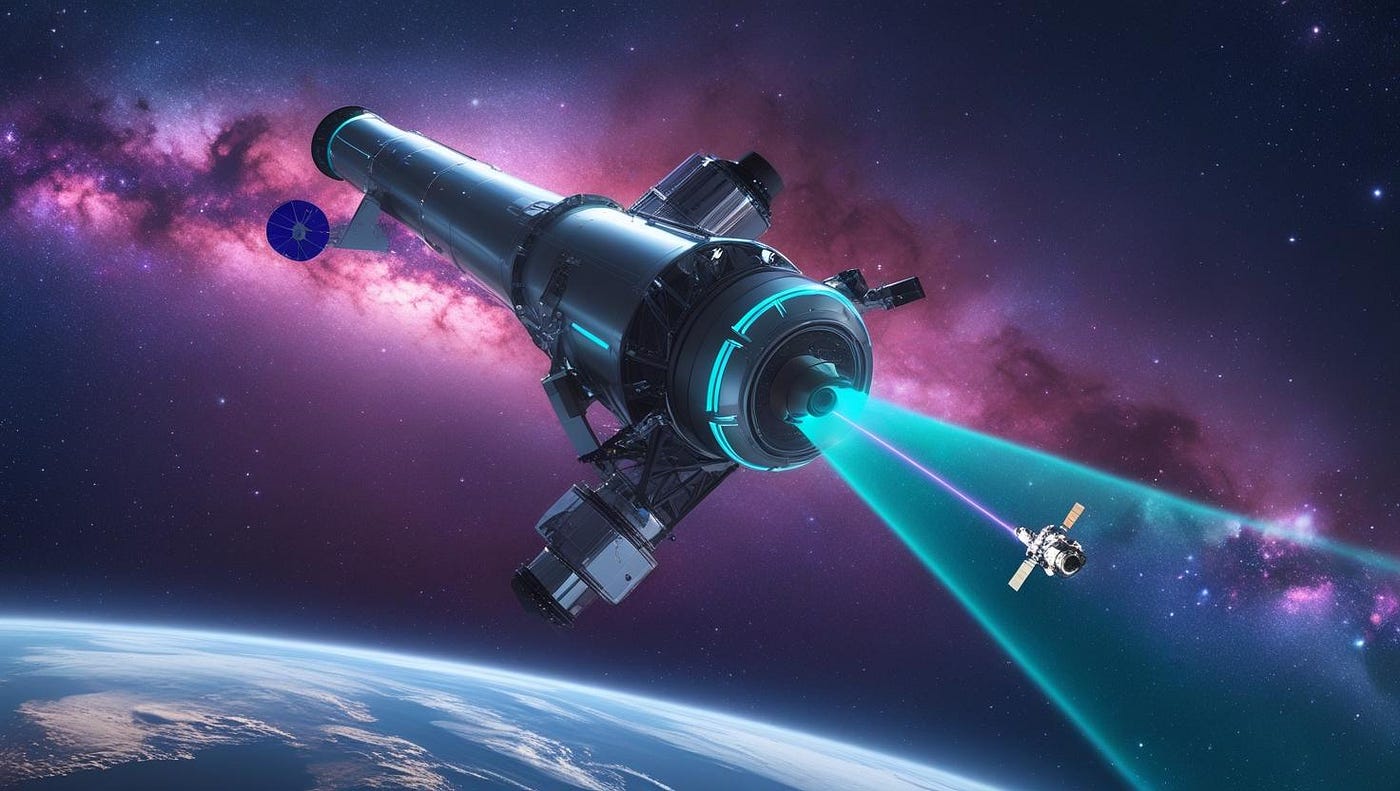
A highly detailed, realistic depiction of a futuristic space telescope, sleek and metallic silver with glowing blue accents, hovering in Earth’s orbit. A vibrant, turquoise laser beam projects from its aperture, precisely targeting a distant, smaller deep-space satellite. The Milky Way galaxy forms a breathtaking backdrop, swirling with nebulae in hues of pink, purple, and deep blue, while a partially illuminated Earth, showing detailed continents and cloud formations, is visible in the lower portion of the frame. The overall atmosphere is cosmic, with a focus on realistic lighting and textures.
How It Differs from the Webb Telescope
Unlike the James Webb Space Telescope (JWST), which focuses on deep-field imaging and capturing ancient light from the early universe, the Roman Telescope emphasizes wide-field surveys. While Webb’s vision is like a magnifying glass into cosmic history, Roman’s is more of a panoramic window.
Roman will operate in the infrared spectrum, like Webb, but with a much broader field of view — making the two telescopes complementary. Together, they can offer a multi-scale view of the universe, from detailed starlight to galactic structures.
𝓦𝓱𝓲𝓵𝓮 𝓶𝓸𝓼𝓽 𝓽𝓮𝓵𝓮𝓼𝓬𝓸𝓹𝓮𝓼 𝓾𝓼𝓮 𝓻𝓪𝓭𝓲𝓸 𝔀𝓪𝓿𝓮𝓼 𝓽𝓸 𝓽𝓻𝓪𝓷𝓼𝓶𝓲𝓽 𝓭𝓪𝓽𝓪, NASA 𝓲𝓼 𝓷𝓸𝔀 𝓮𝔁𝓹𝓮𝓻𝓲𝓶𝓮𝓷𝓽𝓲𝓷𝓰 𝔀𝓲𝓽𝓱 𝓵𝓪𝓼𝓮𝓻-𝓫𝓪𝓼𝓮𝓭 𝓸𝓹𝓽𝓲𝓬𝓪𝓵 𝓬𝓸𝓶𝓶𝓾𝓷𝓲𝓬𝓪𝓽𝓲𝓸𝓷𝓼. 𝓛𝓪𝓼𝓮𝓻 𝓼𝓲𝓰𝓷𝓪𝓵𝓼 𝓬𝓪𝓷 𝓽𝓻𝓪𝓷𝓼𝓯𝓮𝓻 𝓭𝓪𝓽𝓪 𝓪𝓽 𝓾𝓹 𝓽𝓸 100 𝓽𝓲𝓶𝓮𝓼 𝓽𝓱𝓮 𝓼𝓹𝓮𝓮𝓭 𝓸𝓯 𝓽𝓻𝓪𝓭𝓲𝓽𝓲𝓸𝓷𝓪𝓵 𝓻𝓪𝓭𝓲𝓸 𝓼𝔂𝓼𝓽𝓮𝓶𝓼. 𝓜𝓲𝓼𝓼𝓲𝓸𝓷𝓼 𝓵𝓲𝓴𝓮 NASA 𝓛𝓪𝓼𝓮𝓻 𝓒𝓸𝓶𝓶𝓾𝓷𝓲𝓬𝓪𝓽𝓲𝓸𝓷𝓼 𝓡𝓮𝓵𝓪𝔂 𝓓𝓮𝓶𝓸𝓷𝓼𝓽𝓻𝓪𝓽𝓲𝓸𝓷 (LCRD) 𝓶𝓪𝓻𝓴 𝓪 𝓶𝓪𝓳𝓸𝓻 𝓵𝓮𝓪𝓹 𝓯𝓸𝓻𝔀𝓪𝓻𝓭 — 𝓸𝓯𝓯𝓮𝓻𝓲𝓷𝓰 𝓷𝓸𝓽 𝓸𝓷𝓵𝔂 𝓯𝓪𝓼𝓽𝓮𝓻 𝓭𝓸𝔀𝓷𝓵𝓸𝓪𝓭𝓼 𝓫𝓾𝓽 𝓪𝓵𝓼𝓸 𝓻𝓮𝓭𝓾𝓬𝓲𝓷𝓰 𝓽𝓱𝓮 𝓼𝓲𝔃𝓮 𝓪𝓷𝓭 𝔀𝓮𝓲𝓰𝓱𝓽 𝓸𝓯 𝓭𝓪𝓽𝓪 𝓼𝔂𝓼𝓽𝓮𝓶𝓼 𝓸𝓷𝓫𝓸𝓪𝓻𝓭 𝓼𝓹𝓪𝓬𝓮𝓬𝓻𝓪𝓯𝓽.
Telescopes in Space: How They Work
Space telescopes operate above Earth’s atmosphere, avoiding distortion and light pollution. They capture electromagnetic signals — primarily visible, infrared, and radio — and convert them into digital data.
These telescopes have several components:
- Optics (mirrors or lenses)
- Scientific instruments (cameras, spectrometers)
- Communication systems
- Thermal protection and shielding
After collecting light or radiation, onboard instruments convert it into data packets. These are then encoded and transmitted to Earth through high-gain antennas.
Synchronizing Telescopes for a Higher Purpose
It is possible to connect telescopes for collaborative observation. This technique, known as interferometry, is already in use among ground-based observatories. In theory, synchronized space telescopes could one day form a virtual space-based interferometer, offering unprecedented resolution.
One such idea is NASA’s HabEx and LUVOIR concept missions, which envision fleets of space-based telescopes working in harmony. They could directly image Earth-like exoplanets and analyze their atmospheres for signs of life.
References:
- https://roman.gsfc.nasa.gov/
- https://webb.nasa.gov/
- https://www.nasa.gov/feature/goddard/2024/roman-space-telescope-targets-2027-launch
- https://www.nasa.gov/directorates/heo/scan/engineering/technology/optical/
- https://lcrd.gsfc.nasa.gov/
- https://exoplanets.nasa.gov/
- https://science.nasa.gov/mission/nancy-grace-roman-space-telescope/
As NASA pushes forward, each telescope and mission becomes a new chapter in humanity’s celestial journey. Whether through the panoramic eyes of Roman, the deep-sky gaze of Webb, or the laser pulses of future communications, these efforts aren’t just about decoding the universe. They’re about adding our human stories to it. The stars don’t just await exploration — they await us.
메타데이터
- post_id
- 251e5d4dcb77
- slug
- the-stars-await-human-stories-251e5d4dcb77
- url
- https://medium.com/@lukajagor/the-stars-await-human-stories-251e5d4dcb77
- canonical_url
- https://medium.com/@lukajagor/the-stars-await-human-stories-251e5d4dcb77
- author_url
- https://medium.com/@lukajagor
- status
- ok
- fetched_at
- 2026-07-14 13:18:53