Understanding MOQs in Vietnamese Factories: Negotiation Tactics for Growing Brands
August 1, 2025–10 min read
Understanding MOQs in Vietnamese Factories: Negotiation Tactics for Growing Brands
August 1, 2025–10 min read
You’ve found the perfect Vietnamese furniture supplier. Their RTA bedroom sets are beautiful — clean Scandinavian lines, rubberwood construction, competitive pricing. You envision them on your Shopify store, targeted ads running, customers lining up. There’s one problem: the factory’s minimum order quantity (MOQ) is 500 units. At $45 per set, that’s $22,500 upfront. You’re a growing brand with a $10,000 marketing budget and zero inventory. The MOQ isn’t just a number — it’s a barrier between your vision and financial reality. Yet most growing brands don’t negotiate. They assume MOQs are fixed rules, carved in stone by distant factory owners. They’re not. Vietnamese factories set MOQs based on production economics, fabric mill requirements, and supplier risk assessment. All three are negotiable. This guide reveals why MOQs exist, how they vary across product categories, and exactly how to negotiate them down — allowing growing brands to test products at scale without betting the company.
Why Vietnamese Factories Have MOQs: The Hidden Economics
Understanding MOQs requires understanding factory economics. A Vietnamese RTA cabinet maker doesn’t arbitrarily demand 500 units. That number reflects real costs and constraints:
Fabric & Material Mill Minimums: Factories don’t manufacture raw materials — they source them. A fabric mill won’t produce a custom weave for one shipment; they require 5,000+ meters minimum, which might represent 200–300 finished units depending on product. These upstream minimums cascade down: if a factory must buy 5,000 meters of fabric, they’ll set a 300-unit MOQ to absorb that fabric buy.
Production Line Setup & Changeover Costs: Setting up a production line costs \$500–\$2,000 per SKU. A factory amortizes this across units: if setup costs \$1,000 and they charge \$0.50 per unit, they need 2,000 units to justify the investment. Smaller orders make per-unit costs prohibitive.
Risk & Supplier Uncertainty: A factory considering a first order from a small brand faces risk. MOQs protect factories: higher order quantities mean higher revenue per customer, justifying resources invested. A 500-unit MOQ generates \$22,500 revenue; a 50-unit MOQ generates \$2,250 — not worth the overhead.
Container Economics: Ocean freight from Vietnam to the US costs \$1,300–\$2,000 per 20-foot container regardless of how full it is. By setting a 200+ unit MOQ, factories ensure freight doesn’t eat margins.
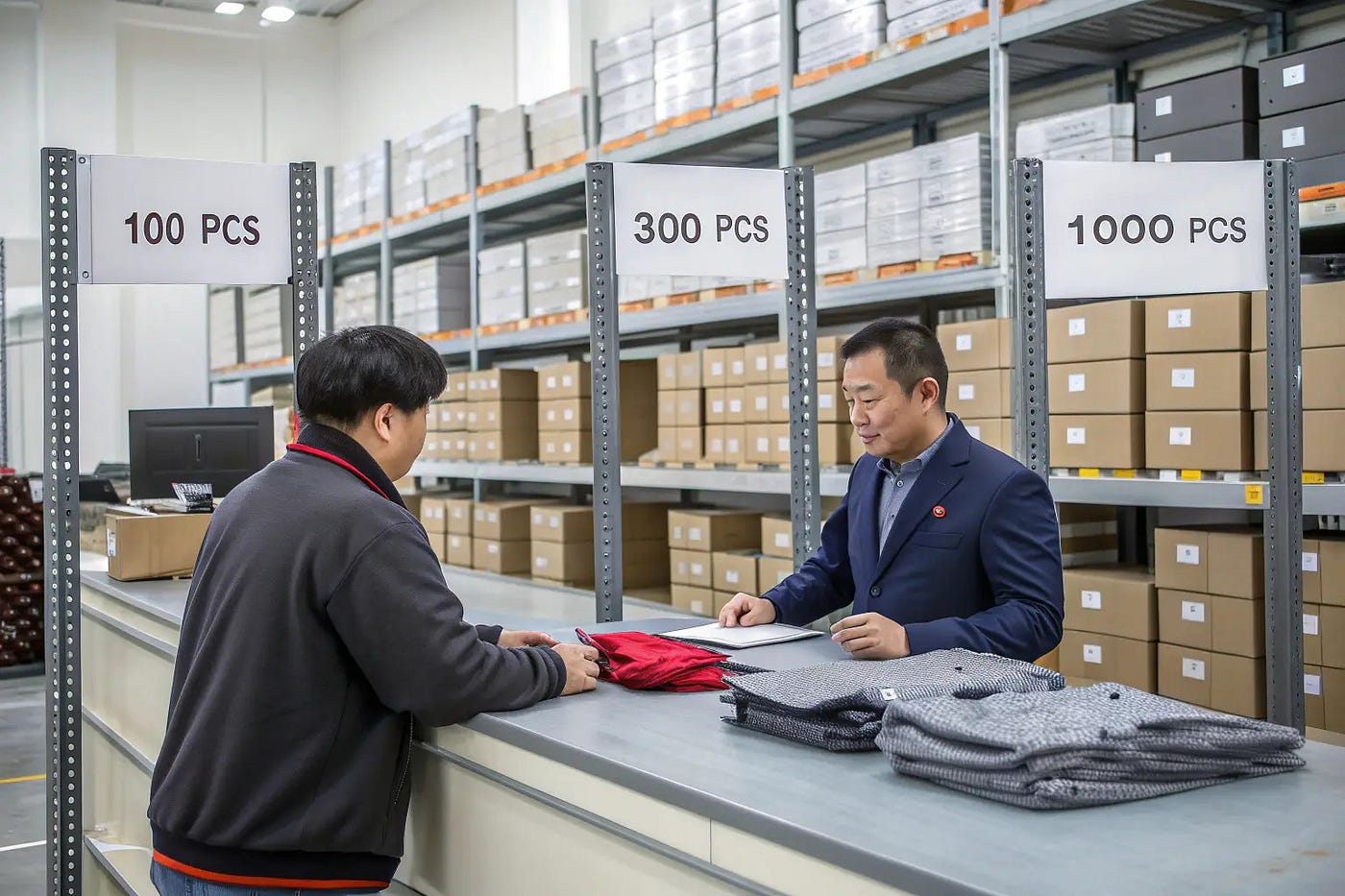
MOQ scales visible in factory operations: order quantities directly impact setup and allocation efficiency
MOQ Variation by Product Category: What to Expect
RTA Cabinets & Knock-Down Furniture: 200–1,000 units. Premium factories: 200–300 units. Mid-tier: 500 units. Small workshops: 800–1,200 units. Factories often allow mixed SKUs within one order — you might order 200 units across 5 different colors without premium charges.
Upholstered Furniture (Sofas, Chairs): 50–300 units. Standard fabric: 50-unit MOQs. Custom fabrics: 100–200 units. Leather: 150+ units. Lower MOQs because fabric mills have flexibility.
Wooden Dining Sets & Tables: 100–500 units. Premium hardwoods: 300+ units. Rubberwood/acacia: 150–250 units. Wood panel sourcing drives requirements.
Outdoor Furniture: 50–200 units. Lower MOQs because aluminum and synthetic rattan have flexible sourcing. Teak or premium wood raises MOQs to 200+.
Storage & Shelving: 100–500 units. Simple shelves: 100 units. Modular systems with hardware: 300–500 units. Hardware kit complexity raises setup costs.
Real Case Study: NestCo Negotiates MOQ from 500 to 200
A Portland-based D2C furniture brand, ‘NestCo,’ wanted to test a minimalist nightstand design. Factory asked for 500-unit MOQ at \$45/unit = \$22,500. NestCo’s founder Sarah negotiated by:
Showing sales projections: ‘If this sells, we’ll place monthly 500+ unit orders starting Month 2.’ A committed customer with growth potential justified the MOQ reduction.
Accepting 15% price premium: Sarah proposed ‘\$51.75/unit to reduce MOQ to 200. Once we hit 500-unit orders, revert to \$45.’ The factory agreed. Sarah’s test cost: \$10,350 — manageable and covered factory risk.
Offering faster payment: 50% deposit upfront + full payment upon production (instead of on shipment). Faster cash flow reduced factory risk.
Factory agreed to 200-unit MOQ at \$51.75/unit. NestCo sold 180 units Month 1 at \$229 retail (53% margin), and placed 500-unit reorder Month 2 at \$45 pricing. The MOQ negotiation saved the company.
Five Negotiation Tactics for MOQ Reduction
Tactic 1: Volume Commitment & Forecast Sharing
Share your 12-month sales forecast. Show market research, pre-orders, email list size, influencer partnerships. Factories invest in future partners with credible growth projections.
Tactic 2: Accept Premium Pricing for Lower MOQ
A 15–25% price premium for 50–75% MOQ reduction is reasonable. Example: \$45 FOB at 500 units vs. \$51.75 FOB at 200 units. Premium offsets factory’s additional setup costs.
Tactic 3: Offer Better Payment Terms
Standard terms: 30% deposit + 70% on shipment. Faster terms in exchange for MOQ reduction: 50% + 50% upon production, or full payment upon production. Factories negotiate MOQs down 20–30% for earlier cash.
Tactic 4: Offer Exclusive Distribution
Propose: ‘You get exclusive North American distribution rights for 12 months.’ Factory locks you as exclusive US channel, protecting its investment. You get exclusivity protection.
Tactic 5: Split Shipments Across Time
Order 500 units but request 200 now, 300 in 60 days. Factory reaches MOQ, you reduce upfront capital and test cash flow. Cost: 5–10% premium for split shipments, but risk reduction justifies it.
Red Flags: When to Walk Away
Factory Won’t Discuss MOQ: ‘MOQ is 500, take it or leave it’ with no conversation. Walk away unless they’re your only source.
MOQ Increases After First Conversation: Suggests poor communication or bait-and-switch. Move on.
Demands Full Payment Upfront: Scam red flag. Legitimate factories never demand 100% upfront before production.
Pressure to Order Immediately: ‘Sale ending tomorrow’ suggests factory desperation (quality issues, cash flow problems). Your test order isn’t their bailout.
MOQ Strategy by Supplier Size
Large Exporters (200+ containers/month): Higher MOQs (500+), less willing to negotiate. But flexible skew options. Best leverage: volume commitments, exclusivity.
Mid-Tier Factories (50–200 containers/month): Most negotiable. MOQs 200–500, willing to reduce to 100–200. Best leverage: payment terms, growth forecasts, 10–15% premium.
Small Workshops (10–50 containers/month): Most flexible on MOQ. MOQs 50–200. Best leverage: exclusivity, follow-up orders. Value long-term relationships.
Recommendation: Start with mid-tier factories. Motivated to grow customer bases, willing to negotiate. Large exporters for scaling 500+ orders. Small workshops for ultra-custom products.

ontainer economics: freight costs drive factory MOQ requirements for shipping efficiency
Dropshipping vs. Wholesale: Which Path?
Dropshipping flips MOQ dynamics. Zero MOQ — push one order at a time. Trade-off: 30–50% higher per-unit costs. Margins compress: wholesale 50% vs. dropshipping 22%. Dropshipping eliminates MOQ risk but requires higher sales volume.
Hybrid Approach: Dropship for testing (Months 1–3, validate demand), then negotiate wholesale MOQ once you have sales proof. Factories far more willing to reduce MOQs when you arrive with: ‘I sold 500 units dropshipping. Now I want 500 wholesale and reduce costs.’
Your MOQ Negotiation Action Plan
- Research factory MOQs upfront: Ask 3–5 factories for standard MOQs. Get market norms. Don’t lowball.
- Build credibility case: One-page summary — sales forecast, pre-orders, email list, influencer partnerships. This is your negotiation ammo.
- Start strategically: ‘We’re a growing brand interested in long-term relationship. Can we discuss MOQ flexibility for test order?’
- Propose specific tradeoff: Price premium (15%), faster payment (50/50 terms), exclusivity, or split shipments.
- Get terms in writing: ‘To confirm, MOQ for Order 1 is 200 units at \$51.75/unit with 50/50 payment terms.’ Prevents misunderstandings.
- Demonstrate follow-through: Place test order, pay on time, share feedback and sales results. Factories reward reliability.
- Prepare for scale: Once validated, approach factory: ‘Ready to scale. Let’s discuss 500-unit monthly pricing.’ You’ll get significant discounts.

Building success through small, manageable orders and sustainable growth strategy
MOQ negotiation is a skill, not a fixed barrier. Growing brands with credible forecasts, realistic expectations, and willingness to offer faster payment or premium pricing can negotiate MOQs down 30–50% from initial asks. Position yourself as a future partner, not a one-off buyer. Vietnamese factories are hungry for growth.
Tags: Vietnam MOQ negotiation | Minimum order quantities | Factory terms | Growing brands | Wholesale sourcing | RTA furniture | Dropshipping vs wholesale
메타데이터
- post_id
- 253084e85c33
- slug
- understanding-moqs-in-vietnamese-factories-negotiation-tactics-for-growing-brands-253084e85c33
- url
- https://medium.com/@vietnamdirectsourcing/understanding-moqs-in-vietnamese-factories-negotiation-tactics-for-growing-brands-253084e85c33
- canonical_url
- https://medium.com/@vietnamdirectsourcing/understanding-moqs-in-vietnamese-factories-negotiation-tactics-for-growing-brands-253084e85c33
- author_url
- https://medium.com/@vietnamdirectsourcing
- status
- ok
- fetched_at
- 2026-06-23 19:38:28

