Farewell in a Language Nobody Speaks: the Island of Sylt
A close cousin of English on a North Frisian island
MONTHLY CHALLENGE
Farewell in a Language Nobody Speaks: the Island of Sylt
A close cousin of English on a North Frisian island
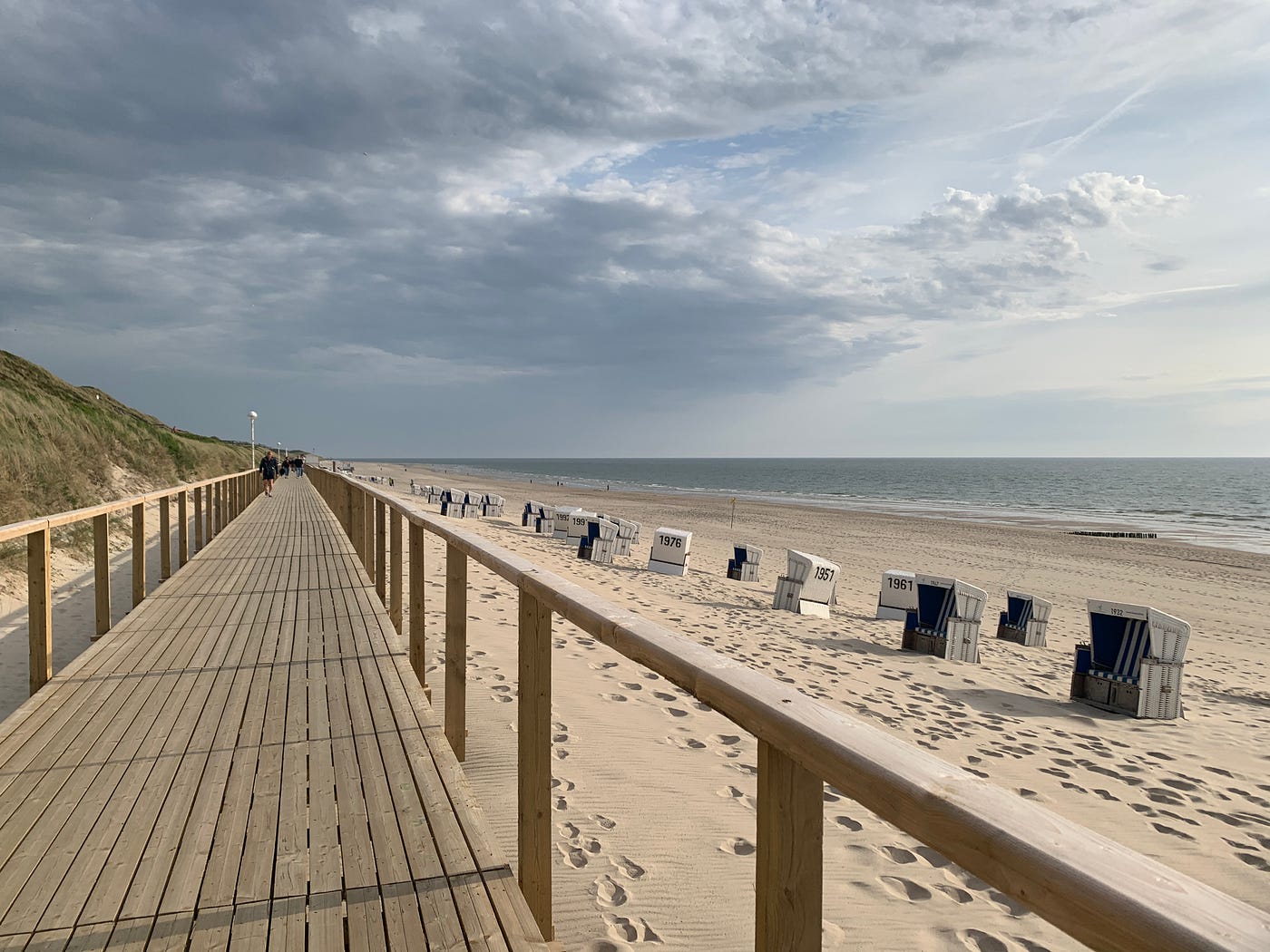
Along the beach at Sylt. Author photo.
‘Moin,’ says the train conductor, greeting people as the train runs along a narrow causeway joining the island of Sylt to the far north of the German mainland. At first, I think she’s mumbling ‘Morgen’ (‘morning’), but then I discover moin is a Low German/Frisian greeting used to mean ‘hello’ at any time of day.
I’m on my way to Sylt for a week of cycling. It’s one of those places where everything is within reach on a bike, although I’m slightly apprehensive as the island is notorious for its popularity with Germany’s jet-set, their Porsches parked outside immaculate second homes with thatched roofs. I’m hoping our paths won’t cross. I’m also worried I might not be able to afford to eat.
A bright orange McLaren sports car sits opposite my lodging, but it doesn’t belong to my landlady — she was born on Sylt and gets around by bike. Over the week I learn that Sylt’s jet-set reputation is only half the island’s story. Sylt’s alternative face is that of the family seaside resort. In the main town of Westerland, families stay in holiday apartments, browse in bucket-and-spade shops and queue for slices of pizza. But outside of the settlements the island feels wide open, including the 25 miles of pale sand along Sylt’s western coast.

North Sylt. Author photo.
The word ‘moin’ has status, as you can buy a mug with Moin painted alongside the distinctive shape of the island. I find myself saying ‘Moin’ in return to everyone, from the checkout woman in Aldi to the server at the coffee roastery. But while the word ‘Moin’ can be heard all day long, there’s another, older dialect that’s silent.
Sylt Island has its own North Frisian dialect, called Söl’ring. It’s distinct from other Frisian dialects because it picked up Danish influences. What excites me is that Old Frisian and Old English are close relatives within the Germanic language family. The Frisians crossed to Britain in the fifth and sixth centuries alongside the Angles, Saxons and Jutes, and many of our common words can be traced back to an old Frisian root.
That means Söl’ring is a living link to today’s English. And although both languages developed with different influences along divergent routes, the shared root is audible in a few words, such as faarwel — closer to the English farewell than the German auf wiedersehen. Another is twuntig, which sounds more like the English twenty than the German zwanzig.
I first spotted this old dialect as the train approached Sylt, when the information screen in the carriage became bilingual, showing the time of arrival in Sylt / Söl’ and Westerland / Weesterlön. My heart raced at the thought of being able to understand some of this ancient cousin of English.

Westerland railway station. Author photo.
But when I get to the island and ask locals if many people speak Söl’ring, they look incredulous. It’s as if I’m asking people in London if anyone still speaks Anglo-Saxon.
It turns out a mere few hundred people speak Söl’ring on Sylt, mostly older people. Bizarrely, most other Söl’ring speakers live elsewhere, because many islanders left for the German mainland, unable to afford to live on Sylt. Still, it clearly has some heritage value, as I spot a few written Söl’ring words here and there, especially in tourist-facing signage, such as cafes and house names. It’s also taught in some of the island's primary schools. There’s an association that works to preserve and teach it, so Söl’ring hasn’t completely died out. It’s just that it’s not exactly spoken on the streets.
I’m resigned to not hearing Söl’ring at all — until I do.

Keitum museum. Author photo.
I cycle over to Keitum, where old captain’s houses with thatched roofs overlook the Wadden Sea. Here in the museum, I can, at least, play recordings of people speaking phrases and reading entire stories in Söl’ring. My favourites are the idioms, although my hope that as an English speaker I might understand basic Söl’ring proves to be… ridiculous.
English and Söl’ring might be close cousins in a word-development sense, but they’ve drifted too far apart to be mutually intelligible.
Hi kniipet di Kat ön Junkens.
In standard German / English this is:
Er kneift die Katze im Dunkeln / He pinches the cat in the dark.
Luckily for me, an explanation is provided: the idiom mocks someone who drinks too much.
No explanation is needed for this insult: Jü es sa dum üs en Skruk (He’s as dumb as an oyster).
Although Söl’ring was once spoken widely on the island, the first publication in the language was printed as late as 1809. There’s a copy of this book, a comedy written by Jap Peter Hansen, in the old Frisian house next door. The Altfriesisches Haus from 1640 preserves island culture from the 18th–19th century, including this wooden travel writing box, carried by sailors so they could write home. Rather lovely, although a bit clunky for today’s travelling writers.

Altfriesisches Haus. Author photo.
Keitum village feels like a living piece of island history, but gentrification has brought it into the 21st century. Even the museum has a row of deckchairs in its manicured grounds, where anyone can sit and look out across the Wadden Sea towards Denmark.

Sylt Museum. Author photo.
Gentrification is at its peak in Kampen, a little further north, the place where people go to spot celebrities. I cycle past a t-shirt shop that also sells champagne, and then stop to photograph a branch of the Douglas cosmetics chain, where a couple of Strandkorb beach chairs invite people to sit outside the store.

Kampen. Author photo.
This style of beach chair is popular along the northern coasts of Europe, and I sat in something similar on a 1970s Polish beach. Here on Sylt, they’ve become a kind of cultural icon of the island, and people buy these chairs for their gardens and their balconies. After each day of cycling, I wander down to the beach, find an empty Strandkorb and sit there reading, as people at the water’s edge silhouette into the setting sun’s reflection.

Strandkorb chairs. Author photo.
The story goes that a Rostock basketmaker was commissioned in 1882 to create a beach seat that would provide shelter from sun, wind and sand. Today’s versions on Sylt have boxy footrests and a retractable tray for drinks, and custom-made versions sell to wealthy visitors at up to 9,000 euros.
The island’s cycling is well organised, with signposted bike paths criss-crossing the island. It’s also fragrant, as the paths are lined with the beautiful, scented wild Kartoffel Rose. It’s an invasive plant and lovely as it is, it’s a threat to the native dune habitats that protect a coastline that loses around a metre to the sea each year.

Sylt cycle paths. Author photo.
Riding up to the northernmost point at List, the cycle route runs through the dunes with the blue of the sea on either side, passing the island’s characteristic thatched houses. Even the bus stops are thatched. Bronze age burial mounds dot the landscape like semi-submerged whales. Sometimes the wind helps me along, other times it brings me to a standstill. Just as my legs need respite, the sound of Meatloaf draws me into a shabby chic ‘bus stop café’ among the dunes, where coffee is served without a Porsche in sight.

Cafe in the dunes. Author photo.
After the (mostly) peaceful cycle paths through the dunes, it’s a shock to wheel the bike into List harbour, crowded with people eating fish. If Kampen is Germany’s so-called version of the Hamptons, then List is channelling San Francisco’s Fisherman’s Wharf.
I take a seat at Gosch, the sprawling fish restaurant that’s grown from an original harbour shack. Away from the champagne and the custom-made beach chairs, Sylt is surprisingly affordable.
Language change is inevitable, and on an island like Sylt, German is naturally going to be a priority when the island’s 20,000 population is joined by almost a million visitors each year. I remind myself it was Germanic tribes, including the Frisians, who wiped out much of the Celtic language when they invaded Britain all those centuries ago.
Now the decline of Söl’ring is accelerated by a different kind of invasion. Söl’ring is dying because its speakers can no longer afford to live on an island that’s too desirable and too expensive.
On my final evening, I walk above the dunes and say a silent faarwel to Sylt in its own language. I’d say it out loud, but I can’t be sure anyone would understand it.

Faarwel to Sylt. Author photo.
Thank you for reading. This is my second response to the June Globetrotters prompt: Languages. Thanks to the editors as always!
Smatta has taken up the challenge with this interesting look at Amritsar and the languages of India:
[embed]In the Land of One Thousand Languages A unique shopping experience in Amritsarmedium.com
메타데이터
- post_id
- 254f5a5cb4b6
- slug
- farewell-in-a-language-nobody-speaks-the-island-of-sylt-254f5a5cb4b6
- url
- https://medium.com/globetrotters/farewell-in-a-language-nobody-speaks-the-island-of-sylt-254f5a5cb4b6
- canonical_url
- https://medium.com/globetrotters/farewell-in-a-language-nobody-speaks-the-island-of-sylt-254f5a5cb4b6
- author_url
- https://medium.com/@michelledlawson
- status
- ok
- fetched_at
- 2026-06-20 20:29:01