Rashid Rida, Zionism, and the Strange First Encounter with European Antisemitism
This is the eighth post in the series.
Rashid Rida, Zionism, and the Strange First Encounter with European Antisemitism
This is the eighth post in the series.
The purpose of this series is to share my attempt to understand today’s Israel-Palestine conflict better by going back to history. Historical study always requires interpretation, so I give my interpretation — but I also try to provide facts and references that readers can check and interpret for themselves.
In the previous post, I began looking at the role of Rashid Rida in the development of modern anti-Jewish and anti-Zionist attitudes in the Middle East.
Rashid Rida was an Islamic scholar, reformer, and the founder and lifelong editor of the influential journal al-Manar. The journal was one of the important platforms of modern Islamic reformist thought. Rida was also regarded, by the 1910s and after, as an intellectual influence on figures such as Amin al-Husseini, later Grand Mufti of Jerusalem, and Hassan al-Banna, later founder of the Muslim Brotherhood.
As I wrote in the previous post, if one looks at the first year of al-Manar, one does not yet find the later, hardened language of anti-Jewish conspiracy. At that point, Rida appears to regard Jews as fellow Easterners — certainly of lower religious status than Muslims in his worldview, and often described as weak — but also as remarkably successful in preserving unity, organization, and mutual aid.
For Rida, this early Jewish example is often used to admonish Muslims: if even the weakest and most persecuted people can organize, collect funds, and help one another, what excuse do Muslims have for disunity and lethargy?
What is also striking is how little attention Jews receive in the first year of the journal. In nearly a thousand pages, there are roughly twenty pages where Jews are mentioned, and in most cases they appear only as part of a list of minorities, as an example of extreme disadvantage, or in relation to a Quranic or religious text.
It is possible that my AI extraction, translation, and search method missed some instances. A full check by an Arabic-speaking specialist working directly with the printed journal would be better. But manual sampling confirms the general impression: Jews are not central in the early issues.
That absence is telling.
Rida was born and grew up in Lebanon, had family connections to Palestine, and was clearly aware of the Zionist project. Jews were already a majority in Jerusalem when he started publishing al-Manar, and he notes that Jews were beginning to dominate areas of trade in Palestinian towns. Yet this does not lead him, at this stage, to sustained hostility. On the contrary, he uses Jewish organization as an example from which Muslims should learn.
In the second and third years of al-Manar, Jews again seem to receive virtually no attention.
Then, in the fourth year, there appears one long article which, in my opinion, may help explain how Rida’s later hostility developed. The article is important because it shows him encountering European-style antisemitism — but reading it in a very different way from European antisemites themselves.
The article appears in volume four of al-Manar, pages 757–765 of the scanned file I used.
The article
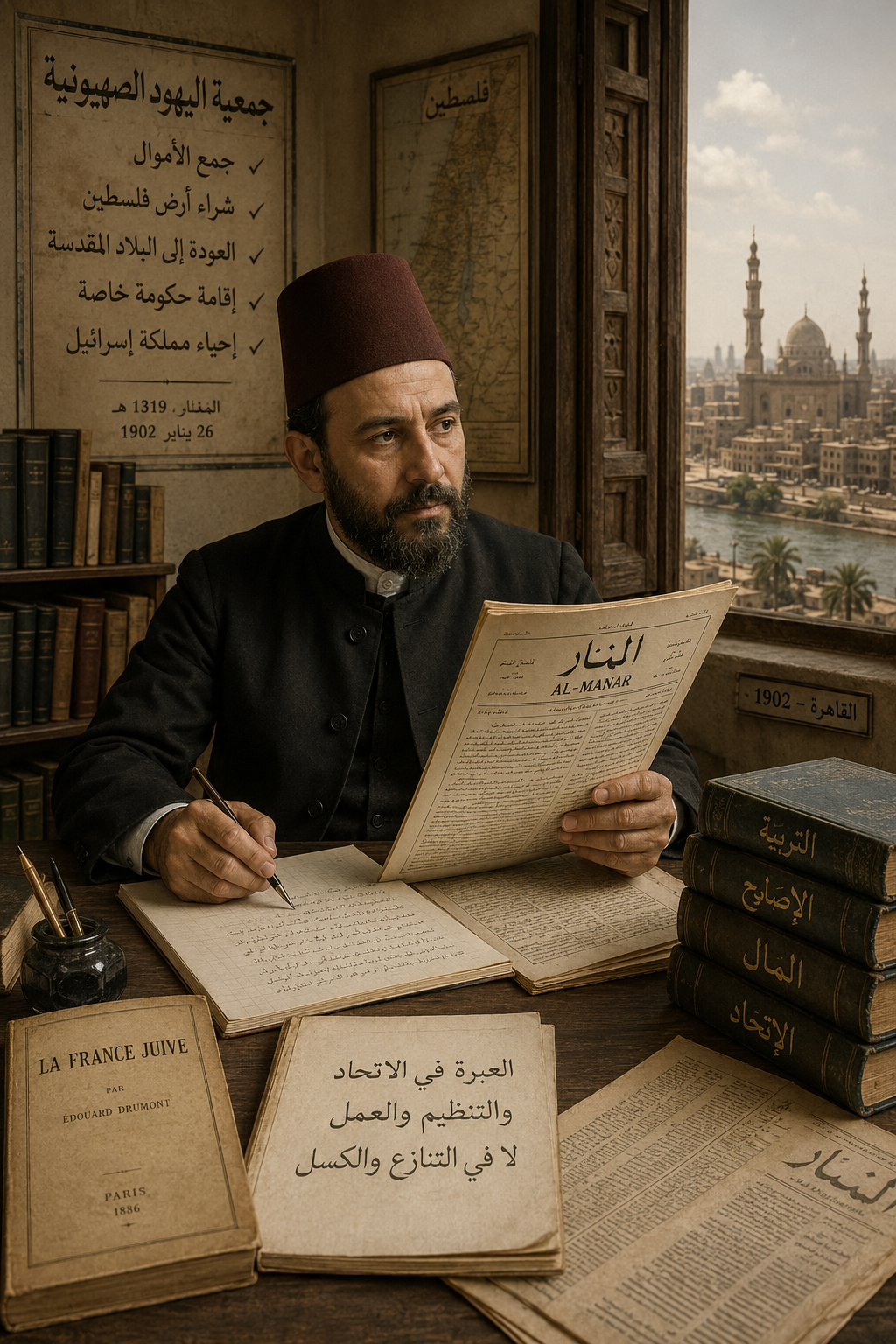
Part Ten — Volume Four al-Manār, 1315 He, peace and blessings be upon him, said: “Islam has bonds and landmarks like the landmarks of the road.” Egypt, Sunday, 16 Shawwāl 1319–26 January 1902 Articles The Life of a Nation after Its Death “The Jewish Zionist Society” “Have they not travelled through the land, so that they might have hearts with which to reason, or ears with which to hear? For indeed it is not the eyes that are blind, but blind are the hearts that are in the breasts.” During the days of the feast, we were speaking with His Excellency Riyāḍ Pasha about the condition of the Muslims and what they need by way of reform. The Jews came up in his speech as a reminder of all reform and progress — namely, money. We mentioned the Zionist Society and its efforts to restore authority and kingship to the People of Israel. The minister said that he had recently read a book by one of the Europeans hostile to the Jews, whose author had written it to defame and disparage them. It was all a confusion of truth and ignorance. In it was the claim that the reins of interests in Paris and France were in the hands of the Jews. He urged some distinguished Egyptians to translate it — not in praise of the Israelites, but as a lesson for the Muslims. …that Muslims should take lesson from the conditions of mankind and from the signs and examples on the earth, while over their eyes is a covering, in their ears a heaviness, and in their hearts coverings into which the admonition of preachers and the warning of warners do not reach. Thus zeal is a hidden grief so long as these thoughts and anxieties remain with them; and they will remain upon them in this article, even though we have already expounded the matter before, for most of our people forget what is useful and need repetition. If we were to hear the warning of the nations morning and evening, or read the events a hundred times and a hundred times by the pen, we would still strike the example, to this day, of the abasement and weakness of the Jews, and would fear that one day we might become like them, while we know neither ourselves nor them. There is no difference in social life between us and them except that some of our lands still remain under the banner of princes from among us, while they are deprived of authority. If we consider the path along which our princes proceed with those remnants of lands left to them: is it the path trodden by the sultans who inherited the earth because they were fit to cultivate it? Or is it the path of tyrannical, unjust despots who lost most of the Islamic kingdoms, until nothing remained to us except that portion by which vanity has exalted us, despite what we witness of foreign domination over us within it? Then we saw a writer who had discerned the path along which the Jews are now proceeding, so that we may know whether it is the path of their forefathers, who were deluded by noble lineage — “the line of the prophets” — and by the mighty title — “the people of God, the sons of God and His beloved” — and by reliance on the blessing of the Torah for victory over the nations, while confining themselves to mutual counsel without action guided by union and holding fast together; or whether it is another path, in which they have taken lesson from God’s law in His creation, preserving their language and their financial association despite their dispersion throughout all regions of the earth and some of them drew near to others through judgment/arbitration and cooperation. They began gathering the sciences of the age and its useful arts, and they excelled in gathering wealth, which is the basis of power and riches in this age. Is this not the path upon which the Israelites have become upright in this age, so that their cut-down strength has become firm and their lost resolve has returned? Nothing is lacking for them to become the greatest nation on the face of the earth except kingship, and they are seeking it by its natural path. A single Jew today is more troublesome than a king among the kings of the East. For what European state threatens the greatest Eastern sultan by word and deed, and compels him by force to give up himself? Yet the state of France tried to give up one Jewish man, and the world rose up against it, and internal wars almost broke out over it, had it not been remedied — that is, in the Dreyfus affair, which no one who knows it has failed to hear of. The Jews have a large financial association — and there is no success for nations except through associations. We did not hear mention of the Zionist Society until about five years ago. It is a political association whose aim is to take possession of the Holy Land, so that it may be the seat of their kingship and the throne of their sovereignty. This society was mentioned in the seventh issue of al-Manār’s first year, pages 44–45. There it was stated that this society’s movement appeared suddenly in Germany, Austria, England, and America. At first it did not openly seek kingship. Rather, it presented itself as wishing to transfer poor Jewish emigrants and expelled persons [word uncertain] to the lands of Palestine, so that they might cultivate them and live securely under the shadow of the Sultan. It is as though it has now become confident in its strength and has emerged from the narrowness of secrecy. For months, Sir Israel Zangwill was sent from London to Istanbul to negotiate over the purchase of noble Jerusalem. He said that the sultanic negotiation was agreeable and sympathetic; and after his return he delivered a speech in the society, saying approximately the following in Arabic: “The Jews will return in great numbers to Palestine, your ancient place, whose sun can never set from the sky of their thoughts. Their number there in the year 2000, that is, at the end of the twentieth Christian century, will reach two hundred thousand — a million — souls. They will turn those lands into lofty gardens with fruits hanging near; they will walk in them amid gardens of delight; they will connect their borders and regions with railways; and they will establish there a well-ordered government peculiar to it, which will be a model of perfection, gathering nations and generations. The People of Israel will be a beacon upon Mount Zion by which all nations will be guided to the virtuous city in social, political, judicial, literary, agricultural, and all livelihood-related affairs. From its laws other states will learn the ways of right guidance in the administration of kingdoms, just as nations and peoples will learn from its social order the reality of civilization, and from its spiritual happiness the meaning of the true end.” He said: “In sum, the aim of the success of these hopes lies in the extension of the Jewish community after their return to Palestine. It may be said that from the time of Christ until this era, the world has not seen anything of the life and works of the Israelites. They were persecuted by Christians and pagans in every kingdom, and that was the reason for their remaining close to one another, for the joining of their hearts, and for their being prevented from mixing with others and marrying outside themselves.” Then he said: “The ultimate goal to which the Jews look is the collection of sufficient funds to purchase the land of Palestine from the Sultan, under whose sovereignty the great movement will take place. What has been collected up to now has reached one million American dollars, and in every city and every village in which Jews reside, in the Easts and Wests of the earth, there is a branch of the Zionist Society collecting money for this purpose. Every hindrance comes from the poor, not from the rich; [the rich?] are responsible by their personal factor/agency [reading uncertain] for giving this project its due of care and attention. Yet the wealth of the rich is not relied upon when the financial direction is in the souls of the poor. This is shown by the rapid gathering of wealth from every side, and the contribution of sums from every horizon. It is hoped that, in a few years, it will succeed in collecting an amount of money sufficient to reach the goal and attain the wish, etc. I think the orator is exaggerating in attributing to the rich Jews a lack of concern for assisting the Zionist Society. Perhaps the wisdom in that is to stir the poor and middle groups to give as much as possible; then the rich will be the ones who complete the work fully. Now we remind you of Baron Hirsch and his spending from his abundance on the purchase of colonies for his people. Whenever a wealthy and generous man like this stretches out his hand to assist this society, the coming of that great day will have drawn near. The poor Jews have collected one million dollars for this work, and they have no more; this calls upon the knowledgeable among their community [reading uncertain]. What, then, will stir the Muslims in Egypt, who are close in number to the Jews of the earth, to assist the charitable society by collecting one thousand qirsh for establishing a college in the Egyptian country? This — and because the Zionist Society has declared its political aims before the witnesses of the press, the French administration [or “managerial French press,” reading uncertain] published them in L’Express at the beginning of the month, because of the stir among the Jews, the persistence of speeches and discussions at night in the hall of the public assembly. It opened its meeting with the following press document: “A Zionist Call to the Jews of Alexandria” “O brothers, a people that has never ceased seeking for itself to have a nation/state, and that has not ceased, and will not cease, striving, however much obstacles oppose it and accidents confront it — those who made the final defense of our sacred house have borne witness to this. That standing was in the days of Philadelphia [reading uncertain], and they tried in vain to wipe from the tablet of existence, with their own hands, the disappearance of the kingdom of Israel. The foundations of our religion and the rulings of our law require us to cling to the wealth/inheritance of our ancient homeland and to believe that the building will return after its decay, and our lofty station acknowledges that the People of Israel have every right and excellence on earth. But the lands of Zion were the cradle of the bond among its members; they are the refuge of the Law, the joy of [structures/compositions? reading uncertain], and because of them they preserve appearances/forms, maintaining the customs of the fathers and grandfathers. “The tempests of oppression and persecution, and the storms of fanaticism and misery that strike the Jews in order to rule over them by their religion, have compelled us to act according to what the laws have made possible, to nullify what consciences have contained, and to emerge from the narrowness of despotism into the open space of exertion. The Zionist project now demands of us that we hasten to action and hurry to adopt the path. It informs us of the consequence of shortcoming and laziness. Enough for us that we are alive/scattered [printed word uncertain] from every place, hated by every human being. The harsh one has cast at us that disgraceful description that represents us most clearly in the story of ‘the Wandering Jew,’ despite our love of reform and our great services to every country in which we have settled, and despite our raising the rank of civilization in every kingdom we have inhabited. Since there is no remedy for this humiliation except union and holding fast together, in order to support the financial renaissance that has been established in our nation by the best of its young men to preserve our sacred rights, and [to follow] the noblest paths and months [reading corrupt]. What remains for us now is to ask you, our brothers: Is there still, after this, any doubt about the success of the Zionist project in the land of Egypt? Let us ask for the assistance of our brothers in distant regions, for they have prepared the way for us. If we bind them as judges of victory, it will come after a little time [reading uncertain]. The inner sense of the months [reading uncertain] is in our need for one another: that you will hasten to answer our call and attend our urgent summons, to be held in the hall of [Manfarqā?] at nine o’clock on the evening of Saturday the 11th of the European month. We shall be awaiting you, so that you may have the pride of Zion. Section of the Yaḥūrūbiyā Society [name uncertain], Alexandria.” What can we now say in warning our people to take lesson from the union of the Jews and their striving to recover their glory, except that they will have a kingdom by which all kingdoms will be ransomed, so that they become the nation of the worlds? We shall repeat some of what we said in the seventh issue of the first year, when mentioning the news of the society — though no one then mentioned that their resolve was to seek kingship except what we indicated in our criticism in that issue. They mentioned — and what appears from this Zionist movement is the life of strong alertness in a people like whom we have seen there. We recall here the third benefit from it, namely: “Third: to awaken a people afflicted with lethargy, almost touched by heedlessness, and to make them rise to [consider] the firm bonds among the Jews despite their dispersion among kingdoms and their scattering through the regions: how they find strength in their arms to assist their brothers and preserve their people from beyond the seas and mountain ridges. The remoteness of lands has not prevented them from perseverance in innovation, and from cooperation with dirham and dinar, by which every hope is realized and to which every work is attached every undertaking. O you who are content with lethargy: stop, and your heads — raise them — and fix your eyes, and look at what peoples and nations are doing. Is what the worlds say about you true? Do you want it to be recorded in the newspapers of all states that the poor of the weakest peoples, whom all governments expel from their lands because of oppression and knowledge of the methods of civilization [syntax uncertain], are capable of possessing your lands, exploiting them, making their livelihoods into wages and their rich into poor? Think about this question and make it the subject of your conversations, so that you may see whether it is true or false, sincere or lying. Then, if it becomes clear to you that you are falling short in the rights of your homelands, the service of your nation, and your path, then look, consider, reflect, remind one another, converse, and debate about such a matter. It is more worthy of consideration than disputes over doctrines, the assumption of offices/affiliations, and shouting declarations of dissociation. It is more deserving of discussion than mutual repulsion and aggression against your brothers; for in good there is occupation away from evil, and in seriousness there is ample room away from falsehood. ‘And none takes heed except one who turns [to God].’ End quote.” This is what we said about four years ago. So what shall we say today? Nothing. We say: the exaggerated amount of clarity, the nearness of the proof and demonstration, or the descent of that abundance into ears and the entry of that opening into eyes [reading uncertain] — [all this] is filled with the force of what has filled people’s ears and hearts from the praises of the free. O God, but the severing of breath [reading uncertain] by the fact that the nation’s hearing of us is a portion from the sky of their greatness [reading uncertain] — so nothing remains for us but to raise objections to them and cut them apart [reading uncertain], instead of restricting the soul in drawing near to them. By “consultation” I mean those doubts that the stagnant people breathe out, so that one may be reassured by words and understand away from clinging to deeds. This is not the place to set out the history of the life of every prince among the Muslim princes, so let there be in it a coin [reading uncertain] we have not mentioned. As for the wretched prince of the nation and those alert to it [reading uncertain], to impose their absolute authority — that is their affair to preserve them from neglect and destruction. We do not intend by this article that the nation should rise up against them, for that would assist the foreigners in swiftly finishing us off. Rather, we intend that the nation should not surrender itself to them, but should strive with everything in its power to acquire useful sciences, broad wealth, and elevated education. Thus one of the necessary consequences of its wisdom would be that the nation becomes an aid to them in the maintenance, might, and greatness of kingship. Whoever is hired [reading uncertain] — his master’s garment has clothed their bodies [reading uncertain] — until, when they become a real nation with a public opinion, they reform or correct his character according to what law and consultation require, following in that the wise methods whose harm is not feared and whose consequence is not dreaded. The footnote says the report was narrated by Aḥmad, Muslim, Abū Dāwūd, al-Tirmidhī, and Ibn Mājah from Thawbān. Research notes The article’s main rhetorical move is to use Zionist organization, fundraising, and political ambition as a warning-example for Muslims. It contrasts Jewish historical weakness with contemporary Jewish finance, association-building, press visibility, and political strategy, then urges Muslims to learn organizational discipline rather than remain passive. Key terms preserved: جمعية اليهود الصهيونية = “the Jewish Zionist Society”; الجمعية الصهيونية = “the Zionist Society”; البلاد المقدسة = “the Holy Land”; بلاد صهيون = “the lands of Zion”; شعب إسرائيل = “the People of Israel”; اليهودي التائه = “the Wandering Jew.”
The European book behind the discussion
The book mentioned in the article is likely Édouard Drumont’s La France juive, usually translated as Jewish France.
Drumont’s book was published in 1886. It was one of the most influential antisemitic polemics of late nineteenth-century France. It argued, falsely and conspiratorially, that Jews had gained excessive control over French finance, politics, journalism, and culture, and portrayed Jews as alien to the French nation.
It mixed economic resentment, racial theory, Catholic traditionalism, nationalism, and conspiracy thinking. Drumont blamed Jews for France’s social and political problems: capitalism, republicanism, secularism, and the decline of traditional Catholic France.
Its claims were not serious historical analysis. They were propaganda. But the book mattered because it helped move antisemitic language from older religious prejudice into modern mass politics and journalism. It also helped shape the climate around the Dreyfus Affair.
What is interesting here is not Drumont himself. His argument is not subtle.
What is interesting is how differently two Middle Eastern Muslims — Rida and Riyad Pasha — appear to read this European antisemitic text.
They notice that the book is hostile to Jews. The article says that the author wrote it “to defame and disparage them.” It also describes the book as “a confusion of truth and ignorance.”
But they do not seem to read it mainly as a reason to persecute Jews.
Instead, they read it as evidence that Jews had become powerful through organization, money, education, discipline, mutual aid, and solidarity. In their reading, the lesson is not “Jews are malicious and must be attacked.” The lesson is: Muslims should learn from how Jews became strong.
This is a very different reception of European antisemitic material.
Power, suspicion, and cultural translation
Here we come to a cultural difference between Christian Europe and the Islamic Middle East.
In much of Christian European moral tradition, “secret power” was easily interpreted as something malicious. The poor and powerless were often idealized as closer to spiritual truth, while hidden financial or political influence could be read as corruption, manipulation, and moral danger.
In Islam, the association is not the same. Power, victory, organization, wealth, and worldly success can be interpreted as signs that a community has understood the laws of social life, discipline, and divine order. Power is not automatically proof of innocence, but neither is it automatically proof of corruption.
This helps explain why Rida and Riyad Pasha could read a hostile European antisemitic book and draw from it a partly admiring lesson: Jews had succeeded where Muslims were failing.
They did not adopt Drumont’s European Christian-nationalist resentment in a simple form. They translated the material into an Islamic reformist argument about Muslim weakness.
That does not make the passage free of anti-Jewish hierarchy. It is not. Jews are still treated as a lower and weaker people whose success should shame Muslims.
But this is exactly the point: the passage is not yet a straightforward importation of European antisemitism. It is a hybrid moment. European antisemitic claims are noticed, but they are being reinterpreted through a Muslim reformist concern with decline, education, money, organization, and communal weakness.
The immediate context: education and reform
The context is essential.
Rida was a reformer. He wanted Muslims to improve education, strengthen institutions, organize, raise funds, and modernize the Ottoman and Muslim world without simply copying Europe.
His calls often failed in practice because of a lack of funding and a lack of effective organization. That is why the comparison with Zionist fundraising matters.
The conversation with Riyad Pasha was probably connected to the question of funding Muslim educational projects in Egypt. Rida explicitly contrasts Jewish fundraising with Muslim failure to collect even a small amount for a college in Egypt.
The comparison is humiliating by design.
If poor Jews can collect a million dollars for a national project, why cannot Muslims in Egypt collect one thousand qirsh for an educational institution?
That is the rhetorical function of Zionism in this article.
The Zionist movement is not treated as harmless. Rida clearly understands that it has political aims. He writes that it seeks possession of the Holy Land and the restoration of Jewish kingship. He even discusses the idea of buying Jerusalem.
But the astonishing point is that this does not yet produce the reaction one might expect from later discourse. The idea that Jerusalem might be bought is mentioned, but not treated as the central outrage of the article.
The central outrage is Muslim passivity.
For Rida, the Zionist project is not primarily evidence that Jews are evil. It is evidence that Muslims are asleep.
Who is Rida criticizing?
A large part of the article is directed not at Jews, but at Muslims.
Rida criticizes Muslims who resist reform, waste energy on doctrinal disputes, avoid practical work, and fail to build institutions. He also criticizes Muslim rulers and wealthy Muslims who do not fund education and reform.
His call to “cut apart” appears to be directed not at Jews, but at fellow Muslims who raise objections, cling to passivity, and resist serious reform. The later part of the article criticizes Muslim princes and wealthy Muslims who fail to support educational and social renewal.
That distinction matters.
At this stage, Rida acknowledges Zionist ambitions: the establishment of Jewish political authority in Palestine, even the idea of purchasing Jerusalem. But his primary conclusion is still: Muslims should learn, organize, fund education, and become a real nation with public opinion and effective institutions.
In other words, he reads Zionism as a warning-example.
Not yet mainly as an apocalyptic enemy.
What happens next?
It is worth noting one more thing.
Although this article is much more focused on Zionism than the first-year mentions, the next year of al-Manar does not appear to continue with constant discussion of Jews or Zionism. In the fifth year, Jews seem again to be mentioned only rarely — mainly in citations of Islamic texts or in lists of minorities.
That suggests that even after this encounter with European antisemitic literature and after a clearer recognition of Zionist political aims, Jews and Zionism still did not immediately become the center of Rida’s journal.
This is historically important.
It shows a stage before the later hardening.
At this point, Rida has encountered European antisemitism. He has recognized Zionism as a political project. He has connected Jewish organization, money, press influence, and political ambition. But he still uses this mainly as an internal Muslim reformist argument.
The object of anger is not yet primarily the Jew.
It is the sleeping Muslim.
That does not make the text harmless. It contains the elements from which later hostility could grow: Jewish power, money, organization, political ambition, and the fear of Muslim decline.
But in this moment, those elements are still arranged differently.
Rida’s question is not yet: how do we destroy the Jews?
It is: why are Muslims not capable of doing what Jews are doing?
메타데이터
- post_id
- 256e59e34da0
- slug
- rashid-rida-zionism-and-the-strange-first-encounter-with-european-antisemitism-256e59e34da0
- url
- https://medium.com/@maria.m.roginskaya/rashid-rida-zionism-and-the-strange-first-encounter-with-european-antisemitism-256e59e34da0
- canonical_url
- https://medium.com/@maria.m.roginskaya/rashid-rida-zionism-and-the-strange-first-encounter-with-european-antisemitism-256e59e34da0
- author_url
- https://medium.com/@maria.m.roginskaya
- status
- ok
- fetched_at
- 2026-06-20 20:29:01