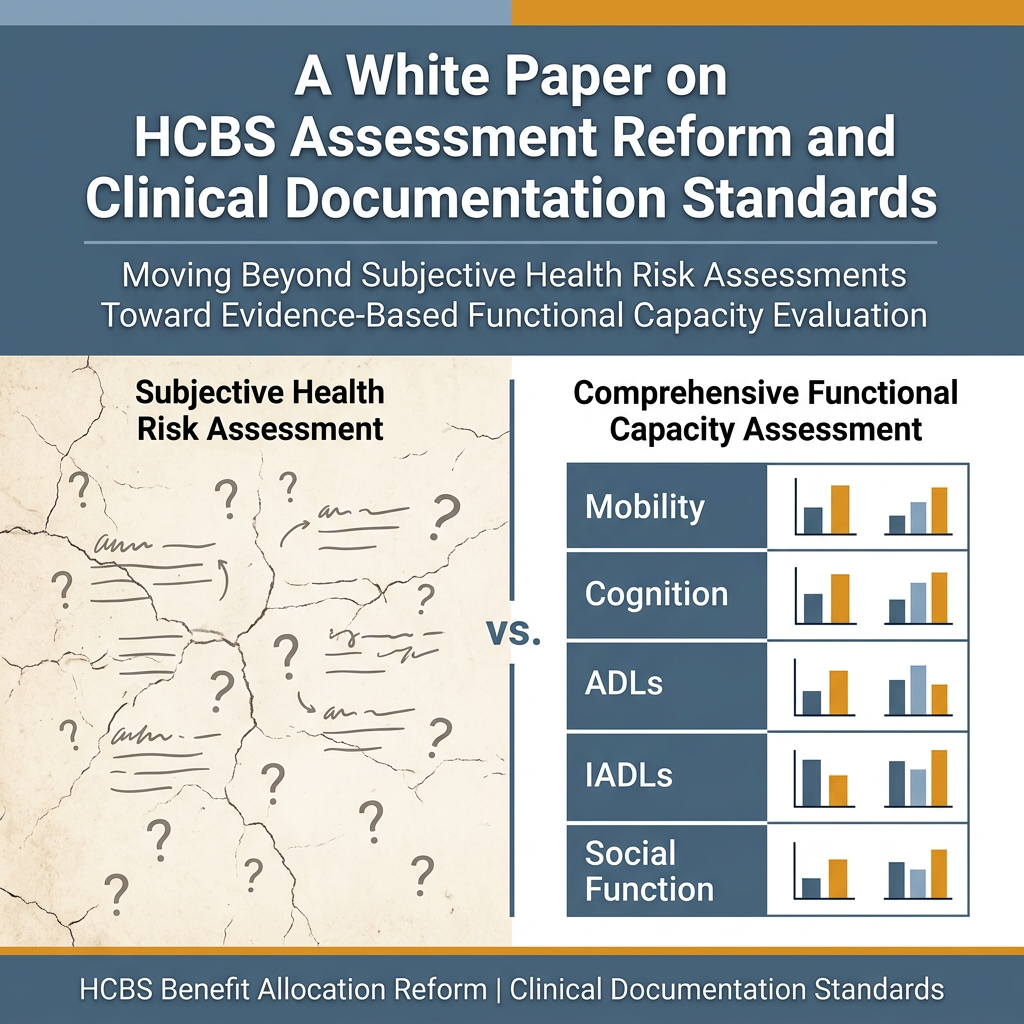
A White Paper on HCBS Assessment Reform and Clinical Documentation Standards
Moving Beyond Subjective Health Risk Assessments with the Necessary Inclusion of Evidence-Based Comprehensive Functional Capacity…
A White Paper on HCBS Assessment Reform and Clinical Documentation Standards
Moving Beyond Subjective Health Risk Assessments with the Necessary Inclusion of Evidence-Based Comprehensive Functional Capacity Assessments for the Clinical Evaluation of Home and Community-Based Services Benefit Allocation
Prepared by: Dennis B. Liotta, MD, MBA, President and Co-founder, OpusCura, LLC
Date: May 2026
Executive Summary
The rapid expansion of Medicaid Home and Community-Based Services (HCBS) programs, which serve more than 4.5 million Americans with disabilities and impairments, has highlighted critical deficiencies in current assessment practices for determining eligibility and allocating services [l]. While federal regulations mandate comprehensive assessment and physician oversight for HCBS recipients, many state programs rely heavily on subjective Health Risk Assessments (HRAs) as primary determinants of benefit allocation, creating significant risks to both program integrity and beneficiary outcomes.
This analysis, drawing from research by Mathematica Policy Research (MPR), the Centers for Medicare & Medicaid Services(CMS), and the Medicaid and CHIP Payment and Access Commission (MACPAC), reveals fundamental gaps between federal requirements for physician-led clinical assessment and actual implementation practices across state programs.
The evidence demonstrates that evaluations of enrollees for HCBS benefits should never be made based solely on the subjectivity of state-mandated HRAs. Instead, comprehensive functional capacity assessments conducted by qualified physicians, utilizing standardized instruments such as CMS’s Functional Assessment Standardized Items (FASI) or similar validated tools, must form the foundation of eligibility determination and service planning processes.
Key findings include the documented use of at least 124 functional assessment tools across states, which creates barriers to standardization and quality measurement [2]. Most concerning is the widespread reliance on subjective assessment approaches that lack the clinical rigor necessary for accurate functional capacity evaluation. Federal guidelines explicitly require that assessment results be reviewed by the beneficiary’s treating physician or a qualified case manager, yet many programs delegate this critical responsibility to non-clinical staff using unvalidated screening tools.
The paper recommends immediate implementation of mandatory physician-led functional capacity assessments for all new and transfer HCBS enrollees, supported by standardized clinical documentation requirements and validated assessment instruments. These reforms would align state practices with federal requirements while ensuring that vulnerable populations receive appropriate levels of care based on objective clinical evidence rather than subjective self-reporting.
Introduction and Background
The landscape of long-term services and supports has undergone a dramatic transformation over the past four decades, with Home and Community-Based Services emerging as the preferred alternative to institutional care for individuals with disabilities and chronic conditions. Since the introduction of Section 1915(c) waiver programs in 1981, HCBS has evolved from a modest demonstration initiative to a cornerstone of the Medicaid program, representing a fundamental shift toward person-centered care delivery in community settings [3].
However, the rapid expansion of HCBS programs has outpaced the development of standardized assessment and quality measurement systems necessary to ensure appropriate service delivery. Unlike institutional settings such as nursing homes, which use standardized assessment tools like the Minimum Data Set (MDS), HCBS programs vary widely in assessment approaches, eligibility criteria, and service planning processes across states.
The significance of this assessment challenge cannot be overstated. Functional assessment serves as the gateway to HCBS services, determining not only initial eligibility but also the type, scope, and intensity of services that individuals receive. Inadequate or subjective assessment practices can result in either the denial of necessary services to individuals with significant functional limitations or the inappropriate allocation of resources to those with lesser needs, undermining both program effectiveness and fiscal sustainability.
Recent research has documented that states currently employ hundreds of different assessment tools with varying degrees of validation and standardization [4]. This fragmentation creates barriers to quality measurement, cross-state comparison, and evidence-based program improvement. More troubling is the documented reliance on subjective assessment approaches that fail to meet basic standards for clinical evaluation and may not comply with federal requirements for physician oversight and clinical documentation.
Federal regulations governing HCBS programs establish clear requirements for comprehensive assessment and physician involvement in service planning processes. Section l9l5(c) waiver programs must demonstrate compliance with assurances related to Level of Care Determination and Service Plan development, both of which require clinical evaluation and physician oversight [5]. Despite these regulatory requirements, many state programs continue to rely primarily on Health Risk Assessments administered by non-clinical staff for benefit allocation decisions.
Current State of HCBS Assessment Practices
Assessment Fragmentation and Inconsistency
The current state of HCBS assessment practices reflects a complex patchwork of approaches that varies dramatically across states, programs, and even individual managed care plans. Research conducted by MACPAC reveals that states currently use at least 124 different functional assessment tools to evaluate beneficiaries’ needs for assistance with activities of daily living [6].
This proliferation stems from the flexibility granted to states under federal Medicaid authorities. Section 1915(c) waiver programs allow each state to develop its own performance indicators and assessment protocols, while Managed Long-Term Services and Supports (MLTSS) programs maintain flexibility to develop their own quality and performance measures, creating additional variation in assessment approaches [7].
While this flexibility enables states to tailor assessment processes to specific populations, it has created significant challenges for standardization, quality measurement, and cross-state comparison. The absence of uniform assessment standards makes it difficult for federal oversight agencies, state program managers, and beneficiary advocates to evaluate program effectiveness or identify best practices.
Predominance of Health Risk Assessments
Health Risk Assessments have emerged as a dominant assessment approach across many state HCBS programs, particularly within managed care delivery systems. These standardized screening tools typically collect information about health conditions, functional limitations, and service needs through structured questionnaires administered by case managers or other non-clinical staff [8].
The appeal of HRAs lies in their efficiency and standardization. These tools can be administered relatively quickly by staffwithout extensive clinical training, and they provide structured data that can be easily aggregated for program monitoring. Many managed care organizations have adopted HRAs as their primary assessment tool for HCBS benefit allocation, viewing them as cost-effective alternatives to more comprehensive clinical evaluations.
However, the widespread reliance on HRAs as primary determinants of HCBS benefit allocation raises significant concerns about both regulatory compliance and assessment accuracy. HRAs are fundamentally screening tools designed to identify potential health risks and service needs, not comprehensive functional capacity evaluations that support clinical decision-making about complex care needs.
Quality Measurement Challenges
The fragmentation of assessment approaches has created significant challenges for quality measurement and program evaluation. Without standardized assessment protocols, it becomes difficult to compare outcomes across programs, identify best practices, or develop evidence-based recommendations for program improvement.
Recent efforts by CMS to develop standardized quality measures for MLTSS programs represent important progress toward addressing these challenges. The release of eight new MLTSS quality measures in 20l8, including five focused on assessment and care planning, provides states with validated tools for evaluating program performance [9]. However, implementation of these measures remains voluntary for most programs, and many states continue to rely on program-specific indicators that limit cross-program comparison.
The Critical Role of Physician-Led Functional Capacity Assessments
Federal Requirements for Physician Involvement
Federal regulations governing HCBS programs establish clear requirements for physician involvement in assessment and care planning, yet many state programs fail to implement them with the rigor needed to ensure comprehensive clinical evaluation. Section l9l5(c) waiver programs must demonstrate compliance with specific assurances related to Level of Care Determination and Service Plan development, which require clinical evaluation of functional capacity and medical needs [l0].
The Service Plan assurance mandates that each participant’s service plan be developed by a qualified case manager and reviewed by the participant’s treating physician or qualified case manager. The physician review requirement establishes clinical oversight as a fundamental component of HCBS service planning, recognizing that while case managers can collect assessment information and coordinate services, the clinical interpretation of functional limitations and medical needs requires physician expertise and oversight.
Similarly, managed long-term services and supports programs must comply with comprehensive assessment and care planning requirements that include physician involvement. CMS guidance for MLTSS programs emphasizes that assessment results must be reviewed and approved by qualified clinical staff, with physician oversight required for complex medical conditions and functional limitations [ll].
Clinical Expertise Requirements for Functional Assessment
The complexity of functional capacity assessment in HCBS populations requires clinical expertise that extends far beyond the capabilities of standardized screening tools or basic case management training. HCBS beneficiaries typically present with multiple chronic conditions, complex medication regimens, and functional limitations resulting from the interplay of medical, cognitive, and psychosocial factors.
Physicians bring essential clinical knowledge to the assessment process that cannot be replicated through standardized screening tools or non-clinical assessment protocols. This includes understanding of how specific medical conditions affect functional capacity, recognition of symptoms that may indicate undiagnosed conditions or medication side effects, and the ability to distinguish between functional limitations that may improve with treatment and those that represent permanent impairments requiring long-term support services.
Evidence-Based Functional Capacity Evaluation
The development of evidence-based approaches to functional capacity evaluation has established clear standards for comprehensive assessment that emphasize objective clinical measurement over subjective screening approaches. Research in occupational health and rehabilitation medicine has demonstrated that functional capacity evaluations must integrate multiple sources of clinical information, including medical history, physical examination, and standardized functional testing, to provide accurate and reliable assessment results [l2].
Functional Capacity Evaluations in clinical settings typically include four major components: intake interview, medical records review, physical examination, and content-valid functional testing. Each component contributes essential information that cannot be obtained through screening tools or self- reporting alone. The content-valid functional testing component is particularly important because it provides an objective measurement of actual functional performance rather than relying on self-reported capabilities or clinical estimates.
Distinction Between Medical Diagnosis and Functional Assessment
A critical aspect of physician involvement in HCBS assessment is the distinction between medical diagnosis and functional assessment, both of which require clinical expertise but serve different purposes in the care planning process. Medical diagnosis focuses on identifying and treating underlying health conditions, while functional assessment evaluates the impact of those conditions on an individual’s ability to perform activities of daily living and participate in community life.
However, research has demonstrated that most physicians are not trained to assess the full array of human functional abilities required for comprehensive disability determinations [l3]. This recognition has led to the development of specialized training programs and certification requirements for professionals conducting functional capacity evaluations in various settings.
Limitations of Subjective Assessment Approaches
Inherent Biases in Self-Reported Health Risk Assessments
The widespread reliance on Health Risk Assessments as primary determinants of HCBS benefit allocation represents a fundamental departure from evidence-based clinical assessment practices and poses significant risks to both program integrity and beneficiary outcomes. HRAs, by their nature as self-reporting instruments, are subject to numerous sources of bias and inaccuracy that limit their reliability for clinical decision-making about complex functional limitations and service needs.
Self-reporting bias represents the most significant limitation of HRA-based assessment approaches. Recipients may systematically overreport functional limitations to secure additional benefits, particularly in programs where service allocation is directly tied to assessment scores. This phenomenon, known as “gaming,” in assessment literature, has been documented across various healthcare settings [l4].
Conversely, beneficiaries may under-report functional capabilities due to fear that acknowledging improvements in functional status could result in service reductions or program disenrollment. This defensive reporting creates a systematic bias toward maintaining or increasing service levels, regardless of actual changes in functional capacity, undermining the assessment’s ability to accurately track functional status over time.
The complexity of functional limitations in HCBS populations further compounds the reliability challenges associated with self-reporting. Many beneficiaries lack the clinical knowledge necessary to accurately assess their own functional capacity, particularly in relation to complex medical conditions, cognitive impairment, or medication effects.
Reliability and Validity Concerns with HRA-Only Approaches
Research in assessment methodology has consistently demonstrated that self-reporting instruments, while valuable for certain purposes, lack the reliability and validity necessary for high-stakes clinical decision-making. Studies comparing self-reported functional status with objective clinical assessments have found significant discrepancies, with self-report showing poor correlation with actual functional performance across many domains [15].
The reliability concerns are particularly pronounced for instrumental activities of daily living, which represent critical functional domains for community living but are difficult to assess accurately through self-reporting. Activities such as medication management, financial management, and meal preparation require complex cognitive and physical abilities that may be impaired in ways that individuals cannot accurately self-assess.
The absence of standardized validation requirements for state-developed HRA instruments compounds these concerns. Unlike clinical assessment tools, which must undergo rigorous validation testing to demonstrate reliability and validity, many state HRA instruments have not been subjected to formal validation studies.
Impact on Benefit Allocation Accuracy
The use of subjective assessment approaches as primary determinants of HCBS benefit allocation has been shown to affect the accuracy of service matching and resource allocation. Analysis of assessment practices across state programs reveals significant variation in service allocation patterns that cannot be explained by differences in beneficiary characteristics or needs, suggesting that the assessment methodology itself influences allocation decisions [16].
Programs relying primarily on HRA-based assessment show greater variation in service allocation patterns compared to programs using comprehensive clinical assessment protocols. This variation suggests that subjective assessment approaches may be less reliable for identifying appropriate service levels and may result in both over-allocation of services to individuals with lower functional limitations and under-allocation to those with higher needs.
Regulatory Compliance Implications
The reliance on subjective assessment approaches as primary determinants of HCBS benefit allocation raises significant questions about compliance with federal requirements for comprehensive assessment and clinical oversight. Federal regulations require that HCBS programs demonstrate compliance with Level of Care Determination and Service Plan assurances, both of which imply clinical evaluation and physician oversight that may not be satisfied through HRA-only approaches.
The Level of Care assurance requires states to demonstrate that waiver participants meet institutional-level of-care criteria, which necessitates a clinical evaluation of functional capacity and medical needs. Determining the institutional level of care solely from self-reported information in HRA instruments may not meet the clinical rigor required, particularly for complex cases involving multiple chronic conditions or cognitive impairment.
Clinical Documentation Standards and Requirements
Federal Guidelines for HCBS Documentation
Federal regulations governing HCBS programs establish comprehensive documentation requirements that extend far beyond basic record-keeping obligations found in other Medicaid services. These requirements reflect the complexity of HCBS service delivery and the need for detailed clinical documentation to support eligibility determinations, service planning, and ongoing care coordination [l7].
The documentation requirements for Section 1915 (c) waiver programs are specified in federal regulations and CMS guidance documents, which emphasize the need for comprehensive clinical documentation to support Level of Care determinations and Service Plan development. These requirements mandate that states maintain detailed records of assessment processes, clinical evaluations, physician reviews, and service plan modifications.
CMS guidance for managed long-term services and supports programs establishes similar documentation requirements, with additional emphasis on care coordination and integration with medical services. MLTSS programs must maintain comprehensive documentation of assessment processes, care plan development, and ongoing monitoring activities, withspecific requirements for clinical oversight and physician involvement in complex cases.
CMS Requirements for Physician Review and Approval
Central to federal documentation requirements is the mandate for physician review and approval of assessment results and service plans. This requirement recognizes that clinical interpretation of functional limitations and medical needs requires physician expertise and that service plans must be medically appropriate and consistent with beneficiary health status and treatment goals.
The physician review requirement is not merely a pro forma documentation obligation but represents a substantive clinical oversight responsibility. Physicians must review assessment results, evaluate the appropriateness of recommended services, and ensure that service plans are consistent with medical treatment goals and safety considerations[l8].
The documentation of physician review must include specific elements: identification of the reviewing physician and their qualifications; the date and scope of the review; the clinical rationale for the assessment and service plan approval; any modifications recommended by the physician; and plans for ongoing clinical oversight and monitoring.
Integration of Objective Clinical Measurements
Effective clinical documentation for HCBS programs must integrate objective clinical measurements with subjective assessment information to provide a comprehensive evaluation of functional capacity and service needs. This integration requires systematic documentation of clinical examination findings, standardized assessment results, and objective functional testing outcomes, along with appropriate clinical interpretation of these findings.
Objective clinical measurements provide essential documentation that cannot be obtained through subjective assessment approaches alone. Physical examination findings, including range-of-motion measurements, strength testing, balance assessment, and cognitive screening results, provide objective data on functional capacity that can be reliably documented and tracked over time.
Standardized assessment instruments, such as FASI, provide additional objective measures that can be consistently documented and compared across assessments and programs. The standardized nature of these instruments enables reliable documentation of changes in functional status and supports quality measurement and program evaluation.
The FASI Framework and Standardized Assessment Tools
Development and Validation of Functional Assessment Standardized Items
The Functional Assessment Standardized Items (FASI) represents the most comprehensive effort to date to develop and validate standardized assessment instruments specifically designed for Home and Community-Based Services populations. Developed by the Centers for Medicare & Medicaid Services (CMS) as part of the Testing Experience and Functional Tools (TEFT) demonstration, FASI addresses critical gaps in assessment standardization while providing validated tools to support both clinical decision-making and quality measurement activities [l9].
FASI items originated from three distinct sources. The self-care items and the majority of mobility items came from CMS assessment tools that have been standardized across Medicare program assessment instruments, including the Inpatient Rehabilitation Facility Patient Assessment Instrument (IRF-PAI), Minimum Data Set (MDS) 3.0, Long-Term Care Hospital Continuity Assessment Record and Evaluation (LTCH-CARE), and Outcome and Assessment Information Set (OASIS).
The second set of items was adapted from existing state assessment tools to reflect the unique needs of people living in the community who receive HCBS. The final group contained additional mobility items developed specifically for inclusion in the FASI set and designed to reflect the broader range of functional community mobility tasks for which individuals receiving HCBS may need supports or services.
Comprehensive Field Testing and Validation Process
The FASI validation process represents one of the most comprehensive field-testing efforts ever conducted for HCBS assessment instruments. The field test was conducted between March 20l7 and September 20l7 across six states and included 360 individuals from five distinct population groups: frail elderly, individuals with physical disabilities, individuals with intellectual or developmental disabilities, individuals with brain injury, and individuals with serious mental illness [20].
The field testing process included rigorous training requirements for all assessors, with a standardized online training program that integrated video vignettes and competency testing. All 98 assessors who participated in the field test were required to pass the online training program prior to conducting assessments, ensuring consistent administration across all participating states and populations.
The field test design included both reliability and validity testing components. Interrater reliability testing was conducted with 110 individuals who received assessments from multiple assessors, enabling evaluation of consistency across different assessors and assessment conditions.
FASI Item Categories and Assessment Domains
FASI includes seven major categories of functional assessment items, each addressing essential domains for community living and HCBS service planning. Self-Care Items assess basic activities of daily living, including eating, dressing, bathing, toileting, and transferring. Functional Mobility Items evaluate an individual’s ability to move around their home and community environments. Activities of Daily Living (ADLs) and Instrumental Activities of Daily Living (IADLs) are core elements assessed for the complex functional activities essential for independent community living, including meal preparation, shopping, financial management, medication management, and household maintenance.
Benefits of Standardized, Interoperable Assessment Data
The implementation of standardized assessment instruments, such as FASI, provides significant benefits for HCBS programs, recipients, and the broader healthcare system. Standardized assessment data enable reliable comparison of functional status across different assessments, assessors, and time periods. This consistency is essential for tracking changes in functional status, evaluating service effectiveness, and making informed decisions about service modifications.
Interoperable assessment data support care coordination by enabling the sharing of functional assessment information across providers and programs. Quality measurement capabilities are significantly enhanced through standardized assessment data that can be aggregated and analyzed across programs and populations.
Policy Recommendations and Implementation Strategies
Mandatory Physician Assessment Requirements
The evidence presented in this analysis supports implementing mandatory physician assessment requirements for all new and transfer enrollees in HCBS programs. Federal regulations should be strengthened to explicitly require physician-conducted or physician-supervised functional capacity assessments for all HCBS enrollees within specified timeframes. New enrollees should receive a comprehensive physician assessment within 30 days of program enrollment, while transfer enrollees should receive a physician review of existing assessment documentation within 15 days.
The physician assessment requirement should specify minimum qualifications and training requirements for physicians conducting HCBS assessments. Physicians should demonstrate competency in functional assessment methodology, an understanding of the impacts of disability and chronic disease on functional capacity, and knowledge of HCBS program requirements and service options.
Documentation requirements for physician assessments should be standardized across all HCBS programs to ensure consistency and support quality assurance activities. Physician assessment documentation must include detailed clinical examination findings, a review of medical history and current treatments, an assessment of functional capacity using validated instruments, a clinical interpretation of assessment results, and specific recommendations for service types and intensity levels.
Clinical Documentation Standards
Comprehensive clinical documentation standards should be established for all HCBS programs to ensure that assessment and care planning processes meet federal requirements and support effective care coordination. Assessment documentation standards should require the comprehensive recording of all assessment activities, including clinical examination findings, standardized assessment results, collateral information from caregivers and other providers, and clinical interpretation of assessment findings.
Care plan documentation standards should require integrating assessment findings with beneficiaries' goals and preferences to develop comprehensive service plans that address identified needs while respecting individual choice and self-determination. Electronic documentation systems should be implemented to support efficient data collection, storage, and sharing while maintaining appropriate privacy and security protections.
Training and Certification Requirements
Comprehensive training and certification requirements should be established for all professionals involved in HCBS assessment and care planning activities. Assessor training programs should address multiple competency areas, including functional assessment methodology, use of standardized assessment instruments, clinical interpretation of assessment results, documentation requirements, and regulatory compliance.
Physician training requirements should address the specific knowledge and skills needed for HCBS functional capacity assessment, including an understanding of community-based service options, person-centered planning principles, and the integration of medical and functional assessment information.
Monitoring and Quality Improvement Processes
Robust monitoring and quality improvement processes should be implemented to ensure that HCBS assessment practices meet federal requirements and achieve program goals of accurate service matching and improved beneficiary outcomes. Performance monitoring systems should track key indicators of assessment quality, including the timeliness of assessments, compliance with documentation requirements, the accuracy of functional capacity evaluations, and the correlation between assessment results and service outcomes.
Quality assurance activities should include a systematic review of assessment documentation, observation of assessment processes, and evaluation of assessment accuracy by comparing it with independent clinical evaluation. Beneficiary feedback mechanisms should be implemented to gather information on assessment experiences and satisfaction with assessment processes.
Comprehensive Assessment Model for HCBS Eligibility
Multi-Component Assessment Framework
The implementation of comprehensive functional capacity assessment for HCBS programs requires a systematic, multi-component framework that integrates clinical evaluation, standardized assessment instruments, and ongoing monitoring. This framework must address the complex needs of HCBS populations while ensuring compliance with federal requirements and supporting person-centered care planning principles.
The proposed assessment framework includes five essential components: initial clinical evaluation by a qualified physician, administration of validated standardized assessment instruments such as FASI, comprehensive documentation of assessment findings and clinical interpretation, development of person-centered service plans based on assessment results, and ongoing monitoring and reassessment to track functional status changes and service effectiveness.
Initial clinical evaluation must include a comprehensive medical history review, physical examination, cognitive assessment, and evaluation of medication effects on functional capacity. This clinical evaluation provides the medical foundation necessary to understand how health conditions and treatments affect functional capacity and service needs.
Integration of Clinical and Functional Evaluations
The integration of clinical and functional evaluations is a critical component of comprehensive HCBS assessment, distinguishing evidence-based approaches from subjective screening methods. This integration requires systematic coordination between medical evaluation and functional assessment to ensure that service recommendations are both medically appropriate and functionally relevant.
Clinical evaluation provides essential information about underlying health conditions, disease progression, medication effects, and prognosis that cannot be obtained through functional assessment alone. Functional evaluation provides an objective measure of actual performance in activities of daily living and instrumental activities essential for community living.
The integration process must address potential discrepancies between clinical findings and functional performance. For example, individuals with significant medical conditions may demonstrate better functional performance than expected based on their diagnoses, while others may show functional limitations that exceed what would be predicted from their medical conditions alone.
Implementation Challenges and Solutions
State-Level Implementation Barriers
The implementation of comprehensive functional capacity assessment faces several significant barriers at the state level that must be addressed through coordinated federal and state action. These barriers include workforce capacity limitations, technology infrastructure requirements, regulatory complexity, and resistance to change from existing assessment practices.
Workforce capacity is perhaps the most significant implementation barrier, as many states lack sufficient numbers of qualified physicians and other clinical professionals with expertise in functional assessment methodology. Implementing mandatory physician assessment requirements will require a significant expansion of clinical workforce capacity, which may be particularly challenging in rural areas and in states with existing healthcare workforce shortages.
Technology infrastructure requirements include electronic assessment systems, data management capabilities, and interoperability standards that enable data sharing across programs and providers. Many states currently operate with outdated technology systems that cannot support comprehensive assessment documentation and data sharing requirements.
Federal Support and Technical Assistance
Successful implementation of comprehensive functional capacity assessment will require substantial federal support and technical assistance to help states overcome implementation barriers and ensure consistent application of enhanced assessment standards. This support should include funding assistance, training resources, technology development, and ongoing technical assistance.
Funding assistance should include federal matching funds for assessment infrastructure development, training programs, and quality assurance activities. Training resources should include standardized curricula for physician training, assessor certification programs, and continuing education requirements.
Evidentiary Summary
The evidence presented in this white paper demonstrates that current HCBS assessment practices fall short of federal requirements and clinical best practices, creating significant risks to both program integrity and beneficiary outcomes. The widespread reliance on subjective Health Risk Assessments as primary determinants for benefit allocation represents a fundamental departure from evidence-based clinical assessment practices and fails to provide the comprehensive evaluation necessary for accurate service matching in complex community-based populations.
Federal regulations clearly establish requirements for physician involvement in HCBS assessment and care planning processes, yet many state programs have implemented assessment approaches that lack adequate clinical oversight or documentation. The gap between regulatory requirements and implementation practices creates compliance risks and undermines the program goals of appropriate service provision and improved beneficiary outcomes.
The limitations of subjective assessment approaches are well documented in the clinical literature and have been confirmed through analyses of HCBS program experiences across multiple states. Self-reporting bias, reliability concerns, and validity limitations make HRA-only approaches inadequate for the complex clinical decision-making required for HCBS benefit allocation and service planning.
The development and validation of standardized assessment instruments, such as FASI, provide evidence that comprehensive, clinically rigorous assessment approaches are both feasible and effective for HCBS populations. The FASI field testing process demonstrated that standardized functional assessment can be implemented consistently across diverse populations and settings while providing reliable and valid measurement of functional capacity and service needs.
The policy recommendations presented in this paper provide a roadmap for comprehensive reform of HCBS assessment practices that would align state implementation with federal requirements while improving both program effectiveness and beneficiary outcomes. Implementing mandatory physician assessment requirements, along with enhanced clinical documentation standards, comprehensive training and certification programs, and robust quality assurance mechanisms, would address the fundamental gaps identified in current assessment practices.
The transformation of HCBS assessment practices represents both a significant challenge and an unprecedented opportunity to improve the quality and effectiveness of community-based long-term services and supports. The evidence clearly demonstrates that current practices are inadequate and that comprehensive reform is both necessary and achievable. The recommendations presented in this paper provide a framework for implementing evidence-based assessment practices that ensure compliance with federal requirements while achieving the program goals of appropriate service provision, improved beneficiary outcomes, and efficient resource utilization.
The success of HCBS assessment reform will ultimately be measured not by compliance with documentation requirements or administrative efficiency, but by the extent to which comprehensive assessment enables accurate identification of functional limitations and appropriate provision of services that support community living, health, and quality of life for the millions of Americans who depend on these critical programs.
References
[l] Mathematica Policy Research. Assessment and Care Planning Measures for Managed Long-Term Services and Supports Programs. 20l9.
[2] Medicaid and CHIP Payment and Access Commission. Functional Assessments for Long-Term Services and Supports.20l6. Available at: https://[www.macpac.gov/wp-content/uploads/20l6/06/Functional-](http://www.macpac.gov/wp-content/uploads/20l6/06/Functional-)
Assessments-for-Long-Term-Services-and-Supports.pdf
[3] Centers for Medicare & Medicaid Services. Home and Community-Based Services Overview. 20l5.
[4] Medicaid and CHIP Payment and Access Commission. Functional Assessments for Long-Term Services and Supports. 20l6.
[5] Centers for Medicare & Medicaid Services. Home and Community-Based Services Overview. 20l5.
[6] Medicaid and CHIP Payment and Access Commission. Functional Assessments for Long-Term Services and Supports. 20l6.
[7] Mathematica Policy Research. Assessment and Care Planning Measures for Managed Long-Term Services and Supports Programs. 20l9.
[8] Milliman. Understanding the benefits of health risk assessment tools. September 202l. Available at:https://[www.milliman.com/en/insight/understanding-the-benefits-of-health-risk-assessment-tools](http://www.milliman.com/en/insight/understanding-the-bene%EF%AC%81ts-of-health-risk-assessment-tools)
[9] Mathematica Policy Research. Assessment and Care Planning Measures for Managed Long-Term Services and SupportsPrograms. 20l9.
[l0] Centers for Medicare & Medicaid Services. Home and Community-Based Services Overview. 20l5. [ll] Centers forMedicare & Medicaid Services. Home and Community-Based Services Overview. 20l5.
[l2] American Physical Therapy Association. Current Concepts in Functional Capacity Evaluation: A Best Practices Guideline. April 20l8. Available at: https://[www.orthopt.org/uploads/content_files/files/20l8%20Current%20Concepts%20in%20OH%20PT-](http://www.orthopt.org/uploads/content_%EF%AC%81les/%EF%AC%81les/20l8%20Current%20Concepts%20in%20OH%20PT-)
FCE%2006–20-l8%20FINAL.pdf
[l3] American Physical Therapy Association. Current Concepts in Functional Capacity Evaluation: A Best Practices Guideline. April 20l8.
[l4] Agency for Healthcare Research and Quality. Health Risk Assessment Topic Brief. Available at: https://effectivehealthcare.ahrq.gov/system/files/docs/health-risk-assessment-topic-brief.pdf
[l5] American Physical Therapy Association. Current Concepts in Functional Capacity Evaluation: A Best Practices Guideline. April 20l8.
[l6] Medicaid and CHIP Payment and Access Commission. Functional Assessments for Long-Term Services and Supports. 20l6.
[l7] Centers for Medicare & Medicaid Services. Home and Community-Based Services Overview. 20l5. [l8] Centers forMedicare & Medicaid Services. Home and Community-Based Services Overview. 20l5.
[l9] Centers for Medicare & Medicaid Services. Functional Assessment Standardized Items. Available at: https://[www.medicaid.gov/medicaid/long-term-services-supports/teft-program/functional-assessment-](http://www.medicaid.gov/medicaid/long-term-services-supports/teft-program/functional-assessment-) standardized-items/index
[20] Centers for Medicare & Medicaid Services. FASI 20l7 Field Test Final Report. March 20l8.
Evidence-Based Assessment Practices and Outcomes
Comparative Analysis of Assessment Methodologies
Research comparing different assessment methodologies across healthcare settings provides compelling evidence for the superiority of comprehensive clinical assessment over subjective screening approaches. Studies in rehabilitation medicine, occupational health, and disability determination have consistently demonstrated that objective functional capacity evaluations yield more accurate and reliable results than self-report instruments or basic screening tools.
A systematic review of functional assessment methodologies found that comprehensive evaluations incorporating clinical examination, standardized testing, and objective measurement showed significantly higher correlations with actual functional performance than self-report instruments. The review identified several key factors that contribute to assessment accuracy: use of validated assessment instruments, integration of multiple information sources, clinical interpretation by qualified professionals, and objective measurement of functional performance.
Comparative studies of assessment approaches in long-term care settings have found similar patterns, with comprehensive assessment protocols producing more accurate identification of service needs and better prediction of care outcomes than screening-based approaches. These studies have also documented improved care coordination and reduced healthcare utilization when a comprehensive assessment guides service planning.
The evidence from FASI field testing provides specific validation of standardized assessment approaches in HCBS populations. The field test demonstrated that standardized assessment could be implemented consistently across diverse populations and settings while producing reliable and valid measurement of functional capacity. Importantly, the field test also showed that standardized assessment results correlated well with clinical judgment and service needs, supporting the validity of this approach for HCBS service planning.
International Best Practices and Models
International experience with functional assessment in community-based long-term care provides valuable insights for HCBS assessment reform. Several countries have implemented comprehensive assessment systems that integrate clinical evaluation with standardized assessment instruments, providing models for evidence-based assessment practices.
The United Kingdom’s Continuing Healthcare Assessment framework requires a comprehensive clinical evaluation for all individuals receiving publicly funded long-term care services. This assessment includes a detailed medical evaluation, a functional capacity assessment using standardized instruments, and ongoing clinical oversight of service plans. The UK model demonstrates that comprehensive assessment can be implemented at scale while maintaining clinical rigor and cost-effectiveness.
Canada’s interRAI assessment system offers another model for standardized assessment in community-based settings. The interRAI instruments have been validated across multiple populations and settings and are used throughout Canada for HCBS assessment and care planning. The Canadian experience demonstrates that standardized assessment can support both clinical decision-making and quality measurement while enabling data sharing across programs and provinces.
Australia’s Aged Care Assessment Teams (ACATs) provide comprehensive clinical assessment for all individuals seeking publicly funded aged care services. The ACAT model requires multidisciplinary assessment teams including physicians, nurses, and allied health professionals, with standardized assessment protocols and documentation requirements. The Australian experience demonstrates that comprehensive assessment can be integrated with person-centered care planning while maintaining clinical standards.
These international models share several features that support their effectiveness: mandatory clinical evaluation by qualified professionals, use of validated, standardized assessment instruments, comprehensive documentation requirements, ongoing clinical oversight of service plans, and integration of assessment results into care coordination.
Outcomes Research and Evidence-Based
Research on the outcomes of comprehensive functional capacity assessment provides strong evidence for the benefits of evidence-based assessment practices. Studies across multiple healthcare settings have documented improved clinical outcomes, better service matching, enhanced care coordination, and increased cost-effectiveness when comprehensive assessment is used to guide service planning.
Clinical outcomes research has shown that comprehensive assessment leads to more accurate identification of functional limitations and service needs, resulting in better matching of services to individual needs. This improved service matching has been associated with better functional outcomes, reduced healthcare utilization, and improved quality of life for service recipients.
Care coordination research has demonstrated that comprehensive assessment provides the detailed functional information necessary for effective communication across healthcare providers and service agencies. This improved communication has been associated with reduced service duplication, better integration of medical and social services, and improved continuity of care.
Cost-effectiveness research has shown that while comprehensive assessment requires greater upfront investment than screening approaches, this investment is typically offset by reduced inappropriate service utilization, improved prevention of functional decline, and reduced need for crisis interventions. Long-term cost-effectiveness studies have found that comprehensive assessment can reduce total care costs while improving outcomes.
Quality measurement research has demonstrated that comprehensive assessment provides the standardized data necessary for meaningful quality measurement and program evaluation. This capability enables the identification of best practices, the monitoring of program performance, and evidence-based program improvement that would not be possible with non-standardized assessment approaches.
Future Directions and Innovation
The future of HCBS assessment lies in continued innovation and improvement of evidence-based assessment practices. Several emerging trends and technologies offer potential to enhance the accuracy, efficiency, and effectiveness of functional capacity assessment while maintaining the clinical rigor necessary for complex care planning.
Technology-enhanced assessment approaches, including wearable devices, remote monitoring systems, and mobile assessment platforms, offer potential for objective measurement of functional capacity in community settings. These technologies could supplement clinical evaluation by continuously monitoring activity levels, mobility patterns, and other functional indicators that are difficult to assess through traditional methods.
Artificial intelligence and machine learning applications offer potential for enhancing assessment accuracy and efficiency through pattern recognition, predictive modeling, and decision support systems. These technologies could help identify individuals at risk for functional decline, predict service needs, and optimize service matching based on assessment results and outcomes data.
Telehealth and remote assessment capabilities offer potential to expand access to comprehensive assessment, particularly in rural areas and for individuals with mobility limitations. These capabilities could enable physician involvement in assessment processes even when in-person evaluation is not feasible, while maintaining the clinical oversight necessary for accurate assessment.
Integration with electronic health records and health information exchange systems has the potential to improve care coordination and reduce the assessment burden by sharing assessment information across providers and programs. This integration could enable more comprehensive assessment, reduce duplicative evaluation, and improve communication across the healthcare system.
Person-centered assessment approaches that integrate beneficiary goals and preferences with clinical evaluation offer potential to improve both assessment accuracy and service satisfaction. These approaches recognize that effective assessment must address not only functional limitations but also individual goals, preferences, and values that affect service planning and outcomes.
The continued development and validation of assessment instruments specifically designed for HCBS populations will enhance the accuracy and relevance of functional capacity evaluation. Future assessment tools should address the unique needs of community-based populations while maintaining the standardization necessary for quality measurement and program evaluation.
Regulatory Framework and Compliance
Federal Oversight and Accountability
The implementation of comprehensive functional capacity assessment requires strengthened federal oversight and accountability mechanisms to ensure consistent application of enhanced assessment standards across all state HCBS programs. Current federal oversight mechanisms, while establishing basic requirements for assessment and care planning, lack the specificity and enforcement mechanisms necessary to ensure compliance with evidence-based assessment practices.
Federal regulations should be updated to include specific requirements for physician involvement in functional capacity assessment, with clear standards for physician qualifications, training requirements, and documentation obligations. These regulations should specify minimum timeframes for physician assessment, requirements for clinical evaluation components, and standards for ongoing clinical oversight of service plans.
Accountability mechanisms should include regular monitoring of state compliance with assessment requirements, with specific performance indicators for assessment quality, timeliness, and clinical appropriateness. States should be required to report assessment compliance rates, quality indicators, and outcome measures as part of their federal reporting requirements.
Enforcement mechanisms should include corrective action procedures for states that do not meet assessment standards, with technical assistance and support provided to help states achieve compliance. In cases of persistent non-compliance, federal authorities should have the authority to impose sanctions or require specific remedial actions to ensure that recipients receive appropriate assessment services.
Quality assurance requirements should include systematic review of assessment practices, outcome monitoring, and beneficiary feedback mechanisms. States should be required to implement comprehensive quality assurance programs that monitor assessment accuracy, identify areas for improvement, and ensure continuous enhancement of assessment practices.
The federal oversight framework should also support innovation and the sharing of best practices, with mechanisms to identify and disseminate effective assessment approaches across states. This support should include funding for pilot programs, technical assistance for implementing new assessment methodologies, and the evaluation of innovative approaches to functional capacity assessment.
State Implementation Requirements
State implementation of comprehensive functional capacity assessment must address multiple regulatory and operational requirements while ensuring compliance with federal standards and maintaining program effectiveness. State regulations should be updated to align with enhanced federal requirements while addressing specific state needs and population characteristics.
Licensing and certification requirements for assessment professionals should be established to ensure that individuals conducting functional capacity assessments have appropriate qualifications and training. These requirements should address both clinical professionals and non-clinical assessment staff, with specific competency standards for each role in the assessment process.
Quality assurance regulations should establish comprehensive oversight mechanisms for assessment practices, including supervisory review requirements, documentation standards, and outcome monitoring obligations. These regulations should specify the frequency and scope of quality assurance activities and establish accountability mechanisms for assessment quality.
Provider network requirements should ensure that states have adequate capacity to provide comprehensive assessment services, including sufficient numbers of qualified physicians and other clinical professionals. States should be required to demonstrate adequate provider capacity and should implement strategies to address workforce shortages in underserved areas.
Data management and privacy requirements should address the collection, storage, and sharing of assessment information while maintaining appropriate privacy and security protections. States should implement electronic assessment systems that support efficient data collection and sharing while complying with federal privacy requirements.
Beneficiary rights and protections should be established to ensure that individuals receive appropriate assessment services and have mechanisms to address concerns about assessment quality or outcomes. These protections should include the right to a comprehensive assessment, appeals processes for assessment decisions, and access to advocacy services.
The state implementation framework should also address coordination with managed care organizations, provider agencies, and other stakeholders involved in HCBS service delivery. This coordination should ensure that assessment requirements areconsistently applied across all service delivery models while maintaining flexibility for innovation and local adaptation.
Economic Impact and Cost-Benefit Analysis
Financial Implications of Assessment Reform
The implementation of comprehensive functional capacity assessment represents a significant investment in HCBS program infrastructure, but economic analysis suggests that this investment can be justified by improved program efficiency, better beneficiary outcomes, and reduced long-term care costs. A comprehensive cost-benefit analysis must consider both the direct costs of enhanced assessment processes and the potential savings from more accurate service matching and improved care coordination.
Direct costs of comprehensive assessment reform include training requirements for assessment staff, technology infrastructure for standardized assessment administration and documentation, physician compensation for clinical evaluation and oversight, and quality assurance activities. These costs represent upfront investments necessary to establish the infrastructure for evidence-based assessment practices and to ensure compliance with federal requirements.
Training costs include the development of standardized curricula, the implementation of certification programs, and the ongoing continuing education requirements for assessment professionals. Technology costs include electronic assessment platforms, data management systems, and interoperability infrastructure that enables data sharing across programs and providers. Physician compensation costs include payment for clinical evaluation time, assessment review activities, and ongoing oversight responsibilities.
Quality assurance costs include systematic review of assessment documentation, outcome monitoring activities, and corrective action procedures for programs that do not meet established standards. These costs are essential for ensuring that assessment reform achieves its intended goals of improved accuracy and compliance with federal requirements.
Potential savings from improved assessment accuracy include reduced over-allocation of services to individuals with lower functional limitations, more appropriate service matching, which reduces the need for service modifications, earlier identification of functional decline, enabling preventive interventions, and reduced healthcare utilization through better care coordination and service planning.
Long-term cost-effectiveness may also include reduced institutional care utilization through more effective community-based service provision, improved beneficiary outcomes that reduce the need for crisis interventions, and enhanced program integrity that reduces inappropriate service utilization and fraud. Research from other healthcare settings suggests that comprehensive functional capacity evaluation can improve both clinical outcomes and cost-effectiveness compared to subjective screening approaches.
Return on Investment Projections
Economic modeling of comprehensive assessment reform suggests that the return on investment can be substantial when considering both short-term efficiency gains and long-term outcome improvements. While precise projections require state-specific analysis based on current assessment practices and population characteristics, available evidence suggests that comprehensive assessment reform can achieve a positive return on investment within three to five years of implementation.
Short-term return on investment comes primarily from improved service matching that reduces inappropriate service allocation. Studies of assessment practices in other healthcare settings have found that comprehensive assessment can reduce inappropriate service utilization by 15–25% compared with screening-based approaches, while improving the appropriateness of services for individuals with greater needs.
Medium-term return on investment includes reduced healthcare utilization through better care coordination and earlieridentification of health problems. Comprehensive assessment enables better integration of medical and social services, which has been associated with reduced emergency department visits, hospitalizations, and nursing home admissions in HCBSpopulations.
Long-term return on investment includes improved beneficiary outcomes that reduce the need for more intensive services over time. Better functional assessment and service matching can help maintain functional independence for longer, delay or prevent institutional placement, and improve quality-of-life outcomes, thereby reducing overall care costs.
The economic benefits of assessment reform extend beyond direct cost savings to include improved program integrity, enhanced quality measurement capabilities, and better compliance with federal requirements, thereby reducing regulatory risks and potential penalties. These benefits, while difficult to quantify precisely, represent significant value for state programs and the broader healthcare system.
Workforce Development and Economic Impact
The implementation of comprehensive functional capacity assessment will require significant workforce development investments that can have positive economic impacts beyond the HCBS program itself. The expansion of clinical assessment capacity will create employment opportunities for physicians, nurses, occupational therapists, physical therapists, and other healthcare professionals, particularly in underserved areas where HCBS populations are concentrated.
Workforce development requirements include recruitment and training of qualified physicians with expertise in functional assessment methodology, expansion of assessment staff capacity to meet increased documentation and quality assurance requirements, and development of specialized training programs for HCBS assessment professionals.
The economic impact of workforce development extends to healthcare education institutions, professional training organizations, and technology companies that provide assessment and documentation systems. This economic activity can help offset the costs of assessment reform while building sustainable capacity for ongoing program improvement.
Rural and underserved areas may particularly benefit from workforce development associated with assessment reform, as expanding clinical assessment capacity can improve access to healthcare services beyond HCBS programs. The development of telehealth and remote assessment capabilities can further extend these benefits by enabling clinical expertise to reach areas with limited healthcare infrastructure.
The workforce development associated with assessment reform can also contribute to broader healthcare quality improvement efforts by establishing standards for functional assessment that can be applied across multiple programs and settings. This standardization can improve care coordination and reduce duplicative assessment processes that burden both providers and beneficiaries.
메타데이터
- post_id
- 257c0d5fcef9
- slug
- a-white-paper-on-hcbs-assessment-reform-and-clinical-documentation-standards-257c0d5fcef9
- url
- https://medium.com/@dliotta_37712/a-white-paper-on-hcbs-assessment-reform-and-clinical-documentation-standards-257c0d5fcef9
- canonical_url
- https://medium.com/@dliotta_37712/a-white-paper-on-hcbs-assessment-reform-and-clinical-documentation-standards-257c0d5fcef9
- author_url
- https://medium.com/@dliotta_37712
- status
- ok
- fetched_at
- 2026-06-11 10:13:20