K2–18b: A Breakthrough in the Search for Extraterrestrial Life
On April 17, 2025, the James Webb Space Telescope (JWST) revealed compelling evidence of dimethyl sulfide (DMS) in the atmosphere of…
K2–18b: A Breakthrough in the Search for Extraterrestrial Life
This artist’s concept shows what exoplanet K2–18 b could look like based on science data. K2–18 b, an exoplanet 8.6 times as massive as Earth, orbits the cool dwarf star K2–18 in the habitable zone and lies 120 light-years from Earth.Illustration: NASA, CSA, ESA, J. Olmsted (STScI), Science: N. Madhusudhan (Cambridge University)
On April 17, 2025, the James Webb Space Telescope (JWST) revealed compelling evidence of dimethyl sulfide (DMS) in the atmosphere of K2–18b, an exoplanet located 124 light-years from Earth. This chemical, associated with biological processes on Earth, was detected with 99.7% confidence, sparking widespread excitement among scientists, policymakers, and the public. While not definitive proof of extraterrestrial life, this discovery represents a significant milestone in humanity’s quest to understand our place in the cosmos, reinforcing the curiosity that has long driven exploration of the universe.
Advances in Observational Data
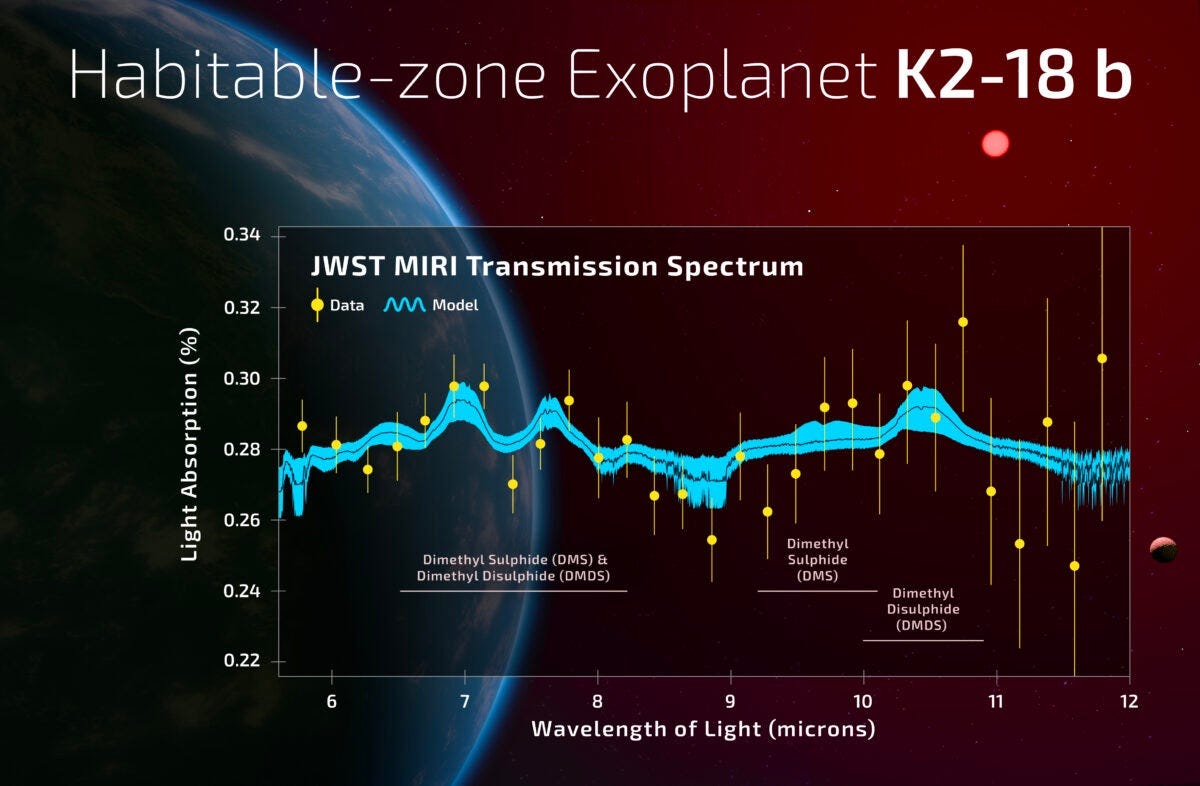
The new spectrum from JWST’s mid-infrared spectrograph (plotted in yellow with uncertainty bars) is consistent with models of the chemical fingerprint of dimethyl sulfide and dimethyl disulfide (blue line) at a 3-sigma level. But they don’t yet rise to the level of 5-sigma, the statistical gold standard in science. Credit: A. Smith, N. Madhusudhan (University of Cambridge)
In 2023, initial JWST observations of K2–18b identified methane, carbon dioxide, and a tentative DMS signal at 68% confidence, offering a preliminary glimpse into the exoplanet’s atmosphere. The 2025 findings, obtained using JWST’s Mid-Infrared Instrument (MIRI), provide a more robust dataset, confirming DMS and detecting dimethyl disulfide (DMDS) at a three-sigma confidence level (99.7%). These compounds, present in concentrations far exceeding those produced by Earth’s marine ecosystems, suggest K2–18b may be a Hycean world — a planet with liquid oceans and a hydrogen-rich atmosphere potentially conducive to microbial life. Researchers, including Dr. Nikku Madhusudhan, have highlighted the significance of these findings, noting their alignment with theoretical models of habitable exoplanets.
The Science Behind the Discovery
HST and JWST observations of K2–18 b. The black points show prior observations of K2–18 b obtained with HST WFC3 in the 1.1–1.7 μm range, with data from eight transits, presented by Benneke et al. (2019b) using data from HST GO 13665 and GO 14682 programs (PI: B. Benneke). The orange and dark-red points show our JWST NIRISS and NIRSpec observations from one transit each. The data are binned for visual clarity to R » 25 and R » 55, respectively, as shown in Figure 3. The dark-blue line denotes the median retrieved spectrum (one-offset case), while medium-and lighter-blue regions denote the 1σ and 2σ contours, respectively. The yellow points correspond to the median spectrum binned to match the JWST observations. Our JWST NIRISS spectrum is in agreement with the HST WFC3 spectrum for most of the common wavelength range except for two data points toward the blue end of the WFC3 band.
The JWST’s observations rely on spectroscopy, analyzing starlight filtered through K2–18b’s atmosphere to identify chemical signatures. These data manifest as spectral graphs, not visual images, despite artistic renderings of blue, ocean-like worlds circulated by NASA. Such illustrations, while evocative, are speculative and based on scientific interpretations rather than direct evidence. The detection of DMS and DMDS underscores the JWST’s unparalleled sensitivity, offering insights into an exoplanet’s composition from 124 light-years away. This technological achievement highlights the meticulous process of translating raw data into meaningful scientific conclusions.
Public and Media Response
Artist’s impression of the exoplanet K2–18b.A. Smith/N. Mandhusudhan, University of Cambridge
The announcement has generated significant public interest, amplified by social media platforms like X, where hashtags such as #K218b and #AlienVibes have garnered millions of interactions. Discussions range from optimistic speculation about extraterrestrial life to humorous suggestions of interplanetary vacations. Mainstream media outlets have contributed to the fervor, with headlines from CNN describing a “signature of life” and NBC labeling the findings as the “strongest evidence yet” of alien existence. While these reports capture public imagination, they often oversimplify the nuanced nature of the discovery, prompting calls for greater scientific literacy.
Scientific Debate and Caution
Spectra of K2–18 b, obtained with Webb’s NIRISS (Near-Infrared Imager and Slitless Spectrograph) and NIRSpec (Near-Infrared Spectrograph), display an abundance of methane and carbon dioxide in the exoplanet’s atmosphere, as well as a possible detection of a molecule called dimethyl sulfide (DMS). Illustration: NASA, CSA, ESA, R. Crawford (STScI), J. Olmsted (STScI), Science: N. Madhusudhan (Cambridge University)
The scientific community remains divided on the implications of the K2–18b findings. Optimistic researchers view the DMS detection as a promising indicator of a potentially habitable environment, while others caution that non-biological processes, such as geochemical reactions, could produce similar chemical signatures. The current three-sigma confidence level, though robust, falls short of the five-sigma threshold typically required for definitive claims in physics and astronomy. This ongoing debate reflects the rigorous, iterative nature of scientific inquiry, balancing enthusiasm with skepticism to refine our understanding of the cosmos.
Current Developments and Global Engagement
The James Webb Space Telescope is powerful enough to analyse the atmosphere of planets that are hundreds of trillions of miles away
As of late April 2025, the K2–18b discovery continues to dominate scientific and public discourse. NASA has prominently featured the JWST’s findings on its website, while academic institutions, including MIT and Caltech, have hosted virtual symposia to debate the origins of the detected chemicals. Social media platforms beyond X, such as TikTok, have seen creative engagement, with users producing viral content imagining life on K2–18b. High-profile figures, including Elon Musk, have commented on the discovery, with Musk’s cryptic remarks about exoplanet colonization fueling speculation among space exploration enthusiasts. These developments underscore the discovery’s broad cultural impact.
Future Observations and Missions
NASA technicians hoist the James Webb Space Telescope’s primary mirror to move it to a clean room at NASA’s Goddard Space Flight Center in Greenbelt, Maryland. Credit: NASA/Desiree Stover
The JWST is scheduled to conduct further observations of K2–18b in 2026, allocating 16–24 hours to gather additional atmospheric data. These efforts aim to achieve a five-sigma confidence level, potentially solidifying the case for biological activity. Looking further ahead, the European Space Agency’s Ariel mission, set to launch in 2029, will survey numerous exoplanets, providing comparative data to contextualize K2–18b’s uniqueness. These initiatives reflect a long-term commitment to unraveling the mysteries of distant worlds, with implications for both science and humanity’s philosophical outlook.
A Shared Human Curiosity

Credit: The Astrophysical Journal Letters (2024). DOI: 10.3847/2041–8213/ad206e
The K2–18b discovery resonates with a universal human instinct to explore the unknown. While the scientific community has diligently advanced our understanding through decades of research, the 2025 data mark a pivotal moment, aligning empirical evidence with longstanding questions about life beyond Earth. This milestone, building on the tentative 2023 findings, underscores the collaborative effort to probe the cosmos and invites reflection on our place within it.
Call to Action: Subscribe for More Cosmic Insights

Follow for more
For those captivated by the K2–18b discovery and eager to explore the frontiers of space science, subscribe to Alejandro Samid’s Medium author profile at medium.com/@alejandrosamid. Follow for in-depth analyses, updates on exoplanet research, and engaging discussions about the universe’s greatest mysteries. Join a growing community of curious minds and stay informed about the latest developments in our quest to understand the cosmos.
메타데이터
- post_id
- 257dadb28f96
- slug
- k2-18b-a-breakthrough-in-the-search-for-extraterrestrial-life-257dadb28f96
- url
- https://medium.com/@21stCenturyArchives/k2-18b-a-breakthrough-in-the-search-for-extraterrestrial-life-257dadb28f96
- canonical_url
- https://medium.com/@21stCenturyArchives/k2-18b-a-breakthrough-in-the-search-for-extraterrestrial-life-257dadb28f96
- author_url
- https://medium.com/@21stCenturyArchives
- status
- ok
- fetched_at
- 2026-07-14 13:18:53