The Pantheon and the Architecture of Modelling
There’s an old popular myth in Rome that it never rained inside the Pantheon, despite the open oculus standing 27 feet above you. It was…
The Pantheon and the Architecture of Modelling
There’s an old popular myth in Rome that it never rained inside the Pantheon, despite the open oculus standing 27 feet above you. It was believed that the divine presence within the building created a barrier, preventing rain from entering through the massive hole in the roof.
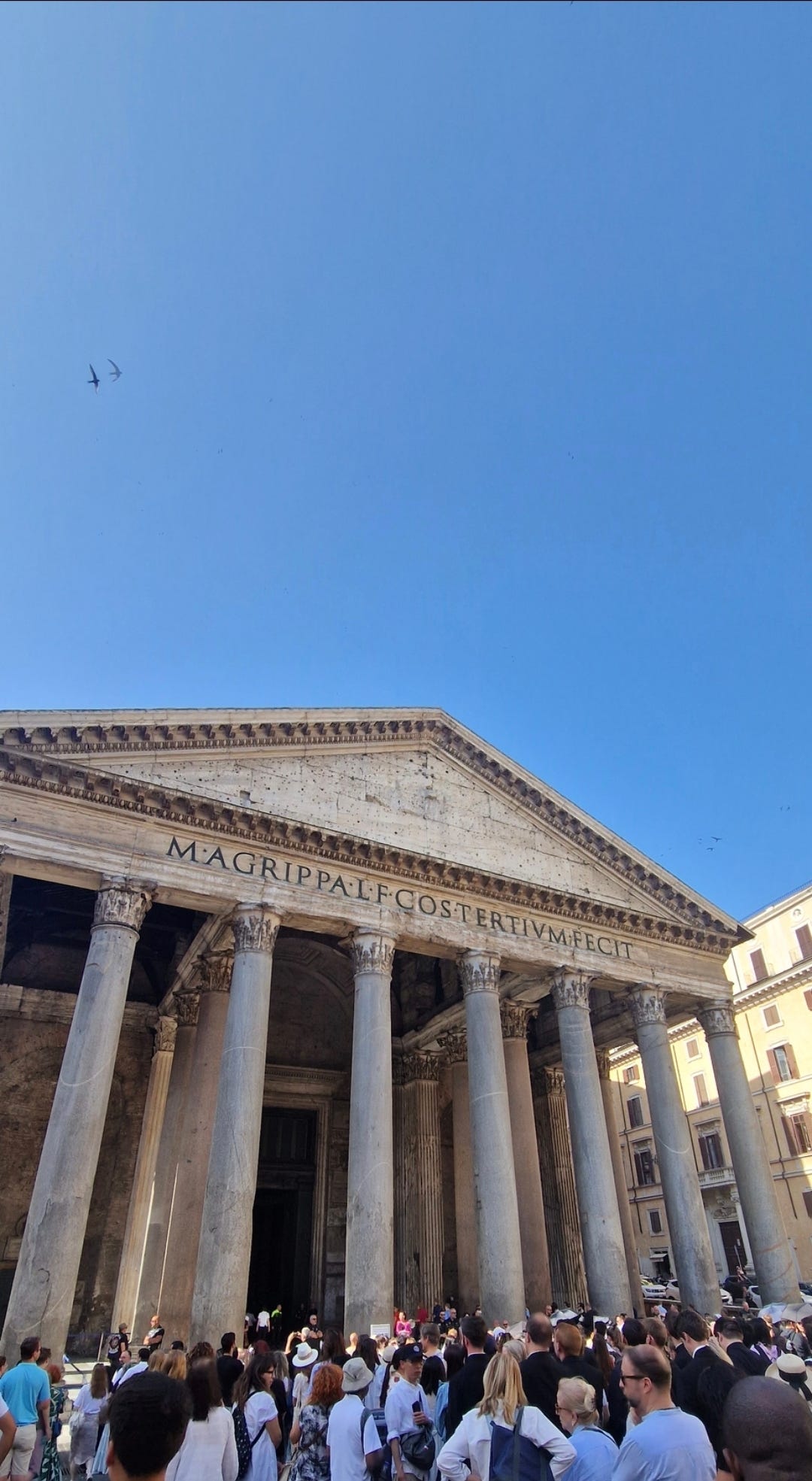

For Pentecost last year, I stood beneath that same oculus and watched rose petals fall through it. It’s one of those moments that stays with you. The petals drifted, twisted and scattered in ways no model could fully capture. You could predict the number of petals. You could estimate the timing. But you couldn’t model the feeling in the room, the way the air shifted the pattern every second, or the quiet unpredictability that made the moment what it was.

That gap between what can be modelled and what can be felt is where reality lives.
Finance spends a lot of time in that gap. Models give us structure. They help us understand risk, price uncertainty and make decisions with imperfect information. But they don’t give us context. They simplify a world that refuses to stay still and when assumptions shift behaviour, volatility, incentives, the environment around the model, the outputs shift with them.
That isn’t failure. It’s a reminder that judgement still matters.
We often talk about models as if they are objective truths. But every model is a story about the world, built on assumptions about how people behave, how markets respond and how uncertainty unfolds. Change the story and the model changes with it. The petals fall differently every time.
This matters even more in a world shaped by AI and automation. We now have tools that can process more data, run more scenarios and generate more outputs than ever before. But capability isn’t the same as understanding. More processing power doesn’t remove the need for context. If anything, it increases it. Because the more sophisticated the tools become, the easier it is to forget that they are still simplifications of a world that is messy, emotional and constantly shifting.
The real skill in modern finance isn’t building the most complex model. It’s knowing when the model is telling you something useful and when it isn’t. It’s understanding the assumptions beneath the surface. It’s recognising when the environment has changed enough that the model’s logic no longer holds. It’s being able to step back and ask, what’s the part of this situation that the model can’t see?
That’s where judgement comes in. Not as a replacement for analytics, but as the capability that makes analytics meaningful.
The Pantheon moment stays with me because it captures something simple but easy to forget, the world doesn’t behave in straight lines. It moves in patterns, currents and shifts that no model can fully anticipate. And that’s not a weakness in the model. It’s a feature of reality.

As finance becomes more automated, more data driven and more reliant on AI powered tools, the ability to hold both structure and uncertainty at the same time becomes one of the most important capabilities we have. To use models without being ruled by them. To understand their power without forgetting their limits. To see the petals falling and know that the model can guide you but it can’t tell you everything.
In the end, good modelling is not about predicting the world perfectly. It’s about understanding it well enough to make better decisions, even when the pattern changes.
And it always does.

메타데이터
- post_id
- 25d40ff47a8a
- slug
- the-pantheon-and-the-architecture-of-modelling-25d40ff47a8a
- url
- https://medium.com/@lukelyons1995/the-pantheon-and-the-architecture-of-modelling-25d40ff47a8a
- canonical_url
- https://medium.com/@lukelyons1995/the-pantheon-and-the-architecture-of-modelling-25d40ff47a8a
- author_url
- https://medium.com/@lukelyons1995
- status
- ok
- fetched_at
- 2026-06-09 15:37:30






