Why Professional Security Guards in Doha and Qatar Are Prepared Before the Shift Starts
Training, supervision, and site-specific preparation are what separate professional security guard services from simple manpower supply.
Why Good Security Is Built Long Before the Guard Is Seen
Most people judge security by the obvious part.
The guard at the entrance. The uniform. The visible presence at the gate, in the lobby, near the access point, on patrol.
That makes sense. It is the part everyone sees first.
But it is also where many clients misread the service.
Because by the time a guard is already standing at post, a lot of the real quality has already been decided. Not during the shift. Before it.
That is the part the security industry still does not explain clearly enough.
Too many providers still treat guarding like a manpower exercise. Fill the position. cover the hours. rotate the roster. On paper, that may look efficient. In practice, it often produces exactly the kind of weak, average service clients end up tolerating for too long.
A uniformed person on site is not automatically a security solution.
That difference matters more in Qatar than many people admit. A hotel, a residential compound, a private villa, an office tower, a labor accommodation, a retail site, and an industrial facility may all use guards, but they do not need the same type of guard behavior. The post may look similar from a distance. The job is not.
A hotel needs calm, polished guest interaction. A residential site needs discretion and consistency. A commercial property needs controlled access and professional first contact. A VIP residence needs privacy and judgment. An industrial site needs stronger patrol discipline, reporting, and alertness around assets and movement.
The site changes the standard.
That sounds obvious. Yet a surprising amount of the market still acts as if one generic guard profile can cover everything.
It cannot.
This is why recruitment matters more than many clients think. The wrong guard does not always fail dramatically. Often the damage is quieter than that. Visitors are handled awkwardly. Access control becomes inconsistent. The tone of the site is missed. Reporting is weak. Small things get overlooked. Nothing looks disastrous, but the client starts to feel that something is off.
That feeling matters.
Because people do not only judge security by whether something bad happened. They judge it by whether the place feels properly controlled, properly understood, and professionally handled.
That does not come from the uniform alone. It comes from the person wearing it and the system behind that person.
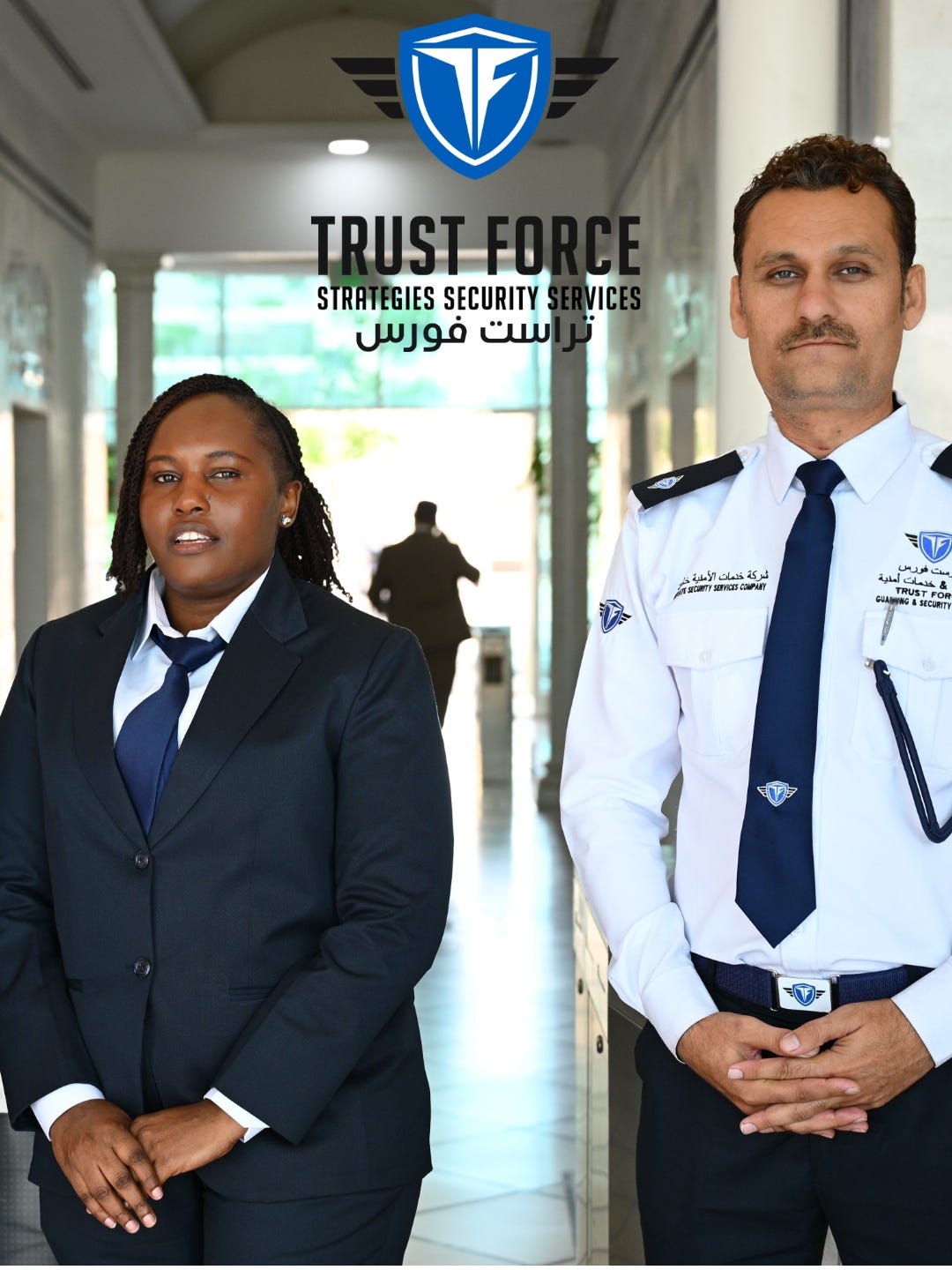
Trust Force’s original article makes an important point here: guards are often the first human representation of the property or organization they protect. That means they are not only filling a post. They are shaping first impressions, visitor experience, and client confidence from the first interaction onward.
That is exactly right.
A professional guard should know much more than where to stand. He should understand who is expected, who is not, what requires escalation, how the site works, what tone is appropriate, what the client is sensitive about, and what “normal” looks like for that location. If that sounds basic, it is. But basic things are where weak deployments usually start to break.
This is why training cannot be treated as a formality.
A guard can be punctual, disciplined, and willing to work hard, and still underperform badly if nobody briefed him properly, defined the reporting line clearly, or translated the client’s expectations into something practical on the ground. That is where many providers lose quality without admitting it. They assume deployment itself is the job. It is not.
Deployment is the beginning of the job.
Supervision matters for the same reason.
In our view, supervision is not just about checking attendance or making sure someone showed up. It is about staying close enough to the operation to know whether standards are actually holding. That means site visits. It means checking post instructions. It means seeing whether the guard’s conduct still matches the environment. It means noticing when a site has changed, when habits are slipping, or when the client’s expectations are no longer being met as cleanly as before.
That is how serious security is managed.
Not by assuming silence means everything is fine.
This is one of the most common problems in the industry. Service does not usually collapse in one dramatic moment. It drifts. Visitor screening becomes less disciplined. Patrol routines lose sharpness. Reporting gets thinner. Instructions that were clear on day one get blurred by routine. Nobody intends for standards to soften, but without supervision, they often do.
That is why field leadership matters so much.
Trust Force’s blog article is right to emphasize active supervision and field involvement rather than management from behind a desk alone. In security, distance creates blind spots. The farther management gets from the site, the more likely it is that average performance starts hiding behind good intentions.
There is another point here that deserves to be said plainly.
Qatar’s security workforce is international. That can be a real strength. Different languages, different service backgrounds, different types of operational experience. But diversity by itself does not create quality. It only becomes an advantage when everyone is aligned to one standard.
Without that, a workforce becomes inconsistent very quickly.
One guard is excellent with visitors. Another is too rigid. One reports well. Another reports late. One understands the tone of a residential site. Another behaves as if he is on a construction gate. This is why discipline, punctuality, briefing, appearance, reporting, and supervision matter so much. They are the things that turn individual personnel into an actual security operation.
Clients often underestimate how much they feel this difference.
They notice it when reception feels smooth instead of awkward. When access control feels controlled instead of theatrical. When a visitor is handled firmly but respectfully. When a problem is reported early instead of being discovered late. When the property feels quietly well-managed instead of merely staffed.
That is what professional security should feel like.
Not dramatic. Not performative. Controlled.
At Trust Force Security, that is how we think about the service. Not as a question of how many guards can be deployed, but whether the people on site have actually been selected well, trained properly, briefed for the specific environment, and actively supervised once operations begin.
That is a different standard from basic coverage.
It is also the standard serious clients should expect more often.
Because in the end, the visible guard is only the surface of the service. The real quality sits underneath: in recruitment, training, briefing, supervision, and the discipline to keep standards alive after the first day on site.
That is what clients are really buying, whether they phrase it that way or not.
They are buying confidence that the site is not just covered.
It is being managed.
For the original Trust Force article behind this piece, read: https://trustforce.qa/professional-security-guards-doha-qatar-training-supervision/ on the Trust Force blog.
메타데이터
- post_id
- 25e5925cbcd5
- slug
- why-professional-security-guards-in-doha-and-qatar-are-prepared-before-the-shift-starts-25e5925cbcd5
- url
- https://medium.com/@pb_30727/why-professional-security-guards-in-doha-and-qatar-are-prepared-before-the-shift-starts-25e5925cbcd5
- canonical_url
- https://medium.com/@pb_30727/why-professional-security-guards-in-doha-and-qatar-are-prepared-before-the-shift-starts-25e5925cbcd5
- author_url
- https://medium.com/@pb_30727
- status
- ok
- fetched_at
- 2026-06-24 18:57:25