What It’s Really Like to Visit the Louvre
When the story broke in October about the Louvre heist, it also broke open some long-kept open secrets about what working in the biggest…
What It’s Really Like to Visit the Louvre
When the story broke in October about the Louvre heist, it also broke open some long-kept open secrets about what working in the biggest art museum in the world is really like.
It was fascinating to me because I had actually been in the gallery that was breached and the more I read about it, the more it made perfect sense. Here’s what I saw when I visited the Louvre 4 months before that could have told anyone what was coming…
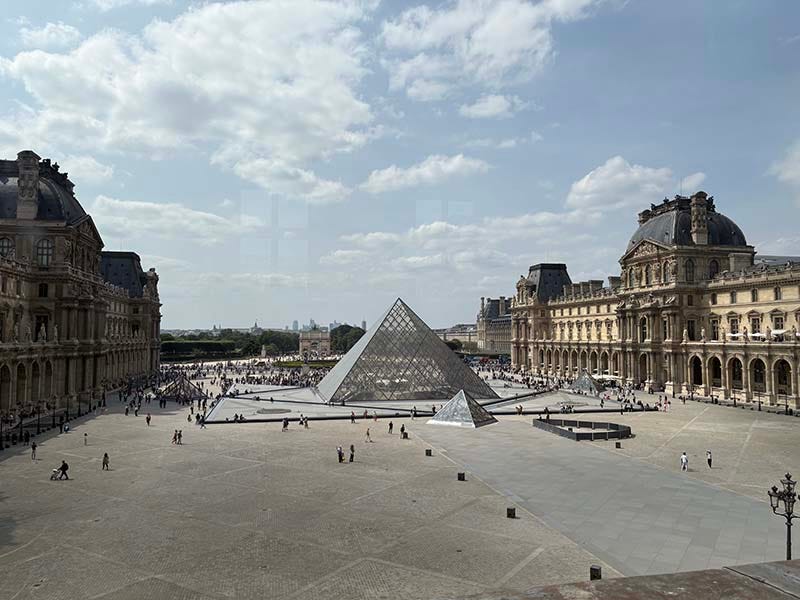
Everyone who visits Paris is practically required by law to make a pilgrimage to the Musée du Louvre. Even if you’re American, it’s ingrained in our collective consciousness. It’s a main character in “The DaVinci Code”. It’s where practically every world-renowned Western painting seems to be located. For a lot of people, the Louvre is France.
And the French Tourism Board knows this. Next to the Eiffel Tower, the Louvre is the other tourist attraction. So, they sell tourists a bus tour that breezes you by the Arc de Triomphe, the Champs Elysees and winds up at…(drumroll) The Louvre.
Well, almost. In our experience, the bus glided slowly past the iconic glass pyramid, glimpsed through throngs of tourists. At first we thought it was driving so slow because it was going to stop, but that was only to make sure we could get some good photos of all the crowds. Where the bus actually stopped was at the side of the boulevard that runs along the west side of the museum. So, we had to cross the street and trudge back to where we had just cruised by at 3 miles per hour.
Most helpful tourist guide websites will tell you it’s a very good idea to buy your Louvre tix in advance, which is what we did. You buy a ticket for a certain time slot. That sounds great in theory, but we ended up taking our Big Bus tour on a bank holiday. So, the 45 minute trip advertised, ended up being about an hour and change. So, after polite-pushing our way through masses of tourists and French schoolchildren on a class trip, we finally rounded the corner to the giant plaza where the entrance was located.
The entrance was located, somewhere, but not really marked. Unless you are the height of a Boston Celtics player, it’s impossible to tell which endless line of tourists snakes to the entrance where you present your tickets. There are museum employees that stand around in the plaza holding walkie-talkies, but they will just wave vaguely towards one of the points of the compass and tell you to go “over there” to get in. By now, we were more than fashionably late for our time slot, but any questions about still being admitted were met with a Gallic shrug and more pointing.
Still, the French don’t really seem overly worried about punctuality (and arguing is above their pay grade) so we somehow made it in after wading along in the same direction as the other Americans. We’re a family of museum goers, but, that’s American museums, which means stanchions, large directional signs and ADA compliant elevators.
One of our party was feeling a lot of sciatica pain after a trip to Monmartre the day before, so we needed to rent a wheelchair. That involved a trip down one floor and getting into a queue for the next available chair. As fate would have it, the wheelchair rental was conveniently located next to the level 0 cafe. Since it was around lunchtime, the cafe was swarming with visitors corraled into lines trying to buy sandwiches and drinks. Our wait-time for a wheelchair was about half an hour so we had time to wind our way through the lines to get food. Our cashier was a young woman who seemed miraculously cheerful considering they were dealing with hundreds of non-French speaking tourists in a postage stamp sized cafe. “We get paid time and a half on holidays!” she replied when my niece asked her how she was getting through her day.
Lunch had and wheelchair procured, we began our journey through one of the largest (and oldest) buildings in Western civilization. It was amazing to discover that at one point the Louvre had been an actual fortress. We rolled past the base of what had been enormous ramparts still preserved in level zero. Some of the stones even had mason’s marks carved into them from 800 years ago.

From there, we were herded into the Egyptian galleries. Since Egypt had been invaded by France, there were of course rooms upon rooms of carved limestone pharohs, sarcophagi and tiny faience figurines. I would have loved to spend the day just here, but now my bladder was sending out post-lunch distress signals. And my sister and niece wanted to gaze upon19th century French impressionism, not tiny blue statues of Bast and Sekmeht.
The Louvre does have printed maps of the galleries’ layouts but they use a cryptic location code made up of alpha-numeric pairs that maybe made more sense in theory than practice. Elevators are in existence, but to get to one, you first need to go to Hall C1, then go through Gallery F5 to find it. And pushing a wheelchair through masses of people anywhere is hard, let alone through masses of people reading about Middle Period Egyptian burial rites.
We finally reached the ground floor elevator, only to find a sign across it saying “Fermé Pour Réparation”. We flagged down someone who seemed to be a guard and after going back and forth in broken French and English, found that there was another elevator in Gallery F8. I pled my case for finding a bathroom on the way since we had been trapped in ancient Egypt and Greece for about 45 minutes at this point.
After trudging through Mesopotamia we found a small bathroom which I happily made use of and then rejoined my party just as they reached the elevator and discovered that it only went up to Level 2. Impressionism was on Level 4. So, we argued over whether it was worth it to keep searching for an elevator that would go up more than two flights, or just get on the working one and try our luck on Level 2.
I’m sure at one point, probably somewhere in the early 20th century, the thinking behind where to locate visitor amenities was centered around educating the masses as they searched for comfort and convenience:
“Why these uneducated proletariats can learn about late period Roman architecture on their way to the water closet!”
“Capital idea! And, if they see how intricately these Phoenician chariots were embellished, they’ll truly appreciate the ornate design of the new lifts being installed!”

What it feels like trying to find the “loo” in “Louvre”
Finding your way to modern conveniences is actually a feast for the senses, just not the ones we usually enjoy. By the time we had navigated our way to the 18th Century we were exhausted and sweaty, just like the staff that languidly waved along the crowds and kept discreetly checking their watches to see if it was time for their break yet.
I wonder what it would be like to work in a place the size of 4 football fields that houses practically our entire collective cultural heritage. Imagine if your job was to stand next to “The Raft of the Medusa” all day or, your beat was the High Renaissance gallery. Most of the guards we encountered were hanging in there ok. I had to ask one man where the nearest “WC” was and he pointed towards the end of the gallery with a world-weariness that was cinematic. Some employees just had a thousand yard stare, which made sense in a room that was literally about 3,000 feet long. Heaven help you if you don’t have thick-soled comfortable shoes on.

I didn’t anticipate the “Mona Lisa” being the highlight of our visit but it was for a surprising reason. I’d read lots of online comments about how it’s smaller than one would think and usually you just get a glimpse of it as you’re carried by in the push of the crowds. We pushed my sister’s wheelchair into the room that housed the most famous painting in history and a guard immediately ushered us to the front of the crowd where we stared in wonder at the details, the symbolism and that unforgettable half-smile for a full minute before being discreetly escorted away. It was amazing. As we turned to go, we faced the crowd and for a split second it felt like we were on the most surreal red carpet in history.

Galerie d’Empire
We did end up in the infamous Galerie d’Apollon towards the end of our journey. Like a lot of surviving French interiors from bygone days, it exemplified the true meaning of “extra, with a side of extraness”. Donald Trump wishes he could decorate like this, and I imagine this is what he’s going for. Nothing says “Empire” like gilt-drenched everything and imagery of your ruler done up like a mythical hero. Those long, high arched windows are the perfect size to maneuver a boomlift into. Hopefully, in the near future we will be reading about the grand re-opening of the gallery with new video surveillance cameras and museum employees who feel valued and appreciated.
Empires all do eventually crumble, and somehow the October heist was a perfect metaphor for how that happens. People disguised as construction workers busted into a room dedicated to French Imperial glory, grabbed a crown and jewels that symbolized expansionist colonialism, and the whole affair pulled back the curtain on French workers’ discontent.
메타데이터
- post_id
- 25eb3ff7b7f0
- slug
- what-its-really-like-to-visit-the-louvre-25eb3ff7b7f0
- url
- https://medium.com/@jennsweb/what-its-really-like-to-visit-the-louvre-25eb3ff7b7f0
- canonical_url
- https://medium.com/@jennsweb/what-its-really-like-to-visit-the-louvre-25eb3ff7b7f0
- author_url
- https://medium.com/@jennsweb
- status
- ok
- fetched_at
- 2026-07-13 21:07:34





