The Kolb’s Significance in Dublin, California
The Kolb family was a major part of what shaped early life in Dublin, California. City of Dublin collection records describe the family as…
The Kolb’s Significance in Dublin, California
The Kolb family was a major part of what shaped early life in Dublin, California. City of Dublin collection records describe the family as significant to local history because they operated the general merchandise store, farmed locally, and “helped shape civic structure”. That phrase demonstrates the importance of the Kolb family. Rather than simply living in Dublin, the Kolbs became part of the town’s foundation involving themselves by becoming pillars in the community. Although this part of Dublin’s history can now feel overshadowed by the recent spikes of population and bustling suburbs, the Kolb family shows how early Dublin got its start through a deep-rooted community.
Their importance first comes into focus at the Green General Store. City records show that George Kolb, Jr. purchased the store in 1894 and ran it until 1909. During this time, it was known as Kolb’s General Store. The store was one of the central institutions in old Dublin Village, and over the years the building served not only as a store, but also as a post office and later a library. In 1896, George married Wilhelmina Hartung, and the couple lived in a cottage behind the store. The cottage commonly known as the Kolb House can be found at Dublin’s Heritage Museum and contains numerous original items belonging to the Kolb family, showing what life was like in the 19th and early 20th century.
Yet the Kolbs’ impact on Dublin reached far beyond the walls of the general store. Like many people during this time in Dublin, the family engaged in agriculture. By 1904, George had purchased about 350 acres from the Dougherty family and begun ranching, and city planning documents later described the Kolb Ranch as a rare surviving example of a way of life that was rapidly disappearing from Dublin and the wider Amador Valley. Over the years, the ranch produced hay and grain, then vegetables, while also being able to support livestock and orchards. A museum assessment notes that after the 1906 earthquake, George loaded the family wagon with provisions, drove them to San Francisco, and brought relatives back to safety in Dublin once the earthquake was over. This moment reflects the values that defined the Kolb family. George’s decision to bring supplies into San Francisco and return with relatives after the earthquake speaks to his sense of responsibility to the community and commitment to family.
That is what makes the Kolb House so important. It is not simply an old building located in the center of Dublin’s Heritage Museum; it is the material expression of the life the family had created in Dublin by the early 20th century. The house was completed in December 1910, and George, Wilhelmina, and their sons Edwin and Harold moved in during January 1911. The house was built by Charles Bruce of Pleasanton, using plans that came from Wilhelmina’s sister Augusta, who had a similar house built in Beverly Hills. The home was furnished in the Arts and Crafts tradition and featured amenities that were modern for the time, including running water and, eventually, electricity. The Kolbs were rooted in farm life, but over time, the house evolved with its era, eventually adding an electric stove and kitchen, around the Second World War.
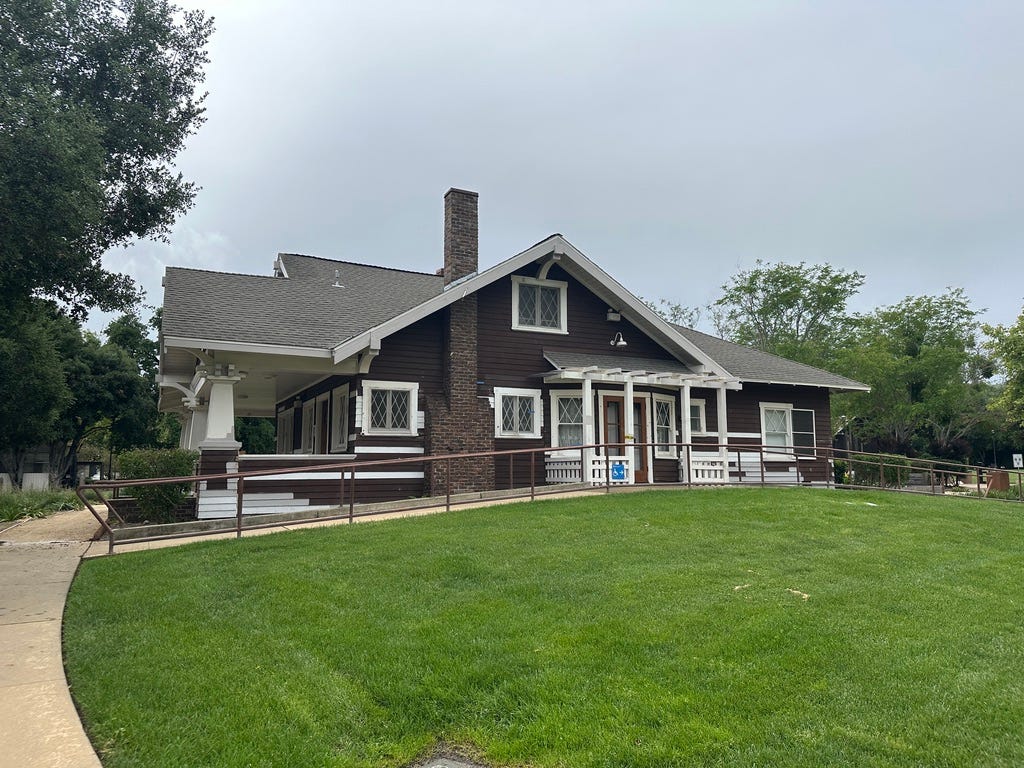
The Kolb House
The house also preserves a story of continuity across generations. After George died in 1933, Harold Kolb, his wife Elsie, and their children Donna and Bill moved into the house with Wilhelmina; daughter Carol was born there in 1938. When Carol Kolb donated the buildings to the City of Dublin, she also donated the contents of the house, and that most of what visitors see today was actually used by the family who lived there. That gives the house an unusual emotional force. Visitors are not looking at a period style assembled after the fact. They are walking through the real domestic world of a family so entrenched in Dublin’s history. This continuity is one of the reasons the house feels so alive as a museum. The rooms are not generic recreations of “old-time life,” but rather are filled with the family’s own furniture, photographs, and personal belongings.
That reality is especially vivid in each and every room of the Kolb House. The living rooms and dining room tell great stories of how the Kolb family beautifully decorated each piece of furniture. But the back porch and kitchen tell an equally important story about labor. The collection inventory for the back porch includes wash tubs, crocks, a butter churn, milk cans, a boiler pan, canning supplies, enamelware pots, a baby bath, rope, and lanterns. The inventory suggests cleaning, preserving food, storing tools, handling the messiness of farm life, and absorbing the practical work that kept a household running were common chores that happened in these rooms. The Kolb House helps museum visitors understand that history comes alive through regular houses that encapsulate the daily lives of these people who worked in these rooms.
The living room inventory includes Mission-style chairs, books, magazines from the 1930s, a piano linked to the Kroger family, a German Christmas tree, and German and Bavarian steins and plates. The Kolb family, who were originally immigrants from Bavaria coming to the United States, and eventually Dublin, reveal their desire to bring parts of their heritage with them through these antiques scattered along the dining room of their house. They were carrying traditions forward while adapting to life in California, and the house became the setting where that blend of lineage and everyday use was made visible.
The Kolb House matters even more because so much of early Dublin’s physical landscape no longer survives. The City’s own history pages describe Dublin’s transformation from a small crossroads community of farms, hotels, a church, a school, and a general store into a suburban city shaped by highways and postwar development. The Kolb property lived through that transition. Official interpretation notes that Interstate 580 cut across the family’s land, while planning documents explain that the ranch remained in family hands for generations and continued operating into the twenty-first century. That long continuity is remarkable. As older landscapes disappeared, the Kolb Ranch endured as a kind of living memory of agricultural Dublin.
Its preservation was therefore an act of choice as much as an act of rescue. City Council minutes show that in March 2008 the City approved an agreement accepting the donation of the Kolb home and related structures. Over the next several years, the buildings were moved and incorporated into Dublin Heritage Park & Museums as the site was prepared, collections were installed, and the public-facing historic park took shape. Public city sources date different stages of that process to 2009, 2010, and 2011. The result of this was a collection of buildings and objects that lets Dublin tell its own story with unusual intimacy and depth.
The Kolb House reveals its importance to its visitors by bringing local history down to human scale. You can understand a city through timelines, maps, and development patterns, but a house lets you step into the past and understand how people actually lived through those changes. It reminds visitors that the making of Dublin was not only the work of major landowners, road builders, or officials. It was also the work of families who sold supplies, farmed the land, raised children, stored tools, celebrated holidays, and stayed rooted long enough for a community to recognize itself in them. That is why the importance of the Kolb family’s legacy in Dublin’s history matters, and why the house they left behind leaves such a significant imprint.
Today, the Kolb House still stands, going through constant renovations to ensure the integrity of the building. The Kolb legacy is known more than ever within the community through the introduction of Harold William Kolb elementary school, constructed in 2011. More than a century after it was built, the Kolb House continues to tell the story of a family whose hard work, resilience, and sense of community helped shape early Dublin. Every room offers a glimpse into the everyday lives that built the city we know today. The Kolb House reminds us that history isn’t only found in famous events, but in the homes people lived in and the objects they used. By preserving places like the Kolb House, we ensure that future generations can continue to connect with Dublin’s past and appreciate the people who made its history possible.
메타데이터
- post_id
- 25f2b7c6a16e
- slug
- the-kolbs-significance-in-dublin-california-25f2b7c6a16e
- url
- https://medium.com/@archivesdublin/the-kolbs-significance-in-dublin-california-25f2b7c6a16e
- canonical_url
- https://medium.com/@archivesdublin/the-kolbs-significance-in-dublin-california-25f2b7c6a16e
- author_url
- https://medium.com/@archivesdublin
- status
- ok
- fetched_at
- 2026-07-12 02:45:26




