Sahih Musnad al-Imam al-Azam Abu Hanifah: Reviving the Hadith Legacy of the Great Imam
Introduction
Sahih Musnad al-Imam al-Azam Abu Hanifah: Reviving the Hadith Legacy of the Great Imam
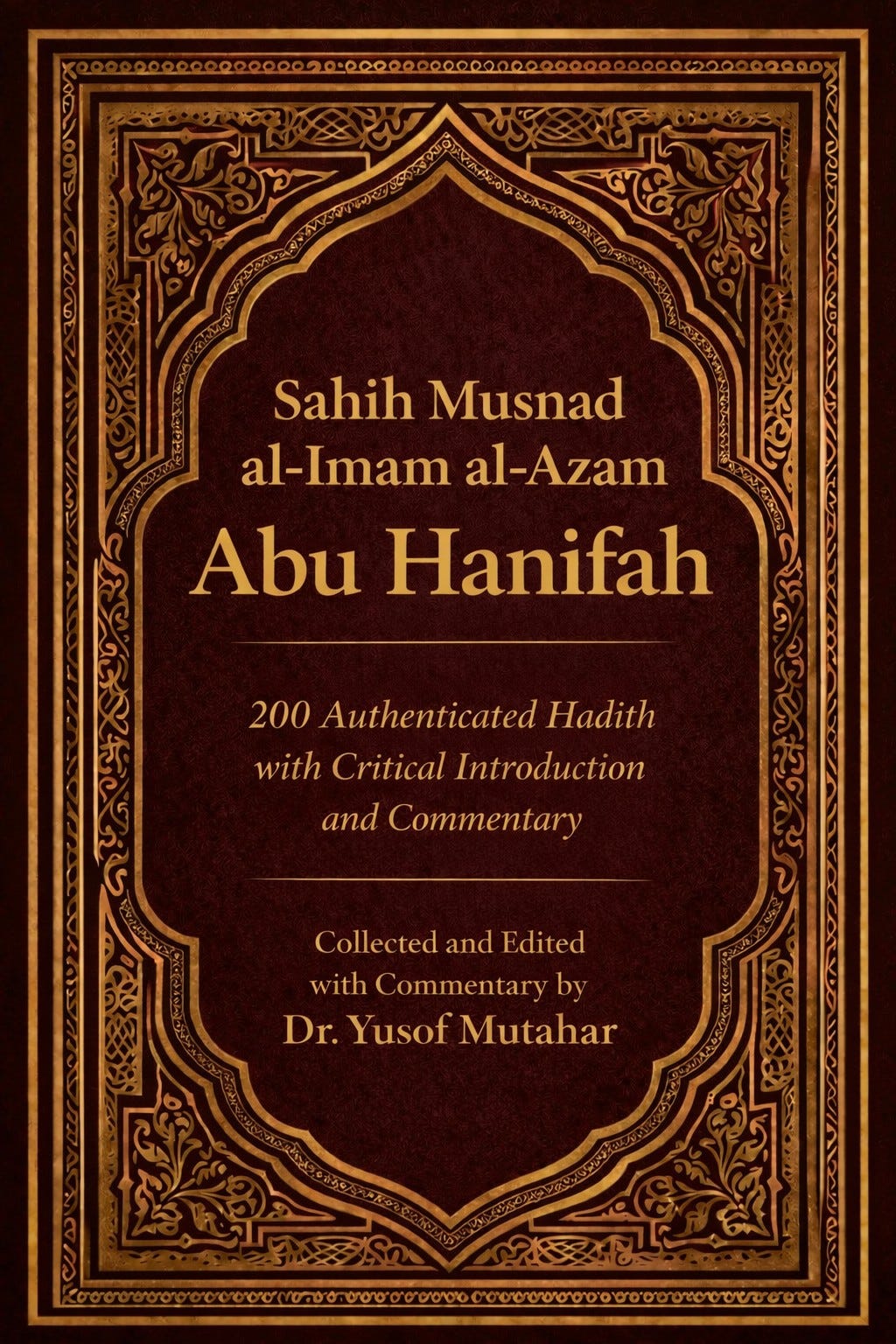
Sahih Musnad al-Imam al-Azam Abu Hanifah: 200 Authenticated Hadith with Critical Introduction and Commentary
Introduction
Few figures in Islamic intellectual history have exercised an influence comparable to that of Imām al-Aʿẓam Abū Ḥanīfah al-Nuʿmān ibn Thābit (d. 150 AH). As the founder of the Ḥanafī school of law, his legal methodology, juristic reasoning, and intellectual legacy have shaped the religious lives of hundreds of millions of Muslims across the world for more than thirteen centuries. Yet despite his immense stature, few scholars have been subjected to as many misconceptions regarding their relationship with the Prophetic Sunnah.
For centuries, critics have repeated claims that Imām Abū Ḥanīfah was weak in hadith, excessively reliant upon opinion, or detached from the tradition of Prophetic transmission. Such assertions have often been reproduced without careful examination of the historical evidence, the realities of second-century Islamic scholarship, or the sophisticated methodological framework that underpinned the Hanafi school. In recent times, the spread of digital media has only amplified these misconceptions, allowing simplistic narratives to circulate among audiences with little exposure to the classical sources.
It was this reality that inspired the writing of Sahih Musnad al-Imam al-Azam Abu Hanifah. The project was conceived as both a contribution to hadith studies and a scholarly defence of one of Islam’s greatest scholars. Rather than responding to misconceptions through polemics, the objective was to allow the evidence itself to speak. The most compelling defence of Imām Abū Ḥanīfah is not emotional attachment, partisan loyalty, or rhetorical argumentation, but the careful study of his transmitted legacy.
Why This Work Was Written
We live in an era where access to information is unprecedented, yet genuine scholarship is increasingly obscured by superficial commentary. In many contemporary circles, the towering legacy of Imām al-Aʿẓam Abū Ḥanīfah is routinely reduced to historical caricatures that bear no resemblance to reality. Individuals with limited training in hadith sciences, legal theory, or early Islamic history frequently parrot inherited, baseless claims without engaging with the primary evidence.
Chief among these egregious falsehoods is the persistent, polemical slander that the Imām’s knowledge of prophetic traditions was confined to a mere seventeen hadiths. This narrative is a complete fabrication that flies in the face of historical reality. In truth, Imām Abū Ḥanīfah was a master who possessed a commanding knowledge of hundreds of thousands of traditions, and who personally narrated thousands of reports throughout his lifetime, forming the very bedrock of his sophisticated legal system.
Such reductive myths are profoundly remarkable when directed at a scholar whose influence upon Islamic law, legal theory, theology, and jurisprudence remains virtually unparalleled. Imām Abū Ḥanīfah was not an isolated rationalist; he belonged to the generation of the Tābiʿūn, studied under the premier authorities of the early Muslim community, and transmitted hadith through exceptionally elevated chains (ʿulūw al-isnād). This work was written to permanently shatter these false narratives. By presenting a dedicated, unanimously authenticated ṣaḥīḥ compilation, this book provides unassailable, empirical evidence that breaks the slander once and for all, proving beyond any shadow of doubt that the Imām’s legal methodology was deeply and masterfully anchored in the Prophetic Sunnah.
The original vision for this project was significantly larger in scope. Initial research aimed to compile approximately five hundred authenticated narrations transmitted through the Imām. As the material accumulated, however, it became clear that such an expansive collection would develop into a multi-volume, encyclopaedic work rather than a focused, accessible scholarly study. While a massive compendium may have possessed its own historical value, it risked obscuring the central purpose of the project beneath an overwhelming volume of text.
Consequently, the deliberate decision was made to condense the collection to exactly two hundred narrations. Surprisingly, this proved to be one of the most intellectually demanding aspects of the entire undertaking. The challenge was never a scarcity of authentic material, but rather the rigorous task of determining which valid narrations should be omitted.
Every single narration retained in this collection was selected through a meticulous process of evaluation, filtration, and refinement. Supreme preference was given to reports that serve as foundational pillars for Islamic creed (ʿaqīdah), worship (ʿibādah), ethics (akhlāq), legal reasoning, and the broader objectives (maqāṣid) of the Sunnah. Particular attention was also dedicated to narrations that explicitly showcase the Imām’s elevated chains of transmission, highlighting his direct proximity to the earliest generations and his seamless integration within the elite scholarly networks of Kūfah.
The final collection therefore represents far more than an arbitrary selection of texts; it is a carefully curated, unassailable body of evidence designed to showcase the undeniable strength of Imām Abū Ḥanīfah’s transmitted legacy. In many respects, the reduction from five hundred narrations to two hundred significantly strengthened the project. The resulting work is sharper, highly focused, and ultimately more persuasive. The cumulative evidence presented throughout this collection establishes beyond reasonable doubt that Imām al-Aʿẓam was not a scholar distant from hadith, but rather a premier transmitter, master interpreter, and foundational custodian of the Prophetic Sunnah.
A Historic Contribution to Hadith Literature
Perhaps the most distinctive feature of Sahih Musnad al-Imam al-Azam Abu Hanifah is that it represents what appears to be the first dedicated ṣaḥīḥ compilation in Islamic history drawn exclusively from the narrations transmitted by Imām Abū Ḥanīfah himself.
To appreciate its significance, one must understand its relationship to both traditional school methodology and universal hadith sciences. Within the internal framework of Ḥanafī jurisprudence, the transmissions and legal vetting of Imām Abū Ḥanīfah carry the ultimate and most authoritative weight; his acceptance of a report is historically regarded by his school as a form of intrinsic validation. The classical tradition faithfully preserved numerous masānīd attributed to the Imām to document these lines, serving as invaluable repositories of early Islamic heritage and safeguarding his pristine chains of narration.
However, these early texts were primarily compiled as broad historical records of transmission rather than restricted, dedicated ṣaḥīḥ volumes. As broad historical archives, they were not originally designed to isolate only those reports that possessed cross-school consensus. The present work addresses this historical gap by building upon that legacy, applying the absolute highest principles of classical hadith criticism to the entire corpus of narrations transmitted through the Imām.
The defining triumph of this project is that it systematically extracts a unique corpus where every narration achieves a status of unanimous authentication (ṣaḥīḥ). By applying the most unyielding, universally accepted standards of both text (matn) and chain (isnād) criticism, this compilation transcends internal legal school preferences. It transforms scattered historical transmission material into a coherent, critically verified collection where every single report meets a global, unassailable threshold of soundness recognized by all major traditions of Islamic scholarship.
Methodology and Authentication
The distinguishing feature of this work lies not merely in its subject matter but in its methodology.
Each narration underwent detailed analysis through the established sciences of hadith criticism. Chains of transmission were examined for continuity, narrator reliability, corroborating pathways, and consistency with the assessments of the major hadith authorities. Reports were cross-referenced against primary hadith sources wherever possible, allowing for comparison with parallel transmissions and supporting chains.
Particular emphasis was placed upon sanad analysis. Rather than simply reproducing narrations, the work investigates the structure of transmission itself, examining the individuals through whom reports were preserved and evaluating the strength of their connections. This process provides readers with a deeper appreciation of both the authenticity of individual reports and the broader transmission networks that sustained the Sunnah during the formative centuries of Islam.
Each hadith is presented with its original Arabic text, complete sanad, English translation, source references, authentication assessment, and explanatory commentary. In addition, many narrations are accompanied by discussions of their legal and theological significance within the Hanafi tradition.
Elevated Chains and Generational Proximity
One of the most remarkable features of Imām Abū Ḥanīfah’s hadith legacy is his extraordinary proximity to the earliest generations of Islam.
Living during the era of the Tābiʿūn, the Imam studied under leading scholars who themselves had direct connections to the Companions of the Prophet ﷺ. Consequently, many of his narrations possess exceptionally elevated chains (ʿulūw al-isnād), containing fewer intermediaries between the transmitter and the Prophet ﷺ than many later collections.
This proximity is particularly significant within hadith studies. Elevated chains were historically regarded as a mark of distinction, reflecting closeness to the earliest sources of transmission and reducing the number of intermediaries through whom a report passed.
The scholarly environment of Kūfah further enhances the importance of these narrations. As one of the great centres of learning in the early Islamic world, Kūfah produced generations of jurists, traditionists, Qur’anic scholars, and theologians. Imām Abū Ḥanīfah emerged from this intellectual environment as a scholar deeply connected to both hadith transmission and legal reasoning.
Hadith and Hanafi Methodology
The work also provides insight into one of the most misunderstood dimensions of Islamic legal thought: the relationship between hadith and Hanafi jurisprudence.
The critical introduction examines foundational concepts including mutawātir and āḥād narrations, qiyās, mursal reports, ʿumūm al-balwā, juristic preference (istiḥsān), and the hierarchy of legal evidence. These discussions demonstrate that Hanafi legal methodology was not constructed in opposition to hadith, but rather represented a sophisticated framework for understanding, evaluating, and applying the Prophetic Sunnah.
Far from revealing a disregard for hadith, the Hanafi tradition demonstrates one of the most intellectually rigorous attempts to harmonise transmitted evidence with legal reasoning and practical application.
Conclusion
Sahih Musnad al-Imam al-Azam Abu Hanifah is far more than a collection of authenticated narrations. It is an intentional, rigorous effort to recover a vital dimension of Islamic intellectual history and to reintroduce contemporary readers to the profound hadith legacy of one of Islam’s greatest scholars.
This project serves as a crucial continuation of my broader research into the Ḥanafī–Māturīdī tradition. My earlier publication, Imam Abu Hanifah: The Master of Qiyas, deconstructed the life and sophisticated analogical reasoning of the school’s founder and firmly establishes and isolates the narrative hadith foundations of that very school. Alongside these studies, my work on the theological lineage continues through Imam al-Maturidi: Architect of Creed and my extensive translation project of Tafsir Al-Maturidi: Ta’wilat Ahl al-Sunna. Together, these works form a unified defense of orthodox Sunni scholarship.
By producing what appears to be the first dedicated ṣaḥīḥ compilation drawn exclusively from the narrations of Imām Abū Ḥanīfah, this work contributes uniquely to the fields of hadith studies, Hanafi legal theory, and the broader history of Sunni scholarship. More importantly, it provides a definitive, scholarly response to centuries of misunderstanding by allowing the empirical textual evidence to speak for itself.
The cumulative result demonstrates with clarity and undeniable force that Imām al-Aʿẓam Abū Ḥanīfah was not merely a jurist of exceptional, unparalleled ability, but also a masterful transmitter, preserver, and interpreter of the Prophetic Sunnah whose monumental contribution continues to shape the intellectual and spiritual life of the Muslim world today.
메타데이터
- post_id
- 25fa4231211b
- slug
- sahih-musnad-al-imam-al-azam-abu-hanifah-reviving-the-hadith-legacy-of-the-great-imam-25fa4231211b
- url
- https://medium.com/@dryusofmutahar/sahih-musnad-al-imam-al-azam-abu-hanifah-reviving-the-hadith-legacy-of-the-great-imam-25fa4231211b
- canonical_url
- https://medium.com/@dryusofmutahar/sahih-musnad-al-imam-al-azam-abu-hanifah-reviving-the-hadith-legacy-of-the-great-imam-25fa4231211b
- author_url
- https://medium.com/@dryusofmutahar
- status
- ok
- fetched_at
- 2026-06-17 10:21:25