UK faces a crisis of confidence as investors and businesses exit
Net business investment fell 4.2% in 2025, while 187,000 high-net-worth individuals left Britain last year, according to data from HMRC and…
UK faces a crisis of confidence as investors and businesses exit
Net business investment fell 4.2% in 2025, while 187,000 high-net-worth individuals left Britain last year, according to data from HMRC and Henley & Partners.
On a grey Tuesday morning in January, the chief executive of a mid-sized engineering firm called me from his office in Solihull. He had just received the quarterly tax bill for his company’s employee stock options plan. It was 38% higher than the same quarter in 2024. “We’re not expanding here anymore,” he said. “We’re looking at Düsseldorf.”
That conversation is not an anecdote. It is a data point in a pattern that has become unmistakable. Britain is experiencing what economists call a “confidence shock” — but that phrase is too clinical. What we are seeing is a slow-motion withdrawal of the very capital, both human and financial, that has sustained the country’s economic position for decades.
The numbers are stark
Consider the following. Net business investment in the UK fell 4.2% in 2025, according to the Office for National Statistics. That is the largest annual decline outside a recession since 2009. Meanwhile, the Henley & Partners 2026 Private Wealth Migration Report shows that 187,000 high-net-worth individuals left Britain last year. That is more than any other country in Europe. Only China and India saw larger outflows.
The tax burden is now at 37.7% of GDP, the highest level since the aftermath of the Second World War, according to the Institute for Fiscal Studies. Rachel Reeves, the Chancellor, has raised employer national insurance contributions, corporation tax, and capital gains tax. She has also tightened the non-dom regime and abolished the furnished holiday lettings tax break. Each measure is defensible in isolation. Together, they create a cumulative impression: Britain is no longer open for business.
The hollowing out of productive capacity
The problem is not just about millionaires moving to Monaco. It is about the erosion of the country’s productive base. In 2024, the UK had 47% fewer manufacturing jobs than in 1997. The pharmaceutical giant AstraZeneca, which employs 18,000 people in Britain, announced in March that its next major R&D facility would be built in Cambridge, Massachusetts — not Cambridge, England. The reason given was “regulatory certainty and tax competitiveness.”
This is not a left-right issue. The previous Conservative government also raised taxes and introduced the Energy Profits Levy. But the current Labour government has accelerated the trend. Its budget in October 2025 raised an additional £41 billion in taxes, the largest single fiscal tightening in a generation. The Office for Budget Responsibility subsequently revised down its forecast for business investment by 1.8% for each of the next three years.
Welfare dependency and the fiscal trap
There is a deeper structural problem. As the wealthy and the businesses leave, the tax base shrinks. But the demands on the state do not. The number of working-age adults claiming out-of-work benefits has risen to 2.8 million, up from 2.1 million in 2019. The health service, the National Health Service, now consumes 44% of all government spending. The state pension age is rising, but the cost of the triple lock — which guarantees pension increases by the highest of inflation, earnings, or 2.5% — is projected to add £12 billion annually by 2028.
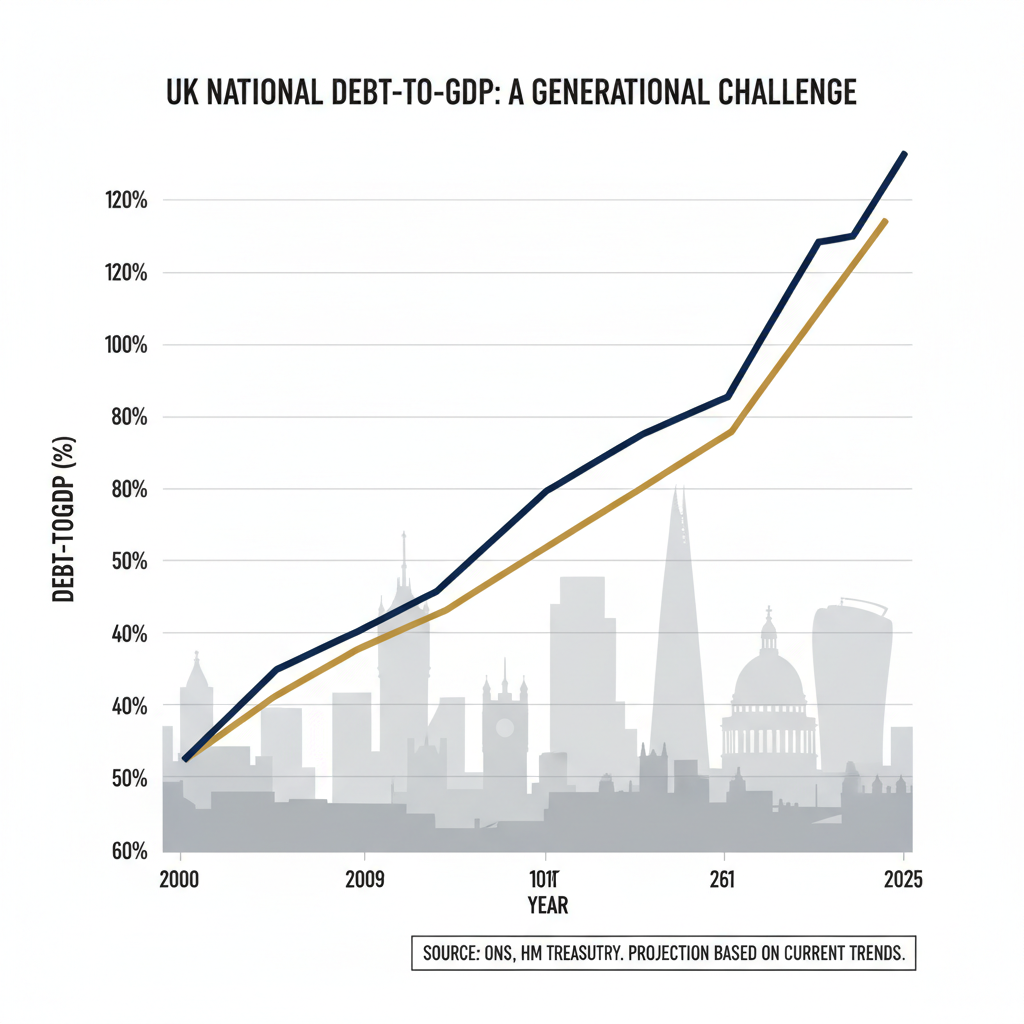
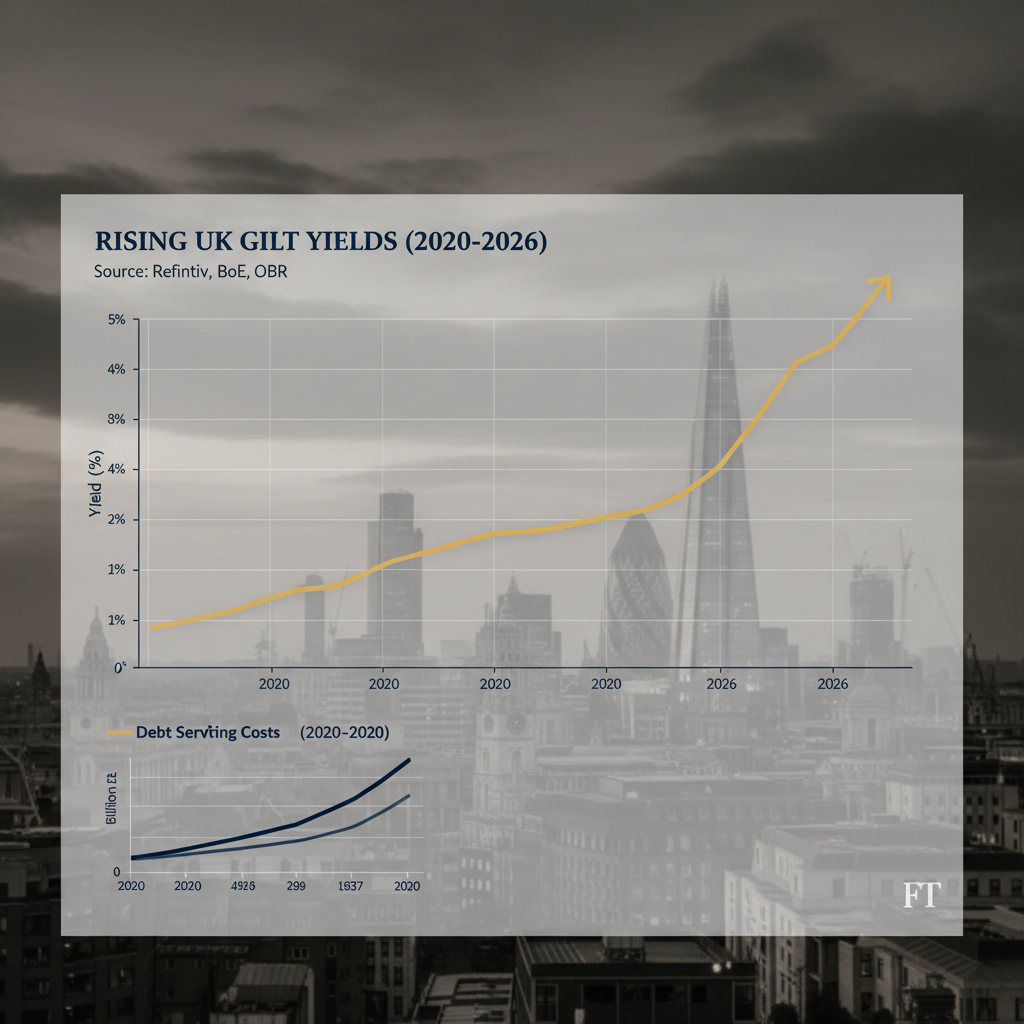
This is the fiscal trap. You cannot cut welfare without harming the vulnerable. You cannot raise taxes without driving away the people who pay them. You cannot borrow more without spooking the bond markets. The yield on 10-year UK government bonds has risen to 4.9%, 80 basis points above German bunds. That spread is the market’s way of saying: I do not trust your arithmetic.
The political paralysis
The crisis is also political. The Labour Party won a landslide in 2024 with 63% of the seats on 34% of the vote. That is a recipe for weak legitimacy. The Conservative Party, meanwhile, has retreated into a factional war over Brexit and immigration. Neither party is offering a credible plan for growth.
Sir Keir Starmer’s government talks about “stability” and “investment.” But its actions tell a different story. The Employment Rights Bill, which gives workers day-one rights and bans zero-hours contracts, has been welcomed by unions and condemned by business groups. The Confederation of British Industry estimates it will cost employers £9.7 billion a year. The net-zero transition, meanwhile, is being pushed through with targets that the government’s own climate advisors admit are unachievable without massive public spending.
The result is a country that is harder to govern. Public trust in government has fallen to 28%, according to the latest British Social Attitudes survey. Voter turnout in the 2025 local elections was just 37%. People have stopped believing that the system can deliver.
What must be done
I do not believe Britain is doomed. The country still has world-class universities, a deep financial sector, and the English language. But the path requires hard choices that neither major party is willing to articulate.
First, the tax system must be simplified and made more predictable. The current system has 1,200 pages of tax law. That is not a code; it is a deterrent. Second, welfare reform must focus on getting people back into work, not just cutting benefits. The Netherlands has shown it is possible to reduce disability claims by 30% through early intervention and employer mandates. Third, the planning system must be reformed to allow housebuilding and infrastructure. The average time to get planning permission for a new factory is 18 months. That is absurd.
None of this will happen without a political consensus. But the current trajectory is unsustainable. The people who fund the welfare state are leaving. The people who depend on it are staying. That arithmetic does not work in the long run.
The Solihull engineer has not yet moved to Düsseldorf. But he has bought a flat there. He is hedging his bets. So is the country.
메타데이터
- post_id
- 25fa5a23daed
- slug
- uk-faces-a-crisis-of-confidence-as-investors-and-businesses-exit-25fa5a23daed
- url
- https://medium.com/@bean_flickr69/uk-faces-a-crisis-of-confidence-as-investors-and-businesses-exit-25fa5a23daed
- canonical_url
- https://medium.com/@bean_flickr69/uk-faces-a-crisis-of-confidence-as-investors-and-businesses-exit-25fa5a23daed
- author_url
- https://medium.com/@bean_flickr69
- status
- ok
- fetched_at
- 2026-06-09 15:37:30