Rakugo: Japan’s Art of Storytelling with Almost Nothing
How Shōwa Genroku Rakugo Shinjū makes a living tradition feel legible — without turning it into a museum label
Rakugo: Japan’s Art of Storytelling with Almost Nothing
How Shōwa Genroku Rakugo Shinjū makes a living tradition feel legible — without turning it into a museum label
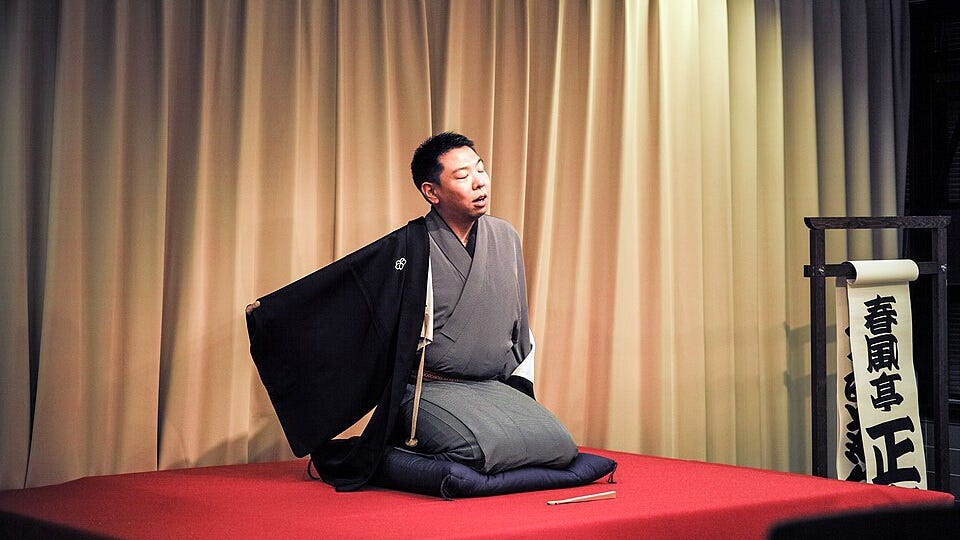
Photo by akira kawamura (via Wikimedia Commons)
It’s easy to imagine the setup even if you’ve never been in the room: one performer, seated on a bare stage, holding almost nothing—often just a folding fan and a small cloth. No set changes. No props to lean on. And yet, within minutes, a street corner appears. A stubborn customer. A nervous apprentice. A wife who already knows how this argument ends.
Rakugo—Japan’s solo comic storytelling tradition—doesn’t build its power by adding more. It does the opposite. It asks what a voice, a body, and timing can create when everything else is stripped away.
This essay isn’t a review, and it isn’t a travelogue. It’s a look at rakugo as a cultural form—its deliberate constraints, its urban textures, its apprenticeship ethos—and then a short look at how *Shōwa Genroku Rakugo Shinjū* helps that form become emotionally readable for viewers who may never attend a live performance.
Rakugo is often labeled “traditional.” That’s true, but incomplete. It’s also practical. It’s work. It’s social. It’s a craft that treats attention as something you earn, not something you seize.
A story told sitting down
Rakugo is performed by a single storyteller, usually seated. The performer typically uses two small items: a folding fan (sensu) and a cloth (tenugui). With those, they can suggest everyday objects—chopsticks, a letter, a pipe, a towel—without ever turning the stage into a full theatre scene. The simplicity is not a budget constraint. It’s the form.
A rakugo performer shifts between characters by turning slightly left or right and changing voice, gaze, and tempo. A conversation can unfold without anyone “entering” or “exiting.” What changes is the angle of the neck, the weight of a pause, the speed of a sentence that pretends it isn’t rushing toward a punchline.
If you only describe the mechanics, rakugo can sound like a clever trick. In practice, it’s closer to a controlled instability. With almost nothing to distract the audience, every choice becomes exposed. The performer can’t hide a weak moment behind spectacle. Timing has to carry meaning.
That’s why rakugo’s simplicity is deceptive. It’s simple the way a well-made lock is simple: small parts, tight tolerances, no room for sloppiness.
Urban DNA: comedy as everyday memory
Rakugo has deep ties to city life—especially the culture that grew around Edo (the historical name for Tokyo). Many classic stories are populated by shopkeepers, tenants, hustlers, gamblers, petty officials, neighbors who can’t mind their own business. The comedy often comes from social friction: pride, hunger, impatience, status anxiety, the awkwardness of asking for what you want.
Even when the situations get exaggerated, they tend to stay anchored in recognizable social textures. Rakugo doesn’t need grand plots. It thrives on the micro-politics of ordinary interaction. It treats the “small” moments—misheard words, delayed decisions, public embarrassment—as the places where character becomes visible.
That’s one reason rakugo can feel alive rather than ceremonial. Its setting is the everyday, and the everyday doesn’t expire.
There’s also a communal premise in the form itself. Rakugo assumes that listening is a shared act. The performer is managing a room, not broadcasting at it. Laughter isn’t just a reaction. It’s the proof that attention is circulating.
Apprenticeship as culture
Rakugo is often taught through apprenticeship. The apprentice learns by watching, assisting, repeating, absorbing rhythms that can’t be captured fully in instructions. It’s not only training in “performance.” It’s training in posture, etiquette, patience, and the subtle discipline of being readable while staying still.
From the outside, apprenticeship can be romanticized as pure tradition. From closer up, it looks like something more concrete: routine. Someone does the slow, daily work of shaping the body and voice into an instrument that can carry stories under constraint.
A key point is that rakugo is bodily knowledge. Yes, it’s language. But it’s language carried by breath, muscle memory, and a controlled face. Stillness is not “doing nothing.” It’s doing something so quietly that the audience doesn’t notice the effort.
That insistence on discipline doesn’t make rakugo cold. It makes it precise. And precision, in this form, is what allows play to land.
When an anime makes a live art feel legible
A paragraph explaining rakugo—seated performer, two props, character shifts—doesn’t convey how it feels when the room begins to move with the storyteller’s rhythm. Rakugo is built on invisible labor: timing, breath, control, trust in the audience’s patience.
This is where *Shōwa Genroku Rakugo Shinjū* becomes unusually helpful. Not because it replaces live performance, but because it translates certain elements of rakugo into a different language of attention.
The series centers on rakugo performers and the world around them. Its real achievement isn’t simply “including rakugo.” It’s making the craft emotionally comprehensible.
Technique becomes atmosphere
The anime can linger on a held breath, a small change in the eyes, a silence that doesn’t read as emptiness but as pressure. Close-ups do something a theatre audience doesn’t typically get: they make the effort visible without breaking the spell. You start to feel the tension behind “effortless.”
Time becomes a substance
Rakugo lives on timing—delaying, accelerating, letting a sentence hang just long enough for the audience to do half the work. The show respects that. Rakugo scenes aren’t treated as cultural wallpaper or quick exposition. They’re allowed to take time, and that patience makes mastery legible. You can sense what has been rehearsed for years because the series doesn’t cut away the moment it becomes quiet.
Apprenticeship becomes relational
By dwelling on teacher–student dynamics, the series shows something essential: rakugo isn’t just a set of stories. It’s a lineage of attention. The craft moves through people—through devotion, resentment, rivalry, longing for recognition, fear of failing in public. The “tradition” is not a museum object. It’s a network of relationships that keeps the form alive.
The result is that rakugo reads less like a cultural fact and more like a lived practice—something fragile enough to be hurt, and strong enough to endure.
Rakugo doesn’t chase attention — it earns it, one deliberate pause at a time.
Why It Matters
Rakugo matters because it reveals a cultural logic that is easy to miss when you only look for spectacle: meaning can be made under restraint.
In many contemporary media environments, attention is gathered through accumulation—more noise, more speed, more cues, more urgency. Rakugo works through the opposite design. It doesn’t flood the senses. It tightens the frame. It asks the audience to stay with small shifts and reward them with a fuller world.
That isn’t nostalgia. It’s a practical method. Rakugo treats attention as something crafted through trust: the performer trusts the audience to follow; the audience trusts the performer to take them somewhere worth going. That mutual trust is a social achievement, not a personal mood.
Culturally, rakugo also offers a grounded way to think about “tradition.” The tradition survives because it is embodied. Because people train. Because someone repeats a movement until it becomes clean. Because the craft is transmitted, not merely celebrated.
And if Shōwa Genroku Rakugo Shinjū lands so strongly for many viewers, it’s partly because it makes that transmission visible: not as an abstract value, but as time spent, bodies tired, relationships strained and repaired, pride swallowed, timing refined.
Putting It Together
Rakugo is often introduced as “a traditional Japanese storytelling performance.” That description is accurate, but it can leave the form at a safe distance—something you “learn about.”
A better way to understand it is closer to craft than to trivia. Rakugo is a disciplined method for building a world with almost nothing. Its minimal tools sharpen the performer’s responsibility. Its city-born stories keep it close to everyday life. Its apprenticeship system shows how culture travels: through bodies, routines, and relationships that insist on patience.
Shōwa Genroku Rakugo Shinjū doesn’t modernize rakugo by flattening it into a message. It makes rakugo legible by staying faithful to its mechanics—its tempo, its restraint, its emotional risk. It treats rakugo as a living practice rather than an aesthetic ornament.
In the end, rakugo’s most surprising feature may be this: the less it gives you on the surface, the more it asks you to participate. And that participation—shared attention, sustained over time—is not only an artistic experience. It’s a cultural one.
Sources
Encyclopaedia Britannica — “Rakugo” overview: https://www.britannica.com/art/rakugo
Japan Arts Council (NTJ) — resources on Japanese performing arts: https://www2.ntj.jac.go.jp/
Wikimedia Commons — free-to-use rakugo images (with proper attribution): https://commons.wikimedia.org/wiki/Category:Rakugo
메타데이터
- post_id
- 26090e8f1c0d
- slug
- rakugo-japans-art-of-storytelling-with-almost-nothing-26090e8f1c0d
- url
- https://medium.com/japonica-publication/rakugo-japans-art-of-storytelling-with-almost-nothing-26090e8f1c0d
- canonical_url
- https://medium.com/japonica-publication/rakugo-japans-art-of-storytelling-with-almost-nothing-26090e8f1c0d
- author_url
- https://medium.com/@darius.ahmadi
- status
- ok
- fetched_at
- 2026-07-13 09:30:18