Ancient Greek civilization: Athens
- Greek democracy - The archons - The Areopagus - Draco…
Ancient Greek civilization: Athens
The history of Athens is closely tied to the history of Greek democracy. It was in Athens that this form of political regime, which contributed to the city’s greatness and spread throughout the Greek world, developed. However, the early history of Athens remains obscure. It is known that there was a palace at the future city’s location during the Mycenaean period, surviving the destruction at the end of the second millennium. This allowed Athens to be a refuge for Greeks who settled in Ionia in the early 11th century. Little is known about the city’s history before the late 7th century. Aristotle, in the first part of the Constitution of Athens, reports that the original royal power was divided among three archons, later joined by six thesmothetes. Initially appointed for life, then elected for ten years, and finally annually, these archons governed with the assistance of a council of elders on the hill of Ares, known as the Areopagus. Two events marked the late 7th century: Cylon’s attempt to establish tyranny, thwarted by archon Megacles of the Alcmaeonid family, and Draco’s creation of a legal code regulating punishment for crimes of bloodshed. Aristotle also attributes a constitution to Draco, which modern critics consider a forgery from the late 5th century by those opposed to democracy.
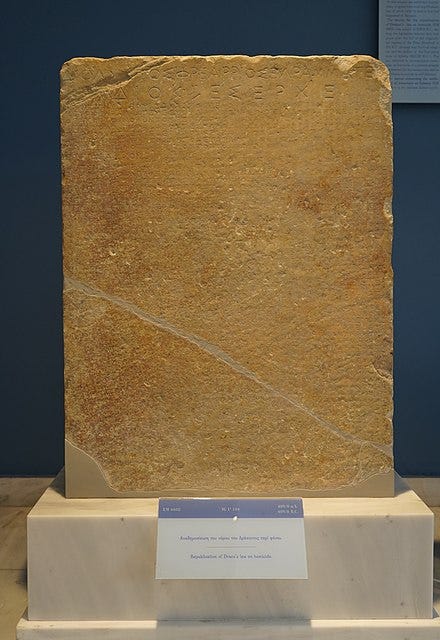
Draco's Law stele, republished in 409/408. Epigraphic Museum of Athens.
With the beginning of the 6th century, and despite the numerous obscurities that remain, the history of Athens becomes more coherent. A serious crisis threatened to break the unity of the city, linked to the difficult situation of indebted or dependent small peasants. Solon, elected archon, resolved the crisis by abolishing peasant dependence and debt, and by drafting a new legal code, much more comprehensive than Draco’s, and notably uniform for all. He refused to proceed with the equal distribution of land demanded by some. He is said to have also established a property-based classification of Athenians and, according to Aristotle, empowered the people over the courts. In the 4th century, Solon was often regarded as the founder of democracy, attributing to him many institutions that would only emerge later in the 6th century. Solon withdrew once his work was done, but disturbances continued, indicating the partial nature of his reforms. Factional struggles among aristocratic groups persisted until Pisistratus' tyranny put an end to them. Pisistratus had to make three attempts before firmly establishing himself in power. While respecting existing institutions, he governed as an absolute master. Under his tyranny and that of his sons who succeeded him, Athens experienced significant development. When Athenian aristocrats, aided by the Spartans, overthrew the tyrants, they couldn’t establish an oligarchic regime. Supported by the "demos," Alcmaeonid Cleisthenes completely changed the structures of Athenian society, replacing ancient Ionian tribes with territorial tribes, and creating the "Boule" of the Five Hundred, a direct emanation of the "demos" that would become the cornerstone of Athens' democratic constitution. The Persian Wars, with the dual victories of Athenian hoplites at Marathon (490 BCE) and Athenian sailors at Salamis (480 BCE) against the Persians, would consolidate the young Athenian democracy. Its triumph was definitively ensured by Ephialtes' reforms in 462/461 BCE and the institution of misthophoria by Pericles.
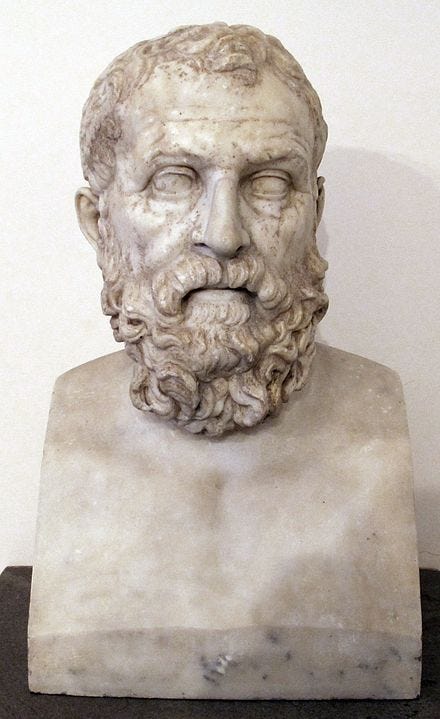
Solon
During the period when Pericles led Athens as a strategist and orator, it was the pinnacle of democracy. The empire’s influence over the Aegean world and the tributes from allies allowed the regime to function smoothly. Payments like "misthoi" for public officeholders and wages for fleet rowers provided citizens with additional resources, preventing social unrest. However, the Peloponnesian War disrupted this balance, lasting over a quarter-century with repeated devastations to Athens' territory, a significant defeat in Sicily, and two oligarchic revolutions. Despite the population’s democratic attachment, Athens faced challenges, including financial difficulties and internal political strife. While democracy was restored twice, in 410 BCE and permanently in 403 BCE, Athens in the 4th century no longer held the power it once did. Economic prosperity briefly returned after 356 BCE, under Eubulus, pursuing a policy of peace and exploiting African resources. Another period of relative prosperity occurred after the defeat at Chaeronea, as Athens distanced itself from the upheaval in the Aegean. Yet, these brief respites couldn’t prevent the city’s final decline. Despite attempts to lead a war against Macedonian influence after Alexander’s death, Athens suffered a defeat leading to the demise of its democratic regime. Although democracy was reinstated several times in the late 4th and early 3rd centuries, it became more symbolic than real, under the watchful eye of a Macedonian garrison in Piraeus and subject to the whims of Macedonian rulers. The glory of the city and the essence of democracy were definitively over.

Pericles
메타데이터
- post_id
- 260fc6ab5e39
- slug
- ancient-greek-civilization-athens-260fc6ab5e39
- url
- https://medium.com/@osmont.gregory/ancient-greek-civilization-athens-260fc6ab5e39
- canonical_url
- https://medium.com/@osmont.gregory/ancient-greek-civilization-athens-260fc6ab5e39
- author_url
- https://medium.com/@osmont.gregory
- status
- ok
- fetched_at
- 2026-07-24 16:21:47