The Fastest Way to Lose a Government Contract Isn’t Your Technical Solution
Most federal proposals don’t fail because of weak ideas. They fail because of avoidable compliance mistakes.
The Fastest Way to Lose a Government Contract Isn’t Your Technical Solution
Most federal proposals don’t fail because of weak ideas. They fail because of avoidable compliance mistakes.
Every year, contractors invest hundreds of hours responding to government solicitations.
They bring in subject matter experts.
They refine technical approaches.
They carefully develop pricing strategies.
And then some of those proposals never receive a meaningful evaluation.
Why?
Because compliance comes before capability.
One misconception we see repeatedly among government contractors is the belief that a strong technical solution can compensate for proposal weaknesses.
In federal procurement, that’s rarely how the process works.
Government evaluators cannot overlook missing requirements, interpret incomplete responses, or make assumptions about information that wasn’t provided.
If a proposal doesn’t comply with the solicitation, its technical strengths may never matter.
Compliance Isn’t Administrative Work
Many teams treat compliance as a final review step.
Experienced proposal teams treat it as a strategy.
The federal market rewards discipline just as much as expertise.
A proposal can contain the best solution in the competition and still be eliminated because of
- Missing required documents
- Exceeding page limits
- Incorrect formatting
- Failure to follow Section L instructions
- Incomplete responses to evaluation criteria
These aren’t minor mistakes.
They’re often proposal-ending mistakes.
For a deeper breakdown of compliance requirements, our **government proposal compliance checklist** provides a practical framework for proposal teams navigating federal solicitations.
The Two Sections That Matter Most
When reviewing a solicitation, two sections deserve immediate attention.
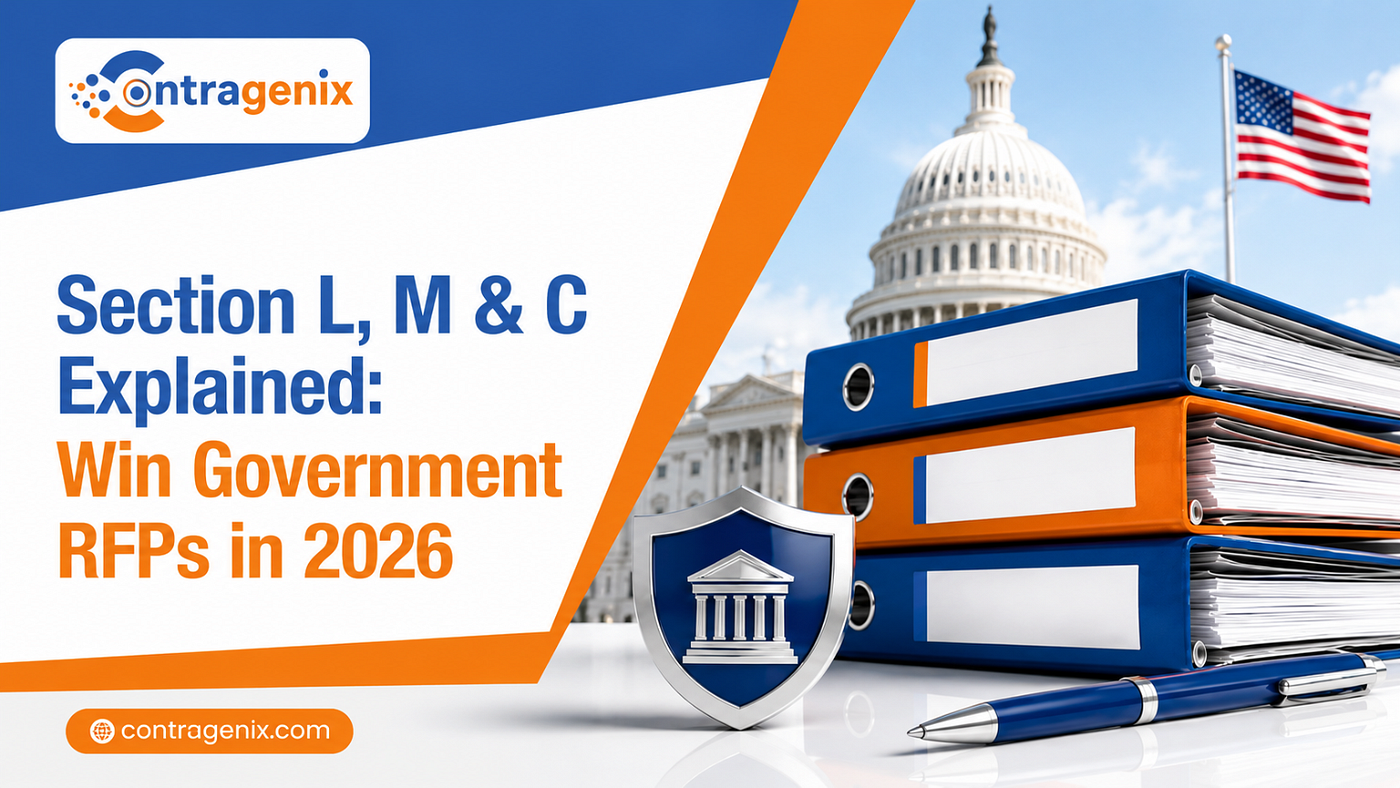
Section L — Instructions to Offerors
This section explains exactly how the proposal must be prepared and submitted.
It typically covers:
- Required proposal volumes
- Page limitations
- Formatting requirements
- Submission procedures
- Required attachments
Ignoring even one instruction can create compliance risks that impact evaluation.
Section M — Evaluation Criteria
This section explains how the government will evaluate proposals.
It tells contractors what evaluators are looking for and how scoring decisions will be made.
One of the most common mistakes contractors make is focusing heavily on Section L while failing to align their response with Section M.
Winning proposals address both.
Why Strong Proposals Still Get Rejected
After supporting proposal efforts across a wide range of opportunities, one pattern appears repeatedly:
Many contractors focus on what they want to tell the government instead of what the government is asking them to demonstrate.
The result is often a proposal that is technically impressive but difficult to evaluate.
Government evaluators are not looking for the longest proposal.
They are looking for clear evidence that the contractor:
- Understands the requirement
- Can execute successfully
- Meets all solicitation requirements
- Provides an acceptable level of risk
Complexity does not automatically create confidence.
Clarity does.
The Compliance Habits of Successful Contractors
Organizations that consistently compete well in government contracting tend to follow disciplined proposal development processes.
They review the entire solicitation.
Not just the statement of work.
Not just the technical requirements.
The entire solicitation.
Including:
- Attachments
- Amendments
- Submission instructions
- Evaluation criteria
- Contract requirements
Many compliance issues originate from sections that proposal teams never fully review.
They Build a Compliance Matrix Early
A compliance matrix helps teams map every requirement in the solicitation to a specific proposal section.
This process creates accountability and reduces the likelihood of missed requirements.
It also helps proposal managers track completion status throughout the proposal lifecycle.
The best proposal teams don’t create compliance matrices because they expect problems.
They create them because they know how costly missed requirements can become.
They verify pricing separately.
Pricing compliance is often overlooked until the final stages of proposal development.
Successful teams verify:
- Labor categories
- Rate structures
- Cost calculations
- Required supporting documentation
- Pricing templates
A technically compliant proposal can still encounter issues if pricing requirements are not followed precisely.
They conduct independent reviews.
Strong proposal teams don’t rely on a single review cycle.
They conduct multiple reviews focused on different objectives:
- Compliance reviews
- Content reviews
- Editorial reviews
- Final quality checks
Each review reduces proposal risk and improves overall submission quality.
They Never Wait Until Submission Day
One of the most preventable proposal mistakes is waiting until the last minute to submit.
Submission portals experience issues.
Files become corrupted.
Teams discover formatting errors.
Unexpected problems occur.
The strongest proposal teams build submission time into their schedule rather than treating submission as the final task.
Why Proposal Development Has Become More Specialized
Federal solicitations continue to become more detailed and complex.
Responding effectively often requires coordination between:
- Technical experts
- Proposal writers
- Pricing specialists
- Program managers
- Executive leadership
As a result, proposal development has evolved from an administrative function into a strategic capability.
Many organizations seek support for proposal development for government contracts to help manage compliance, reviews, technical writing, and submission requirements.
The challenge isn’t simply writing.
It’s ensuring that every requirement is addressed, documented, reviewed, and submitted correctly.
Compliance Starts Before Proposal Writing
Another misconception is that compliance begins when writing starts.
In reality, compliance begins much earlier.
It starts during opportunity assessment.
It continues during RFP analysis.
It influences proposal structure, content development, reviews, and final submission.
For organizations new to federal procurement, understanding the broader **government contracting process** can help teams build stronger proposal and capture strategies before pursuing opportunities.
The most successful contractors build compliance into every stage of proposal development rather than treating it as a final checkpoint.
The Reality Most Contractors Learn Too Late
Government evaluators cannot give credit for information that isn’t provided.
They cannot assume capabilities.
They cannot correct proposal deficiencies.
They evaluate what is submitted.
Nothing more.
That’s why proposal compliance is not a paperwork exercise.
It’s one of the most important competitive advantages a contractor can develop.
The strongest government proposals are rarely the most complicated.
They are the most responsive to the solicitation.
The Bottom Line
Most proposal teams spend significant time thinking about how to win.
Not enough time thinking about how proposals get rejected.
The strongest government proposals share a common characteristic:
They make it easy for evaluators to verify compliance, understand the solution, and assess the contractor’s qualifications.
Before improving your technical approach, ask a simpler question:
Would your proposal survive a compliance review?
For readers interested in additional resources on federal procurement, proposal development, and government contracting strategy, visit **Contragenix**.
Discussion
Every contractor encounters compliance challenges at some point.
What’s the most common compliance issue you’ve seen during a proposal effort?
- Missing requirements?
- Page limit violations?
- Last-minute submission problems?
- Weak compliance tracking?
- Misinterpreting Section L instructions?
- Incomplete pricing documentation?
Share your experience in the comments. The lessons learned from proposal compliance are often the ones contractors remember the longest.
메타데이터
- post_id
- 26388b4d735b
- slug
- the-fastest-way-to-lose-a-government-contract-isnt-your-technical-solution-26388b4d735b
- url
- https://medium.com/@sam.fatima_72398/the-fastest-way-to-lose-a-government-contract-isnt-your-technical-solution-26388b4d735b
- canonical_url
- https://medium.com/@sam.fatima_72398/the-fastest-way-to-lose-a-government-contract-isnt-your-technical-solution-26388b4d735b
- author_url
- https://medium.com/@sam.fatima_72398
- status
- ok
- fetched_at
- 2026-07-10 06:10:56