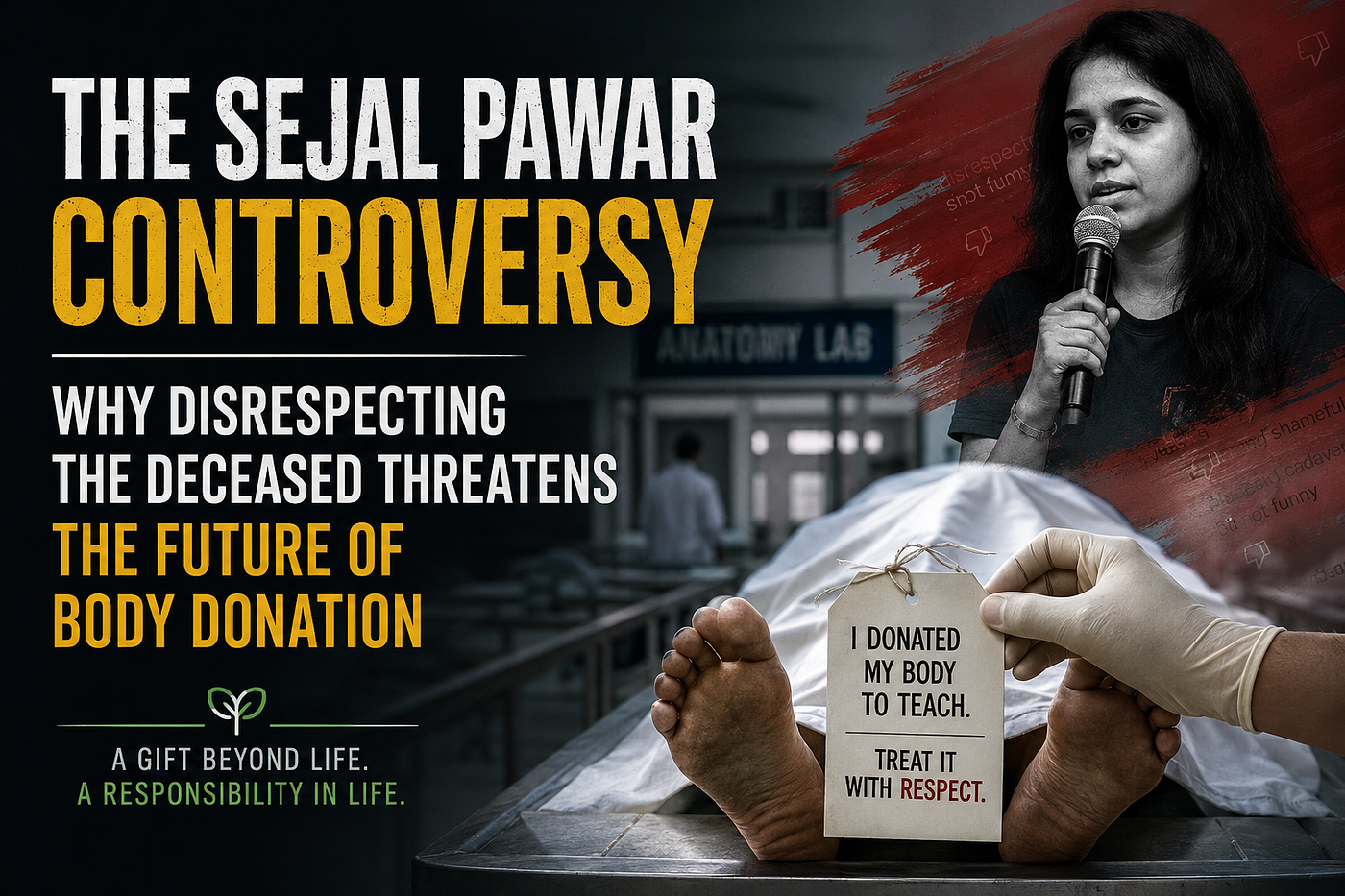
The Sejal Pawar Controversy: Why Disrespecting the Deceased Threatens the Future of Body Donation
The controversy surrounding Sejal Pawar has sparked intense public debate. Much of the discussion has focused on outrage, punishment, and…
The Sejal Pawar Controversy: Why Disrespecting the Deceased Threatens the Future of Body Donation
The controversy surrounding Sejal Pawar has sparked intense public debate. Much of the discussion has focused on outrage, punishment, and social media backlash. Those conversations are understandable. But they may also be distracting us from the most important issue.
The real concern is not a viral clip.
It is trust.
And trust is the foundation on which body donation programs survive.
According to reports, the controversy arose after remarks made about cadavers during a comedy show were widely perceived as disrespectful toward deceased individuals whose bodies had been donated for medical education. The comments triggered criticism from medical organizations, hospital authorities, students, doctors, and members of the public. Investigations followed, disciplinary action was initiated, and the incident quickly became a national discussion.
Yet the deeper question is far larger than any one individual.
What happens when people begin to wonder whether their bodies will be treated with dignity after death?
That question should concern every medical college, every doctor, and every citizen.
The Extraordinary Gift Few People Talk About
Body donation is one of the most selfless acts a person can make.
A donor receives no benefit.
There is no reward, recognition, or personal gain.
Someone simply decides that after death, their body can help train future doctors, improve medical education, and ultimately save lives.
Medical students often refer to cadavers as their “first teachers.” The phrase may sound symbolic, but it reflects a profound reality. Before a student performs surgery, treats a patient, or enters a hospital ward as a physician, much of their understanding of the human body begins in the anatomy laboratory.
Every donated body represents a human life.
A family.
A story.
A deliberate act of generosity.
That generosity depends on one assumption: respect.
Without it, the entire system becomes fragile.
Trust Is Easier to Lose Than to Build
Medical institutions spend years encouraging body donation.
Many families are already hesitant.
Religious beliefs, cultural traditions, emotional attachments, and social pressures often make the decision difficult. Even individuals who support science may struggle with the idea of donating their bodies after death.
When someone finally chooses to do so, they are placing enormous trust in medical institutions.
They are essentially saying:
“I believe you will treat my remains with dignity.”
Trust like that takes decades to build.
A single public controversy can damage it surprisingly quickly.
This is why the Sejal Pawar incident resonated so strongly. The concern was never merely about a joke. The concern was about what the joke seemed to reveal.
If donors are seen as material for entertainment rather than individuals deserving respect, future donors may start asking uncomfortable questions.
And once those questions begin, donation rates can suffer.
Several medical professionals and students have publicly expressed concern that incidents of this nature could discourage future body donations and undermine public confidence in medical education.
That fear should not be dismissed.
It is entirely reasonable.
The Dead Cannot Defend Themselves
There is another reason this issue feels different from many public controversies.
The deceased cannot respond.
They cannot object.
They cannot explain who they were.
They cannot protect their dignity.
That responsibility falls entirely on the living.
Civilized societies have always recognized this principle. We treat human remains differently because they represent human beings who once lived among us. Respect for the dead is not simply a religious idea or a cultural tradition.
It is a reflection of how we value human dignity itself.
When that respect weakens, something important is lost.
Not only in medicine.
In society.
Professionalism Begins Long Before Graduation
One of the most revealing aspects of the controversy is how strongly many medical students reacted.
Across professional forums and discussions, numerous students emphasized that anatomy education is built upon respect for donors and that cadavers should never be reduced to objects of amusement.
That response matters.
It suggests that many future doctors understand what is at stake.
Professionalism is often discussed in terms of patient care, ethics committees, and hospital conduct. But professionalism begins much earlier.
It begins when students first encounter the human body in an anatomy lab.
It begins when they learn that knowledge carries responsibilities.
And it begins when they understand that technical skill without respect is incomplete.
A brilliant surgeon who lacks empathy is still missing something essential.
Medicine is not only about understanding the body.
It is also about honoring the person.
A Larger Lesson for the Digital Age
The controversy also highlights a broader cultural problem.
Today, nearly everything can become content.
Moments become clips.
Experiences become jokes.
Serious subjects become material for engagement.
The internet rewards attention, not necessarily judgment.
But not every subject belongs in the same category.
Some boundaries exist for good reasons.
Human remains are one of them.
Body donation is one of them.
The challenge facing modern professionals is learning where those boundaries should remain intact, even in an age that constantly pushes against them.
What Should Happen Next?
The goal should not be endless outrage.
Outrage rarely solves underlying problems.
The goal should be restoring trust.
Medical institutions should use incidents like this as opportunities to strengthen ethics education, reinforce the importance of donor dignity, and communicate clearly with the public about how donated bodies are treated.
Most importantly, society should continue celebrating those who choose body donation.
Their contribution remains invaluable.
Without them, medical education becomes weaker.
Future doctors become less prepared.
And ultimately, patients suffer.
The Real Victims of Lost Trust
The long-term danger of controversies like this is not damage to reputations.
Reputations recover.
Public attention moves on.
The greater risk is that potential donors quietly change their minds.
A family that was considering donation decides against it.
A person who intended to register never completes the paperwork.
A future donor begins to wonder whether their generosity will truly be respected.
Those decisions happen privately.
No headlines announce them.
Yet they can have lasting consequences for medical education.
That is why the conversation matters.
The Sejal Pawar controversy is not ultimately about one student, one joke, or one disciplinary inquiry.
It is about preserving public trust in a system that depends entirely on voluntary generosity.
Body donation is one of the highest expressions of public service after death.
The least society can do in return is ensure that such generosity is met with dignity, gratitude, and respect.
Anything less risks discouraging the very people whose final gift helps train the doctors of tomorrow.
메타데이터
- post_id
- 26421e720ce9
- slug
- the-sejal-pawar-controversy-why-disrespecting-the-deceased-threatens-the-future-of-body-donation-26421e720ce9
- url
- https://medium.com/@iitkarthik/the-sejal-pawar-controversy-why-disrespecting-the-deceased-threatens-the-future-of-body-donation-26421e720ce9
- canonical_url
- https://medium.com/@iitkarthik/the-sejal-pawar-controversy-why-disrespecting-the-deceased-threatens-the-future-of-body-donation-26421e720ce9
- author_url
- https://medium.com/@iitkarthik
- status
- ok
- fetched_at
- 2026-06-22 05:41:33