Hats off to science: A new drug doubles survival in pancreatic cancer
A genetic breakthrough produced a seismic shift in oncology.
**Hats off to science: **A new drug doubles survival in pancreatic cancer
A genetic breakthrough produced a seismic shift in oncology.
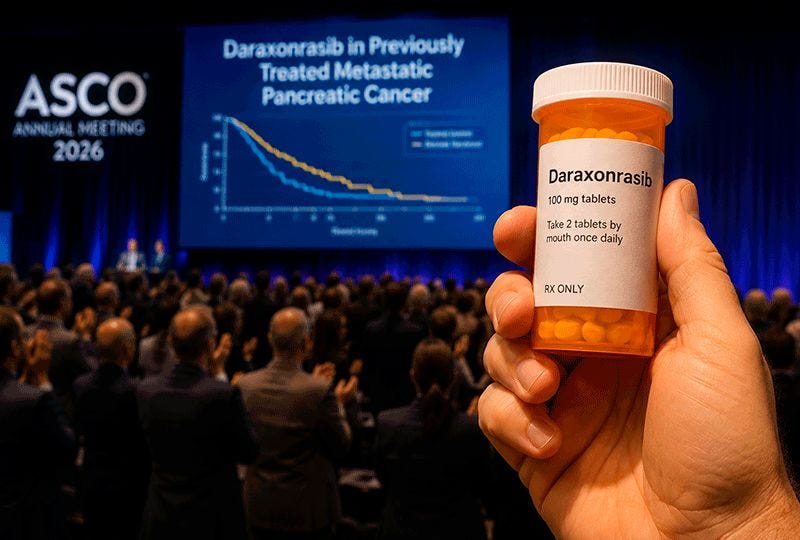
Image credit: A presenter at the ASCO 2026 Annual Meeting displays the survival rate breakthrough for daraxonrasib. Source: ASCO via Russian Time Magazine
It wasn’t just applause. It was a true roar. A very unusual reaction in the world of medical conferences. Thousands of cancer specialists cheered, whistled, and rose to their feet for a 42-second standing ovation during a presentation. Hundreds of thousands of patients felt hope.
I wish I saw this joy a decade ago, when one of my uncles died of pancreatic cancer. But more than anything, I wish I heard good news on treatment of tumors — one of which killed my father one month before my second son — his third grandchild — was born almost 17 years ago.
The reason ovation erupted is a slide presented by Dr. Brian Wolpin of the Dana-Farber Cancer Institute at the 2026 American Society of Clinical Oncology (ASCO) Annual Meeting this week. It showed a single, staggering number: a 60% reduction in the risk of death for patients with metastatic pancreatic cancer taking an experimental new drug called daraxonrasib.
It was developed by Revolution Medicines, a biopharmaceutical company based in Redwood City, California, while Dana-Farber Cancer Institute in Boston, Massachusetts, provided independent clinical research expertise to test it in patients.
When the applause finally subsided, Dr. Wolpin could only ad-lib: “That time was not built into my talk.”

Image credit: ASCO
For a disease that has long been considered a death sentence — one that has defied decades of scientific attempts to crack its code — the moment marked a seismic shift. For the first time, the “undruggable” enemy at the heart of pancreatic cancer had been brought to its knees.
Why pancreatic cancer is so difficult
To understand why the applause lasted so long, you have to understand the scale of the tragedy pancreatic cancer represents.
While overall cancer survival rates have climbed dramatically — the American Cancer Society reports that the five-year survival rate for all cancers combined now stands at 70% — pancreatic cancer has remained stubbornly, cruelly, behind. Its five-year survival rate is just 13%. In 1995, that number was just 5%, according to *Oncology News Central*.
Progress has been made, but it has been glacial.
The problem is twofold. First, the pancreas sits deep in the abdomen, so tumors grow silently. By the time symptoms appear — jaundice, abdominal pain, unexplained weight loss — the cancer has often already spread. More than half of patients (51%) are diagnosed at stage IV, when the disease has metastasized to distant organs. For those patients, the five-year survival rate is just 3.4%.
Second, and more fundamentally, pancreatic cancer is driven by a genetic gremlin that scientists spent four decades failing to stop.

More than 90% of pancreatic ductal adenocarcinomas (PDACs) — the most common form of the disease — harbor mutations in a gene called KRAS. This gene produces a protein that acts as a master switch for cell growth. When mutated, the switch gets stuck in the “on” position, commanding cancer cells to multiply endlessly.
For decades, KRAS was considered “undruggable.” Its surface is unusually smooth, lacking the deep pockets that drugs need to bind to and disable it. Scientists tried everything but nothing really worked.
A game changer
But in recent years, a new approach emerged. Instead of attacking KRAS directly, a new class of drugs — called RAS(ON) inhibitors — targets the protein’s active, cancer-causing state. Daraxonrasib, developed by Revolution Medicines, is one of these.
It works by attaching a cellular protein called cyclophilin A, and this complex then binds to the active KRAS protein and flips the switch to “off.”
The Phase 1/2 trial showed promise. But no one was prepared for what the Phase 3 trial RASolute 302 would deliver.
It was a global, randomized, open-label study (see the findings in The New England Journal of Medicine). It enrolled 500 adults with metastatic PDAC who had already received one prior course of chemotherapy. Patients were randomized 1:1 to receive either oral daraxonrasib (300 mg daily) or the investigator’s choice of standard second-line chemotherapy regimens.
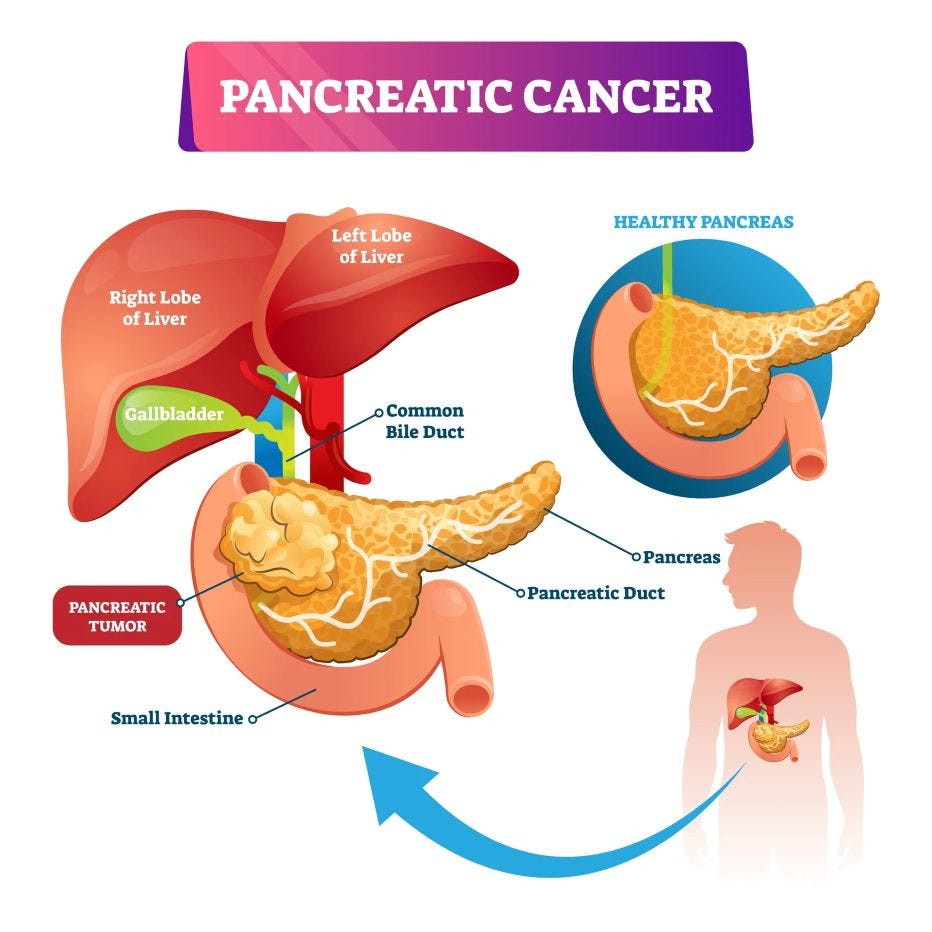
Image credit: Nature
The results were unambiguous.
In the overall patient population, the median overall survival for patients taking daraxonrasib was 13.2 months — nearly double the 6.7 months seen in patients receiving standard chemotherapy. The hazard ratio for death was 0.40, meaning a 60% reduction in the risk of death.
The drug also doubled the time patients lived without their cancer worsening. Median progression-free survival was 7.2 months for daraxonrasib versus 3.6 months for chemotherapy.
The objective response rate — the percentage of patients whose tumors shrank significantly — was 31.6% for daraxonrasib, compared to just 11.2% for chemotherapy.
And crucially, the benefit wasn’t limited to patients with specific KRAS mutations. The survival advantage was seen broadly, across different RAS mutations and even in patients with wild-type (non-mutated) RAS.

A drug patients can live with
Perhaps as important as what the drug does is what it doesn’t do. Chemotherapy is a blunt instrument, killing rapidly dividing cells indiscriminately. It saves lives, but it exacts a heavy toll.
Daraxonrasib, by contrast, was far better tolerated.
While the most common side effects were a prominent skin rash (affecting over 86% of patients) and stomatitis (mouth sores), patients on daraxonrasib were significantly less likely to need dose reductions (36.1% vs. 57.5% for chemo) and far less likely to stop treatment altogether due to side effects (1.2% vs. 11.2%).
The study claims that patient-reported outcomes showed that those taking daraxonrasib experienced significantly better quality of life, with delayed deterioration in pain symptoms and overall health status compared to those on chemotherapy.
To appreciate why this drug is so significant, it helps to understand just how central KRAS mutations are to pancreatic cancer — and how that compares to other cancers.
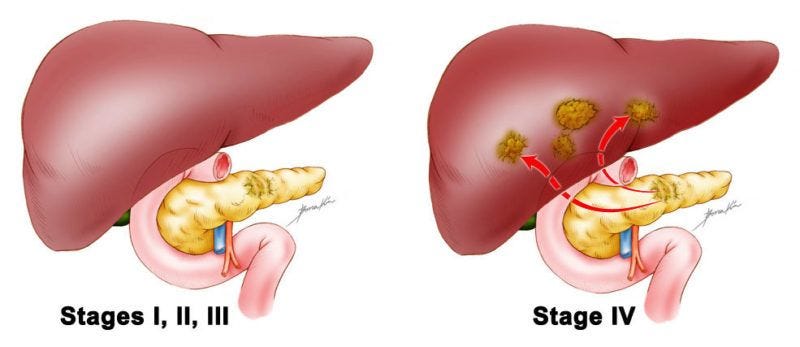
Image credit: Nature
Across all cancer types, KRAS is one of the most frequently mutated oncogenes. A comprehensive analysis of over 10,800 tumor samples found that KRAS mutations are present in about 20% of all malignancies. But the distribution is wildly uneven.
Here is the prevalence of KRAS mutations across different cancers :
-
Pancreatic cancer: 73.51%
-
Colorectal cancer: 41.45%
-
Uterine cancer: 21.23%
-
Biliary tract cancer: 14.56%
-
Lung cancer: 11.24%
-
Gastric cancer: 8.57%
In other words, pancreatic cancer is, genetically speaking, a KRAS-driven disease more than any other common malignancy. This is why a drug that effectively targets KRAS mutations has the potential to fundamentally change the treatment landscape for pancreatic cancer in a way that is less true for other tumor types.
What data say
According to the World Cancer Research Fund, there were an estimated 19.97 million new cases of cancer worldwide (including non-melanoma skin cancer) in 2022, including non-melanoma skin cancer. Out of the total, pancreatic cancer accounted for approximately 511,000 new cases — up from 458,000 in 2018.
North America has the highest incidence rate (8.5 per 100,000), followed by Europe (7.3 per 100,000). China alone accounts for approximately 23.3% of global cases (about 119,000 new cases in 2022).
This is the latest official statistics I could find.

https://medium.com/reflections-and-realities/dad-still-making-love-with-mom-50bf5fc3d5cb
About 70% of patients are diagnosed at an advanced or metastatic stage, when the cancer has already spread — exactly the population studied in the RASolute 302 trial
Revolution Medicines now plans to submit the data to the U.S. Food and Drug Administration through a new fast-track approval pathway that could take as little as two months. The FDA has already allowed the company to begin an expanded access program, making the drug available to eligible patients before formal approval.
If approved — and all signs point to yes — daraxonrasib will become the first targeted therapy approved for pancreatic cancer that directly attacks the fundamental genetic driver of the disease.
For the 67,530 Americans who will be diagnosed with pancreatic cancer this year, and the 52,740 who will die from it, that day may not come soon enough.
In May this year, I received $65 in donations via BuyMeCoffee. For the first time in my life, absolute strangers — people whose names I don’t even know — sent me money simply because they appreciated my writing. It’s a feeling I can’t yet describe. Thanks for taking the time to read my stories.
메타데이터
- post_id
- 26450ae1cce7
- slug
- hats-off-scientists-just-increased-the-survival-rate-from-pancreatic-cancer-26450ae1cce7
- url
- https://medium.com/reflections-and-realities/hats-off-scientists-just-increased-the-survival-rate-from-pancreatic-cancer-26450ae1cce7
- canonical_url
- https://medium.com/reflections-and-realities/hats-off-scientists-just-increased-the-survival-rate-from-pancreatic-cancer-26450ae1cce7
- author_url
- https://medium.com/@sensmedia.srl
- status
- ok
- fetched_at
- 2026-06-09 15:37:30