Distributed System Architecture
Distributed system architectures are bundled up with components and connectors. Components can be individual nodes or important components…
Distributed System Architecture
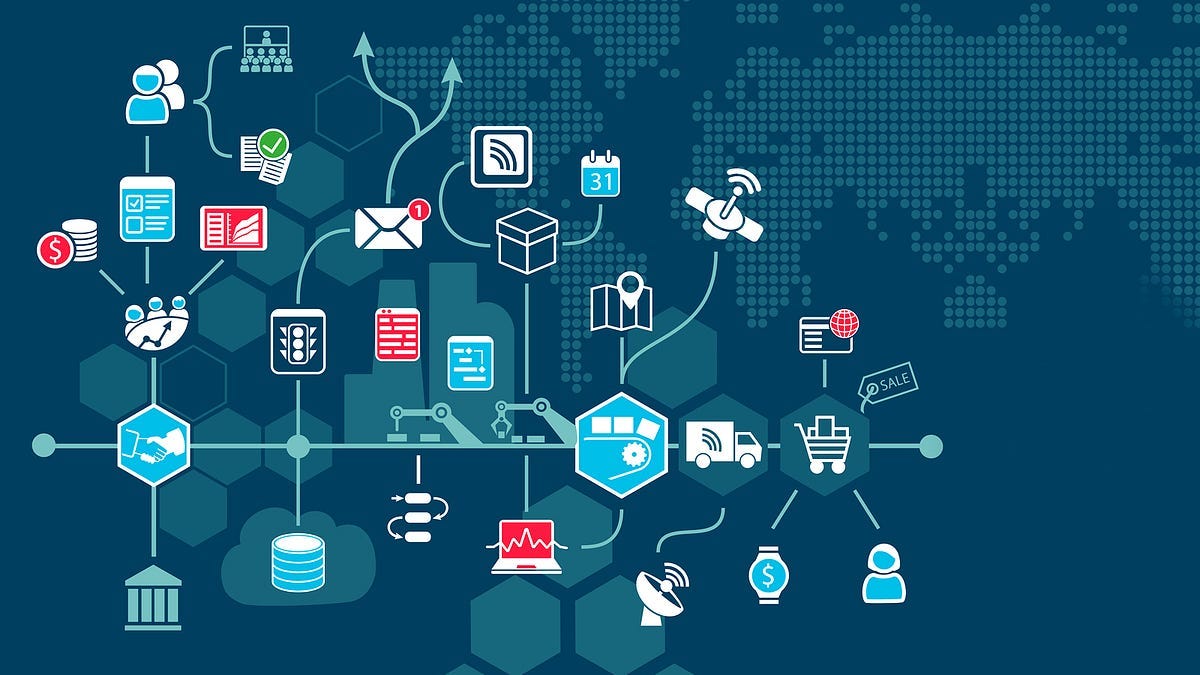
Distributed system architectures are bundled up with components and connectors. Components can be individual nodes or important components in the architecture whereas connectors are the ones that connect each of these components.
- Component: A modular unit with well-defined interfaces , replaceable, reusable
- Connector: A communication link between modules which mediates coordination or cooperation among components
So the idea behind distributed architectures is to have these components presented on different platforms, where components can communicate with each other over a communication network in order to achieve specifics objectives.
Architectural Styles
Architectural styles are classified into two major architectures as
1.Software Architecture
2.System Architecture
when it comes to distributed systems.
The basic idea is to organize logically different components, and distribute those computers over the various machines.
Further these architectures are divided into sub concepts such as,
Software Architecture :
- Layered Architecture
- Object Based Architecture
- Data-centered Architecture
- Event Based Architecture
- Hybrid Architecture
System Architecture
- Client-server Architecture
- Peer to Peer Architecture
Software Architecture
Software architectures in distributed systems refer to the high-level structures and design patterns that govern the organization of software components and their interactions within a networked environment. These architectures are essential for developing distributed systems that can efficiently process data, handle communication, and provide services across multiple interconnected nodes. Software architecture has main four architectural styles and combination of the architectures as hybrid architecture in distributed systems.
1. Layered Architecture

Layer architecture allows to organize the different kinds of components, and every layer make the communication in between its adjacent layers by pushing the requests and obtaining the all response. This layered architecture style also separates components into various units then it will be make the sufficient path for communication. Therefore anyone layer is unable to direct makes communication along with other layers. Then a layer is able to interact with its neighboring layers and then further layer for transferring own information to another layer and this process will be continue.
In some scenario, the layered architecture is in cross-layer coordination; and then in this layer, all adjacent layers are able to skip until it complete the request and offer the better performance output. The request flow path from upper to bottom and response flow towards from bottom to upwards. The main benefit of layered architecture is that every layer easily modified individually without getting any affect the entire system. This architecture style is usually used for OSI (Open System Interconnection) model.
2. Object Based Architecture

Object-Based Architecture is a software design approach that shares similarities with Object-Oriented Architecture (OOA) but differs in some fundamental aspects. While Object-Oriented Architecture focuses on creating complex systems using objects that combine data and behavior, Object-Based Architecture primarily emphasizes data encapsulation and abstraction, making it a useful choice for certain types of software systems.
At the core of Object-Based Architecture is the concept of objects, much like in OOA. These objects encapsulate data or attributes, representing real-world entities or abstract concepts within a software system. However, in Object-Based Architecture, the emphasis lies more on the data itself than on the behaviors associated with the objects.
One key feature of Object-Based Architecture is data abstraction. Objects in this architecture encapsulate data and provide well-defined interfaces for accessing and manipulating that data. This abstraction shields the internal data representation from external components, enhancing security and promoting data consistency and integrity.
Unlike Object-Oriented Architecture, Object-Based Architecture does not enforce the encapsulation of behavior (methods or functions) within objects. While objects in OOA often encapsulate both data and methods that operate on that data, Object-Based Architecture primarily focuses on data encapsulation. This means that in Object-Based systems, behaviors may be implemented separately, outside of the objects themselves.
Object-Based Architecture can be a suitable choice for systems where data modeling and data manipulation are the primary concerns. It is commonly used in databases, data warehouses, and systems that involve extensive data structuring and management. By emphasizing data encapsulation and abstraction, Object-Based Architecture allows for the creation of modular and maintainable systems, particularly when the behaviors associated with data manipulation are straightforward and consistent.
In summary, Object-Based Architecture is a design approach that centers on encapsulating and abstracting data within objects, while leaving the implementation of behaviors separate. It provides a way to structure and manage data in a modular and organized manner, making it well-suited for systems where data modeling and management are the primary considerations. However, for systems requiring complex behaviors and interactions, Object-Oriented Architecture may be a more suitable choice.
3. Data Centered Architecture

Data-Centered Architecture is a design paradigm that places data at the core of software and system development. Unlike some other architectural patterns that focus on behavior or components, data-centered architecture prioritizes the management, storage, and accessibility of data as the primary concern. This approach is particularly well-suited for systems where data is the central asset, such as databases, information systems, and data warehouses.
At the heart of Data-Centered Architecture is the idea that data is the most critical element of a system. This data can take various forms, including structured databases, unstructured documents, multimedia files, or even real-time data streams. The architecture emphasizes data modeling, data storage, data retrieval, and data manipulation as its primary components.
One of the key benefits of Data-Centered Architecture is data consistency. By centralizing data management and providing standardized access points, it ensures that data remains accurate, up-to-date, and coherent across the entire system. This is particularly important in environments where multiple components or services need access to the same data.
Data-Centered Architecture often relies on robust data management systems, such as relational databases or NoSQL databases, to store and organize data efficiently. These systems are designed to handle data storage, retrieval, indexing, and security, allowing developers to focus on utilizing data rather than building low-level data management components.
Another advantage is the ability to integrate and exchange data with external systems or services seamlessly. Data is often exposed through well-defined APIs, making it easier for other systems or applications to interact with and consume the data, promoting interoperability.
Despite its strengths, Data-Centered Architecture is not a one-size-fits-all solution. It’s most effective in scenarios where data is the primary concern, but may be less suitable for systems that require complex behavior or intricate communication patterns. In such cases, complementary architectural patterns, such as service-oriented or event-driven architectures, may be combined with Data-Centered Architecture to create comprehensive solutions.
In conclusion, Data-Centered Architecture is an architectural approach that prioritizes the management and accessibility of data within a system. It ensures data consistency, reliability, and integration while centralizing data-related concerns. When applied appropriately, it can lead to the development of robust and efficient data-centric systems.
4. Event Based Architecture

Event-Based Architecture (EBA) is a software design pattern that revolves around the generation, detection, and handling of events within a system. Events represent significant occurrences or state changes, and EBA is particularly suited for building responsive, real-time, and loosely coupled distributed systems.
At the core of Event-Based Architecture are events, which act as messages or notifications triggered by specific actions or conditions within a software system. These events can range from user interactions in a graphical user interface (GUI) to data updates, sensor readings, or external system events. The central idea is to decouple components by allowing them to communicate indirectly through events, promoting modularity, scalability, and maintainability.
Key components of Event-Based Architecture include:
1. Event Producers: These are entities or components responsible for generating events. They could be user interfaces, sensors, application modules, or external systems. Event producers dispatch events when specific conditions are met or actions are performed.
2. Event Consumers: Event consumers subscribe to or register interest in specific types of events. They respond to events by executing predefined actions or event handlers. Consumers can be various software components, services, or even external systems that interact with the event-driven system.
3. Event Broker or Message Bus: The event broker acts as an intermediary between event producers and consumers. It’s responsible for routing events to the appropriate consumers based on their subscriptions. Common event brokers include message queues, publish-subscribe systems, and event-driven middleware.
Advantages of Event-Based Architecture:
1. Loose Coupling: EBA reduces dependencies between components, making systems more flexible and easier to evolve. Components can work independently as long as they understand the events they produce and consume.
2. Scalability: It is well-suited for distributed and scalable systems. As system load increases, you can add more event consumers to handle events efficiently.
3. Real-time Responsiveness: EBA allows for real-time processing and response to events, making it ideal for applications that require immediate action upon certain events, such as IoT, financial systems, and social media platforms.
4. Modularity and Reusability: Components are organized around event handling, promoting modular and reusable code. Event-driven design encourages cleaner separation of concerns.
5. Decentralization: Events can be generated and consumed by different parts of a system, potentially distributed across various servers or even cloud-based services.
In summary, Event-Based Architecture is a powerful design pattern for building responsive, scalable, and loosely coupled software systems. It leverages the concept of events to facilitate communication and coordination among system components, making it particularly well-suited for modern, distributed, and real-time applications.
5. Hybrid Architecture

Hybrid architecture in distributed systems refers to a design approach that combines elements of multiple architectural patterns to address specific requirements and achieve a balance between different system characteristics. It’s essentially a mix-and-match approach that leverages the strengths of various architectural styles to create a customized solution tailored to the needs of a particular application or system.
In complex distributed systems, it’s often challenging to find a single architectural pattern that perfectly fits all requirements. Each architectural style comes with its own set of advantages and trade-offs. Hybrid architecture recognizes this reality and allows architects and developers to integrate different architectural patterns to optimize system performance, scalability, security, and maintainability.
System Architecture
System-Level Architecture, also known as high-level architecture or system architecture, is a critical aspect of software and hardware design. It defines the overarching structure, components, and interactions of a complex system. This comprehensive blueprint guides the development, integration, and management of all subsystems, ensuring that they work cohesively to achieve the system’s intended functionality and objectives.
System-Level Architecture varies based on the type of system being designed. In software engineering, it might involve defining the high-level structure of a software application, including the user interface, data storage, and core processing components. In hardware design, it might outline the arrangement of components, such as processors, memory, and input/output interfaces, in a computer system.
The two major system level architectures that we use today are Client-server and Peer-to-peer (P2P). We use these two kinds of services in our day to day lives, but the difference between these two are often misinterpreted.
1. Client-Server Architecture

Client-Server Architecture, often abbreviated as C/S or C/S architecture, is a fundamental computing model used in distributed systems where the responsibilities of processing and managing data are divided between two distinct entities: the client and the server. This architecture underpins much of modern computing, powering everything from web applications and email systems to database management and cloud computing. Below, we’ll delve into the key aspects and advantages of Client-Server Architecture in more detail.
Basic Structure In a Client-Server Architecture, the client and server are separate software components or machines that interact over a network. The client is responsible for requesting services, data, or resources, while the server is responsible for providing these services and managing data. This division of labor simplifies system design, as it separates concerns and allows for modular development.
Client
- The client, typically a user’s device or software application, initiates requests for specific services or data from the server.
- It presents the user interface and handles user input, making it the user-facing part of the system.
- Clients can range from web browsers in web applications to desktop software in client-server desktop applications.
Server
- The server is responsible for processing client requests, executing requested actions, and managing data.
- It operates in the background, waiting for incoming requests and responding accordingly.
- Servers can include web servers, database servers, email servers, and more, each dedicated to specific tasks.
Advantages 1. Scalability: Client-Server Architecture can be easily scaled by adding more servers to handle increased client demands. This scalability is vital for web applications and services that experience varying levels of traffic.
2. Centralized Data Management: Servers centralize data storage and management, ensuring data consistency and security. This centralization is critical for applications requiring secure and controlled access to data.
3. Security: Servers can implement security measures to control access, authenticate clients, and protect data. This centralized approach often results in better security management.
4. Resource Sharing: Client-Server Architecture enables resource sharing, such as file storage, printing, and processing power. Multiple clients can access and utilize server resources concurrently.
5. Maintenance and Updates: Centralized servers allow for easier maintenance and updates, as changes can be applied to the server without affecting clients. This simplifies the task of keeping the system up-to-date and secure.
Variations: Client-Server Architecture comes in various forms, including two-tier, three-tier, and n-tier architectures. These variations introduce additional layers between the client and server to enhance scalability, separation of concerns, and flexibility.
In conclusion, Client-Server Architecture is a fundamental model for designing distributed systems. Its division of responsibilities between clients and servers streamlines development, enhances security, and allows for efficient resource management. This architecture remains a cornerstone of modern computing, enabling the delivery of a wide range of services and applications over networks.
2. Peer-to-peer (P2P) Architecture
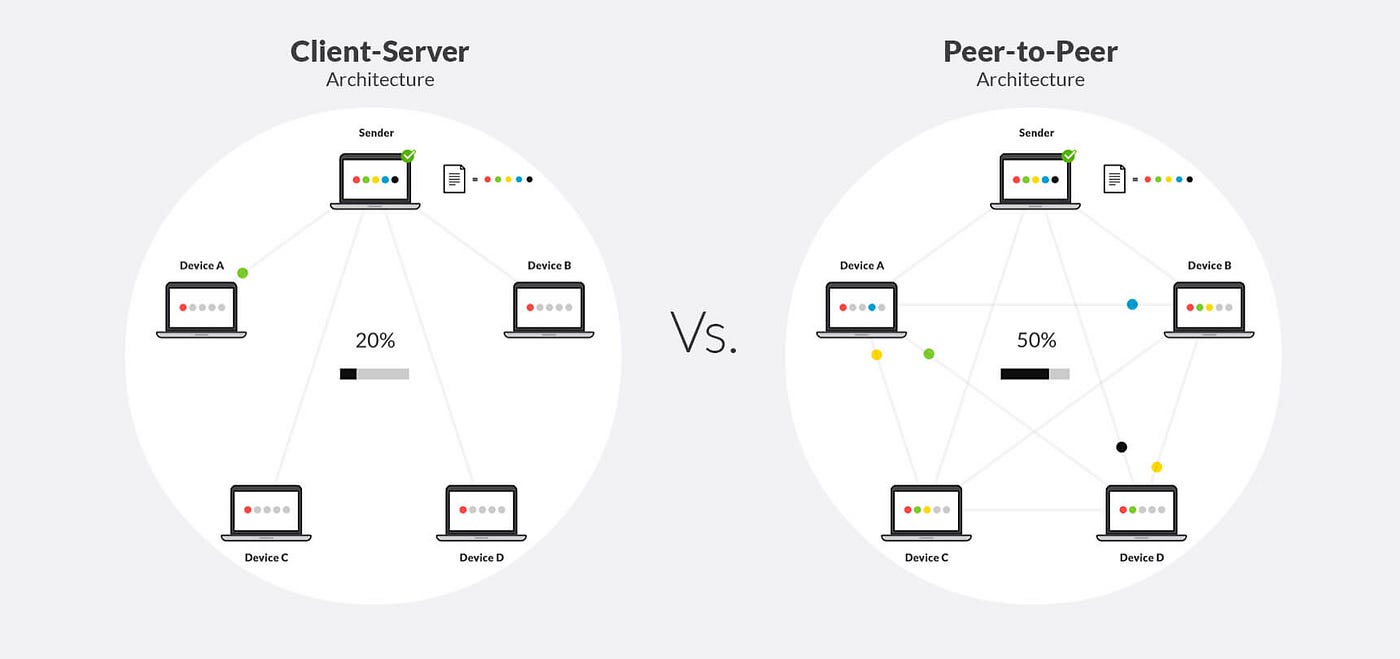
Peer-to-Peer (P2P) architecture is a decentralized and distributed system design that plays a fundamental role in networked communication and data sharing. Unlike traditional client-server models, where a central server handles requests and resources, P2P networks enable individual nodes (peers) to act both as consumers and providers of resources, promoting a more distributed and collaborative approach.
Key Characteristics of Peer-to-Peer Architecture
1. Decentralization: In a P2P network, there is no central authority or server that controls resource distribution. Peers interact directly with one another, creating a decentralized system where no single point of failure exists.
2. Resource Sharing: Peers in a P2P network can share various resources, including files, processing power, and even internet connectivity. This sharing can occur both actively (intentional sharing) and passively (resources being used by others).
3. Autonomy: Each peer in a P2P network is autonomous and responsible for its own actions. This autonomy enhances the network’s fault tolerance and resilience.
4. Scalability: P2P networks can easily scale by adding more peers, as each peer contributes to the network’s resources and capabilities. This scalability is a significant advantage in scenarios with variable demand.
5. Dynamic Topology: P2P networks often feature dynamic and ever-changing topologies as peers join and leave the network. This adaptability is crucial for networks where nodes frequently come and go.
Types of P2P Architectures
1. Pure P2P: In pure P2P networks, all peers have equal status and contribute resources to the network. Examples include file-sharing networks like BitTorrent, where each peer shares and downloads files directly from other peers.
2. Hybrid P2P: Hybrid P2P networks combine elements of both P2P and client-server architectures. Certain nodes may have specialized roles or additional responsibilities, such as indexing or routing, while others function primarily as peers. Skype, for instance, uses a hybrid P2P architecture.
3. Structured P2P: Structured P2P networks impose a specific organization on the network, typically based on a distributed hash table (DHT). Examples include Chord and Kademlia, which enable efficient resource lookup and retrieval in large-scale networks.
4. Unstructured P2P: In unstructured P2P networks, there is no strict organization, and peers connect based on various criteria, often through a flood-based search. Early file-sharing networks like Napster and Gnutella were unstructured P2P networks.
Applications of P2P Architecture
1. File Sharing: P2P networks have revolutionized file sharing, allowing users to share and download files directly from one another, reducing the reliance on central servers.
2. Content Delivery: P2P-based content delivery networks (CDNs) optimize the distribution of web content, making websites more resilient to high traffic loads.
3. Collaborative Computing: P2P architecture enables distributed computing projects like SETI@home and Folding@home, where volunteers contribute their idle computing resources to scientific research.
4. Communication: Some VoIP (Voice over Internet Protocol) and messaging applications employ P2P architecture to establish direct connections between users for communication.
5. Blockchain: Blockchain technology, used in cryptocurrencies like Bitcoin, relies on P2P networks for consensus, transaction verification, and maintaining a ledger of all transactions.
In summary, Peer-to-Peer architecture is a versatile and decentralized design approach that has a broad range of applications across various domains, emphasizing autonomy, scalability, and resource sharing among peers. Its resilience and adaptability make it a valuable solution for modern networked systems.
Challenges of designing software architectures for distributed systems
Designing software architectures for distributed systems is challenging because distributed systems have unique characteristics, such as:
- Complexity: Distributed systems are often complex, with many components that interact with each other in complex ways. This can make it difficult to design a software architecture that meets all of the requirements of the system.
- Concurrency: Distributed systems are often concurrent, meaning that multiple components are executing at the same time. This can make it difficult to design a software architecture that is correct and efficient.
- Failure: Distributed systems are susceptible to failures, which can occur at any time. This can make it difficult to design a software architecture that is resilient to failures.
메타데이터
- post_id
- 26b3bc03df4d
- slug
- distributed-system-architecture-26b3bc03df4d
- url
- https://medium.com/@t.i.tpeeriya/distributed-system-architecture-26b3bc03df4d
- canonical_url
- https://medium.com/@t.i.tpeeriya/distributed-system-architecture-26b3bc03df4d
- author_url
- https://medium.com/@t.i.tpeeriya
- status
- ok
- fetched_at
- 2026-06-17 12:55:42




