Why Generic Hotel Strategies Fail in 2026 — Discover the EPA™ Specialisation Library (S1–S20)
Are generic hotel strategies already failing in 2026?
Why Generic Hotel Strategies Fail in 2026 — Discover the EPA™ Specialisation Library (S1–S20)

Experience Portfolio Architecture™ Specialisation Library S1-S20 Extra Modules
Are generic hotel strategies already failing in 2026?
Yes and the deeper problem is not that hotels lack effort, but that many still try to win with room-centric tactics in a market that now rewards specialisation, experience design, and clearer value creation. The EPA™ Specialisation Library (S1–S20) is built precisely to replace generic positioning with segment-specific hotel positioning strategy, stronger guest experience, and more resilient hotel profitability.
Why generic fails
Generic hotel strategy fails because it treats all demand as if it were interchangeable. EPA’s core premise is the opposite: guests choose properties for meaning, identity fit, and desired outcomes, not just for a bed and a rate. When a hotel cannot explain why it deserves attention beyond price and location, it gets dragged into the discount trap and loses control over hotel revenue optimisation.
That problem is more visible in 2026 because the market itself has shifted. EPA Module 0 says quiet luxury, authenticity, emotional connection, space, silence, and regenerative experiences are now part of the new luxury logic. In other words, generic hospitality is increasingly invisible, while experience-based hospitality is becoming the new baseline for differentiation.
What EPA changes
Experience Portfolio Architecture shifts the hotel from room-selling to experience architecture. The Specialisation Library extends that shift by giving hotels a precise way to speak to defined guest segments and design offers that match real motivations rather than vague demographic assumptions. That is why the modules are described as precision tools, not add-ons.
The strategic logic is simple but uncomfortable: if your positioning is broad, your competition is everyone; if your positioning is specific, your competition shrinks and your value rises. EPA’s S1–S20 modules are built to make that specificity commercially usable, with market reality, guest profiling, readiness, revenue architecture, legal framing, and repositioning without renovation embedded into each module.
The library logic
The library is organised around distinct specialisation pillars, which helps hotels choose a path that matches their property and market. Some modules target guest segments, such as S1 Pet Co-Experience Architecture, S2 Digital Nomad Hotel Positioning, S3 Family-Centric Experience Design, S4 Senior Group Experience Architecture, S15 Solo Traveller Empowerment, and S17 Multi-Generational Family Celebration. Others focus on outdoor or lifestyle revenue, like S8 Glamping, S9 Sustainable, S10 Wellness, S11 Culinary, S12 Couples, S13 Adventure, S14 Cultural Heritage, S18 Artistic, S19 Seasonal, and S20 Wedding.
There are also commercial and group-business modules such as S5 Event-Led Revenue, S6 Youth Camps, S7 Medical Special Needs Youth Camps, and S16 Corporate Team Transformation Retreats. This matters because a hotel does not need to “be everything”; it needs to own the right few categories that fit its assets, calendar, and local context. That is a much stronger hotel positioning strategy than chasing every market at once.
Why guests respond
Guests respond to clarity. EPA repeatedly frames guest choice as a motivational decision: what people buy is not just the room, but the emotional and practical result they expect from the stay. This is why the library uses motivational segmentation and why each module has organiser or guest profiles rather than generic personas.
The advantage is practical, not theoretical. A pet guest, a solo traveller, a wedding organiser, a digital nomad, and a creative retreat leader all evaluate value differently, stay differently, and spend differently. When a hotel designs around those differences, guest experience improves because the offer finally feels relevant instead of merely available.
The profit argument
Generic strategy often keeps revenue tied to occupancy alone, which EPA explicitly challenges. Module 0 states that most hotels suffer not from a guest shortage but from a length-of-stay shortage, and that a single structural change can materially increase revenue without adding rooms. The Specialisation Library turns that insight into specific commercial formats with value-based pricing, longer minimum stays, and stronger ancillary revenue.
This is why the library is directly tied to hotel profitability. S2 targets extended stays of remote professionals, S10 uses wellness to justify premium multi-night packages, S11 transforms food into a high-margin destination engine, S12 monetises romance, S16 turns retreats into B2B revenue, and S20 builds high-value wedding business. The common thread is simple: longer stays, higher perceived value, and better-fit demand improve margin more reliably than generic volume chasing.
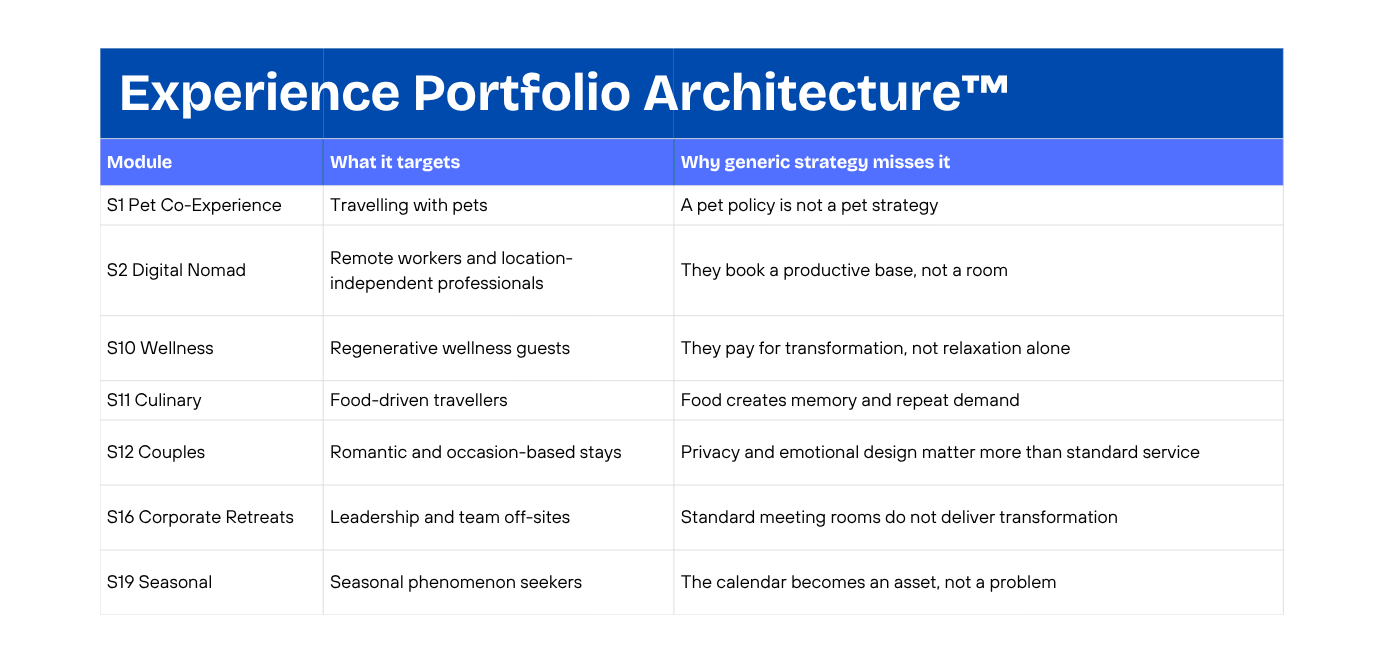
Experience Portfolio Architecture™ Why generic strategy misses it.
The point is not that every hotel should sell all of these. The point is that generic positioning ignores how different revenue streams behave and how different guests decide. EPA gives hotels a way to choose, not a way to blend into the middle.
Community as advantage
Another reason generic strategies fail is that they treat the hotel as a self-contained product. EPA treats the hotel as part of a local ecosystem. That is visible in modules like S9 Sustainable, S11 Culinary, S14 Cultural Heritage, S13 Adventure, and S19 Seasonal, all of which rely on local partners, local stories, and local assets as part of the offer.
This is commercially powerful because community integration is harder to copy than a room type or a discount. A generic hotel can be replicated; a hotel embedded in local culture, producers, guides, artisans, and experiences is much harder to replace. That creates differentiation, reputation, and a stronger brand moat.
No-renovation thinking
EPA is also relevant because it does not assume heavy CapEx. Many modules explicitly include repositioning without renovation or minimum viable activation paths. That means hotels can move from generic to specialised through programming, packaging, partnerships, and operational design instead of waiting for a full rebuild.
This is especially important for independent hotels with margin pressure. If a property waits for a perfect renovation before changing strategy, it often waits too long. EPA’s message is more provocative: stop asking whether your building is ideal and start asking whether your positioning is lazy.
How to choose modules
The smartest implementation path is focused, not maximalist. A hotel should start with one primary specialisation, then add one or two supporting modules that fit the property’s physical reality and calendar. For example, a nature-led hotel might combine S8 Glamping, S9 Sustainable, S10 Wellness, and S19 Seasonal, while a city boutique might lean into S11 Culinary, S12 Couples, S16 Corporate, or S18 Artistic.
A disciplined selection process looks like this:
- Identify the strongest natural asset of the property.
- Match it to the guest segment that already has intent and willingness to pay.
- Build one offer with clear pricing, minimum stay logic, and partner support.
- Measure success through profit, stay length, and repeat demand, not vanity occupancy alone.
- Expand only after the first specialisation proves commercial traction.
That is how a hotel avoids the common mistake of trying to sound strategic while still behaving generically.
The uncomfortable truth
Generic hotel strategy fails in 2026 because the market no longer rewards “nice enough.” It rewards relevance, identity, and experience architecture. EPA’s Specialisation Library is designed to turn that reality into a commercial system rather than a brand slogan.
For hotels that want stronger hotel profitability, the choice is no longer between tradition and innovation. It is between being remembered for something specific or being priced like everyone else. The EPA™ answer is clear: specialisation is the strategy, and generic is the risk.
PS: If you like the way I look at the world of hospitality, let’s check my courses: Experience Portfolio Architecture™
Tired of seasonal struggles and OTA dependency? Build an Experience Portfolio that fills your hotel with the right guests, for the right reasons. https://timeapokolconsultant.com
메타데이터
- post_id
- 26d20b3a9e81
- slug
- why-generic-hotel-strategies-fail-in-2026-discover-the-epa-specialisation-library-s1-s20-26d20b3a9e81
- url
- https://medium.com/@timea_81899/why-generic-hotel-strategies-fail-in-2026-discover-the-epa-specialisation-library-s1-s20-26d20b3a9e81
- canonical_url
- https://medium.com/@timea_81899/why-generic-hotel-strategies-fail-in-2026-discover-the-epa-specialisation-library-s1-s20-26d20b3a9e81
- author_url
- https://medium.com/@timea_81899
- status
- ok
- fetched_at
- 2026-08-06 00:21:56