How evolution works
Living things don’t exactly adapt to their surroundings
FOSSILS ET AL.
How evolution works
Living things don’t exactly adapt to their surroundings
Photo by David Clode on Unsplash
A few weeks ago, I was at the zoo when a young kid beside me asked why the frogs in the exhibit in front of us were green. I replied to him: “It is to help them blend into their surroundings.” He looked at me and then asked: “How did they know to turn green?” I paused and thought about how to explain genetics and natural selection to a seemingly five-year-old kid. After a while, I turned to him and said: “They got lucky, I guess.”
When I took an online course about evolution last year, one of the biggest mindblowers that I had was when I learnt the truth about how evolution actually works — like many others, I used to think that organisms evolve to adapt to their surroundings, however, the truth is that evolution is a million-year miracle that occurs through random genetic mutations and natural selection.
The common misconception
Photo by Jo Woods on Unsplash
Many people think that organisms evolve to adapt to their environment. For example, frogs evolved green skin because their environment was green, giraffes evolved to be tall because they had to eat from tall trees, etc. It’s like the organisms are aware of the challenges their environment presents and the next generation just magically develops the necessary tools and traits to overcome said challenges. This misconception is further reinforced by statements such as ‘species x needs to adapt to this environment to survive’ — statements which are extremely common in nature documentaries and school materials.
Mutations
Pop culture has led us to believe that mutants are either giant scary beasts or enhanced humans with superpowers. However, the truth is that all of us are mutants — mutations happen every day and in every single one of us. A mutation is defined as a change in the sequence of DNA in an organism’s genome. Mutations can occur due to errors during DNA replication (during cell division) or from external factors such as radiation and chemicals (the mutation that we are more familiar with).
Photo by Warren Umoh on Unsplash
Mutation is an extremely huge topic that I can’t fully cover in this story, but here are the facts about mutation that are important to this topic:
- Mutations are constantly happening — as long as your cells are dividing, there will always be a chance of mutation.
- Mutations are random: the effects of mutation are mostly neutral and invisible, but some mutations end up being beneficial while others end up being detrimental (The most famous detrimental mutation is cancer).
- Mutations happen independently of the environment. (Unless, of course, radiation or nasty chemicals come into play, but in the context of evolution, we can ignore these factors).
So, how does mutation play into evolution? Mutations create variation. If mutations don’t exist then you would be the exact 50/50 copy of your parents, and you and your siblings would be pretty much identical. Because of variation, some organisms within a species are able to survive and reproduce better than others, allowing natural selection to come into play.
Photo by Matthew Smith on Unsplash
Natural Selection
Natural selection filters out detrimental mutations from the population, allowing individuals with beneficial mutations to have an increased chance of reproduction. These beneficial mutations will then be passed on to the next generation and eventually become more common in the population.
Frogs become green not because they want to camouflage with the leaves, it’s because those that weren’t green ended up being picked off by predators, and eventually, only green frogs remain. Giraffes didn’t grow tall because they wanted to reach the tall leaves, it’s because the shorter giraffes starved to death after being outcompeted by other herbivores. This is how evolution works — not as a directed and intentional process, but more of a let’s try everything and let natural selection filter out what works.
The Luria-Delbruck Experiment
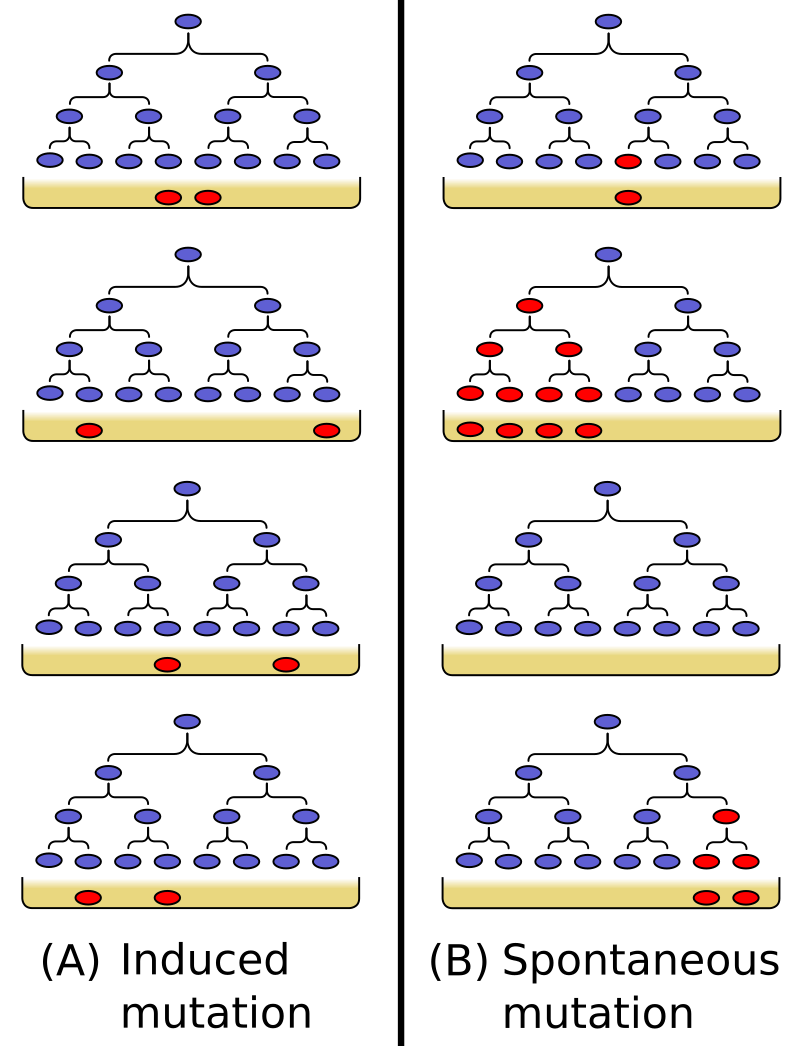
Not convinced? The Luria Delbruck experiment was a famous experiment conducted in 1943 to test this theory. The main goal of the experiment was to test if mutated traits(in this case the resistance to viruses) were developed because of the environment (induced mutation) or happened randomly (spontaneous mutation). Multiple cultures of bacteria were first grown under similar conditions. Each culture was then exposed to a lethal virus. Naturally, only bacteria that have developed a resistance to the virus would survive.
If the bacteria developed resistance because they were exposed to the virus, there should be a similar number of bacteria that survive in each culture.
If the resistance came from a random mutation that happened before the virus was introduced, then there would be a significantly huge variation in the number of bacteria that survived in each culture since it is virtually impossible that the mutation occurred in all the cultures at the same time.
The two possible scenarios are depicted in the diagram below:
By Madprime — Own work, CC BY-SA 3.0, https://commons.wikimedia.org/w/index.php?curid=2103556
The result showed that there was a huge variation between each culture. The conclusion was clear: The bacteria did not develop the resistance gene on demand. Instead, a bacteria mutated to have the resistant gene by chance, and this gene was then passed down to its offspring and only this lineage of bacteria would have survived the virus. As this lineage of bacteria continues to reproduce and the other remaining bacteria get killed off by the virus, eventually only bacteria with the virus-resistant gene will remain.
Conclusion
Photo by Suzanne D. Williams on Unsplash
Evolution doesn’t happen on demand, it’s a long process driven by random mutations and filtered by natural selection — evolution doesn’t give an organism what it needs, it keeps what works.
This also means that all organisms alive today, including us, happened by chance — all of us are only here because our common ancestor got a completely random mutation that separated him or her from the rest of the apes, and by sheer luck that mutation happened to be beneficial and helped them reproduce. If we were to rewind time millions of years ago and start all over again, the biodiversity we know today would be completely different, and there is a chance that humans would not exist at all!
So yeah, we humans and every other species alive today, no matter the shape or size are here because of sheer luck. I don’t know how that makes you feel but I feel extremely grateful to be here right now.
If you enjoyed this article do help support me here: yarzsjd.medium.com/subscribe
메타데이터
- post_id
- 26f8173af8cc
- slug
- how-evolution-works-26f8173af8cc
- url
- https://medium.com/fossils-et-al/how-evolution-works-26f8173af8cc
- canonical_url
- https://medium.com/fossils-et-al/how-evolution-works-26f8173af8cc
- author_url
- https://medium.com/@yarzsjd
- status
- ok
- fetched_at
- 2026-07-19 14:09:49