I Have Questions About Dinosaurs: Are Our Cherished Images of Them Holding Us Back?
On our perception of long-extinct animals and how we continue to change how we interpret their remains
I Have Questions About Dinosaurs: Are Our Cherished Images of Them Holding Us Back?
On our perception of long-extinct animals and how we continue to change how we interpret their remains

Sinclair Dinoland in the 1964 World’s Fair, New York (image: Wikipedia)
For many years two questions have bothered me about the representation of dinosaurs. Namely, did brachiosaurus and diplodocus type dinosaurs have trunks, and did tyrannosaurs have vestigial wings?
Full disclosure here. I am an archaeologist and have never academically studied dinosaurs. But as a friend of mine once said, dinosaurs are a gateway to archaeology. We grew up with images of dinosaurs as fierce beasts, giant herbivores, or as cuddly toys. We’ve stood next to their skeletons at museums and read about the razor-sharp teeth of the carnivores. People are fascinated by them, and their images are embedded in our minds.
In archaeology, and I expect with paleontology, there is a problem when an image or a reconstruction is made. It becomes fixed in people’s minds that this is the way it is, and it becomes difficult for the public to change that mental image. It’s especially so when the image has been the standard for generations.
Paleontology is a relatively new science, with its beginnings in the mid-1800s. Early on, dinosaurs were divided between bird-hipped and lizard-hipped. The bird-hipped ones were the ones that stood upright, and the lizard-hipped went around on all fours with squatting legs.
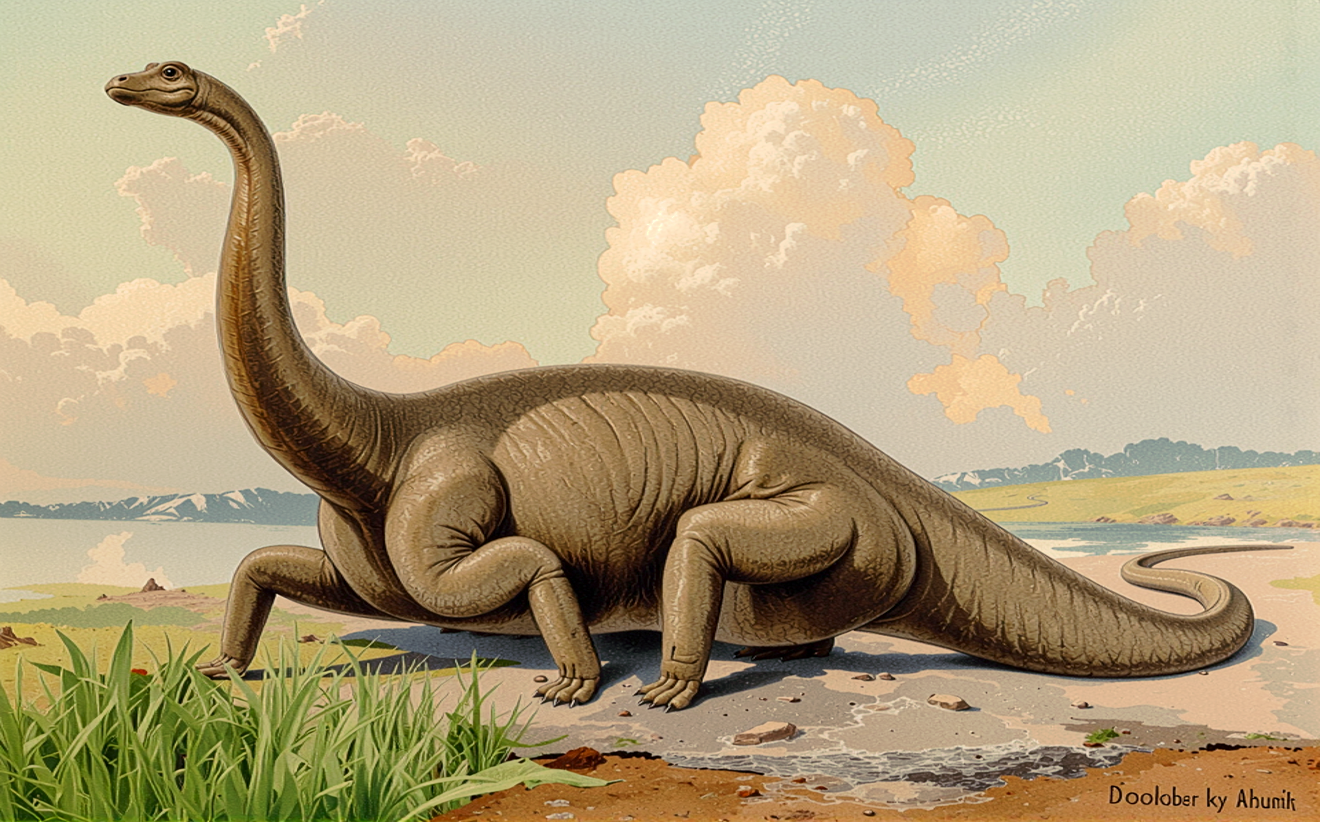
Early illustration of a dinosaur by Heirch Harder (image: Wikimedia Commons)
Some early reconstructions were built with dinosaurs having bent, lizard-like legs. In some images, the legs were too short for the chest to be held above ground, so some illustrations show them walking while straddling ditches so that the short legs could accommodate the keel of their sternum. Apparently these dinosaurs needed a roadway of shallow ditches to get wherever they needed to go. It was a case of shoehorning the inaccurately interpreted evidence into a theory that just didn’t work.
Earlier interpretations were that the fossils were the remains of dragons, such as the one St. George killed, or other mythological monsters. Even the bones of modern animals were misinterpreted, with the skull of an elephant being used as evidence of the Cyclops from the story of Ulysses. An elephant skull has a large central hole where the trunk is attached to the skull, in what appears to be the forehead. It does look as if a large central eye could be located there, while the small eye sockets on the side could go unnoticed.

Comparing skulls (images from Wikimedia Commons elephant, tapir, camarasaurus, brachiosaurus)
Brachiosaurs: Did they have trunks?
It was the image of the mistaken Cyclops that made me wonder if a long-necked dinosaur, such as a brachiosaurus, had a short trunk or an elongated, prehensile nose similar to the one on a tapir. Most images of dinosaurs like diplodocus have nostrils placed high on the head. It looks odd to have nostrils there unless it was the sort of animal that spent a lot of time underwater. But a short prehensile snout or trunk would make sense if it was grasping for leaves high up in trees. There is considerable debate on the issue. Scientists look for muscle attachments and consider how a prehensile nose or trunk would be useful in browsing in trees.
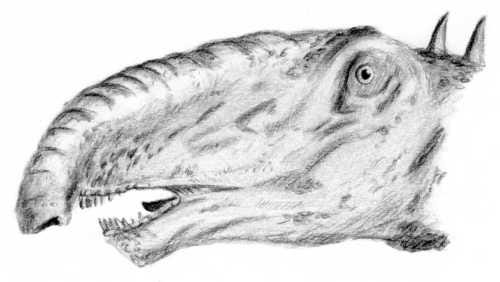
Arthur Weasley’s illustration of a diplodocus with a short trunk (image: wikimedia). This is one of four possible interpretations that he illustrated.
Arthur Weasley, the paleontological illustrator, did a series of drawings, including one in which diplodocus has an elongated snout. Traditionally, diplodocus was depicted with nostrils emerging from the top of its head because that was where the opening for them was in its skull. However, without the evidence of soft tissue, we cannot be certain where the nostrils were located on the dinosaur’s head.
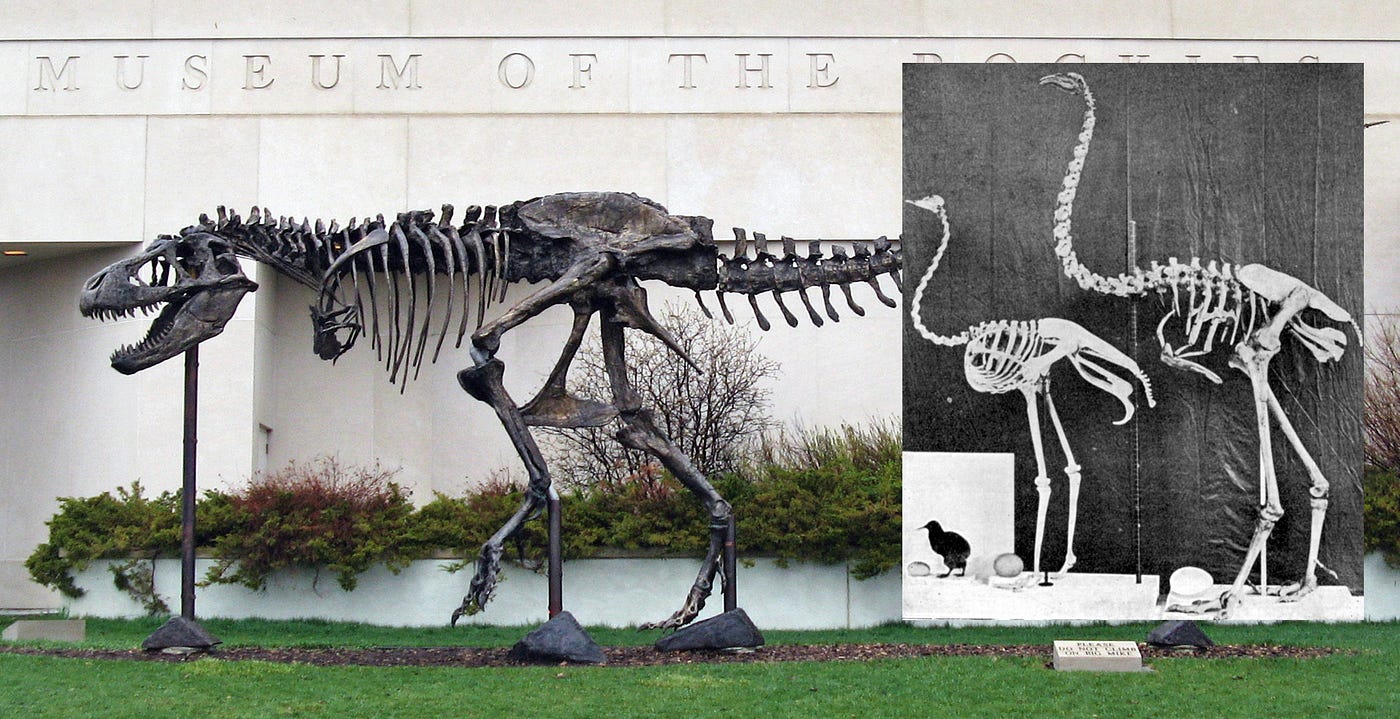
T-Rex skeleton and skeletons of dinorus and ostrich (images wikimedia commons here and here)
Tyrannosaurs: Did they have vestigial wings?
The image of the tiny arms of a monstrous T. rex is an indelible image. It is the subject of countless memes and sometimes an allegory for the limits of power. From the first reconstruction, it was assumed that these were arms for grasping, even though they were too short to grasp much of anything. Later, it was discovered that tyrannosaurs were feathered. That was difficult for a lot of people to take on. Generations had lived with the dinosaur having a leathery, elephantine hide. The idea of feathers seemed almost silly in the context of a fearsome land predator.
One day I was in the Natural History Museum in London, where I saw a reconstructed skeleton of an ostrich. I walked back and forth between that and the skeleton of the tyrannosaurus. The limbs looked similar. I wondered why the limbs of the tyrannosaur were rotated forward when it made so much more sense to have them rotated down like a wing. Ostriches and other large flightless birds use their wings for maneuverability when they run. If tyrannosaurs did have longer feathers extending from short wings, they could also use these for sharp turns when pursuing prey. It would make more sense than having tiny vestigial arms.
After generations of images of leathery-skinned dinosaurs, it’s hard to shift to an image of them being fully feathered. Films like the Jurassic Park franchise and numerous dinosaur documentaries have embedded the idea of what dinosaurs looked like: large, leathery animals with hides like elephants or rhinos. In some cases, dinosaurs were given a bit more colour than the usual elephant grey or muddy brown. In others, some get a small decorative ruff of feathers. But unless they were known to be a creature that flew or glided, we rarely see a dinosaur depicted with a full body covered with feathers and wings like a modern flightless bird. For a T. rex to lose its tiny arms and instead be depicted with flightless wings would come as a cultural shock. There wouldn’t be rioting in the streets, but there would be a lot of people who would reject the idea entirely, not because there would be scientific grounds for maintaining the status quo of tiny arms, but because this is the image they have always known.
A good example was the change in status of Pluto. Since it was discovered, Pluto was designated as the ninth planet. But in 2006 it was demoted to a *dwarf planet. A dwarf planet is something smaller than a regular planet that doesn’t share its orbit with other dwarf planets or other bodies such as large asteroids. There was public outrage over a simple redesignation. This was not anything that affected people’s lives, and yet there was almost a religious fervor about whether or not Pluto was a planet. Pluto* was still out there. It cannot be seen with the naked eye, or even most telescopes, but its status was publicly controversial.
On his website, the artist *C.M. Kosmemen* draws modern birds and animals the same way that dinosaurs are popularly depicted. The results were interesting in that it was hard to reconcile what a hippo actually looks like when drawn in the same way that we depict dinosaurs. Stripped of most of the soft tissue and leaving only the necessary musculature, elephants and horses become nightmarish creatures, almost unidentifiable. On his website, Kosemen goes into detail about his reconstruction techniques for illustrating dinosaurs and his corrected depictions of them, along with the images he created of modern animals if they were drawn the way dinosaurs are usually depicted. Kosemen’s illustrations aren’t definitive, but they show us the range of possibilities that we haven’t explored because we continue to look at dinosaurs through the interpretations of people who first drew them over a hundred years ago.
Once again, I am not a professional paleontologist, but these thoughts keep returning to me, making me wonder about our perception of long-extinct animals and how we continue to change how we interpret their remains.
Perhaps someday there will be museum displays that show alternative images for dinosaurs—winged, snouted, or in other new and plausible interpretations. It will be impossible to know definitely until fossils that preserve the soft tissue of trunks or the feathered hands of dinosaurs.

Cenozoic scene by Charles R. Knight (image: Wikimedia commons)
References
C.M. Kosmemen (cmkosemen.com)
Rincon, P (2015) BBC News Why is Pluto no longer a planet? BBC News https://www.bbc.com/news/science-environment-33462184
Vincent, M. (2019) “Nightmarish Sketches Reveal What Modern Animals Would Look Like if We Drew Them in the Same Way as dinosaurs Based on their Skeletons”. Daily Mail https://www.dailymail.com/sciencetech/article-7754553/Nightmarish-sketches-reveal-modern-animals-look-like-drew-based-skeletons.html
메타데이터
- post_id
- 2712e9f01aba
- slug
- i-have-questions-about-dinosaurs-are-our-cherished-images-of-them-holding-us-back-2712e9f01aba
- url
- https://thequantasticjournal.com/i-have-questions-about-dinosaurs-are-our-cherished-images-of-them-holding-us-back-2712e9f01aba
- canonical_url
- https://thequantasticjournal.com/i-have-questions-about-dinosaurs-are-our-cherished-images-of-them-holding-us-back-2712e9f01aba
- author_url
- https://medium.com/@gfregni
- status
- ok
- fetched_at
- 2026-06-09 15:37:30