Why Most Factories Overspend on CNC Press Brakes: The Truth Behind the 110T 3200 “Best Seller”
A technical breakdown of the ADH 110T 3200: Choosing between DA66S vs. DA53T, 4+1 vs. 6+1 axes, and why mechanical crowning matters for…
Why Most Factories Overspend on CNC Press Brakes: The Truth Behind the 110T 3200 “Best Seller”
A technical breakdown of the ADH 110T 3200: Choosing between DA66S vs. DA53T, 4+1 vs. 6+1 axes, and why mechanical crowning matters for your ROI.
The Tonnage and Bed Length Trap: “110T 3200” Is Not a Capability Guarantee
V-Die Reality Check: Capacity Depends on the Part
“110T 3200” means 110 tons across a 3.2-meter bed, not guaranteed thick-plate capacity at any length. Divided out, that is roughly 34 tons per meter, or about 10.4 tons per foot. For example, 4 mm mild steel over a suitable 32 mm V-die may need about 13 tons per foot. Across 10 feet, the job needs about 130 tons. The DA66S can plan the sequence and check collisions, but it cannot create tonnage the hydraulics lack.
Effective Bending Length: Bed Span Is Not Always Usable Length
A flat V-bend may use the full 3200 mm because the sheet can extend beyond the side frames. Boxes, pans, and deep channels are different: their flanges must pass between the uprights, so usable length may be closer to 2600–2700 mm. Collision detection warns you; it does not widen the frame.
Nominal Tonnage Concentration: Short, Heavy Parts Still Deflect Frames
Real capacity also changes with V-die opening, material tensile strength, bend length, and air bending versus bottoming. Concentrated force can deflect the ram and bed. Buyers must calculate their actual parts before assuming this press brake fits the work.
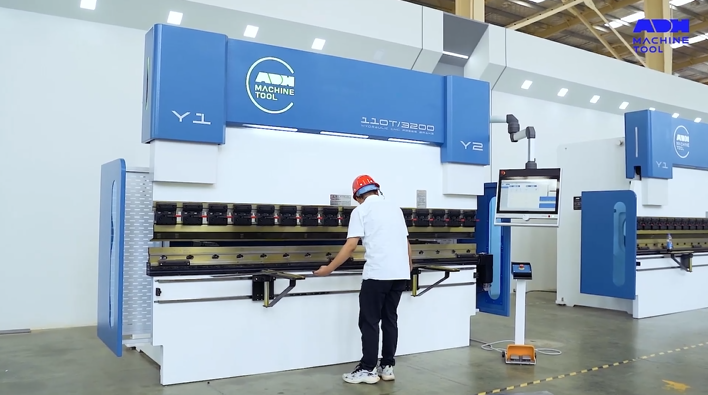
ADH press brake
The Brain-vs.-Body Check: Does the Delem DA66S Match the Machine?
The Delem DA66S is the brain; the press brake is the body. The controller can calculate bend sequences, target angles, corrections, tooling data, crowning values, and 3D simulations, but productivity depends on whether the machine executes those commands repeatably. On a strong platform, the DA66S is a multiplier. On a weak one, it exposes mechanical limitation.
When a Premium Controller on a Basic 3-Axis Frame Becomes a Bad Investment
A simple Y1/Y2 plus X-axis machine can bend basic brackets. The DA66S earns its keep when the hardware supports complex work.
Check whether the machine includes the mechanisms the controller is expected to drive:
- R-axis height adjustment, not manual repositioning
- Z1/Z2 backgauge finger movement for asymmetric parts
- Accurate X-axis positioning with sufficient backgauge reach
- Rigid frame construction for 110-ton, 3200 mm workload
- Stable hydraulic synchronization between Y1 and Y2
- Fast, consistent servo response
Without them, advanced functions become unused.
3D Graphical Simulation: Profit Driver or Expensive Display?
Simulation only helps when the digital setup matches the physical machine. The DA66S can flag collisions and show steps, but assumes accurate tooling data, reachable gauge positions, and real clearance. If operators need shims, workarounds, or checks, simulation becomes guidance, not automation.
Why High-End Electronics Cannot Fix Low-End Tolerances
It cannot compensate for weak repeatability, poor hydraulics, loose backgauges, or incomplete safety integration. Crowning is a clear example: a value works only if the machine has CNC crowning the DA66S can control. Otherwise, precision stays on the screen, not the part.
The Invisible Performance Specs: Accuracy, Repeatability, and Crowning
A Delem DA66S can calculate bend sequences, compensation, and axis positions, but it does not bend metal. It sends commands to valves, motors, gauges, and crowning devices. The final part depends on ram control, backgauge positioning, deflection management, tooling condition, and material variation.
In shop terms, accuracy means the first part reaches the intended dimension or angle. Repeatability means later parts return to that result without constant correction. A machine can be accurate after setup yet weak in repeatability if the ram drifts, the gauge has backlash, or the frame deflects unpredictably.
Mechanical vs. Hydraulic Crowning: Ensuring Consistent Angles on a 3200mm Workpiece
On a 3.2-meter bed, crowning is central to angle consistency. Under load, the ram and bed deflect. Without effective crowning, a long part may bend open in the center while the ends are correct, or the center may close while the ends remain under-bent.
Hydraulic crowning uses pressure to compensate for deflection. Mechanical or CNC crowning uses wedges or driven mechanisms to create a controlled curve in the lower bed. Do not judge by the label alone. Long parts, tight tolerances, stainless or high-strength material, and high-volume runs require stable compensation.
Ask how crowning is calculated and adjusted, whether it is CNC-controlled from the DA66S, how it is verified under load, and what end-to-center angle variation to expect on long bends.
Back-Gauge Precision: Matching Axis Speed and Repeatability to the DA66S Processing Power

back gauge
The DA66S can plan fast, collision-aware sequences, but the backgauge must keep up. Slow axes, backlash, weak fingers, or limited travel turn software speed into waiting time.
For complex parts, confirm required axes, such as X, R, Z1, and Z2, and whether fingers position independently. Ask for repeatability figures, maximum speed, and a live multi-bend demonstration.
Frame Rigidity and Ram Parallelism: The Mechanical Foundation of High-Precision Bending
Ram parallelism is only as trustworthy as the measuring system. Glass scales should read true ram position, not frame distortion. Better machines isolate measurement through proper mounting, often with independent C-frame structures.
Inspect scale mounting, ask how Y1/Y2 parallelism is controlled under tonnage, and request bend samples across the bed. The controller is the brain, but repeatable bending comes from the machine obeying it.
The Tooling Ecosystem: The Hidden Cost That Dictates ROI
ADH Clamping Systems: European Standard vs. Proprietary Tooling Compatibility
Tooling is not an accessory; it determines whether the ADH 110T 3200 can turn the Delem DA66S’s programming speed into fast setups and repeatable bends. The controller may load tool data and sequence jobs quickly, but slow clamping can erase that advantage.
Clamping type matters. Manual clamping forces operators to align, tighten, and verify segments, so every punch or die change becomes a labor bottleneck. Hydraulic, pneumatic, or safety-rated quick clamping is essential if your work mix requires frequent tool changes.
Compatibility affects long-term cost. European-standard tooling offers broader sourcing and easier expansion, while proprietary interfaces can limit flexibility and raise replacement costs.

press brake tooling
Integrating Your Existing Tool Library: Protecting Total Cost of Ownership
The DA66S can model existing tool profiles, but digital accuracy depends on physical fit. Worn tools, mismatched tangs, weak holders, or inaccurate dies undermine angle consistency.
ROI depends on buying the right tools and safety-rated clamping for the production mix.
The Infrastructure Factor: Support and Software Beyond the Delivery Date
After purchase, the ADH 110T 3200 with Delem DA66S is only as reliable as the support structure behind it. This is not a simple manual or basic NC brake; it needs parameter backups, diagnostics, software updates, spare parts, and technicians who understand both the controller and the machine.
The Delem Support Network: Who Owns the Warranty for the Controller vs. the Machine?
Clarify support responsibility before buying: who supports the controller, hydraulics, machine parameters, and software? A fault can quickly expose split responsibility between the machine builder, controller supplier, dealer, and local service provider. If the DA66S shows a communication error, who restores parameters after a fault? Who confirms whether the issue is software, a proportional valve, an encoder, or wiring?
Do not accept vague promises. Get a single accountable contact in writing, including response time, remote diagnostics capability, and technician availability.
Offline Programming and Connectivity: Is Your Shop Workflow Ready for Digital Twin Bending?
The DA66S can support offline programming and digital workflow, but only if someone maintains the software side. Who updates DA66S software? Who manages backups, machine data, tooling libraries, and connectivity when workflows change?
Lead Times on Critical Spares: The Reality of Operating Chinese Hardware in Local Markets
Ask who stocks valves, encoders, seals, backgauge parts, drives, cables, and I/O modules. If every part ships from overseas, a small fault can become extended downtime.
The Buy/Skip Decision Matrix: Who Should Actually Write the Check for This Configuration?
The ADH 110T 3200 with Delem DA66S makes sense only when the machine’s output justifies the added complexity. The controller is not the purchase; the whole bending system is the purchase, so it is worth comparing it against a CNC-focused bending solution such as an ADH Machine Tool press brake when configuration fit, automation potential, and shop-level implementation matter.
The High-Mix, Low-Volume Shop: Buy for Setup Speed and First-Part Accuracy
Buy this configuration if your shop runs varied parts, short batches, complex bends, frequent setups, or expensive material where one bad sequence can erase margin. In that environment, the DA66S earns its place through 3D visualization, bend sequencing, collision checking, and offline programming. It helps move the thinking from the machine to the front office, keeps the brake producing, and improves the odds of a correct first part.
This is the strongest fit: a job shop or production cell that changes work often and needs higher first-part accuracy, fewer test bends, and faster operator handoff.
When to Downgrade: Buy Less Control if the Work Is Simple
Skip or downgrade if your work is simple, repetitive, low-tolerance, or mostly basic brackets, channels, boxes, and 90-degree bends. In that case, many DA66S features will sit unused. A DA-53T or similar controller can handle core press brake motion without paying for advanced 3D workflow you do not need.
If the budget is limited, spend first on the machine body: proper crowning, precision-ground tooling, hardened tooling, and reliable support. A mid-range controller with excellent tooling will usually outperform a premium controller mounted on an under-equipped brake.
Final Verification: Buy Only if the Whole System Fits
Before signing, confirm the support structure. Ask whether licensed Delem Profile-T offline software is included, who trains your programmer, whether local Delem modules are stocked, and who can troubleshoot synchronization between the controller, backgauge, hydraulics, and valves. Demand a backgauge repeatability test and a certified deflection report for the specific frame.
Buy if you run high-mix, short-batch, complex work; need offline programming, frequent setup changes, and better first-part accuracy; and will invest in proper tooling, crowning, trained operators, software discipline, and local service.
Buy conditionally if you can add those missing pieces before the machine becomes mission-critical.
Skip or downgrade if the work is repetitive, basic, low-tolerance, or if you are buying the DA66S mainly because it looks premium.
The worst buyer pays for the premium controller but refuses the tooling, service, training, and machine options needed to benefit from it. The real question is not whether the DA66S is good. It is whether the entire press brake configuration is coherent.
메타데이터
- post_id
- 271c8d126400
- slug
- why-most-factories-overspend-on-cnc-press-brakes-the-truth-behind-the-110t-3200-best-seller-271c8d126400
- url
- https://medium.com/@adhmachinetools/why-most-factories-overspend-on-cnc-press-brakes-the-truth-behind-the-110t-3200-best-seller-271c8d126400
- canonical_url
- https://medium.com/@adhmachinetools/why-most-factories-overspend-on-cnc-press-brakes-the-truth-behind-the-110t-3200-best-seller-271c8d126400
- author_url
- https://medium.com/@adhmachinetools
- status
- ok
- fetched_at
- 2026-06-21 19:25:17