Your Employability Is at Stake. And This Is Not Just About AI.
Your job is being redesigned from above and dissolved from below. The natural response is to freeze. That is the one move you cannot…
Your Employability Is at Stake. And This Is Not Just About AI.
Your job is being redesigned from above and dissolved from below. The natural response is to freeze. That is the one move you cannot afford.
Try to follow two conversations at once. You can’t. Your brain grabs one and lets the other slide.
Therapists rely on this. Flood someone with too many signals at the same time and they stop resisting. They drift. In therapy it is called a confusion induction, and I have used it myself in coaching. Overwhelm the conscious mind with more than it can track, and it quietly hands over the wheel. Trance and hypnosis are the result.
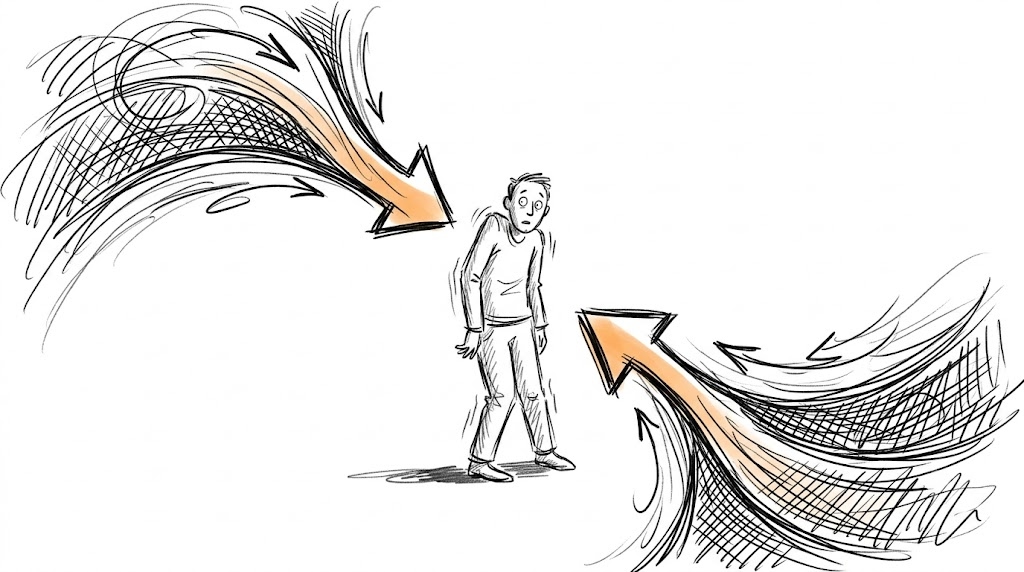
Right now, two large changes are arriving in your working life at the same moment. The work itself is being redesigned around you. And the way you interact with that work is dissolving into plain conversation. Two signals, both big, both at once.
The natural response to that kind of overload is exactly the trance state hypnotists aim for. You freeze. You wait. You assume that someone, somewhere, will sort it out for you.
That is the one thing you cannot afford to do. Paralysis is not an option.
Around us: The forces are real, and the big research houses agree on them
Let me start with the part that is not controversial.
Work is changing for three reasons that compound each other.
- There are fewer people entering the labour market, so processes have to be redesigned around scarcity.
- Geopolitical tension is forcing companies to rethink supply chains and where work actually happens.
- And AI is arriving in nearly every workflow at once.

You do not have to take my word for the framing. The World Economic Forum’s Future of Jobs Report 2025 attributes the reshaping of work to four drivers: technological change, demographic shifts, geoeconomic tension, and economic pressure. McKinsey’s State of Organizations 2026, built on input from more than ten thousand executives across fifteen countries, lands on almost the same three forces: AI acceleration, economic and geopolitical disruption, and changing expectations about work.
When two of the most-read pieces of research in the field reach for the same frame, you can stop debating whether the ground is moving. It is. The more useful question is a personal one. As an individual, you have to ask yourself: what does this do to my job, specifically?
A company has to handle this change across the whole organisation. As an employee, you have to work out what it means for you.
And this is where most articles stop. They describe the weather and leave you standing in the rain. I want to do something more useful. Let me show you how your own day-to-day job gets hit from two directions, and what each force actually does to it.
All three forces matter and are linked, but AI is the one reshaping your job from two directions at once, today, not on some multi-year horizon. That’s the one I want to unpack.
From above: your job is being taken apart and rebuilt around skills
Companies are no longer asking “how many people do we have in which boxes on the org chart?” They are asking a harder question: “what will our business model require us to be able to do, and who can do it?”

Follow the logic downward. The business model defines the processes. The processes define the jobs. The jobs are really just bundles of tasks. And every task requires a particular set of skills. For a growing number of companies, even the top of that chain, the business model itself, is shifting underneath them.

It is becoming operational practice. Mercer’s 2025/2026 Skills Snapshot found that 38 percent of organisations now keep an enterprise-wide skills library, and 55 percent are actively mapping skills to the jobs that need them. They are quite literally re-architecting the workforce one skill at a time.
The reason they bother is simple. The WEF estimates that 39 percent of workers’ core skills will be transformed or made obsolete between now and 2030. That figure has actually come down from 44 percent in 2023, partly because more people are now in active training. But 39 percent is still close to two in five of the capabilities your job runs on.

So the role you hold today is being quietly disassembled into tasks and skills, then reassembled around what the business now needs. That is the force from above.
From below: the interface to your work is dissolving
The second force is quieter, and most people miss it, because it does not look like a reorganisation. It looks like convenience. But it is quietly redefining your day-to-day job.
I wrote about this last year in a piece called “The Future of UI is No UI.” The short version: for forty years we refined the graphical interface, from the first mouse and windows all the way to Apple’s Liquid Glass. That entire tradition is now being bypassed. For routine self-service tasks, the screen full of forms and menus is being replaced by a single prompt field.

Think about a typical HR manager. A large part of their week used to be processing. Pulling reports. Checking leave balances. Routing approval forms. Answering the same policy question for the fortieth time. Screens, fields, clicks.
Now an employee simply types “I would like next Friday off, am I clear to take it?” and the system resolves eligibility, balance, and approval in one exchange. No portal. No form. The task did not get faster. It disappeared.
And this is only the beginning. Increasingly, agents will handle these steps in the background, passing tasks to one another through agent-to-agent (A2A) systems, without anyone touching a screen at all.
That prediction is no longer speculative. Conversational AI in 2026 has moved well past the chatbot stage into assistants that hold context, reach into business systems, and complete multi-step workflows. In customer service, roughly 30 percent of cases were resolved by AI in 2025, with around half expected by 2027. The tasks are dissolving on schedule.
Here is the part that matters. When the processing tasks vanish, the job does not vanish with them. It gets recomposed around what is left: judgement, the difficult conversations, the edge cases the system escalates, the design of the policies themselves. The job title may not change at all. The contents of the day change completely.

That is the force from below. The interface shift quietly deletes whole categories of tasks, and the job reforms around the remainder.
You are standing exactly where the two forces meet
Now put the two together, because that is where you actually live. This is no longer an abstract trend. It is of personal importance. The ground is being reshaped while you are still standing on it.
From above, someone is mapping your role into tasks and skills and asking which still matter. From below, the interface shift is deleting some of those tasks before the mapping is even finished.

Your job is being rebuilt and partly erased at the same time.
In a recent meeting, a customer put it more bluntly than I would have dared. She said:
‘The current situation is similar to the Manhattan Project. It is a re-defining moment for job architectures.’
Strong words, maybe too strong. But sitting in that room, watching a serious organisation pull its own roles apart in order to understand them, I understood the impulse behind the comparison, even if I would not have reached for it myself.”
So here is the uncomfortable question. It is for everyone reading this, myself included.
If your job is being redesigned around you and partly dissolved beneath you, who is responsible for keeping you employable?

For a long time the honest answer was “your employer, through the L&D department.” That answer no longer holds. Learning and development teams are good, but they are structurally too slow. They cannot rebuild curricula at the speed the tools are changing. The WEF puts a number on the gap: of every 100 workers, 59 will need reskilling or upskilling by 2030, and 11 are unlikely to receive it at all.
Read that again. Eleven out of every hundred get left behind. Not because they could not adapt, but because no one reskilled them in time.
Your job is changing. You cannot count on your employer to manage your re-learning for you. That part is yours.
I do not write that to frighten you. I write it to hand you the wheel. Because the moment you accept that it is yours, you stop being a passenger in someone else’s redesign and start running your own.
Run the redesign on yourself
Treat this as a wake-up call. Better, treat it as an opportunity to rethink your own job before someone else does it for you.
Here is the quiet irony in all of this. The exercise companies are spending millions on, the one that maps their model down to the skills they need, is exactly the exercise you can run on yourself. At a scale of one.
You cannot control the three forces. You cannot slow the tools, fix the demographics, or settle the geopolitics. You cannot control your employer’s roadmap or how fast L&D moves. The only thing fully inside your control is you: your skills, your strengths, and what you actually want to spend your working life doing.
So audit yourself the way a company audits itself. What do you do today, broken into real tasks? Which of those tasks are dissolving into conversation? Which of your skills sit in the 39 percent that is shifting, and which are the durable ones the WEF keeps flagging: analytical thinking, judgement, resilience, the ability to work well with other people? And then the question companies routinely forget to ask: which of these do you actually enjoy?
Do this before the environment does it for you. There is a real difference between redesigning your own role and being handed the memo about how it has already been redesigned. That is what it means to take the wheel back: not just answering the audit questions, but choosing the framework you answer them with.
A compass that happens to be a few hundred years old
When I ran this exercise for myself, I needed something to organise it around. I found it in an old Japanese idea called Ikigai.

Ikigai sits at the intersection of four questions.
- What do you love?
- What are you good at?
- What does the world need?
- And what can you be paid for?
It is, in effect, a personal version of the very map companies are now drawing. Where the enterprise lines up business model against capability, you line up passion against strength against demand. It turns a vague anxiety about the future into four concrete questions you can actually answer.
That intersection is where durable employability lives. Not in any single skill, which the next tool may simply absorb, but in the place where what you are good at meets what the changing world still needs and still pays for.
I cared enough about this to work through it properly myself, using Ikigai as the frame. A wrote my personal took selection down in a book, that might be helpful on your journey. You do not need to do the same deep dive to begin. You need a quiet hour and a willingness to ask the four questions honestly.
Don’t drift
Two changes are arriving at once. From above, your job is being rebuilt around skills. From below, the interface to your work is dissolving into conversation. The overload is real, and the natural response is to freeze and wait for instructions.
Companies are not waiting. They are spending serious money to re-map their people, task by task and skill by skill.
The only question that matters is whether you will run that same redesign on yourself first, while it is still yours to run.
Don’t drift. Start with the four questions.
References and further reading
- World Economic Forum: The Future of Jobs Report 2025 — https://www.weforum.org/publications/the-future-of-jobs-report-2025/
- McKinsey & Company: The State of Organizations 2026 — https://www.mckinsey.com/capabilities/people-and-organizational-performance/our-insights/the-state-of-organizations
- Mercer: Skills Snapshot Survey 2025/2026 — https://www.mercer.com/de-de/insights/talent-and-transformation/skill-based-talent-management/rebuilding-reward-and-career-frameworks-based-on-skills/
- Markus Kammermeier: The Future of UI is No UI — How Self-Service Tasks Are Disappearing Into Conversation (Medium, 2025) — https://medium.com/@m.kammermeier/the-future-of-ui-is-no-ui-how-self-service-tasks-are-disappearing-into-conversation-35ce5d217a0b
- Markus Kammermeier: IKIG-AI (2nd edition) — https://www.ikig-ai.de/
메타데이터
- post_id
- 273b65d71bc6
- slug
- your-employability-is-at-stake-and-this-is-not-just-about-ai-273b65d71bc6
- url
- https://medium.com/@m.kammermeier/your-employability-is-at-stake-and-this-is-not-just-about-ai-273b65d71bc6
- canonical_url
- https://medium.com/@m.kammermeier/your-employability-is-at-stake-and-this-is-not-just-about-ai-273b65d71bc6
- author_url
- https://medium.com/@m.kammermeier
- status
- ok
- fetched_at
- 2026-07-17 00:37:06





