Living Your Way Towards an Answer
On future consciousness, relational depth, and the practice that makes it possible
Living Your Way Towards an Answer
On future consciousness, relational depth, and the practice that makes it possible
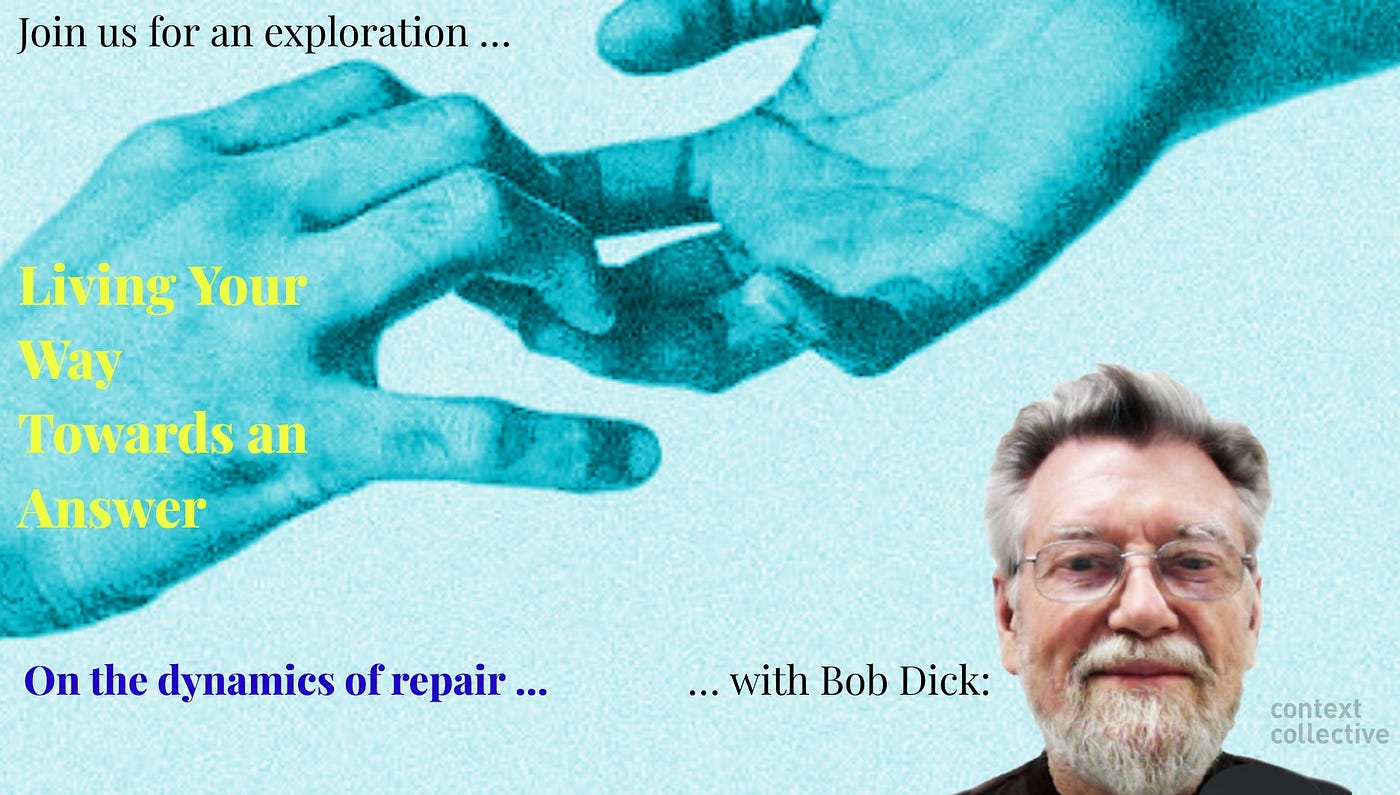
This is the fourth and final article co-authored by Bob Dick and Sebastian Wolf Siebzehnrübl, exploring the foundations of relational practice through the lens of Chris Argyris’s action science. The series has been building toward a four-session webinar program, “Repairing Relationship,” offered in July 2026. Details at the end of this article.
We began this series with a question that most experienced practitioners carry quietly: why does this keep getting harder?
We have looked at what makes it hard structurally — the gap between espoused values and actual behaviour, the cycle of untested assumptions, the self-sealing dynamics of organisational defensiveness, and the particular paradox that well-intentioned intervention can trigger the very resistance it was designed to dissolve.
We have, naturally, also looked at what makes repair possible — the quality of tentativeness and genuine curiosity that Bob Dick has refined across fifty years of practice, and the foundational insight from Sheldon Davis that the relational capacities required for genuine contact are not absent in people. They are rather suppressed. And the work of a practitioner is not to install new capacities but to create conditions in which what is already present can come forward. We refered to the Process Enneagram in our last article — for those familiar, they will recognize Richard Knowles’s concept of the “bowl”: ultimately the conditions created make an organisation (a living system) “leaderful”. You may also recognise Richard’s concept of “discretionary energy”.
This final article takes a step back. Not to summarise what has come before, but to ask a set of larger questions:
What is this practice ultimately in service of? What does it look like when it is genuinely inhabited rather than merely applied? And what does it make possible — not only in the rooms we enter professionally, but in the lives we are living while we do this work?
The acceleration we are inside
We noted in the first article that the conditions of practice have shifted. Not just the external conditions — the economic pressure, the technological disruption, the elevated relational temperature in most workplaces. But something more interior: the capacity for the kind of sustained, honest, unhurried attention that genuine relationship requires.
AI has not created this condition. It has accelerated and made visible something that was already present. The dynamics that Argyris spent fifty years mapping were operating long before algorithms arrived. What has changed is the rate at which those dynamics are running — and the degree to which the environments we work in have become structurally hostile to the kind of presence that repair requires.
This matters because the primary response most organisations have to increasing complexity and speed is to add more process, more monitoring, more structure. To attempt to manage the human dynamics that are generating difficulty rather than to understand and work with them. This is Model I operating at the systemic level: unilateral control of the environment as a response to uncertainty.
What it produces — inevitably, as Argyris would predict — is more of what it is trying to prevent. More disconnection. More untested assumptions. More of the invisible, distributed defensiveness that makes honest conversation increasingly costly and increasingly rare.
Deceleration as professional practice
The most underrated professional act available to practitioners right now is not a new intervention. It is a deliberate deceleration.
Not passivity. Not withdrawal. A quality of intentional slowing that creates the conditions under which genuine attention becomes possible again — for the practitioner themselves, and then, through the practitioner’s presence, for the people and systems they work with.
This is what it means, in practical terms, to sense overheating — in a conversation, in a team, in yourself — before it becomes damaging. To recognise the signature of a system running too fast to hear itself. And to do something that feels counterintuitive in conditions of pressure: to slow down rather than accelerate, to become more present rather than more active, to ask rather than to act.
For a leader, this means being able to hold a team through difficulty without the team’s anxiety becoming your own — and without the pressure to resolve things prematurely closing down the honest conversation the situation is asking for. It means being able to stay curious when everything in the room is pulling toward control.
For a coach, it means reaching the level where real change actually lives: beneath the presenting issue, in the assumptions the client has never thought to question. In the quality of the relationship within which those assumptions can finally be voiced — tentatively, with a genuine invitation to be corrected.
For a consultant, it means the difference between a recommendation that genuinely lands and one that is received politely and quietly set aside. It means understanding why a technically correct diagnosis can produce the opposite of what was intended — and knowing what to do instead. Not a different technique. A different quality of presence in the system you are trying to serve.
In each case, what develops is not primarily authority or method. It is the capacity to remain genuinely present when the room gets tense, gets harder to read. And with that presence comes something rarer still: the ability to help others slow down enough to hear themselves, and each other, more clearly than the pace of their situation has been allowing.
The deeper promise: future consciousness
There is a concept in futures thinking called future consciousness — the capacity to remain genuinely responsive, flexible, and present in conditions of increasing turbulence. Not through prediction — the future is not predictable in the ways most strategic planning assumes. But through the development, in oneself and in one’s relationships, of the relational depth that makes real adaptability possible.
What the futures thinkers often underspecify is where that relational depth comes from. It does not come from scenario planning or strategic foresight, however valuable those may be. It comes from the capacity for honest, non-defensive relationship — from the ability to stay curious in the face of disconfirming information, to voice assumptions as assumptions, to repair what breaks rather than route around it.
This is precisely what Argyris’s action science, at its deepest level, is building. Not a set of tools. A quality of being in relationship — with others, and with oneself — that is genuinely responsive rather than defensively managed.
When this capacity is developed, something changes in the practitioner that is difficult to describe but immediately recognisable to anyone who has experienced it. The work becomes less effortful in one sense and more demanding in another. Less effortful because you are no longer working against the grain of the system — trying to impose movement on something that is resisting it. More demanding because you are staying genuinely present with what is actually happening, rather than managing it from a safe distance behind your professional expertise.
You begin to see what is being protected, not just what is being said. You begin to hear the assumption behind the statement, the fear behind the resistance, the care behind the apparent obstruction. And because you can see these things — and because your presence communicates that you can see them without judgment — something shifts in the quality of what is possible.
Living the question
Rilke wrote to a young poet: live the questions now. Perhaps then, someday far in the future, you will gradually, without even noticing it, live your way into the answer.
This is not a counsel of passivity. It is a precise epistemological observation about how certain kinds of knowledge are actually acquired — not by accumulating information or developing technique, but by inhabiting a question with enough honesty, patience, and genuine curiosity that you gradually become capable of answers you could not have arrived at from the outside.
The question why does this keep getting harder is that kind of question. It cannot be answered by reading a framework or attending a workshop. It can only be answered by staying with it — by bringing it into your practice, your relationships, your ongoing reflection. By noticing, over time, what your own defensive routines look like. What assumptions you are carrying about the people you work with. What happens when you voice those assumptions tentatively and wait, genuinely, to be corrected.
This is what double-loop learning actually feels like from the inside. Not an insight, but a gradual shift in the governing values that shape your behaviour — from the defensive, controlling orientation that Argyris called Model I toward the curious, collaborative, genuinely open orientation of Model II. A shift that cannot be achieved by deciding to make it. Only by practising the specific moves, repeatedly, in the specific conditions where the theory-in-use most reliably asserts itself.
What the program offers
The July 2026 webinar program, Repairing Relationship, is a four-session intensive built around this body of work.
It is not a lecture series. It is a sustained, structured practice — a place to bring the question why does this keep getting harder and to work with it directly, in conversation with Bob Dick and with a small, carefully held group of fellow practitioners.
Across four sessions, participants develop the perceptual capacity to see what is actually happening in a relationship or group in real time — not just what is being said, but what is being protected. They acquire the specific conversational practices of Model II: voicing assumptions as assumptions, inviting genuine correction, preserving the agency of the other person. And they develop the systemic reading that allows them to understand why teams and organisations develop the patterns they do — and what kinds of moves can begin to shift them.
These are not skills you acquire and then apply. They are practices you inhabit and gradually deepen. The program provides the conceptual foundation, the practical tools, and — perhaps most importantly — the quality of relational holding that makes honest practice genuinely possible.
Bob Dick brings to this more than fifty years of working directly in this lineage — refining Argyris’s insights through decades of practice with relationships, teams, organisations, and communities across widely different settings. His style is warm, participative, and rigorously practical. He has spent as long learning how to work with these dynamics without raising defensiveness as he has learning the dynamics themselves. That combination — depth of understanding and sophistication of approach — is genuinely rare.
The orientation sessions
Before the program begins, two free 30-minute orientation sessions will be offered early next month — open to anyone curious about the work. At least one of these will be scheduled before the early-bird registration deadline.
These sessions are not a sales pitch. They are themselves a small demonstration of the quality of inquiry the program builds: honest, unhurried, genuinely curious. Come with your questions. Come with the specific version of why does this keep getting harder that you have been carrying. Come and see whether this is the right container for it.
No commitment required.
Curious? Join us in July for Repairing Relationship: Openness, Trust and the Art of Honest Inquiry in a series of four webinars starting on the 7th and continuing on the 14th, 21st and 28th of July 2026: Why do well-intentioned efforts to improve relationships sometimes make them worse? Drawing on Chris Argyris’s action science, this four-session online program offers evaluators, coaches, consultants and OD practitioners precise, learnable tools for rebuilding trust, surfacing untested assumptions, and turning defensive dynamics into genuine inquiry. Maximum 15 participants. Early bird until June 17th at €399 — against a standard fee of €499.Link to register below.
Recordings of sessions are available exclusively to registered participants who miss a session. Recordings capture only the facilitators’ contributions — not participant interventions — and are not distributed beyond the registered cohort.
Cancellations: full refund 14+ days before the first session; 50% refund 7–13 days before; no refund fewer than 7 days before. Substitution by another participant is welcome at any time.
To register: https://www.tickettailor.com/events/contextcollective/2209886
A closing thought
We began this series with a question. We end it with something that is, in one sense, the same question — but held differently.
Not why does this keep getting harder as a complaint or a confession. As a genuine inquiry. One that is worth sitting with, and worth bringing into conversation with others who are asking it alongside you.
The question itself, held honestly and without premature resolution, is already the beginning of the practice. Because the willingness to stay with it — to resist the temptation to dissolve it into a framework or a technique — is the first expression of the curiosity that makes real learning possible.
We hope to see you in July.
Bob Dick is a Brisbane-based educator, consultant, mentor, and coach with more than fifty years of experience in action science, facilitation, and organisational learning. His work draws directly on Chris Argyris’s research and practice, refined through a lifetime of application across widely different settings.
Sebastian Wolf Siebzehnrübl is a Berlin-based Systemic Inquiry Practitioner working at the intersection of systems thinking, evaluative inquiry, and relational practice. He is affiliated with context collective, Berlin.
메타데이터
- post_id
- 2764d92ea5ce
- slug
- living-your-way-towards-an-answer-2764d92ea5ce
- url
- https://medium.com/@context_collective_berlin/living-your-way-towards-an-answer-2764d92ea5ce
- canonical_url
- https://medium.com/@context_collective_berlin/living-your-way-towards-an-answer-2764d92ea5ce
- author_url
- https://medium.com/@context_collective_berlin
- status
- ok
- fetched_at
- 2026-08-08 13:11:19