Multi-Agent Reinforcement Learning for Smart Cities and Beyond
How Intelligent Agents Are Learning to Coordinate Traffic, Energy, Robots, and Entire Urban Ecosystems
Multi-Agent Reinforcement Learning for Smart Cities and Beyond
How Intelligent Agents Are Learning to Coordinate Traffic, Energy, Robots, and Entire Urban Ecosystems
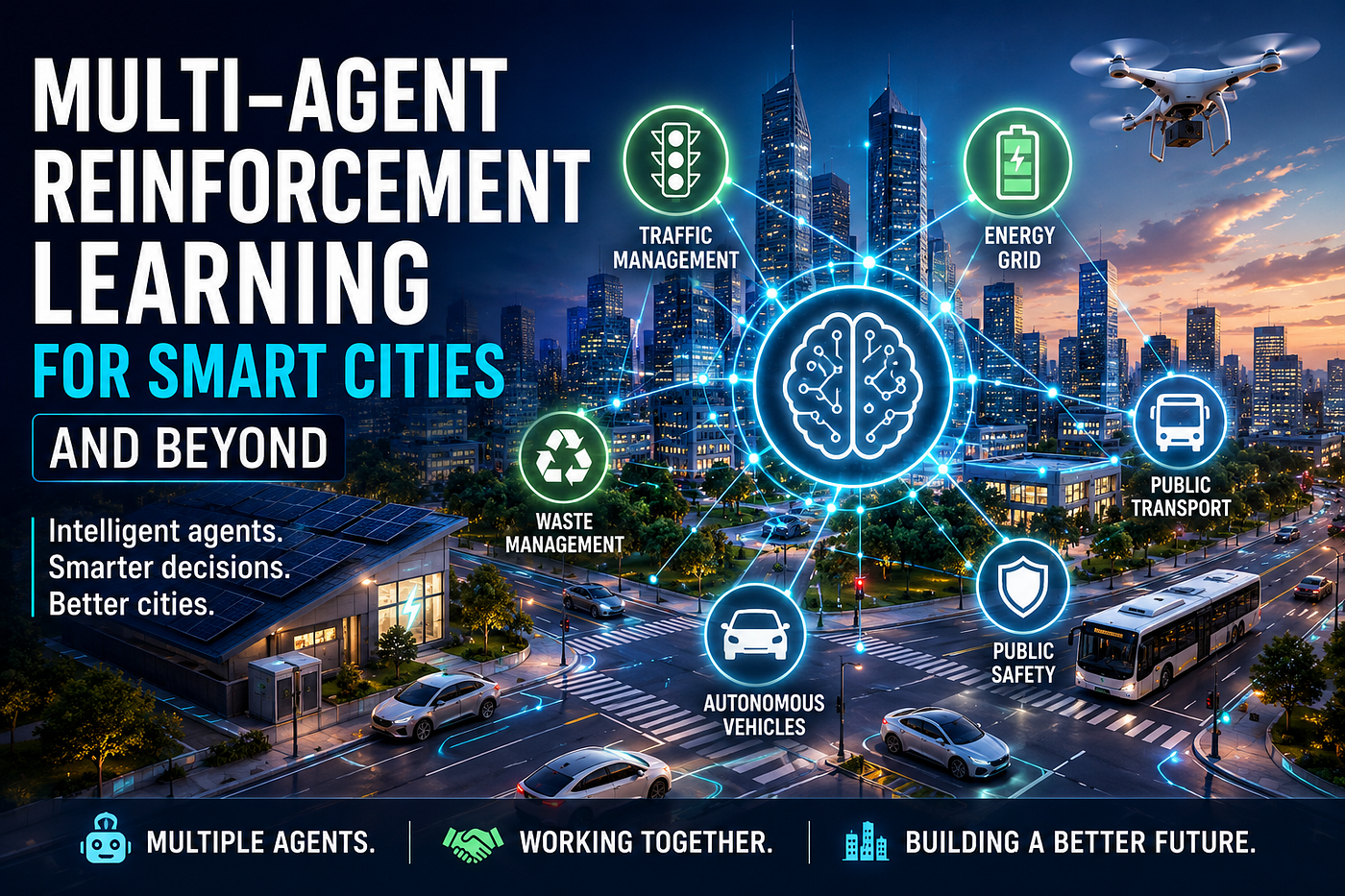
How Intelligent Agents Are Learning to Coordinate Traffic, Energy, Robots, and Entire Urban Ecosystems
Imagine a city where traffic lights cooperate to reduce congestion, power grids automatically balance electricity demand, and fleets of autonomous vehicles coordinate with one another without human intervention.
It sounds like science fiction, but the building blocks already exist today — and one of the technologies making it possible is Multi-Agent Reinforcement Learning (MARL).
While Artificial Intelligence often brings to mind a single super-smart system, the future may actually belong to millions of smaller AI agents working together. In many ways, that’s exactly how human societies function: no single person runs an entire city, yet somehow everything keeps moving.
Multi-Agent Reinforcement Learning takes this idea and applies it to machines.
Let’s explore how MARL could transform smart cities — and why its impact will likely extend far beyond them.
What Is Multi-Agent Reinforcement Learning?
Before diving into MARL, let’s quickly revisit Reinforcement Learning (RL).
In RL, an AI agent learns by interacting with an environment. It performs actions, receives rewards or penalties, and gradually discovers which decisions lead to the best outcomes.
Think of teaching a dog tricks:
- Sit? Reward.
- Roll over? Reward.
- Chew the couch? No reward.
Over time, the dog learns what works.
Now imagine instead of one dog, you have an entire team. They must learn not only how to behave individually but also how to cooperate — or sometimes compete — with one another.
That’s Multi-Agent Reinforcement Learning.
In MARL, multiple agents share an environment and continuously adapt their behavior. Depending on the problem, agents may:
- Cooperate (traffic lights optimizing traffic flow)
- Compete (AI opponents in games)
- Operate independently while sharing resources (delivery robots in a warehouse)
You can think of a smart city as a giant multiplayer game where every participant is trying to make life more efficient.
Why Smart Cities Need Multiple AI Agents
Modern cities are incredibly complex.
At any given moment, thousands of systems operate simultaneously:
- Traffic networks
- Public transportation
- Electrical grids
- Water systems
- Emergency services
- Waste management
- Telecommunications infrastructure
Traditionally, these systems are managed separately. But cities are interconnected ecosystems.
For example:
- Heavy traffic increases fuel consumption.
- Increased fuel use raises emissions.
- Hot weather increases electricity demand.
- Power shortages affect transportation systems.
A single centralized AI could theoretically manage everything, but as cities grow, centralized systems become bottlenecks.
This is where MARL shines.
Instead of one massive AI, imagine:
- Every traffic light is an agent.
- Every electric charging station is an agent.
- Every autonomous bus is an agent.
- Every drone delivery hub is an agent.
Together, they create a distributed intelligence network that can adapt in real time.
The advantages are significant:
- Better scalability
- Faster responses
- Greater resilience
- Reduced single points of failure
- Improved adaptability
In short, MARL allows cities to think collectively.
Smarter Traffic Management
If you’ve ever sat at a red light with no cars in sight, you’ve already encountered one of the biggest inefficiencies in urban infrastructure.
Most traffic systems still rely on fixed schedules or simple sensors. They don’t truly understand what’s happening across an entire city.
With MARL, each intersection becomes an intelligent agent.
Imagine this scenario:
- One intersection notices heavy congestion.
- It communicates with nearby intersections.
- Neighboring traffic lights adjust their timing.
- Traffic is rerouted dynamically.
Instead of isolated decisions, the entire network collaborates.
Researchers have spent years training MARL systems in traffic simulators, and many studies have shown promising improvements in:
- Average travel time
- Traffic throughput
- Fuel efficiency
- Carbon emissions
For drivers, that could mean fewer frustrating commutes.
For cities, it could mean billions of dollars saved annually.
And perhaps most importantly, less time spent wondering why you’re stopped at an empty intersection at 11 PM.
Building Smarter Energy Grids
Electricity demand is becoming increasingly unpredictable.
Solar panels generate power only when the sun shines. Wind turbines depend on weather conditions. Electric vehicles can suddenly create spikes in energy consumption.
Managing all of this manually is difficult.
MARL offers an elegant solution.
Imagine every component in a power grid acting as an agent:
- Solar farms
- Battery storage systems
- Charging stations
- Residential neighborhoods
- Commercial buildings
Each agent learns when to consume, store, or redistribute energy.
For example, if one neighborhood experiences unusually high demand, nearby battery systems could compensate automatically.
This becomes especially important as countries invest heavily in renewable energy.
A smart grid powered by MARL could:
- Reduce waste
- Lower operating costs
- Improve reliability
- Increase renewable energy adoption
- Prevent blackouts
The future electrical grid may resemble a giant conversation between millions of AI agents making decisions every second.
Autonomous Transportation Ecosystems
Self-driving cars are often discussed as standalone technologies.
But here’s the interesting part: autonomous vehicles become dramatically more useful when they communicate with one another.
Imagine a city with:
- Self-driving taxis
- Autonomous buses
- Delivery robots
- Drone fleets
- Smart parking systems
If every system operates independently, inefficiencies remain.
With MARL, however, vehicles can coordinate:
“I’m approaching an intersection.”
“I’m carrying emergency medical supplies.”
“Traffic is building two blocks ahead.”
“An accident was detected on Main Street.”
Of course, AI agents don’t literally speak English, but they exchange information continuously.
The result?
- Reduced congestion
- Safer roads
- More efficient routing
- Faster deliveries
- Better public transportation
It’s possible that future cities won’t eliminate traffic entirely — but they may make it far less painful.
Public Safety and Emergency Response
Emergencies are unpredictable, which makes them ideal candidates for decentralized AI.
Consider a large earthquake.
Immediately, multiple decisions need to happen:
- Which roads remain accessible?
- Where should ambulances go first?
- Which hospitals have available capacity?
- Where should rescue teams be deployed?
A centralized system could quickly become overwhelmed.
MARL allows many agents to make decisions simultaneously.
Potential agents include:
- Ambulances
- Police units
- Fire departments
- Medical drones
- Search-and-rescue robots
- Emergency communication systems
Together, they could form a coordinated response network capable of adapting in real time.
This same technology could also assist during:
- Floods
- Wildfires
- Hurricanes
- Large public events
- Industrial accidents
In emergency situations, seconds matter. Distributed intelligence could save lives.
Beyond Smart Cities
Smart cities are only the beginning. MARL is already finding applications across numerous industries.
Healthcare
Hospitals are complex environments with constantly changing priorities.
AI agents could manage:
- Patient scheduling
- Bed allocation
- Medical robots
- Resource distribution
Imagine an emergency room where multiple AI systems collaborate to reduce waiting times.
Industrial Automation
Modern factories increasingly rely on collaborative robots.
MARL can help robots:
- Coordinate assembly tasks
- Optimize production lines
- Share resources
- Prevent bottlenecks
Think of it as teamwork for machines.
Telecommunications
Future 5G and 6G networks will require intelligent traffic management. AI agents could dynamically allocate bandwidth and optimize network performance for millions of users simultaneously.
Space Exploration
Perhaps the coolest application is space. Instead of sending one expensive robot to another planet, researchers are exploring swarms of smaller robots.
Imagine hundreds of autonomous explorers cooperating on Mars:
- Mapping terrain
- Collecting samples
- Sharing discoveries
- Adapting to unexpected conditions
If MARL succeeds in space, it may become one of humanity’s most important technologies.
Challenges That Still Need Solving
Despite its potential, MARL isn’t magic. Training multiple AI agents is significantly harder than training one.
Researchers continue to face several major challenges:
Non-Stationary Environments
Every agent is learning simultaneously. That means the environment constantly changes, making training more difficult.
Credit Assignment
If ten agents succeed together, who deserves the reward? Determining individual contributions remains a major research problem.
Scalability
Training five agents is manageable. Training five million agents? That’s an entirely different challenge.
Communication Costs
Agents often need to exchange information. Too much communication creates overhead. Too little communication reduces effectiveness.
Safety and Ethics
What happens if AI agents make harmful decisions? As MARL systems become integrated into public infrastructure, ensuring safety, transparency, and accountability will become increasingly important.
Popular MARL Algorithms and Tools
If you’re interested in experimenting with MARL yourself, several popular algorithms and frameworks are worth exploring.
Algorithms
- Independent Q-Learning (IQL)
- MADDPG (Multi-Agent Deep Deterministic Policy Gradient)
- QMIX
- COMA
- MAPPO (Multi-Agent Proximal Policy Optimization)
Frameworks
- Ray RLlib
- PettingZoo
- PyMARL
- MARLlib
- Mava
Fortunately, you don’t need a smart city to get started.
Many researchers begin with simulated environments involving simple agents before scaling up to more complex systems.
The Future of Intelligent Cities
Over the next decade, MARL will likely intersect with several other technologies:
- Internet of Things (IoT)
- Large Language Models (LLMs)
- Edge Computing
- Digital Twins
- Generative AI
One particularly exciting idea is the concept of a digital twin — a virtual replica of an entire city.
Before implementing changes in the real world, city planners could test them in simulation:
- What happens if a major road closes?
- How would a heatwave affect energy demand?
- Where should new charging stations be built?
MARL agents could experiment millions of times in simulation before making recommendations for the real world.
Eventually, cities may become partially self-managing.
Not because a single superintelligence takes over, but because millions of smaller intelligences quietly collaborate behind the scenes.
Final Thoughts
Multi-Agent Reinforcement Learning represents a fascinating shift in how we think about AI.
Rather than building one giant brain, we’re building societies of intelligent agents capable of cooperation, adaptation, and collective problem-solving.
Smart cities provide the perfect testing ground for this technology, but their influence won’t stop there. From hospitals and factories to telecommunications and space exploration, MARL is steadily expanding into every corner of modern life.
The next time you’re stuck in traffic, imagine a future where every traffic light, bus, and vehicle is working together to get you home faster.
That future may arrive sooner than we think.
메타데이터
- post_id
- 276641b635e0
- slug
- multi-agent-reinforcement-learning-for-smart-cities-and-beyond-276641b635e0
- url
- https://medium.com/@ujangriswanto08/multi-agent-reinforcement-learning-for-smart-cities-and-beyond-276641b635e0
- canonical_url
- https://medium.com/@ujangriswanto08/multi-agent-reinforcement-learning-for-smart-cities-and-beyond-276641b635e0
- author_url
- https://medium.com/@ujangriswanto08
- status
- ok
- fetched_at
- 2026-07-19 14:44:42