Scurvy in the Womb: Why Ancient California’s Babies Had Scurvy but Their Mothers Didn’t
A Recent Study Found Scurvy in Infants as Young as 40 Weeks in Late Holocene California
Scurvy in the Womb: Why Ancient California’s Babies Had Scurvy but Their Mothers Didn’t
A Recent Study Found Scurvy in Infants as Young as 40 Weeks in Late Holocene California
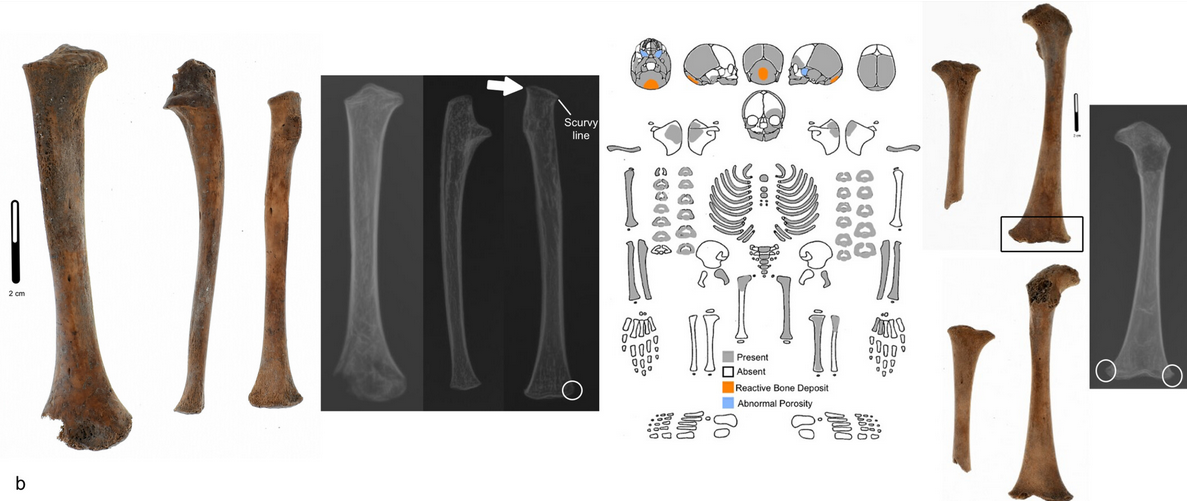
Infant’s bones (ALA-B92) with signs of scurvy, including: White line of Fraenkel (white arrow), Trümmerfeld zones (white line), and Pelkan’s spurs (white circle). A skeletal preservation showing distribution of abnormal bone. Credit: Caine et al. 2026
Today, most doctors tell expecting mothers to eat well and stay hydrated, and they will likely prescribe various supplements, including vitamin A, D, folate, B12, B6, C, phosphorus, iron, and calcium. What most modern doctors wouldn’t do is say, ‘Well, stop eating fish, steer clear of all meat, and you might as well throw away your table salt, you won’t be needing it for the next 9 months.’
But as we all probably know, food taboos are quite common throughout history and often also include women and expectant mothers. And then there is the simple fact of the changing seasons and natural disasters, which create food shortages and limit vitamin and mineral intake. In ancient California, various isotopic and ethnographic research has shown evidence of regional, seasonal, and cultural variability in food shortages; however, evidence of nutritional deficiencies is limited.
A new study by Dr. Alyson Caine and her colleagues set out to identify evidence of one such nutritional deficiency, namely scurvy, in Indigenous Californian remains from the late Holocene. Not only did they find evidence of scurvy, but weirdly enough, it was only seen in the bones of children, including infants that had only just been born, but why?
Scurvy and California’s Nutrient-Rich Landscape
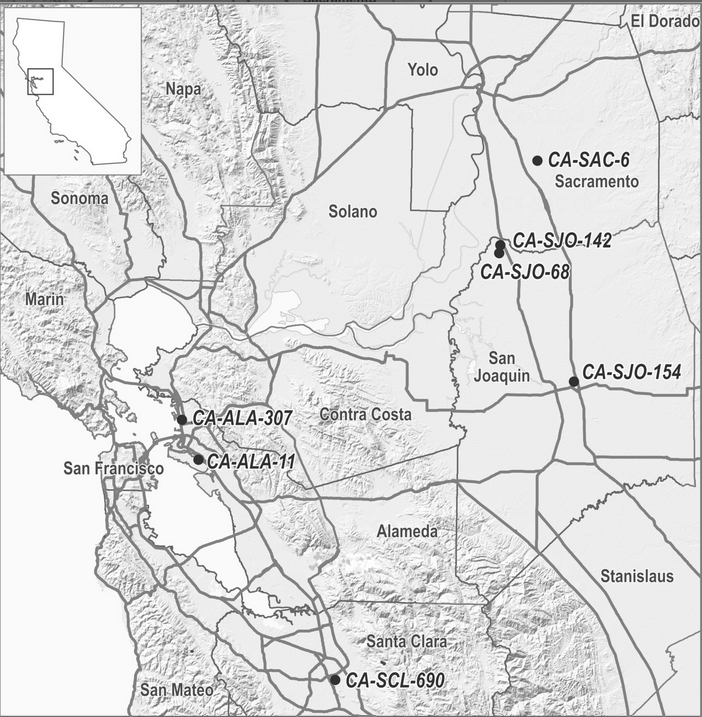
Map showing sites were individuals came from across California including: SCL = Santa Clara County; ALA = Alameda County; SAC = Sacramento County; SJO = San Joaquin County. Credit: Caine et al. 2026
Scurvy is a nutritional disease that develops after 1 to 3 months of vitamin C intake falling below 10mg/day. Although it can also arise from malabsorption, aka the body’s inability to properly absorb vitamin C, such as in conditions like Crohn’s disease (chronic inflammatory bowel disease) or celiac disease (an autoimmune disease where eating gluten triggers an immune system attack on the small intestine). Other factors that can inhibit vitamin C absorption include smoking and alcohol consumption, while boiling water-soluble foods like milk can destroy vitamin C.
Symptoms of scurvy include feeling incredibly tired and weak all the time, joint and muscle pain, red and blue spots on the skin, bruising easily, and swollen, bleeding gums. In the worst cases, your teeth begin to fall out.
Often, individuals with scurvy also have other co-occurring deficiencies, such as zinc, iron, folate, vitamins D and B, meaning that finding evidence of scurvy in the archaeology can also signal other deficiencies affecting a population.
Despite California having many vitamin C-rich foods, dietary diversity was not uniform. What does that mean? Well, basically, people at the coast usually ate more marine resources, while inland groups ate more freshwater and terrestrial sources. Of course, seasons played a role too, with spring and summer providing various berries and geophytes (bulbs, corms, and tubers). Meanwhile, fall and winter often saw diets shift to fish, seeds, and acorns.
Depending on how these foods were processed, their nutrient concentrations would also vary drastically, so while California’s landscape was, in theory, rich in various resources, that did not mean everyone was eating equally nutrient-rich foods all the time.
Finding Scurvy in the People of Ancient California
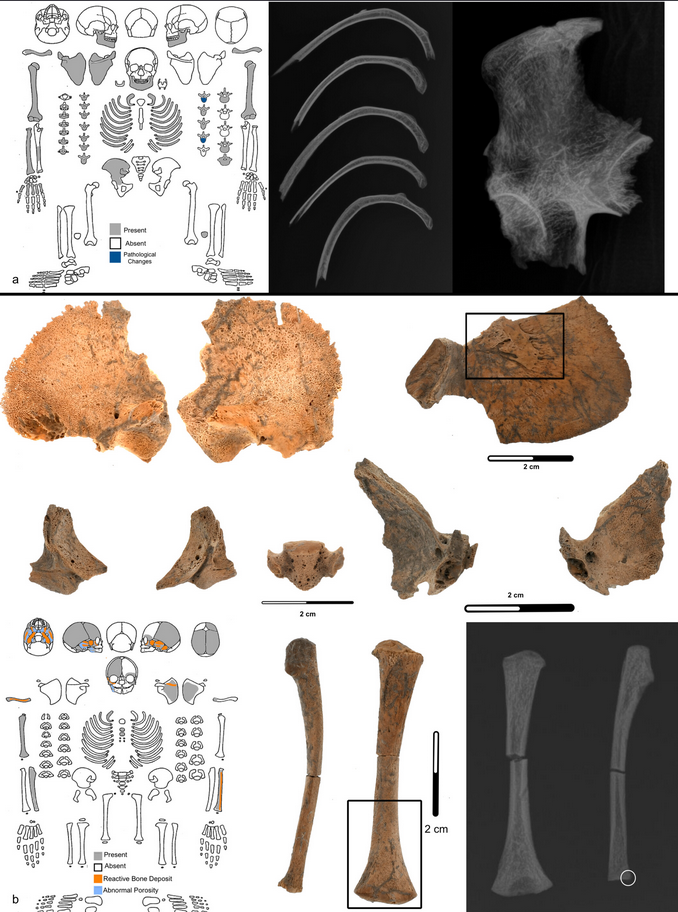
The first double burial from CA-ALA-11: an adult female (ALA-B26) showing pathological changes to her ribs and pelvis, and an infant (ALA-B27) with signs of scurvy. Credit: Caine et al. 2026.
To determine what types of nutritional deficiencies ancient Californians may have experienced, the remains of 27 individuals from different Late Holocene sites located in California’s San Francisco Bay Area and Central Valley were examined. These remains date from roughly 500 BCE to 1834 CE. Among them were two primary sites, including a shell mound (CA-ALA-11) and a village site (CA-SCL-690), and five additional sites curated from the Phoebe A. Hearst Museum of Anthropology (PAHMA).
The study applied both macroscopic analysis as well as radiographic imaging, aka X-rays to look for signs of scurvy with X-rays proving particularly insightful as they allowed for the identification of key features such as white lines of Fraenkel (white lines caused when bone growth is disrupted), Trümmerfeld zones (Scurvy lines, aka. band of weakened bone), and Pelkan’s spurs (small bony projections on bone edges), though individuals from the PAHMA sites could not undergo the radiographic imaging as these remains were originally analyzed between 2004 and 2006 and were no longer available for further study.
They found that while most children and infants showed signs of scurvy, not a single adult did.
But why were children affected and not adults, and how is it possible that individuals as young as ~40 weeks old were affected by scurvy?
The Tolls of Pregnancy and the Consequences of Scurvy
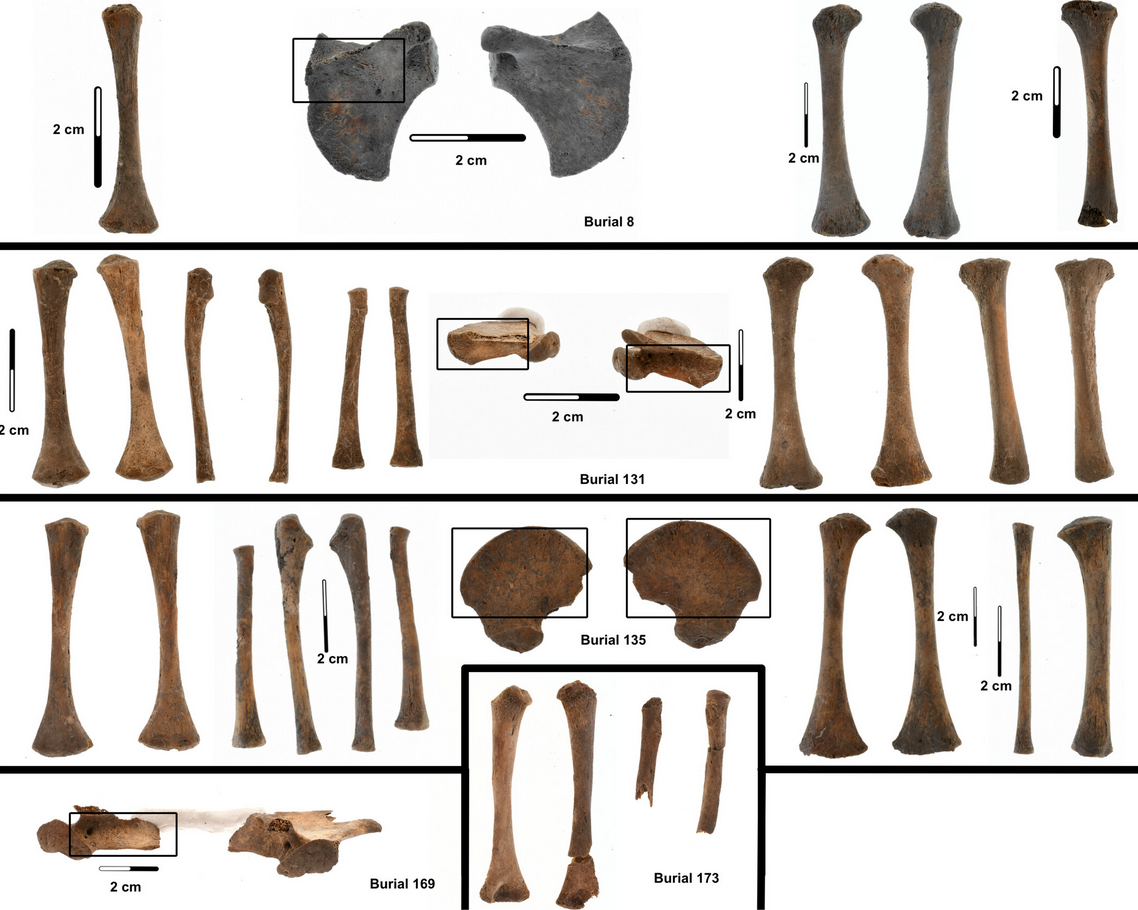
Post-cranial skeletal remains of five individuals from CA-ALA-11 (from top to bottom: ALA-B8, ALA-B131, ALA-B135, ALA-B169, and ALA-B173), showing macroscopic signs of scurvy including reactive bone deposits on the scapulae, long bones, and pelvis. Credit: Caine et al. 2026.
Remember how, in the beginning, I said most modern doctors will prescribe you a myriad of supplements? Well, this is because during pregnancy and breastfeeding, women are particularly vulnerable to nutritional deficiencies. In pregnancy, energy needs increase by 200–300 kcal/day, protein turnover is increased by 25%, and fatty acid concentrations can decrease by up to 52%.
These physiological changes, in tandem with cultural practices, seasonal food shortages, or simply already being malnourished and nutrient-deficient before pregnancy, can have a cascading effect.
So, it is possible that these children had mothers who were deprived of certain nutrients. From ethnographic accounts, it is known that when geophyte harvests were low, acorns and seeds, low in vitamin C, would supplement the diet.
Meanwhile, gruel made for weaning infants was typically made from these very same ingredients, seeds, geophytes, and acorns, leading to nursing and pregnant women and their infants becoming disproportionately affected by nutritional deficiencies.
On top of that, some ethnographic research suggests that pregnant and nursing women abstained from hunting and did not eat meat, fish, or salt. A nursing or gestating baby is not consuming solid foods; all their vitamin C comes from the mother, either through the umbilical cord or via breast milk. If the mother is not getting enough vitamin C, neither is the baby.
But if the mothers were possibly vitamin C-deficient, why did they not have signs of scurvy on their bones?
Well, for one thing, you can be vitamin C-deficient and not develop scurvy; scurvy is the result of prolonged and extreme vitamin C deficiency. And secondly, an adult’s bone turnover (that is, the renewal of bones over time) is much slower than in children, particularly in infants, who undergo rapid bone growth over a short period.
Two burials, both from CA-ALA-11, were particularly noteworthy. The first is a double burial of an adult female (45+ years old/ ALA-B26) and an infant (~40 weeks old/ ALA-B27). The child had evidence of scurvy, including Pelkan’s spurs, indicating it had lacked vitamin C for at least 3 months while in utero.
Meanwhile, the female showed no signs of vitamin C deficiency. But that doesn’t mean she would have been unaffected. Depleted vitamin C can cause pregnancy complications, including hemorrhage, poorly attached placenta, and increased risk of premature birth. Of course, it is possible that at age 45+ she may have had age-related pregnancy complications, but her burial with a scurvy-affected infant who dies at term suggests vitamin deficiency may have been a factor.
The second double burial, also of a female (40–44 years old/ ALA-B91) and an infant (8–10 months old/ ALA-B92), shows a similar pattern. The infant has signs of scurvy, while the adult does not. Its age at death indicates it likely would have had scurvy for ~3–6 months. This would likely have caused the infant pain, resulting in it being fussy and screaming. If breastfeeding had ceased early and its diet had been shifted to gruels, these vitamin deficiencies would likely have worsened.
A recent study by Dr. Caine and colleagues analyzed the remains of Late Holocene Californians, finding that infants and children were disproportionately affected by scurvy while adult individuals showed no clear sign of the disease. Taken together with known regional diet variations, seasonal food shortages, and cultural food norms, they suggest that these infants and children likely developed scurvy due to their mothers’ insufficient nutrient intake during pregnancy and breastfeeding.
In at least two cases of double burial, this may have also led to complications for the mother, even though skeletal signs of scurvy were not found in the adults, likely due to slower bone turnover rates.
Scurvy may not have been the cause of these infants’ deaths, but it likely did contribute to their overall frailty.
Do you think anyone ever noticed a correlation with winter months and food taboos leading to more frail and sick children, and how common do you think such nutritional deficiencies likely were, especially considering they may have seemed invisible in the archaeological record?
Let me know your thoughts, and if you’d like to support the countless hours I pour into researching, writing, and bringing these hidden corners of history to life, why not Buy Me A Coffee
References
Caine, A., C. Canzonieri, E. J. Bartelink, and A. Galvan. 2026. “The Association of Pregnancy and Scurvy in Indigenous Women and Their Children From the Late Holocene in California (USA).” International Journal of Osteoarchaeology 1–16. https://doi.org/10.1002/oa.70114.
NHS. (2020, November 23). Scurvy. Nhs. https://www.nhs.uk/conditions/scurvy/
Published in Palaeopress. **Follow **to explore everything old
메타데이터
- post_id
- 27bcc9748be7
- slug
- scurvy-in-the-womb-why-ancient-californias-babies-had-scurvy-but-their-mothers-didn-t-27bcc9748be7
- url
- https://medium.com/palaeopress/scurvy-in-the-womb-why-ancient-californias-babies-had-scurvy-but-their-mothers-didn-t-27bcc9748be7
- canonical_url
- https://medium.com/palaeopress/scurvy-in-the-womb-why-ancient-californias-babies-had-scurvy-but-their-mothers-didn-t-27bcc9748be7
- author_url
- https://medium.com/@sandeeoster17
- status
- ok
- fetched_at
- 2026-06-11 10:13:20