The Hidden Impact of Warehouse Storage on Asset Reliability and Maintenance Costs
In the race to procure equipment on time, the industry forgot to ask a harder question: where does it all go?
The Hidden Impact of Warehouse Storage on Asset Reliability and Maintenance Costs
In the race to procure equipment on time, the industry forgot to ask a harder question: where does it all go?
Let us see the storage in oil and gas is treated, far too often, as the space between procurement and installation with a passive holding pattern with no engineering discipline of its own. That assumption is expensive. This article is about dismantling it.
What You’ll Take Away
This is a focused guide to oil and gas equipment storage what a compliant, fit-for-purpose storage operation looks like, how international standards and specifications define its requirements, and what separates a storage facility that protects asset value from one that quietly destroys it. Whether you’re managing a project laydown yard, running a third-party logistics hub serving O&G clients, or responsible for warehousing strategy on an EPC contract, the framework here applies directly to your work.
Storage Is Not Preservation’s Little Brother
Before anything else, let’s separate two concepts that are routinely conflated.
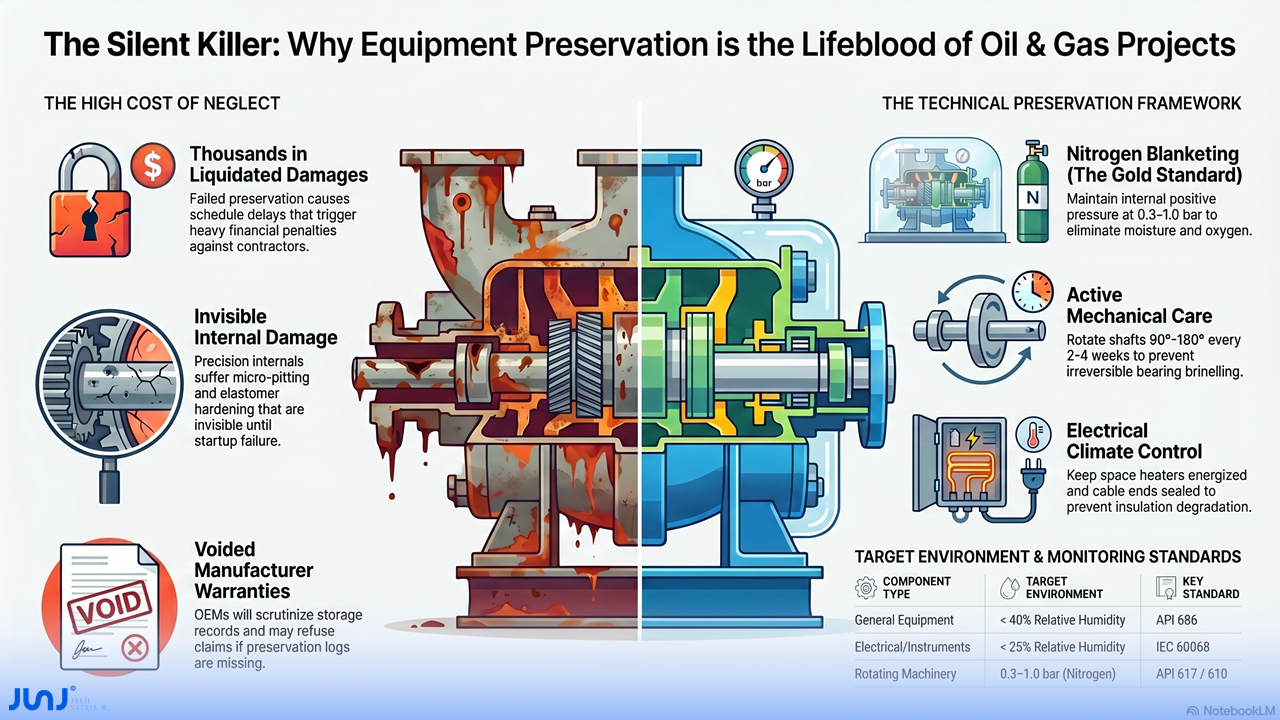
Preservation is the active discipline of protecting equipment from degradation — applying treatments, maintaining nitrogen charges, rotating shafts, managing humidity. It’s about what you do to the equipment.
Storage is the discipline of managing the physical environment in which equipment resides — the facility, the layout, the material control systems, the access conditions, and the governance structure that ensures the right equipment is in the right place in the right condition at the right time. It’s about where and how equipment lives between procurement and installation.
Both are necessary. Neither substitutes for the other. A technically excellent preservation program executed in a poorly managed storage facility will still produce damaged equipment. Likewise, the most sophisticated warehouse in the world provides no protection if the preservation activities inside it are neglected.
In oil and gas, the standards that govern each are distinct. Preservation is primarily governed by equipment-specific standards — API 686, API 610, API 617, IEC 60068. Storage governance draws from a broader, cross-functional set: quality management systems, materials management specifications, logistics frameworks, and operating company warehouse standards. The two must be designed together and managed as an integrated system.
The Storage Classification Framework
Not all O&G equipment can or should be stored the same way. A robust storage operation begins with a classification framework that assigns every item to an appropriate storage category based on its sensitivity, value, and preservation requirements.
The industry standard approach, reflected in Shell DEPs, Aramco SAES/SAMSS standards, and most major EPC contractors’ Materials Management Procedures, typically uses three to four storage classes:
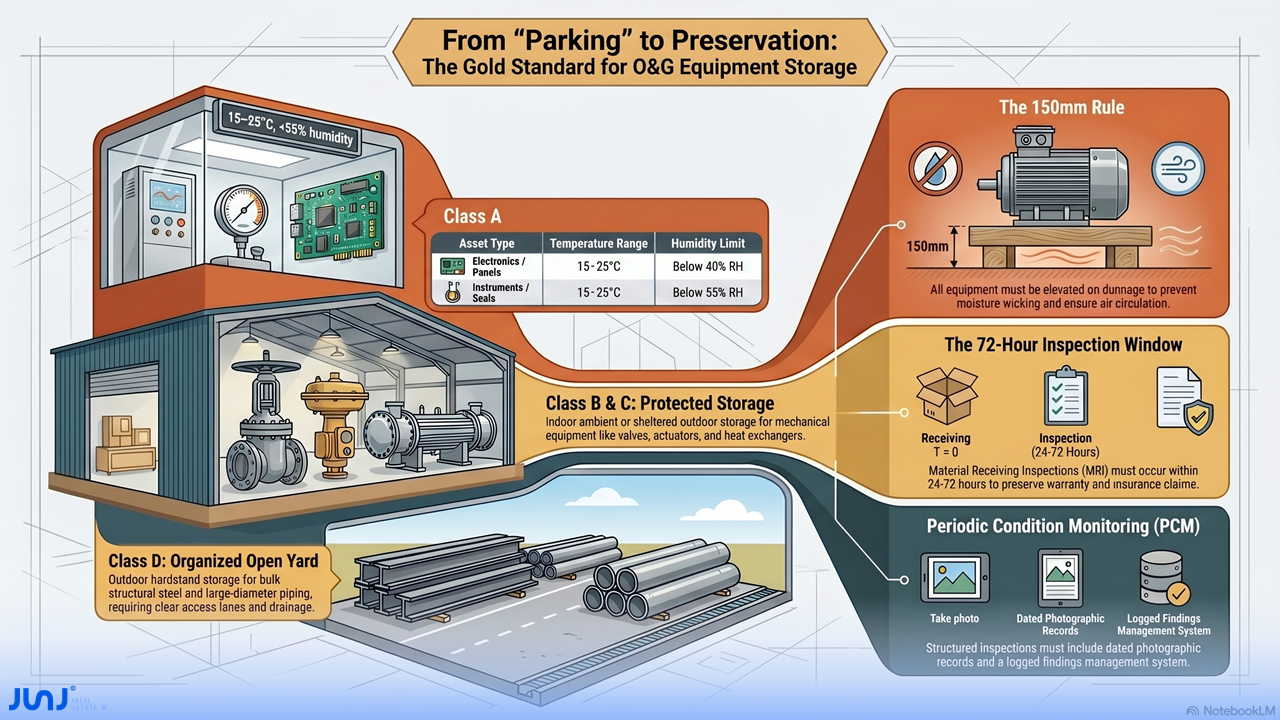
Class A — Controlled Environment Storage (Indoor, Climate-Controlled) Reserved for the most sensitive items: instrumentation and analyzers, electrical panels and switchgear, optical and electronic components, specialty elastomers and seals, and high-value small-bore items. Requirements: temperature 15–25°C, relative humidity below 55% (below 40% for electronics), continuous environmental monitoring with alarm capability, access restricted and logged.
Class B — Covered Storage (Indoor, Ambient) General indoor storage for mechanical equipment requiring protection from direct weather but not strict climate control: valves, actuators, flanges, fittings, piping spools, small pumps. Requirements: dry, ventilated building, clean floor (no soil contact), racking or dunnage, good lighting for inspection access.
Class C — Sheltered Outdoor Storage Large or heavy items that cannot practically be stored indoors but require protection from direct rain, UV, and pooling: large pressure vessels, heat exchanger bundles, skid-mounted equipment with adequate weatherproofing, structural steel. Requirements: hardstand (compacted gravel or concrete), drainage, shade canopy or tarpaulin support frames, no ground contact.
Class D — Open Yard Storage Bulk structural steel, concrete products, cable drums (with UV-rated outer sheath), large-diameter piping. Requirements: hardstand, drainage, organized layout with clear access lanes, adequate dunnage to prevent ground contact and water pooling.
The governing principle: equipment should be assigned to the highest storage class its preservation requirements demand — not the lowest class the project can get away with for cost reasons. Downgrading storage classification to save money on warehouse rental is one of the most reliably counterproductive decisions an O&G project can make.
Actionable tip: Develop a Storage Class Assignment Register during the engineering phase, before procurement orders are placed. Map every major equipment tag to its required storage class. This register drives the storage facility specification and prevents the scramble that happens when equipment arrives and no one has defined where it goes.
What a Compliant O&G Storage Facility Looks Like
The Physical Facility
The physical infrastructure of a compliant O&G storage facility is defined by a combination of international standards and project-specific specifications. Key requirements include:
Hardstand and drainage. All outdoor and covered storage areas must be on compacted hardstand — either concrete or engineered gravel — with positive drainage to prevent water pooling. ISO 8501 (Surface Preparation Standards) and project civil specifications typically define hardstand requirements. Equipment sitting in standing water will corrode regardless of how well it was preserved at the factory.
Dunnage. All equipment must be elevated off the ground on timber, rubber, or steel dunnage to prevent moisture wicking and to maintain air circulation underneath. Minimum clearance is typically 150mm (6 inches) for general equipment. This seems obvious. In practice, it is frequently ignored for “temporary” placements that become permanent.
Access lanes. Storage areas must maintain clear, dimensioned access lanes for inspection, handling equipment, and emergency egress. OSHA 29 CFR 1910.176 and equivalent international standards (UK HSE guidance L26, ISO 45001) specify minimum lane widths. A storage yard that can’t be safely walked-through or accessed by a forklift is also a yard where inspection quality suffers.
Signage and zoning. Each storage zone must be clearly marked, with storage class, any access restrictions, and hazardous material segregation requirements visibly posted. Zoning is not just about organization — it’s a safety control. High-voltage equipment, pressurized vessels, and hazardous chemical stores require physical separation and appropriate hazard signage under IMDG Code, ADR, and local regulatory frameworks.
Security and access control. O&G equipment stores significant value. Access must be controlled, logged, and limited to authorized personnel. Unauthorized handling of preserved or calibrated equipment — even well-intentioned — can compromise preservation integrity and calibration status. Access logs must be maintained and form part of the facility’s quality records.
The Materials Management System
The backbone of a compliant storage operation is its materials management system — the processes and tools that track every item from receipt through storage to issue and installation.
Material Receiving Inspection (MRI). Every item arriving at the storage facility must pass a receiving inspection before placement. Per most EPC project materials management procedures and ISO 9001:2015 requirements, the MRI checks: physical condition against the packing list and purchase order, preservation integrity (are all blanks in place? is the nitrogen pressure correct? are VCI bags sealed?), documentation completeness (MTRs, test certificates, preservation records), and any visible damage or discrepancy.
Damage identified at receipt must be formally reported within the project’s specified timeframe — typically 24 to 72 hours — to preserve warranty and insurance claims. A damage report filed three weeks after receipt will be challenged by any manufacturer or insurer. This time window matters.
Unique identification and tagging. Every item in storage must carry a unique, weather-resistant identification tag linked to the inventory system. For O&G projects, equipment tags typically follow the project’s tag numbering convention (e.g., 40-P-001A for a pump). Bulk materials are tracked by material code and lot number. Tags must be readable after months of outdoor storage — embossed metal or UV-stable printed labels, not paper tied with string.
Inventory management platform. Whether it’s an enterprise CMMS like SAP MM, a project-specific materials management system, or a purpose-built warehouse management system (WMS), every item in storage must have a live inventory record showing its location (yard, bay, row, stack), storage class, preservation status, and current condition code. Spreadsheet-based inventory management is inadequate for complex O&G projects. It cannot enforce workflows, cannot flag overdue preservation activities, and cannot generate the traceability reports that client audits and handover packages require.
Actionable tip: Insist on a location-based inventory system from project Day 1 — not just a list of what’s on site, but a spatial record of exactly where each item is. When you need to find a specific valve spool among three thousand items in a busy laydown yard, “it’s somewhere in Area C” is not an acceptable answer.
Periodic Condition Monitoring
Equipment in storage does not stay in the condition it arrived in. Conditions change, preservation degrades, and damage can develop slowly without any single dramatic event. Periodic Condition Monitoring (PCM) is the structured inspection regime that catches these changes before they become failures.
A robust PCM program includes:
Defined inspection frequency by storage class and criticality. Class A items — climate-controlled, high-sensitivity are typically inspected monthly. Class C and D items in outdoor storage may also warrant monthly inspections in harsh environments. Inspection frequency should be risk-based and documented in the project’s Storage and Preservation Plan.
Structured inspection checklists. Each PCM walk-down uses a standardized checklist covering: physical condition (no new damage, dunnage intact, covers secured), preservation status (nitrogen pressure, desiccant condition, VCI bag integrity), identification tag legibility, and storage class compliance (is it where it should be, stored as specified?). Checklist completion is mandatory — it is not a free-text observation exercise.
Photographic records. PCM records must include dated photographs of each item or equipment group. Photographs provide an objective record that supports condition assessments, trend analysis, and dispute resolution. A written description of “good condition” is subjective. A photograph is not.
Findings management. PCM findings are only valuable if they drive action. Deficiencies found during walk-downs must be logged in a findings register, assigned to a responsible person with a target close-out date, and tracked to completion. Open findings that remain unaddressed across consecutive PCM cycles are a governance failure.
Actionable tip: Conduct at least one unannounced PCM walk-down per quarter. Announced inspections improve results for the inspection. Unannounced inspections reflect the true baseline condition of the storage program.
Re-Preservation and Shelf Life Management
Most factory-applied preservation treatments are warranted for 12 to 24 months. Most major O&G projects experience storage durations that exceed this — driven by construction delays, financing issues, regulatory timelines, and the general optimism of original project schedules.
When the preservation warranty period expires, equipment does not automatically fail — but the protective treatment may no longer be performing as specified, and the manufacturer’s warranty on the equipment itself may be affected. Re-preservation is the process of restoring preservation to its original standard.
Re-preservation activities typically include:
- Re-application of preservation oils and VCI treatments
- Replacement of desiccants and humidity indicator cards
- Re-charging of nitrogen blankets where pressure has been lost or is approaching minimum
- Inspection and re-sealing of all covers, blanks, and protective packaging
- Updated documentation: new preservation record entries, revised preservation expiry dates
Re-preservation is also triggered by the shelf life management of specific components. Elastomers, instrumentation batteries, calibrated instruments, lubricants, and specialty chemicals all carry manufacturer-defined shelf lives. A shelf life register — integrated into the materials management system — should flag items approaching expiry before they become a commissioning problem. Finding that half your O-ring kits have expired two weeks before first oil is a procurement headache that is entirely avoidable.
Actionable tip: Build re-preservation cost and schedule into the project baseline from the outset. Treat it as a planned scope item, not a contingency. Projects that budget for re-preservation execute it. Projects that don’t, delay it until the damage is done.
The Third-Party Logistics Dimension
Not all O&G project storage is managed by the project team directly. Increasingly, especially on international projects where equipment is manufactured across multiple countries and shipped to remote installation sites, third-party logistics (3PL) providers and specialist O&G warehousing companies manage consolidated storage hubs at major ports and logistics centers.
A 3PL provider operating in the O&G sector carries responsibilities that go well beyond conventional warehousing:
Preservation custodianship. The 3PL takes on formal responsibility for executing and documenting preservation activities during the storage period. This must be contractually defined — what activities, at what frequency, to what standard, with what documentation. A generic warehousing contract does not create these obligations. They must be explicitly written in.
HAZMAT compliance. O&G equipment often arrives with residual chemicals, pressurized assemblies, and radioactive source items (e.g., nuclear density gauges). The 3PL must be certified and operationally capable for the relevant transport and storage regulations — IMDG, ADR, IATA DGR, and local equivalents.
Client audit rights. The operating company or EPC contractor must retain the contractual right to conduct unannounced audits of the 3PL facility and its records. This right is only meaningful if it is exercised. Periodic third-party audits by an independent inspector — not just client site visits — provide a more objective assessment of compliance.
Seamless handover documentation. When equipment leaves the 3PL facility for final delivery to the installation site, the complete storage and preservation history must transfer with it. This means the Equipment Preservation Record, PCM reports, any damage reports, re-preservation records, and shelf life status of all components. An equipment package that arrives at site without this documentation has no verifiable preservation history — and no credible basis for commissioning sign-off.
Actionable tip: When evaluating a 3PL for O&G project storage, request their last two internal audit reports, their current nonconformance register, and three client references from O&G projects of comparable scale. The quality of their response to that request will tell you more than any facility tour.
Storage as a Project Discipline
The oil and gas industry has the technical knowledge, the standards framework, and the logistics infrastructure to manage equipment storage correctly. What it consistently underinvests in is treating storage as a genuine project discipline — one that requires engineering input during the planning phase, contractual rigor during execution, and senior leadership visibility throughout.
The projects that get storage right don’t get it right by accident. They get it right because someone, early in the project lifecycle, asked the questions that storage failures prove were never asked elsewhere: Where is all of this going to go? Who is responsible for it while it’s there? How will we know if something goes wrong? And what does “acceptable condition at commissioning” actually mean?
Those are not complicated questions. But they are ones that a surprising number of projects reach first oil without ever having properly answered.
In your experience, what’s the single biggest gap between how O&G storage is planned on paper and how it’s actually executed in the field — and what would it take to close it? I’d be genuinely interested in what you’ve seen. Share your thoughts in the comments.
메타데이터
- post_id
- 27c4e47e85df
- slug
- the-hidden-impact-of-warehouse-storage-on-asset-reliability-and-maintenance-costs-27c4e47e85df
- url
- https://medium.com/@wsatria212/the-hidden-impact-of-warehouse-storage-on-asset-reliability-and-maintenance-costs-27c4e47e85df
- canonical_url
- https://medium.com/@wsatria212/the-hidden-impact-of-warehouse-storage-on-asset-reliability-and-maintenance-costs-27c4e47e85df
- author_url
- https://medium.com/@wsatria212
- status
- ok
- fetched_at
- 2026-06-23 19:38:28