Paris et le Désert Français — 79 years after
In 1947, Jean-François Gravier sat down to write an essay, developing the most influential (and probably really bad) idea in French…
Paris et le Désert Français — 79 years after
In 1947, Jean-François Gravier sat down to write an essay, developing the most influential (and probably really bad) idea in French post-war history of spatial planning. “Paris et le désert français” diagnosed what he called macrocéphalie parisienne — the capital devouring the nation, hoarding its talent, draining its regions into a vast provincial wasteland. The essay was an intervention, a provocation, a policy manual dressed up as social geography. And it worked, probably even better than the author ever expected. For half a century, French territorial politics ran on Gravier’s fuel. Seventy-nine years later, we are still arguing about the same city, the same desert, the same fear.
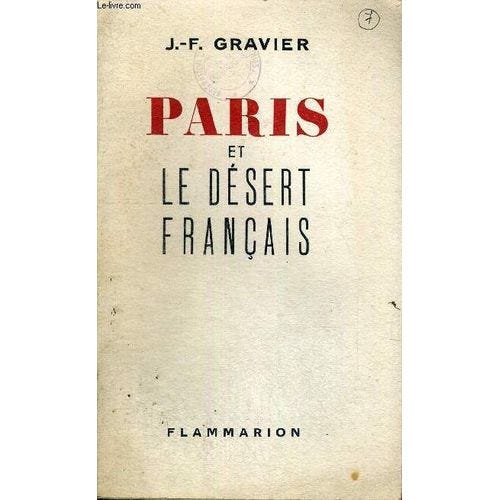
The argument was not subtle–Paris was a mere parasite; the provinces were the host. The solution was to stop the feeding: restrict migration to the capital, force industries to relocate, and build counterweights. The métropoles d’équilibre — Lyon, Marseille, Lille and Dijon, Nantes, Toulouse, and Strasbourg, to a lesser extent, were partly his children, administrative responses to a diagnosis that treated urban concentration as pathology. The villes nouvelles on the Île-de-France periphery followed the same logic in inverse: if you can’t shrink Paris, at least dilute it. The entire apparatus of postwar French regional planning was soaked in Gravier’s rhetoric, which was itself soaked in something older and more troubling: a deep anti-urban anxiety that ran from Rousseau through Vichy, the regime Gravier had not exactly avoided himself.

This is the part that deserves a longer stare. The man who wrote the definitive critique of Parisian centralism had spent the Occupation years in the service of a state whose rural-redemptive ideology made city-hatred a kind of civic virtue. He condemned the authoritarian concentration of power while proposing, without apparent irony, that the state should forcibly relocate enterprises, cap urban migration, and redesign economic geography by decree. The cure was more centralised than the disease. He wanted to fight the Leviathan by building a slightly different Leviathan and pointing it at the provinces. The logic has a certain elegance, especially if you don’t look too closely at it.
The empirical foundations were shaky even by the standards of the time. Gravier’s data on the Parisian monopoly was disputed almost immediately, and later scholarship has been unkind to his numbers. What his essay captured was not a social fact so much as a social anxiety — the provincial resentment of metropolitan condescension, the sense that talent disappeared into Paris like water into sand. That feeling was real enough. Whether the mechanism he proposed bore any relation to the actual dynamics of the French spatial economy was another question, which the work was not particularly interested in answering. It preferred diagnosis to evidence, prescription to analysis. And the prescriptions landed. The métropoles d’équilibre did grow the regional policy did shift resources, but the honest reading of what happened is that secondary cities developed where economic conditions allowed, not where the state pointed. When forced relocations produced results, they produced artificial industrial ecosystems cut off from their supply chains and labour markets, efficient as a bonsai tree planted in concrete. When the villes nouvelles succeeded, they succeeded as extensions of the Parisian agglomeration, not as alternatives to it. The desert didn’t bloom. It got a little more complicated.
The ghost of Gravier is still legible in contemporary French debates about territorial inequality, France périphérique, les gilets jaunes— the high-visibility vests and the grievances behind them. Christophe Guilluy picked up the spatial narrative and updated the vocabulary: metropolitan elites versus peripheral precarity, globalised centres versus immobile peripheries. The diagnosis rhymes with Gravier even when it doesn’t cite him. The prescription — that something must be done about Paris — has the same shape. Whether “something” means more redistribution, more forceful deconcentration, or simply better infrastructure and less regulatory friction à la campagne depends on who is speaking, but the framing holds.
What actually changed in seventy-nine years is the register we reach for. Gravier wrote in the idiom of the postwar planning paradigm, when the state was rebuilding everything, and the question was not whether to intervene but in which direction. Today, the same anxiety gets refracted through market urbanism, through agglomeration economics, through Jane Jacobs and Edward Glaeser and the consensus that dense cities are productive because concentration works — that talent clustering is not theft but generation, that the prosperity of Paris does not logically require the impoverishment of Clermont-Ferrand or Angers. The economic geography literature since the 1990s has made Gravier’s anti-agglomeration intuitions increasingly hard to defend on technical and even more on political grounds: the impossibility of fixing lagging regions by cooling the capital’s engine finally became obvious and mainstream.
What Gravier ultimately failed to grasp then was not simply the geography of France, but the political economy through which geography is made to hurt. The problem was never Paris as such., but the long lasting production of unequal dependency: deindustrialised towns asked to survive on memory, peri-urban households locked into car dependence, public services thinned out in the name of fiscal discipline, housing markets allowed to turn centrality into rent extraction, and cultural legitimacy still distributed as though metropolitan life were the measure of reality while the rest of the country existed mainly as backlog, reserve, or complaint. That is why the old opposition between Paris and the provinces now looks less like a diagnosis than misdirection. In France in April 2026, after yet another sequence of budgetary hardening, parliamentary fragility, and executive survival through procedural force, the territorial question no longer appears as a matter of moving activity around a map. It appears as a question of who pays for cohesion, who waits for infrastructure, who is priced out of the centre, and whose everyday environment is allowed to degrade in the meantime. The current government’s passage of the 2026 budget only after concessions on social housing and student welfare, alongside warnings from public institutions about strained public finances, shows the contradiction clearly: the state still knows inequality is territorial, but too often treats repair as a variable of budget technique rather than a democratic obligation.
This is also why the cultural and ecological dimensions matter so much. The French territorial crisis is not only about income and investment. It is also about visibility, memory, and habitability. It is about which landscapes are maintained, which town centres are hollowed out, which neighbourhoods are cooled, insulated, and connected, and which are left with heat, distance, noise, and precarity. Even in Paris, where the post-Hidalgo left has (at least 2 weeks after the elections) continued to defend a greener and less car-dominated city, the contradiction is obvious: ecological improvement without deep social redistribution easily becomes a luxury good. At the same time, housing scarcity turns every environmental gain into a new mechanism of exclusion. The new municipal push for tens of thousands of social and affordable homes, office-to-housing conversion, and large-scale energy renovation exists precisely because the city has become too expensive to reproduce ordinary life without active public intervention. At the same time, national indicators show housing starts deteriorating sharply, especially in the rental and social sectors.
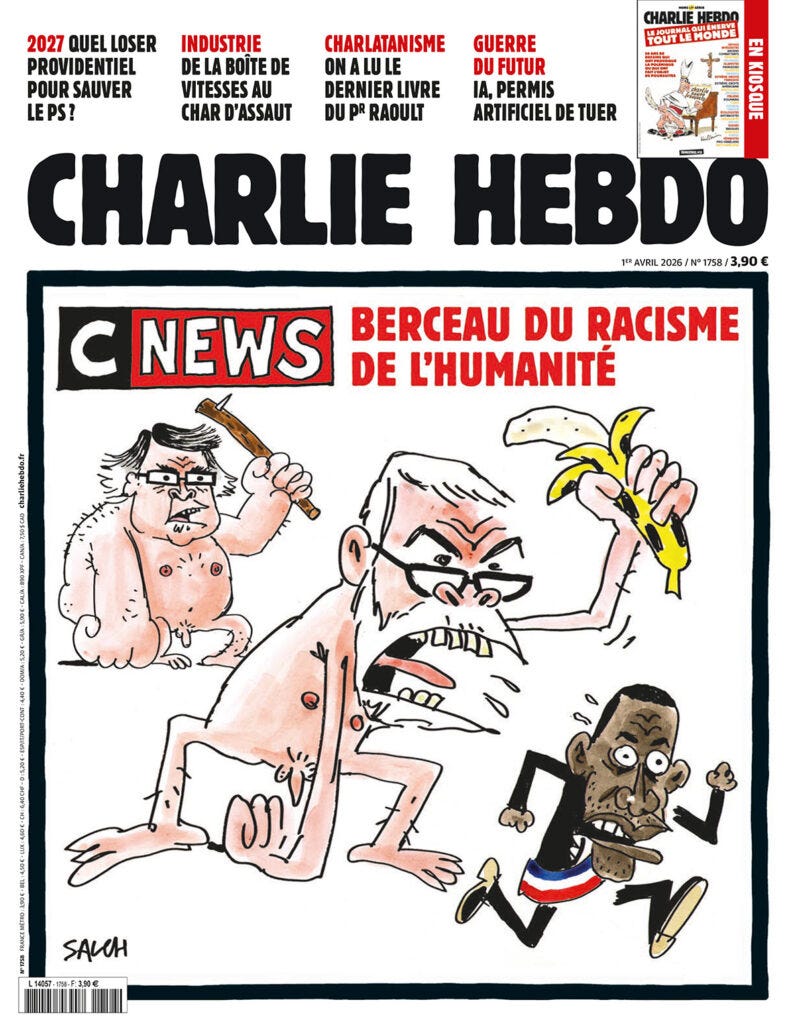
Gravier’s lasting achievement, then, was not analytical precision but political narration. His categories were unstable, his causal story weak, his provincial imaginary often closer to moral theatre than to social explanation. But he supplied the French state with an enduring language of imbalance. That language proved useful because it translated diffuse anxieties about centralisation, class, culture, and belonging into a spatial fable simple enough to govern through. That is why the essay survived its own errors. It offered not truth in any form, but a durable script, politically attractive and suitable for some.
Seventy-nine years is long enough to recognise the structure of a national myth: Paris et le désert français was never really a planning essay. It was about hierarchy: about who gets to define value, whose way of life appears modern, whose landscape counts as alive, and whose abandonment can be redescribed as natural. That hierarchy is still with us, though its forms have changed. Today, it passes through housing prices, school closures, rail service cuts, climate adaptation, touristification, second homes, and the selective greening of already-advantaged places. The desert was never the provinces. It was the political imagination that could look at inequality, extraction, and ecological neglect and still insist that the real problem was the one city itself.
메타데이터
- post_id
- 27d5fa73f1a2
- slug
- paris-et-le-désert-français-79-years-after-27d5fa73f1a2
- url
- https://medium.com/@bmjmwqkr/paris-et-le-d%C3%A9sert-fran%C3%A7ais-79-years-after-27d5fa73f1a2
- canonical_url
- https://medium.com/@bmjmwqkr/paris-et-le-d%C3%A9sert-fran%C3%A7ais-79-years-after-27d5fa73f1a2
- author_url
- https://medium.com/@bmjmwqkr
- status
- ok
- fetched_at
- 2026-06-17 12:55:42