A Step Forward, But Not Far Enough: What the F1 Movie Gets Wrong About Inclusion
The film features diverse characters but gives them little control over their own stories.
A Step Forward, But Not Far Enough: What the F1 Movie Gets Wrong About Inclusion
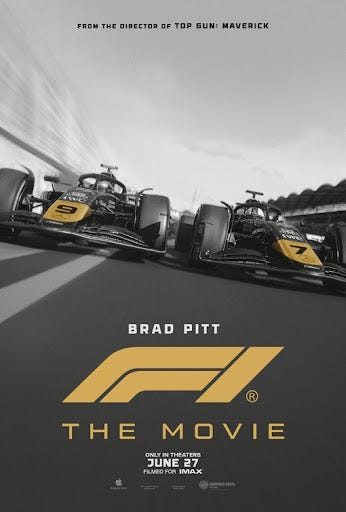
I recently watched the F1 movie on its first day of release, and overall I enjoyed it. The movie had a successful start, and according to Variety, it “generated $57 million domestically and $146.3 million in its opening weekend.” It received a 3.8 rating on Letterboxd and a 7.9 on IMDb. The movie received some criticism for a variety of reasons. Part of this was already expected, since real F1 fans were likely to be skeptical about the film. Carlos Sainz even reminded fans to be more open-minded about Hollywood a few days before the release.

There are criticisms that this movie is a collection of cliches; the aging comeback hero, the talented arrogant rookie, a dramatic final race, and over simplified rivalries. And there are some F1 fans that didn’t find the movie “real enough”. However the numbers and ratings say that this is a successful movie and there are already rumors of a sequel. But beyond these criticisms and success what I found interesting was how the film imagines the world of Formula 1. Specifically: who gets to be seen, whose stories are told, and what that says about the sport itself.
Racing is a sport that still struggles with lack of diversity, especially when compared to other major sports. The lack of people of colour and women in Formula 1 has been a long-standing issue. According to the Hamilton Report 2021 “Only 1% of employees in F1 are black and that 83% of Black and Minority Ethnic people have experienced racism within the sport.” Only 37% of people who work in F1 are women. The last time a woman raced in an F1 car was decades ago, and only 2 women managed an F1 team. When I went to see the movie, I was curious to see how it would handle this topic.
One thing I appreciated was that APXGP, the fictional team in the film, includes a diverse group of team members. This felt like an intentional and important choice. Damson Idris plays Joshua Pierce, the team’s rookie driver and the second Black driver in that F1 season with Lewis Hamilton. The team’s chief mechanic, Dodge Dowda, is also Black and played by Abdul Salis. Kerry Condon plays the team’s technical manager Kate McKenna, making her the first woman in that role in the story. Callie Cooke appears as Jodie, a young and inexperienced pit crew mechanic.
In the movie, we see that Joshua Pierce feels stressed and afraid of losing his seat. Kate McKenna, the technical director, is under pressure to prove that she deserves her position and can succeed in it. Jodie, the young pit crew member, tries to learn quickly and avoid mistakes. Each of them has their own struggles and challenges and this is important to see, because these struggles exist in real life. I found it interesting and I liked their idea of showing these struggles at first, but as the movie continued, my ideas started to change. At first, I liked that the film chose to show these personal struggles. But as the movie continued, I started to feel a bit differently. In the end, all of their problems were solved by the older white male character, which felt too familiar and predictable.

For example, Jodie makes a few mistakes during the race and gets some criticism from the team. Sonny is the one who steps in to protect her. Later on, when she sees him again, she thanks him but also says that next time she doesn’t want anyone to speak up for her, because it makes her look weak. I liked this scene, but the message fell of at the end of the movie.
The same thing happens with Kate McKenna, the technical director. She is introduced as the first woman in that role, clearly competent and ambitious. But instead of fully exploring her professional story, the film shifts her character toward a romantic subplot with the lead driver. She wants to prove herself, she wants to show everybody that she deserves this position and can succeed at it including her ex-husband and ex-boss. This does not look good. In a world where women constantly face doubt and exclusion, it’s frustrating to see yet another story where a woman’s motivation is defined by the need to prove men wrong.

The romantic relationship between Kate and Sonny also weakens her character’s independence. Instead of standing on her own, her story becomes tied to his. A spoiler alert, but it is Sonny who brings her the victory, gives her the opportunity to prove herself.
Of course, the diversity issue in racing is a much bigger problem, and it’s something Formula 1 has started to address through new policies and programs. It wasn’t this movie’s job to solve that on its own, and to be fair, it made a promising start with its casting. But the way the story developed didn’t live up to that potential. It could have offered so much more, especially in how it portrayed its female characters. With a sequel already being discussed, I’m hopeful that the next film will give these characters more depth, more agency, and a story that reflects the kind of sport F1 is trying to become.
메타데이터
- post_id
- 27e91ab3fda2
- slug
- a-step-forward-but-not-far-enough-what-the-f1-movie-gets-wrong-about-inclusion-27e91ab3fda2
- url
- https://medium.com/@atincgoc/a-step-forward-but-not-far-enough-what-the-f1-movie-gets-wrong-about-inclusion-27e91ab3fda2
- canonical_url
- https://medium.com/@atincgoc/a-step-forward-but-not-far-enough-what-the-f1-movie-gets-wrong-about-inclusion-27e91ab3fda2
- author_url
- https://medium.com/@atincgoc
- status
- ok
- fetched_at
- 2026-06-25 12:15:08