Did You Know Earth’s Atmosphere Glows?
The invisible daylight phenomenon that scientists call “dayglow”
Did You Know Earth’s Atmosphere Glows?
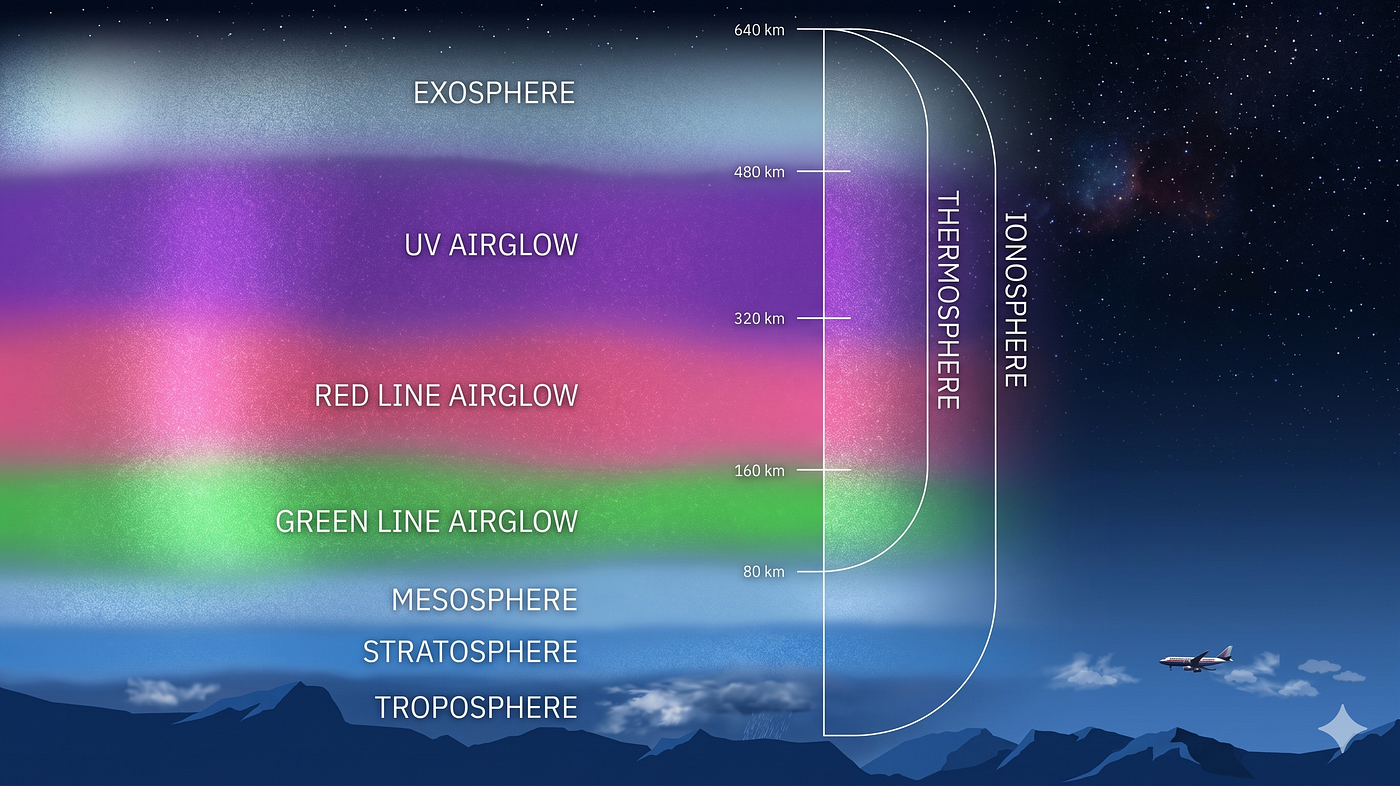
The invisible daylight phenomenon that scientists call “dayglow”
Most of us think of the atmosphere as transparent.
We look up during the day and see a blue sky. At night, we see stars. In both cases, the atmosphere seems like an invisible blanket surrounding our planet.
But what if I told you that Earth’s atmosphere is actually glowing all the time?
Not just during spectacular auroras. Not only at night. The atmosphere produces its own light even on a bright sunny afternoon.
This fascinating phenomenon is known as dayglow, and it offers scientists a unique window into the mysterious region of our planet that lies between Earth and space.
An Invisible Glow Above Our Heads
The atmosphere extends much farther than most people realize. Hundreds of kilometers above the surface, where the air is incredibly thin, atoms and molecules interact with sunlight in remarkable ways.
When energetic ultraviolet radiation from the Sun strikes the upper atmosphere, it excites atoms and molecules. These excited particles cannot remain in that state forever. Eventually, they release their excess energy in the form of light.
The result is a faint glow spread across the entire sky.
This glow is called dayglow because it occurs during the daytime when the atmosphere is directly illuminated by sunlight.
The glow is far too faint for our eyes to see because it is overwhelmed by the brightness of scattered sunlight. However, sensitive scientific instruments aboard satellites can detect it and reveal a surprisingly active upper atmosphere.
What Makes the Atmosphere Glow?
The Sun is the main driver of dayglow.
Solar radiation interacts with atmospheric gases such as oxygen and nitrogen. These interactions can excite atoms, ionize particles, or break molecules apart.
As the excited particles return to lower energy states, they emit light at specific wavelengths.
One of the most important contributors to dayglow is atomic oxygen. High above Earth, oxygen atoms can emit light in different colors, including green and red wavelengths that scientists use to study atmospheric processes.
Each emitted wavelength acts like a fingerprint, helping researchers identify which gases are present and what physical processes are occurring.
In a sense, the upper atmosphere is constantly sending out signals about its condition. Scientists simply need the right instruments to read them.
Why Do Scientists Care About Dayglow?
At first glance, studying a faint atmospheric glow may seem like a niche scientific pursuit.
In reality, dayglow observations help researchers answer important questions about our planet.
By analyzing dayglow emissions, scientists can investigate:
- The composition of the upper atmosphere
- Atmospheric temperature and density
- The effects of solar activity
- Energy transfer processes in near-Earth space
- Long-term changes in Earth’s upper atmosphere
These measurements are particularly important because the upper atmosphere influences satellite operations, communication systems, and navigation technologies such as GPS.
Understanding this region helps scientists better predict how Earth’s space environment responds to changes in solar activity.
A Natural Laboratory Between Earth and Space
The region where dayglow occurs is often called the thermosphere and ionosphere.
This is a fascinating part of the atmosphere because it sits at the boundary between our planet and outer space. Here, the influence of the Sun becomes especially important.
Solar storms, variations in ultraviolet radiation, and changes in atmospheric chemistry can all leave their signatures in dayglow emissions.
By observing these subtle changes, scientists gain valuable insights into the dynamic relationship between Earth and the Sun.
The Hidden Beauty of Our Planet
Perhaps the most remarkable thing about dayglow is that it reminds us how active our planet really is.
Even when the sky appears calm and empty, countless physical processes are taking place high above us. Atoms are absorbing energy, releasing light, and responding to the ever-changing influence of the Sun.
The atmosphere is not simply a layer of air surrounding Earth.
It is a living, dynamic system that glows, evolves, and constantly interacts with space.
The next time you look up at the daytime sky, remember: beyond the blue that your eyes can see lies an invisible glow stretching around the entire planet — a hidden light show that scientists are still working to understand.
메타데이터
- post_id
- 27fc48c91e2e
- slug
- did-you-know-earths-atmosphere-glows-27fc48c91e2e
- url
- https://medium.com/@swarupchavan333/did-you-know-earths-atmosphere-glows-27fc48c91e2e
- canonical_url
- https://medium.com/@swarupchavan333/did-you-know-earths-atmosphere-glows-27fc48c91e2e
- author_url
- https://medium.com/@swarupchavan333
- status
- ok
- fetched_at
- 2026-06-09 15:37:30