Corridor-by-Corridor Expansion: Why “Global Coverage” Is a Myth in Payments
Every cross-border payments platform loves to say the same thing:
Corridor-by-Corridor Expansion: Why “Global Coverage” Is a Myth in Payments
Every cross-border payments platform loves to say the same thing:
“We support global payments in 180+ countries.”
But anyone who has actually operated in cross-border payments knows the truth.
Global coverage does not mean global capability.
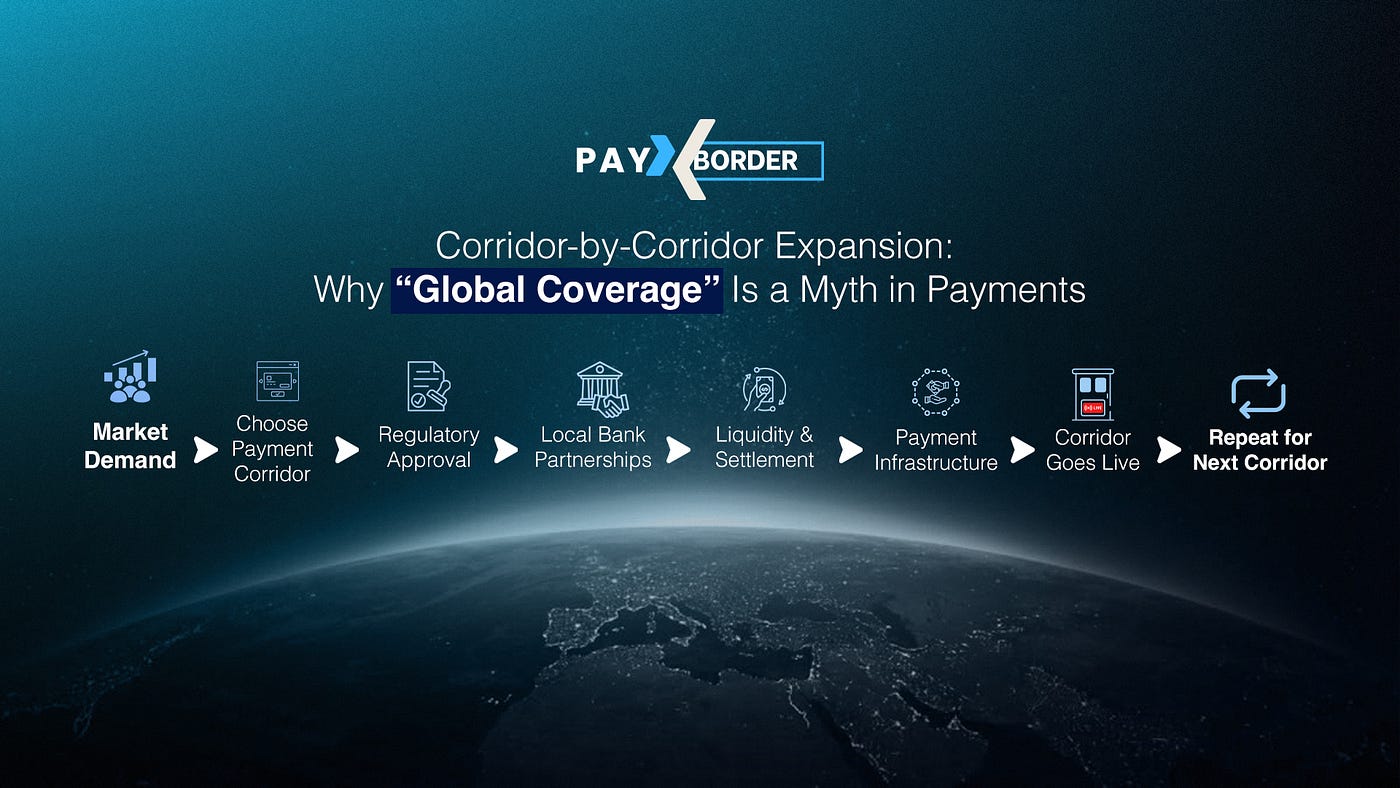
In reality, cross-border payments succeed corridor by corridor, not country by country.
A corridor is the payment route between two markets, for example:
- India to UAE
- UK to Nigeria
- US to Mexico
Each corridor has its own:
- regulatory environment
- banking partners
- settlement rails
- liquidity requirements
- FX mechanics
- success rates
This is why experienced fintechs expand strategically corridor by corridor, not by chasing the illusion of “global coverage.”
Let’s break down why this matters and how payment companies should choose corridors wisely.
The “Global Coverage” Illusion
Many payment platforms list 100 to 200 supported countries, but the real question is:
How well do those corridors actually work?
Two providers might both support Brazil payouts, yet the experience could be completely different.
Example differences:
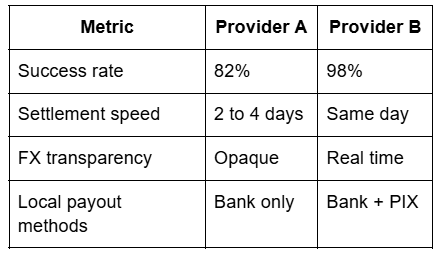
Both technically support the same country, but only one truly supports the corridor well.
This is why serious fintech infrastructure companies measure success by corridor performance, not coverage count.
What Actually Defines a Strong Payment Corridor
When evaluating or expanding a corridor, four factors matter most.
1. Success Rate (The Most Underrated Metric)
A corridor with 90% success might look acceptable on paper.
But in real operations, that means 1 in 10 payments fail.
Failures create:
- support tickets
- reconciliation issues
- customer distrust
- operational costs
Top-performing corridors often achieve:
97% to 99% success rates
This usually depends on:
- strong local bank partnerships
- reliable payout rails
- good compliance screening
2. Settlement Speed
Speed depends heavily on local infrastructure.
Some markets support instant settlement rails, while others rely on slower correspondent banking networks.
Examples of fast corridors:
- US to Mexico (SPEI)
- EU to SEPA countries
- India to UPI enabled payouts
Slower corridors may include:
- some African bank transfer routes
- certain LATAM correspondent banking routes
Speed expectations also vary by use case:
- Payroll, next day can be acceptable
- Remittances, near instant is expected
- Marketplace payouts, same day is preferred
3. Partner Strength in the Destination Market
Your payout partner determines:
- payment success rates
- compliance handling
- regulatory stability
- operational reliability
Weak partners often lead to:
- higher rejection rates
- sudden corridor shutdowns
- delayed settlements
Strong partners provide:
- local clearing access
- multiple payout rails
- regulatory compliance support
In cross-border payments, your local partner is your infrastructure.
4. Real Market Demand
Not every corridor deserves investment.
Smart payment companies prioritize corridors with clear transaction demand, such as:
- freelancer payments
- outsourcing hubs
- trade corridors
- diaspora remittances
- marketplace payouts
Examples of high demand corridors today:
- US to India
- UK to Pakistan
- EU to Turkey
- Middle East to Philippines
- US to Mexico
The goal is volume plus reliability, not just coverage.
The Smart Strategy: Corridor First Expansion
Instead of announcing support for 150 countries, the most successful fintech platforms build deep capability in fewer corridors first.
A typical expansion strategy looks like this:
Phase 1: Core corridors
- Highest transaction demand
- Strong payout partners
- Clear regulatory framework
Phase 2: Adjacent corridors
- Same region
- Same partner network
- Similar compliance structure
Phase 3: Opportunistic corridors
- Emerging markets
- New payment rails
- Strategic customer demand
This approach leads to:
- higher success rates
- faster settlements
- stronger operational reliability
Why Infrastructure Platforms Think This Way
Cross-border payments are not a single system.
They are a network of localized payment ecosystems.
Each corridor requires:
- liquidity management
- FX pricing
- compliance screening
- partner integration
- reconciliation systems
That is why infrastructure providers increasingly focus on corridor optimization, not just coverage expansion.
The Key Question Every Payments Company Should Ask
Instead of asking:
“How many countries do you support?”
Ask:
- What is the success rate per corridor?
- What are the typical settlement times?
- Who are the local payout partners?
- What payout methods exist (bank, wallet, instant rails)?
- How transparent is the FX spread?
Those answers reveal the true capability of a cross-border platform.
Final Thought
In cross-border payments, coverage is easy to claim but difficult to deliver.
The companies that win are not the ones with the longest country list.
They are the ones that build high performance corridors.
Because in payments, reliability beats reach every time.
Book a Demo — https://payxborder.group/contact
𝐂𝐨𝐧𝐭𝐚𝐜𝐭 𝐮𝐬 𝐧𝐨𝐰 𝐭𝐨 𝐥𝐞𝐚𝐫𝐧 𝐦𝐨𝐫𝐞 𝐚𝐛𝐨𝐮𝐭 𝐨𝐮𝐫 𝐬𝐞𝐫𝐯𝐢𝐜𝐞𝐬! Visit our website: https://payxborder.group/ Reach us at: +971 585 133 311 Service inquiries: sales@payxborder.group Customer Support: support@payxborder.group
메타데이터
- post_id
- 2829ddf9fe7b
- slug
- corridor-by-corridor-expansion-why-global-coverage-is-a-myth-in-payments-2829ddf9fe7b
- url
- https://medium.com/@payxborder/corridor-by-corridor-expansion-why-global-coverage-is-a-myth-in-payments-2829ddf9fe7b
- canonical_url
- https://medium.com/@payxborder/corridor-by-corridor-expansion-why-global-coverage-is-a-myth-in-payments-2829ddf9fe7b
- author_url
- https://medium.com/@payxborder
- status
- ok
- fetched_at
- 2026-07-11 09:34:02



