I Thought Animal Farm Was a Book About the Past.
Why Orwell’s Animal Farm still explains how societies gradually adapt to the loss of freedom.

I Thought Animal Farm Was a Book About the Past. It Turned Out to Be a Book About How Human Consciousness Changes
Why Orwell’s Animal Farm still explains how societies gradually adapt to the loss of freedom.
Introduction
For more than twenty years, I have been studying the forces that act on human consciousness, and during that time I have read hundreds of books on psychology, history, political theory, propaganda, social engineering, and cognitive science, yet despite the differences in subject matter, terminology, and method, I found myself returning to the same question with almost obsessive consistency: why do societies keep making the same mistakes, why do people who sincerely long for freedom sometimes become part of the very system that destroys it, and why do the most dangerous changes almost never look dangerous while they are actually unfolding.
As the years went on, I began to notice a pattern that felt too persistent to dismiss, because writers who lived in different eras, belonged to different cultures, and devoted themselves to completely different fields of study often arrived at conclusions that were strikingly similar in structure, even when they seemed to be talking about different things on the surface. Hannah Arendt examined the nature of totalitarianism, Victor Klemperer showed how language can slowly reshape the way an entire society thinks, Gustave Le Bon explained why a crowd begins to think differently from the individual person inside it, Stanley Milgram demonstrated how far ordinary people are willing to go once responsibility is handed over to authority, Erich Fromm tried to answer the unsettling question of why a person sometimes gives up freedom willingly, and Daniel Kahneman revealed how easily the mind makes decisions that we later experience as our own.
They were all studying different sides of human behavior, but the more often I returned to their work, the harder it became to ignore the feeling that they were all describing the same underlying mechanism, only from different angles and in different vocabularies. What has always interested me is not the events themselves, because the news can tell us what happened and history can help us understand why it became possible, but neither of those gets all the way down to the question that matters most to me, which is this: what changes in human consciousness make those events possible in the first place.
That was when I returned to George Orwell’s Animal Farm, which I had once read, like most readers, as a satire of the Soviet Union and little more than that. This time I approached it differently, not as a historical allegory and not as a political fable in the narrow sense, but as an attempt to understand what Orwell had seen so clearly that, eighty years later, the same pattern continues to reappear in different countries, under different political systems, and across cultures that otherwise have very little in common.
It was then that I realized the real value of Animal Farm has very little to do with how precisely it maps onto one particular period of history, because Orwell was doing something much more important than documenting the logic of a single revolution or exposing the trajectory of a single regime. What he captured was a mechanism, a sequence of internal shifts through which a society can move, often so gradually that almost no one notices the transition clearly enough while it is happening, from the dream of freedom to a condition in which freedom itself begins to feel suspicious, destabilizing, and even dangerous.
The longer I sat with that idea, the more clearly I understood that Animal Farm is not really a novel about the past at all, but a guide to recognizing processes that rarely begin with open violence, direct coercion, or anything dramatic enough to trigger immediate alarm, because most of the time they begin with something much more persuasive and much more familiar: a promise of justice, order, and a better life.
Every revolution begins with hope
The more I studied the history of revolutions and large-scale social change, the more I found myself struck by one simple fact that never really stopped feeling important to me: almost no system comes to power by promising people less freedom. No one begins a political campaign by saying, “We are going to limit your rights,” or, “We are going to make you poorer,” or, “We are going to forbid you from saying what you think.” The language is almost always the opposite of that, because nearly every major political idea begins with a promise to improve life in some recognizable way, whether by offering more justice, more safety, more equality, or more order.
In The Anatomy of Revolution, the historian Crane Brinton pointed out that revolutions almost never begin as a conscious march toward dictatorship, but instead grow out of the belief that the existing order can be made fairer and more humane, which is precisely why revolutions are usually born out of hope rather than hatred. People go into the streets not because they dream of destroying their country, but because they believe the system they live under can be corrected, improved, and brought closer to the ideals it claims to serve.
There is nothing unusual about that, and in fact the ability of a society to demand change is what allowed humanity to abolish slavery, limit the absolute power of monarchs, secure civil rights, and dismantle many forms of institutional injustice that once seemed permanent. The desire to change society is not, in itself, dangerous. What becomes dangerous is something else entirely, and it usually arrives at a moment people do not immediately recognize for what it is: the moment when an idea stops being something that can be discussed and turns into something that must be believed, when the goal begins to justify the means, when any disagreement is recast as a threat to the common future, and when criticism is no longer treated as an attempt to correct mistakes but as an act of betrayal.
At that point, the idea ceases to function as an instrument of change and begins to demand something much heavier than agreement, because what it now wants is loyalty. This, at least in my view, is the transition George Orwell saw more clearly than many historians and political theorists, and it is one of the reasons Animal Farm continues to feel so sharp. He does not begin the story with dictatorship. He begins with a dream. Old Major does not speak to the animals about power, at least not at first, but about freedom, and he does not ask them to hate so much as invite them to imagine a world in which no one lives off the labor of others.
It is such a simple and compelling idea that it becomes almost impossible to argue with, which is exactly why the animals believe so quickly, why the reader believes with them, and why this is the point where it becomes necessary to stop and ask a question that is usually left unexamined: what has to happen for a society that began with a dream of freedom to one day consent, of its own will, to give part of that freedom away?
It seems to me that this is where Orwell’s real investigation begins, and that what he is ultimately studying is not revolution by itself, not the Soviet Union as a historical case, and not any one set of political leaders, but the slow transformation of human consciousness under pressure, under persuasion, and under the moral seduction of a cause that once looked unquestionably just. That may be the deepest reason the book still feels frighteningly modern, because the process it describes has not disappeared at all.

Orwell was not writing about politics. He was writing about patterns.
Some books help us understand the age in which they were written, while others go on explaining new ages long after the original moment has passed, and Animal Farm belongs very clearly to the second category. When the novella was published in 1945, most early reviews treated it first and foremost as a political satire of the Soviet Union, which was a perfectly understandable reading because the allegorical structure was hardly hidden: Old Major resembled Marx and Lenin, Napoleon pointed unmistakably toward Stalin, Snowball echoed Trotsky, and the story of the farm itself closely followed the arc of the Russian Revolution, moving from the promise of universal equality to the concentration of power in the hands of a few.
But the more interesting question, at least to me, is not why Orwell’s contemporaries read it that way, but why people still read it eighty years later even if they have never lived in the Soviet Union, never experienced that historical system directly, and know it only as a subject in books. Why is it still taught in universities, and why does it continue to surface in discussions of political theory, history, and social psychology? If Orwell had written nothing more than a sharp and talented satire of one particular regime, the book would have taken its place beside dozens of other historically specific works that remain useful mainly to specialists. That is not what happened, and I think the reason is simple in principle, even if its implications are enormous: Orwell did not merely describe one state. He described a mechanism that repeats.
That, to my mind, is one of the things that separates truly exceptional works from merely good ones, because at a certain point they stop belonging only to the period that produced them and begin to outlive it intellectually. A similar idea was developed a few years later by Hannah Arendt in The Origins of Totalitarianism, where she argued that the totalitarian regimes of the twentieth century cannot really be explained by pointing to a single ideology, a single leader, or a single country, since what matters far more are the processes that make such systems possible in the first place. In other words, Arendt was not simply looking for culprits. She was looking for patterns, and I think that was exactly what Orwell was doing as well, except that instead of writing an academic study, he wrote a short fable about animals and somehow managed to preserve the structure of the problem with remarkable precision.
A few decades later, the German philologist Victor Klemperer, who survived Nazi Germany, arrived at an observation that feels strikingly close to Orwell’s. In LTI: The Language of the Third Reich, he shows that major political transformations do not begin with tanks and do not begin with laws, at least not in the deepest sense, because they begin earlier, in language itself, when words slowly acquire new meanings, when certain expressions disappear, and when others are repeated so often that people stop hearing them as claims and start experiencing them as reality. What changes in that process is not only the way a society speaks, but the way it thinks, which is why Klemperer wrote that words act like tiny doses of arsenic: a person swallows them without noticing, they seem to have no effect at all, and only later does the poison begin to work. When I first read Klemperer, what struck me immediately was how closely his conclusions echoed what Orwell had already captured through literary form before Klemperer’s own book appeared.
What surprised me even more, though, was that psychologists would later identify many of the same regularities from an entirely different direction. Stanley Milgram showed how easily ordinary people submit to authority when responsibility for the consequences is transferred to the system. Solomon Asch demonstrated that a person can begin to doubt even obvious facts if the surrounding majority confidently insists on the opposite. Elizabeth Loftus proved that human memory is not a fixed archive of the past, but something that is constantly revised under the pressure of new circumstances and repeated interpretations. Daniel Kahneman explained why the mind prefers continuity and coherence even when reality is changing little by little in ways that should, in theory, force us to reconsider what we think we know. Each of these researchers worked in a different field, studied a different phenomenon, and used a different method, yet the more I placed their work side by side, the clearer one pattern became: none of them was studying Orwell’s novel, and yet each of them, in his or her own language, was describing the same process Orwell had already rendered in literary form back in 1945.
That is why I no longer read Animal Farm as a novel about the Soviet Union alone, or even as a novel about totalitarianism in the narrow sense. I read it as a model, as a kind of intellectual laboratory in which we can watch what happens to a society when language changes, when memory changes, when ideas about what is normal begin to shift, and when a person’s relationship to freedom slowly becomes less stable than it once seemed. If that reading is correct, then the next question almost asks itself: where does this process actually begin? Intuition tells us that it begins with violence, but history, psychology, and political theory suggest something quite different, because by the time violence becomes visible, the deeper process is already well underway. It begins much earlier, at the moment when a society still sincerely believes that it is living by the old rules.
The most dangerous changes almost never look dangerous
Imagine that tomorrow any government in the world were to announce, officially and without disguise, “Starting today, freedom of speech is abolished. We will rewrite history. Those who disagree will be punished.” A statement like that would trigger an immediate reaction, and even many people who generally support the authorities would be unlikely to accept such an abrupt turn without resistance, which is precisely why history almost never moves in such a blunt and transparent way, and why the largest changes in public life rarely arrive in the open.
When I was reading historians, psychologists, and scholars of authoritarian systems, one thing kept striking me with unusual force: despite the differences in era, country, and subject matter, they returned again and again to the same conclusion, namely that the most consequential changes in society almost never happen all at once, but are built out of dozens of smaller steps, each of which, taken on its own, appears reasonable, temporary, or even necessary. Orwell understood this instinctively, which is why in Animal Farm it is almost impossible to point to the exact moment when the farm finally ceased to be a society of free animals, because there is no single moment that carries that weight. Every change looks minor when it first appears, every new decision can be explained, every concession seems temporary, and as a result the animals do not really notice the process itself so much as the consequences that have already accumulated by the time they look up.
Nearly half a century after Orwell’s novel was published, the biologist Daniel Pauly described a phenomenon that came to be known as shifting baseline syndrome. While studying the condition of global fisheries, he noticed something revealing: each new generation of fishermen accepted an already degraded ecosystem as the natural norm because they no longer remembered what it had looked like before. It later became clear that this principle explains far more than environmental decline, and today sociologists, historians, and researchers of social change use it to explain why people so often fail to notice the gradual transformation of the world around them. Each new normal feels ordinary because the comparison is no longer being made against what existed twenty years ago, but against what existed yesterday, which is why people are usually quicker to register the results of change than the moment at which the change actually begins.
A similar idea appears in Daniel Kahneman’s Thinking, Fast and Slow, where he shows that the human mind responds much more readily to abrupt changes than to gradual ones, because our attention is built to notice threats that emerge suddenly, while slow-moving shifts are absorbed into the environment and begin to feel natural simply because they never demanded a single dramatic reaction. We notice jumps, but we barely notice drift, and that is why a person rarely notices how evening turns dark, cannot name the minute when day became night, barely registers how children grow up, and cannot clearly identify the moment when a habit hardens into a way of life, because all of these changes happen by degrees rather than by rupture.
When I first placed Kahneman’s ideas alongside Orwell’s novel, I was struck by how precisely literature sometimes anticipates what science later learns to describe more formally, because Orwell is showing exactly this mechanism at work, not a revolution in the narrow sense, not a coup, and not the sudden destruction of freedom, but adaptation. The animals do not accept the new system in a single day. They adjust to it step by step, often without realizing that what they are adjusting to would once have been unthinkable.
Hannah Arendt was pointing to something similar when she wrote about the origins of totalitarian regimes, because she showed that the destruction of freedom rarely begins with open violence and is almost always preceded by the slow erosion of familiar ideas about what is normal. People grow used to what would have seemed exceptional the day before, then begin to regard it as necessary, and eventually stop remembering that another reality once existed at all. That is why, in my view, Orwell’s most unsettling insight is not simply that power can change, since history offers more than enough examples of that, but that a society’s very sense of what counts as normal can change with it. Once that happens, the struggle is no longer over territory, institutions, or even power in the narrow political sense. It becomes a struggle over human consciousness itself.
If this pattern really exists, then the next question follows almost automatically: what instrument allows a society’s sense of normality to be altered faster than anything else? Orwell’s answer was remarkably simple.
Language.
It is language that becomes the first battlefield in the struggle for human consciousness.
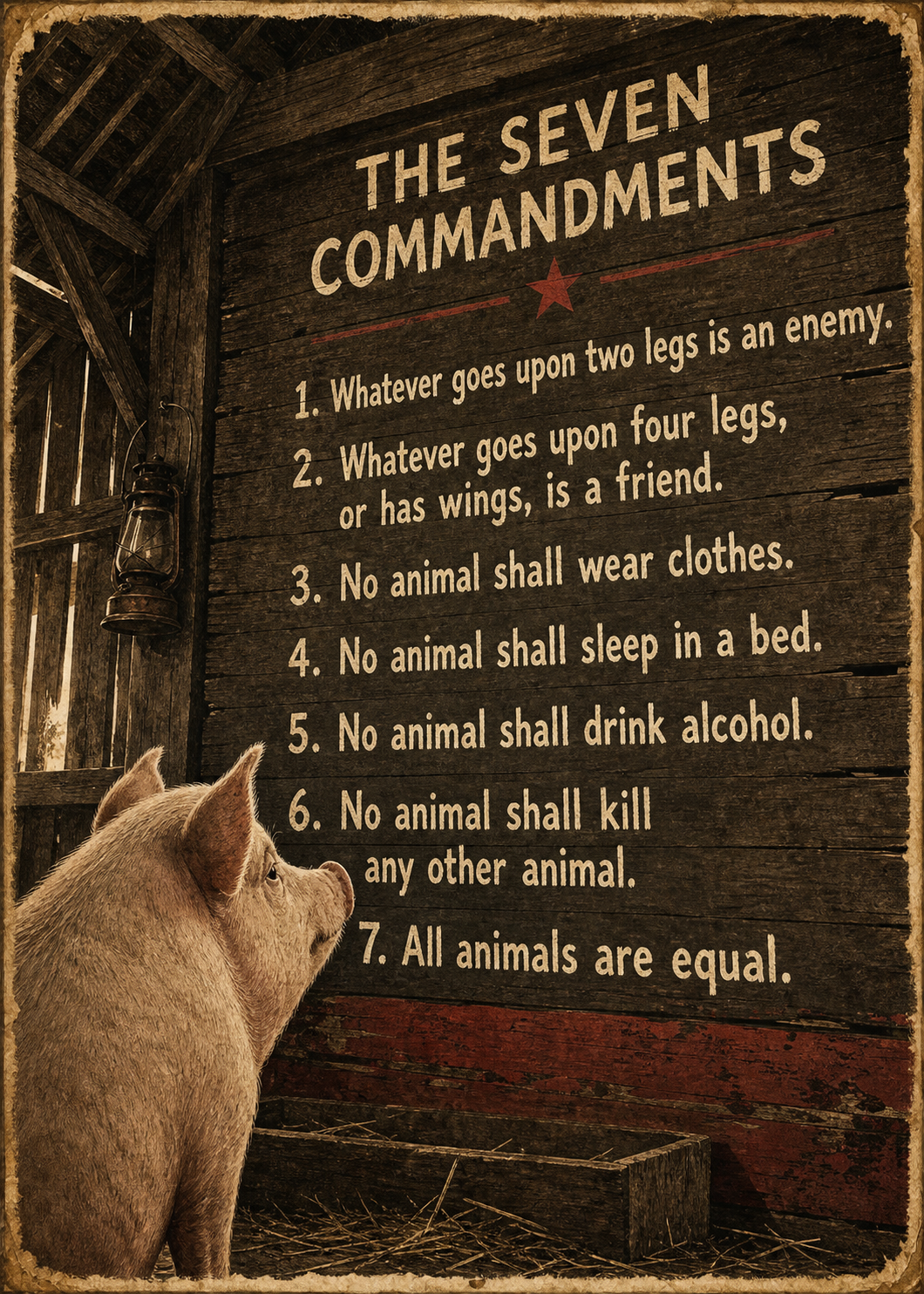
Every system begins with rules. Every change begins with an exception.
After driving out Mr. Jones, the animals do what seems not only understandable but almost inevitable: they create rules, not in order to restrict freedom, but in order to make sure that the new authority does not one day come to resemble the old one, and in that sense the rules they establish are meant to outlive the revolution itself. The Seven Commandments appear on the barn wall, and they are more than a list of laws, because they function as a social contract, a promise the new system makes to itself about what it will never become.
History reveals a pattern here that is difficult to miss once you begin looking for it, because societies that have passed through trauma almost always start in the same place: they try to build rules that will protect them from repeating the past. After the Second World War, Germany embedded safeguards in its Basic Law that were meant to make the return of a Nazi-style regime structurally impossible. After the end of apartheid, South Africa adopted one of the most progressive constitutions of its time, placing human rights above short-term political convenience. After the collapse of the Soviet Union, many newly independent states wrote guarantees of separation of powers, freedom of speech, and political pluralism into their constitutions, as if to say, in legal form, that some lessons had been paid for too dearly to be forgotten.
But the more interesting question begins after that initial moment of clarity, because the real issue is not how societies write rules, but what happens to those rules once power begins to settle back into daily life. At first glance, the answer seems obvious enough: someone breaks them. Orwell, though, shows something subtler and much more unsettling, because rules are almost never discarded all at once. They are explained, qualified, expanded, adjusted, and reinterpreted, and sometimes it takes only a few added words for the original meaning to survive in appearance while disappearing in substance.
When I first noticed this feature of the novel, I took it mainly as a brilliant literary device, but later I found almost the same pattern described in contemporary research on democratic decline. In How Democracies Die, Steven Levitsky and Daniel Ziblatt argue that modern democracies are far more likely to weaken gradually than to collapse through military coups, which means that constitutions may remain in force, parliaments may continue to sit, elections may still be held, and courts may still exist in formal terms, while the actual functioning of the system changes from within. The form remains recognizable, but the way the form is used begins to shift, and what the authors are describing is not the sudden destruction of democratic institutions, but their slow erosion through practice, precedent, and selective application.
Year after year, the international research project Varieties of Democracy, or V-Dem, arrives at similar conclusions in its Democracy Reports, showing that contemporary autocratization rarely begins with the abolition of a constitution and far more often reveals itself first through the gradual weakening of independent institutions, the restriction of press freedom, pressure on the judiciary, and changes to the rules of political competition. That is why researchers now speak more and more often not about a dramatic leap into authoritarianism, but about autocratization, a gradual transformation of the system that can remain almost invisible to the people living inside it, especially when each separate step can be justified by emergency conditions, security concerns, or the supposed need to make government more efficient.
Yet if you step back and look at the sequence as a whole, a recurring pattern begins to come into view, and that is exactly the pattern Orwell saw. It is no accident that he does not have Napoleon publicly reject the Commandments. Instead, he has their meaning altered little by little, and the difference between those two things may seem minor at first, but it is actually fundamental, because when a rule is openly revoked, society can still recognize that a violation has occurred, whereas when a rule quietly changes its content while keeping its familiar form, people are left with the impression that the system is still the same even though its foundation is already shifting under their feet.
That is why, at least to my mind, the most dangerous stage does not begin when the rules disappear altogether, but when the rules continue to exist and no longer mean what they once meant, because at that point society starts losing more than the rules themselves. It begins to lose trust in the very idea of rules as such, and once that trust is weakened, power no longer has to defeat the law directly, because it can simply keep the language of the law while hollowing out its substance.
Does this mechanism repeat itself in history?
Up to this point, we have been talking about literature, psychology, and political theory, but any hypothesis becomes truly persuasive only when it can be tested outside the environment in which it first emerged. If George Orwell really did grasp a universal pattern, then it should not reveal itself only on the pages of Animal Farm. It should leave traces in real history as well. I chose several well-known examples, not because I wanted to compare different countries to one another, and not because I wanted to argue that one history is simply a copy of another, but because I was interested in one question alone: does the mechanism itself repeat?
Germany, 1933
On January 30, 1933, Adolf Hitler became Chancellor of Germany, yet on that day the Weimar Republic did not cease to exist, the constitution remained in force, parliament continued to function, and the courts continued to issue decisions, so if one looked at events purely in formal terms, the state system appeared almost unchanged. The real break came later. On March 23, 1933, the Enabling Act was passed, giving the government the authority to enact laws without parliamentary participation, including laws that contradicted the constitution itself. One detail matters here more than it may seem at first glance: the law was presented as an emergency measure adopted under conditions of severe political and economic crisis, which meant that, formally speaking, the issue was not the abolition of democracy, but the temporary expansion of executive power. Historians later came to see precisely this kind of exception as especially important, and Richard Evans, in his monumental Third Reich trilogy, shows that this law became one of the decisive legal turning points after which the political system began to change rapidly from within. The rules still existed, but for the first time an exception had appeared that made it possible to bypass the rules themselves.
The Soviet Union, 1936 to 1938
On December 5, 1936, the new Soviet Constitution was adopted, and in the official press it was described as the most democratic constitution in the world. It guaranteed freedom of speech, freedom of assembly, personal inviolability, and universal suffrage, so in formal terms the rules had become even more progressive than before. And yet within a matter of months the Great Terror began. Historians such as Robert Conquest, and later Oleg Khlevniuk, who worked extensively with declassified archives, show that in 1937 and 1938 mass repression reached an unprecedented scale. The constitution was not abolished. It continued to exist. Formally, the rights remained in place. In practice, using them became nearly impossible. The text of the constitution did not change, but it ceased to shape everyday reality. Orwell saw this moment with astonishing clarity. On the farm, no one wipes the commandments off the wall either. They remain where they are, but sooner or later someone appears beside them to explain that they had “always meant exactly this.” In the novel, that role belongs to Squealer. In real history, a similar function almost always emerges alongside changes in the rules themselves, as people, institutions, and official interpreters appear whose task is not to change the rule openly, but to convince society that the rule had always meant what it now conveniently means.
What contemporary research shows
One could argue that both of these examples belong to the exceptional tragedies of the twentieth century, and that is exactly why contemporary comparative research matters so much. The Varieties of Democracy project, or V-Dem, tracks the condition of democratic institutions in more than 170 countries each year, and the authors of its recent reports note that modern autocratization usually does not unfold through the immediate cancellation of a constitution or the sudden elimination of elections. It begins much earlier, through sequential changes in legislation, the weakening of judicial independence, pressure on the media, and the gradual reshaping of the rules of political competition. Freedom House reaches similar conclusions, documenting a steady decline in political rights and civil liberties across different regions of the world over the course of recent years. Researchers keep drawing attention to one shared feature of these processes: almost every individual change comes with its own rational explanation. Fighting terrorism. Protecting national security. Countering foreign interference. Combating extremism. Each measure taken in isolation may appear justified, but what modern political scientists study is the sequence, because that sequence is what eventually reveals the pattern.
This is where one parallel struck me with particular force. Orwell was writing a work of fiction. Historians were digging through archives. Psychologists were studying human behavior. Political scientists were analyzing state institutions. International research projects were working with vast bodies of data. What struck me was not that their conclusions resembled one another, but that they arrived at them independently, and yet all of them kept describing the same sequence over and over again. Rules rarely disappear all at once. First, exceptions appear. Then come new interpretations. After that come the people who explain to society why those new interpretations had always been the only correct ones. And only years later does it become obvious that what changed was no longer this or that individual rule, but the system itself.
If this pattern is still at work today, then the next question is unavoidable: can we see this mechanism not in history textbooks, but in events unfolding right in front of us now?
Instead of a conclusion: the hypothesis has been formulated. What remains is to test it.
When I first began rereading Animal Farm, I thought I was simply trying to understand the book more deeply, but the further this inquiry went, the clearer it became that I was really trying to understand something else entirely: why societies keep passing through strikingly similar processes even when they speak different languages, live inside different cultural traditions, and hold completely opposing political beliefs.
By this point, we have already moved through several very different fields of knowledge, including literature, history, social psychology, and contemporary political science, and each of them was concerned with its own subject, its own evidence, and its own method, yet what struck me most was how often they arrived at conclusions that seemed to converge. History shows that major transformations rarely begin with an open rejection of earlier principles. Psychology explains why a person can gradually accept what would have seemed impossible only a short time before. Political science identifies recurring patterns in the way institutions begin to change. And Orwell, writing in 1945, managed to bring all of this together in a short novel.
That is why I no longer read Animal Farm as a satire aimed at one particular country, or even simply as a novel about dictatorship. I read it as an intellectual model, a model that helps us notice processes that are usually hidden behind separate events and isolated explanations. But any serious inquiry has to be tested, and if this mechanism really does exist, then it should not appear only in literature or in historical archives. Its traces should also be visible in contemporary history.
That is what we will try to do in the second part of this study, not in order to force reality into a conclusion that has already been chosen in advance, but in order to test whether the model Orwell described actually helps us make sense of events unfolding in front of us now. And perhaps that is where the hardest question truly begins, because it asks something far more difficult than retrospective analysis ever does: can we recognize a change in social norms while it is still happening, before it has hardened into history?
Methodology
This article opens a broader series of studies devoted to the mechanisms through which public consciousness, language, social norms, and political institutions change over time, and its purpose is not to compare different countries to one another or to argue that distinct historical eras are somehow identical, but rather to identify recurring patterns that have been described independently in literature, historical scholarship, social psychology, and contemporary political science.
The article is built on an interdisciplinary approach, which means that each major conclusion is compared against several independent sources drawn from different fields of knowledge, allowing the analysis to move beyond the interpretation of any single author or any single school of thought and making it possible to trace how similar mechanisms are described by researchers who were working separately, often in very different intellectual traditions and for very different reasons.
Five main groups of sources were used in preparing this article: literature, historical research, experimental psychology and cognitive science, theories of social norms, and contemporary comparative political science, with each of these bodies of work contributing a different angle on the same broader question and helping to test whether the pattern described here remains visible across disciplines rather than only within one specialized framework.
This article is not intended to offer a political judgment on particular states or individual historical events. Its task is to examine how social norms, language, collective memory, and a society’s sense of what is acceptable change gradually over time, while bringing into conversation the conclusions reached by researchers from different disciplines.
All historical examples are used strictly as analytical case studies for testing the general hypothesis formulated in the article.
Core sources
George Orwell, Animal Farm (1945) George Orwell, Politics and the English Language (1946)
History and political philosophy
Hannah Arendt, The Origins of Totalitarianism Victor Klemperer, LTI: Lingua Tertii Imperii Richard J. Evans, The Coming of the Third Reich Richard J. Evans, The Third Reich in Power Robert Conquest, The Great Terror Oleg V. Khlevniuk, Stalin: New Biography of a Dictator
Social psychology and cognitive science
Solomon Asch, Opinions and Social Pressure Stanley Milgram, Obedience to Authority Elizabeth Loftus, Eyewitness Testimony Daniel Kahneman, Thinking, Fast and Slow Daniel Pauly, Anecdotes and the Shifting Baseline Syndrome of Fisheries
Theory of social norms
Cristina Bicchieri, Norms in the Wild Robert Cialdini, Raymond Reno, and Carl Kallgren, A Focus Theory of Normative Conduct Cass R. Sunstein, How Change Happens
Contemporary political science
Steven Levitsky and Daniel Ziblatt, How Democracies Die Barbara Geddes, Joseph Wright, and Erica Frantz, How Dictatorships Work V-Dem Institute, Democracy Report 2025 Freedom House, Freedom in the World 2025
메타데이터
- post_id
- 282abd30c168
- slug
- i-thought-animal-farm-was-a-book-about-the-past-282abd30c168
- url
- https://medium.com/@isaacp_81117/i-thought-animal-farm-was-a-book-about-the-past-282abd30c168
- canonical_url
- https://medium.com/@isaacp_81117/i-thought-animal-farm-was-a-book-about-the-past-282abd30c168
- author_url
- https://medium.com/@isaacp_81117
- status
- ok
- fetched_at
- 2026-07-17 02:16:50