Open Source and PCB: Why Hardware Is Replicating Software‘s Collaboration Model
From KiCad to open source hardware, the PCB industry is undergoing a quiet revolution
Open Source and PCB: Why Hardware Is Replicating Software‘s Collaboration Model
From KiCad to open source hardware, the PCB industry is undergoing a quiet revolution
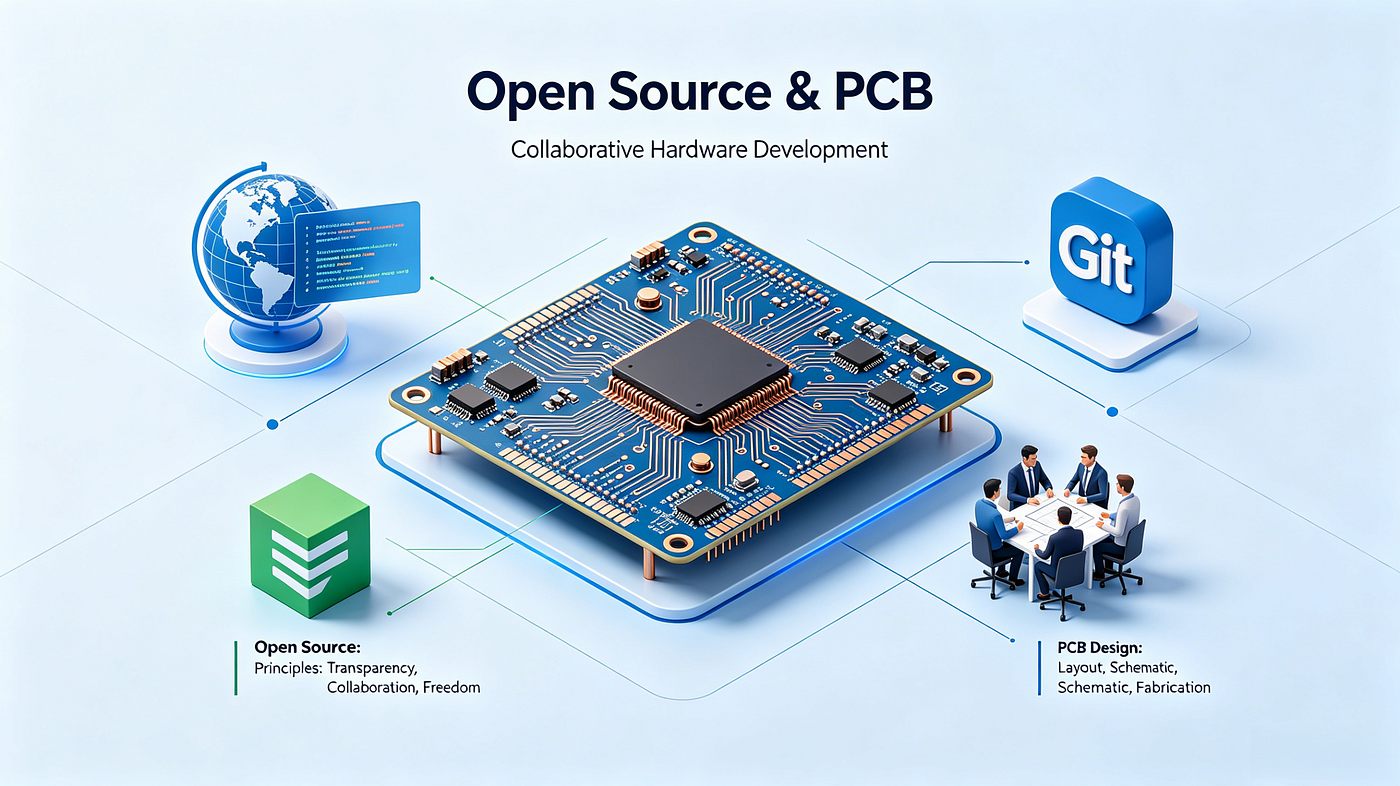
If you’re a software engineer, the term “open source” probably means Linux, GitHub, React — code that’s public, free to use, and open to contributions.
But you might not realize that the open source movement is quietly transforming the PCB industry.
From open source PCB design software to open source hardware projects, shared design libraries, and the rise of personal fabrication, PCBs are undergoing a shift similar to what happened in software. Some have even called it “the GitHub moment for hardware.”
This article explores the three layers of the relationship between open source and PCBs — and how they will shape the future for electronics engineers and hardware entrepreneurs.
Part 1: The Tool Layer — The Rise of Open Source PCB Design Software
Ten years ago, designing a serious PCB meant expensive commercial software: Altium, Cadence, Mentor (now Siemens EDA). Individual developers and small teams could hardly afford legal access, let alone contribute to the tools themselves.
Today, the landscape has changed dramatically.
KiCad: The Open Source Altium Alternative
KiCad is the most mature open source PCB design tool available today. Its capabilities are now impressive:
- Schematic capture
- PCB layout and routing
- 3D viewer
- Component library management
- Native support for Windows, Linux, and macOS
More importantly, KiCad isn’t just free — it’s truly open. Users can freely view and modify the source code, and the community has contributed thousands of component footprints and design rules. With the release of versions 6 and 7, KiCad can now handle professional-grade designs. Many small hardware companies have adopted it as their primary tool.
Why this matters for the industry:
- Lowers the barrier to entry — Students and hobbyists can learn PCB design without expensive software licenses, dramatically lowering the cost of innovation for individual developers.
- Designs are auditable — Open source means any engineer can inspect the design files, not rely on a single vendor’s proprietary format.
- Long-term maintainability — No vendor lock-in due to licensing changes.
Other Open Source PCB Tools
- gEDA — A veteran open source electronics design suite, primarily for Linux users.
- Horizon EDA — A newer open source EDA tool emphasizing data consistency and version control.
Part 2: The Design Layer — Open Source Hardware and Shared PCB Designs
If open source software is about “sharing code,” then open source hardware (OSHW) is about “sharing schematics and PCB design files.”
Defining Open Source Hardware
According to the Open Source Hardware Association (OSHW), open source hardware is hardware whose design documentation is made public, allowing anyone to study, modify, distribute, make, and sell the device. At the core of that design documentation are PCB design files — Gerbers, schematics, bill of materials, and layout files.
Famous examples include:
- Arduino — Any manufacturer can legally produce “Arduino-compatible” boards as long as they respect the open source license.
- Raspberry Pi Pico — While the main Raspberry Pi 4 board isn’t fully open source, the RP2040 chip and its reference design are, which has led to a wave of third-party development boards.
- RISC-V — An open source instruction set architecture that has sparked numerous open source chips and their accompanying reference PCB designs.
- Open Source Silicon — Various open source projects are now attempting to design high-performance RISC-V chips using open source EDA tools, with public reference designs.
At the PCB level, open source typically includes:

The Business Value of Open Source Hardware
Many people mistakenly believe “open source” means “no business model.” In hardware, that’s not true.
Successful open source hardware business models include:
- Selling physical boards — The PCB and components still have manufacturing costs. Arduino, Adafruit, and SparkFun all make money by selling boards while keeping designs open.
- Technical services — Companies need custom designs or technical guidance. The credibility gained from open source contributions can lead to paid consulting.
- Software and cloud services — Hardware as an entry point, with revenue coming from companion software, cloud services, or SaaS.
- Brand and ecosystem — Open sourcing a design increases product visibility and expands ecosystem influence.
Part 3: The Community Layer — Collaborative Platforms for PCB Design
GitHub gave software engineers an infrastructure for collaboration. The PCB industry is gradually building similar platforms.
1. GitHub Itself Is Now Hosting PCB Designs
Today, many open source hardware projects host their PCB source files directly on GitHub. Examples include:
awesome-pcb– A curated list of PCB-related tools, libraries, and learning resources.pcb-gcode– A tool for generating G-code for PCB CNC manufacturing.collab-hw– Harvard's collaborative hardware design course materials and shared libraries.
2. PCB-Specific Design Communities
- KiCad.info Forums — KiCad users discuss design problems and share component libraries and experiences.
- OSH Park Community — A well-known open source PCB prototyping service where users can publicly share their designs.
- Hackaday.io — A hardware maker community with countless open source PCB projects.
- Elektor Labs — Engineers share PCB projects and receive community feedback.
- PCBWay‘s Shared Projects — Users can make PCB designs public, enabling community discussion and iterative improvement.
3. Git-like Version Control Is Coming to Hardware
EDA tools don‘t universally use Git yet — but the trend is emerging.
- KiCad stores files as text — Schematic and PCB files can be saved as human-readable text, making them suitable for Git-based version control and collaborative review.
- Altium 365 — Cloud-based collaboration and version control.
- Upverter — A browser-based online EDA tool with built-in collaboration and version management.
What Open Source Is Bringing to the PCB Industry

The Role of a PCB Manufacturer in the Open Source Ecosystem
As a PCB manufacturer, we participate in the open source ecosystem from two angles:
- Providing prototyping and small-batch production services for open source hardware projects. Once hardware is open sourced, developers often need a reliable manufacturing partner.
- Open sourcing some of our own designs where appropriate. For example, publishing standard DFM checklists, open sourcing generic test fixture PCBs, and sharing other resources that help the community. We believe the open source spirit applies to the manufacturing side as well — and we‘re happy to help hardware engineers turn open designs into physical boards.
Conclusion: Open Source Is Making PCBs More “Flat”
The open source movement has profoundly affected the PCB industry in at least three ways:
- Open source tools (KiCad and others) lower the barrier to design, bringing more people into hardware development.
- Open source designs (open source hardware) promote knowledge sharing and design reuse, accelerating the pace of innovation.
- Collaborative communities are reshaping how PCB design work gets done, raising the quality of complex designs through shared expertise.
In the future, as open source principles penetrate deeper and EDA tools mature further, PCB design could become a globally collaborative activity just like software development.
This article is brought to you by AnyPCBA, a PCB manufacturer supporting the open source hardware ecosystem. Whether you design in KiCad, Altium, or another tool, we can turn your ideas into real boards.
메타데이터
- post_id
- 282eef5751d9
- slug
- open-source-and-pcb-why-hardware-is-replicating-software-s-collaboration-model-282eef5751d9
- url
- https://medium.com/@AnyPCBA_Official/open-source-and-pcb-why-hardware-is-replicating-software-s-collaboration-model-282eef5751d9
- canonical_url
- https://medium.com/@AnyPCBA_Official/open-source-and-pcb-why-hardware-is-replicating-software-s-collaboration-model-282eef5751d9
- author_url
- https://medium.com/@AnyPCBA_Official
- status
- ok
- fetched_at
- 2026-06-24 18:57:25