Event-Driven Architecture for Modern Banking Platforms
Event-Driven Architecture (EDA) enables banks to process events in real time, decouple systems, and deliver scalable, resilient digital…
Event-Driven Architecture for Modern Banking Platforms

Event-Driven Architecture (EDA) enables banks to process events in real time, decouple systems, and deliver scalable, resilient digital experiences. By publishing immutable event streams that multiple microservices can consume independently, EDA supports instant payments, AML checks, fraud detection, and seamless customer journeys across modern banking platforms.
What is Event-driven Architecture?
Event-Driven Architecture (EDA) is a software architecture pattern in which system components communicate and react via events, isolated signals indicating a state change. An event can represent anything from a database update, a user action, or a system-generated trigger.
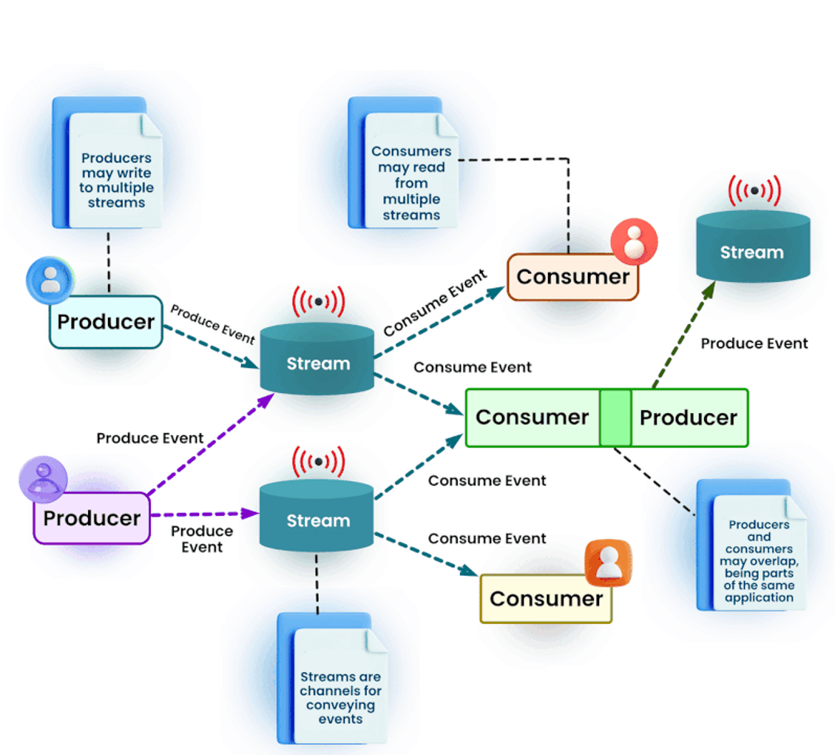
EDA decouples producers and consumers of events; producers release events without knowing which components will handle them, and consumers subscribe to events they are interested in. This allows asynchronous, reactive processing, enabling systems to scale horizontally, improve fault tolerance, and handle high-throughput, real-time workloads efficiently.
In summary, EDA shifts the focus from request-driven interactions to event-driven workflows, supporting loosely coupled, scalable, and highly responsive architectures.
Event-driven Architecture Use Cases in Modern Banking
In a digital bank or any modern financial software platform, events are essentially messages that signal when something important has happened. Assume that there is a digital notification indicating that something has changed, such as after a payment was made, a user updated their profile, or a loan application moved to the next stage.
These events are recorded in immutable logs called topics, which act like a historical ledger of everything that has occurred. Systems or services that need to react to these events, called event consumers, can pick them up immediately. Some events trigger actions right away, like sending a confirmation email, while others may sit in the log until a specific combination or threshold of events occurs, triggering more complex processes.
The importance of this approach is flexibility; it allows banks to build systems that respond in real time, scale efficiently, and keep a complete history of every action without tightly coupling all parts of the system. It’s the backbone of truly responsive event-driven digital banking.
A few examples of the use cases,
- Create or update customer profile
- Create accounts
- Transactions
- The customer applies for a loan
- The customer is approved for a loan.
- The eKYC check is completed for identity verification.
In the above use cases, an event represents a point-in-time state of a specific data object. Events are streamed from the systems or microservices that generate them and are consumed by other systems that need them for business processes. At the core of this architecture is an event backbone; for example, in modern work with this digital bank, most of the developers are using Apache Kafka, which decouples producers and consumers, allowing them to operate independently.
Events are immutable; once they are created, they can be achieved (for example, in cloud storage) but never modified. Each topic acts as a permanent, ordered log of events, which can be easily accessed by multiple consumers. As new events are generated, they are automatically appended to their respective topics, which are typically structured around key business domains like Accounts, Transactions, and Customers.
Multiple consumers can read the same event at their own pace, each for different purposes. For instance, when a customer updates their account information, this event is logged in the Accounts topic. At the same time, a dedicated microservice could consume the same event to reconcile account data across platforms, ensuring consistency without impacting the original process.
This approach enables real-time, scalable, and highly flexible workflows, forming the backbone of modern event-driven banking systems.

In addition to that, events are central to many processes. Customer-facing systems, like the mobile app, generate events whenever payments are made, transfers are completed, or account details are updated. Third-party platforms also produce events, such as loan origination systems tracking application progress.
Event-based microservices make integration simpler and allow data to flow efficiently between systems. Sequences of events can trigger automated workflows like fraud detection or AML checks.
By decoupling producers and consumers, events allow systems to operate independently, scale efficiently, and respond in real time, delivering faster, smarter services for both customers and the bank.
Real-world Example for EDA in Modern Fintech Platforms
- Revolut Revolut uses an event architecture to support its global payments. EDA allows systems to scale effectively, enabling millions of transactions to be processed per second. This allows Revolut to offer fast and reliable services to its customers around the world.
2. Square Square uses Apache Kafka to integrate its various financial services. Event architecture allows for smooth scaling and management of data from various sources, which is crucial for effective transaction handling and data analysis.
3. PayPal PayPal has implemented an event architecture to increase the flexibility and scalability of its payment services. EDA enables PayPal to respond faster to market changes and better protect users against fraud by analyzing and processing events in real time.
4. Robinhood Robinhood uses an event architecture to provide its users with instant notifications about stock price changes. EDA enables rapid processing of market data and provides up-to-date information to investors, which is crucial for making quick investment decisions.
5. Stripe Stripe uses event-driven architecture to support its payment systems, which allows for fast and efficient payment processing. EDA minimizes latency and improves user experience by ensuring seamless transaction processing.
Conclusion
While having multiple advantages in event-driven architecture, it transforms modern banking platforms by enabling systems to respond instantly to every action or change. This real-time approach allows banks to automate workflows, detect fraud, ensure compliance, and integrate diverse systems efficiently. By decoupling event producers and consumers, banks gain flexibility and scalability while delivering faster, smarter, and more reliable services that enhance customer experience.
References
메타데이터
- post_id
- 28394cbf9ff0
- slug
- event-driven-architecture-for-modern-banking-platforms-28394cbf9ff0
- url
- https://medium.com/adl-blog/event-driven-architecture-for-modern-banking-platforms-28394cbf9ff0
- canonical_url
- https://medium.com/adl-blog/event-driven-architecture-for-modern-banking-platforms-28394cbf9ff0
- author_url
- https://medium.com/@eranda.gunasena
- status
- ok
- fetched_at
- 2026-07-22 20:11:34