The Difference Between Agentic Coding andVibe Coding Actually Matters
Everyone is using AI to write code now. But how you use it determines whether you’re building a solid engineering foundation or just hoping…
The Difference Between Agentic Coding andVibe Coding Actually Matters
Everyone is using AI to write code now. But how you use it determines whether you’re building a solid engineering foundation or just hoping for the best.
There is a massive split happening in how developers interact with AI tools. On one side, you have people who type a quick prompt, watch the AI generate code, hit accept, and move on. On the other side, you have developers who treat AI as a structured collaborator, directing it, reviewing its logic, and keeping full control over the decisions that actually matter.
The first approach has a name now: Vibe Coding. The second is what people are calling Agentic Coding.
On the surface, they might look exactly the same. In practice, the outcomes couldn’t be further apart.
The Reality Check: Vibe coding feels fast. Agentic coding actually is fast, and the code survives production.
What is vibe coding?
Vibe coding is what happens when you treat AI as a magic box. You describe what you want, it spits something out, and you ship it. There is no prior review of the implementation plan, no critical evaluation of the architectural approach, and very little understanding of what the AI actually built. You are literally just feeling your way through the development cycle.
This isn’t necessarily wrong for throwaway scripts, weekend side projects, or quick experiments. But for anything you need to maintain, scale, or hand off to another human being, vibe coding creates a catastrophic kind of technical debt. It’s the kind of debt where nobody really understands the codebase, including the person who built it.
What is agentic coding?
Agentic coding is about keeping yourself firmly in the driver’s seat. You still use AI heavily, sometimes for the bulk of the actual writing, but you control the structure, the decisions, and the engineering standards.
The AI executes. You architect.
In practice, an agentic workflow looks like this:
- Plan first, execute second: You start every feature or project with a proper Product/Feature Requirements Document (PRD/FRD) before touching a line of code.
- Collaborative blueprinting: You use an AI tool in planning mode, review the implementation plan it generates, push back where needed, and only switch to build mode once you’re satisfied with the logic.
- The right tool for the job: You recognize that forcing one model to do everything yields mediocre results. You intentionally route tasks, using something like Codex for backend logic and Claude Code for frontend work.
- Zero guessing games: The AI never has to guess at your conventions because your repository already documents them clearly.
The Post-Execution Habit
One of the simplest ways to transition into an agentic workflow is to implement a strict post-execution review. Every time an AI finishes an implementation, try sending this exact prompt:
“Review what you just implemented and improve it for correctness, strong typing, maintainability, production safety, consistency with the rest of the codebase, and the removal of dead or placeholder code.”
This single habit catches more edge cases and silent failures than most manual code reviews.
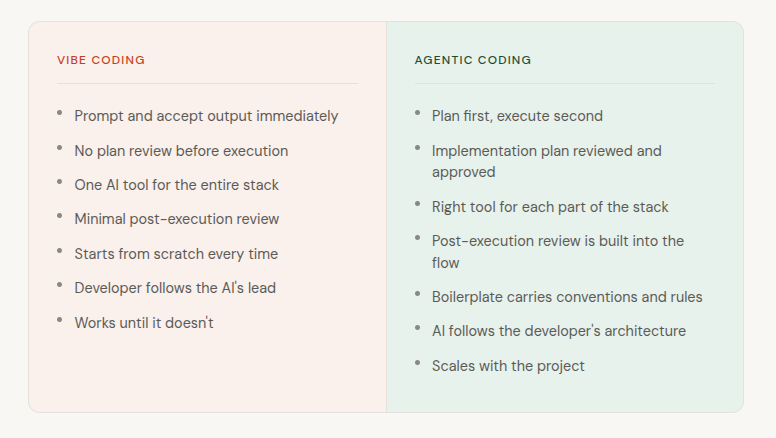
The Core Differences at a Glance
The Power of an AGENTS.md File
One of the most underrated components of an agentic workflow is the starting point. Most developers start from scratch, forcing the AI to guess at naming conventions, design patterns, and state management.
A disciplined agentic workflow solves this with a dedicated configuration file, an AGENTS.md file placed at the root of your repository.
What exactly is an AGENTS.md file?
Think of it as an instruction manual written exclusively for artificial intelligence. Just like a README.md file explains a project to human onboarding engineers, an AGENTS.md file defines the boundaries, tech stack, and guardrails for AI coding agents. It provides the immediate contextual grounding that an LLM needs to write highly tailored code instead of generic solutions.
How does the AI actually recognize it?
Modern developer-focused AI tools and coding agents (like Cursor, Windsurf, Claude Code, or OpenCode) are hardwired to scan the root directory of a project before they begin execution.
When you boot up an agentic session, the tool automatically indexes files with specific naming conventions (such as AGENTS.md, .cursorrules, or .claude). The AI parses this file and injects its contents directly into its system prompt or context window. This means your rules are actively whispering in the AI's "ear" during every single generation, preventing it from straying from your architecture.
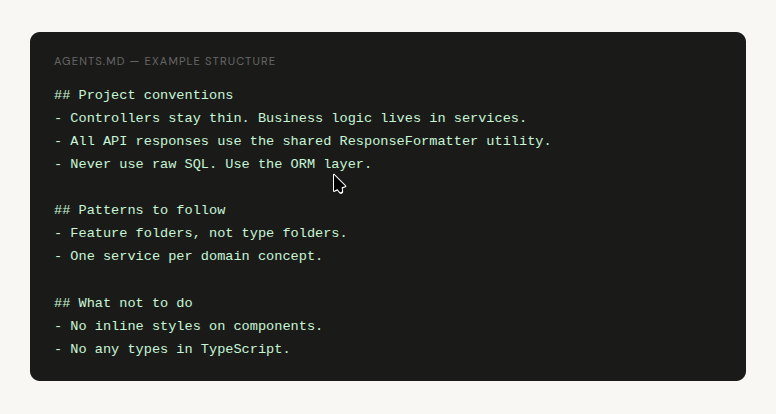
A typical layout includes:
## Project conventions
- Controllers stay thin. Business logic lives in services.
- All API responses use the shared ResponseFormatter utility.
- Never use raw SQL. Use the ORM layer.

## Patterns to follow
- Feature folders, not type folders.
- One service per domain concept.

## What not to do
- No inline styles on components.
- No any types in TypeScript.
When an AI reads this file before writing a single character of code, the output matches your repository seamlessly. Without it, the AI improvises, and improvisation in production is dangerous.
Where Vibe Coding Actually Belongs
Don’t get me wrong, vibe coding isn’t entirely useless. It has a place. That place just isn’t your Minimum Viable Product (MVP).
When you are building an MVP, you are still discovering what the product is. The architectural decisions you make during this phase will define the codebase for years to come. If you vibe code your way through the foundation, you end up with a structural baseline that was never actually designed; it just happened. And foundations that just happen tend to collapse under weight.
The time to let loose is after the MVP is shipped and you understand the shape of the product. Once the core architecture and conventions are rock solid, vibe coding becomes a brilliant accelerator. You can afford to move fast on minor features because the sandbox is already securely built.
Build the MVP with intention. Then let the AI run. The order matters infinitely more than the tools.
The Mindset Shift
The underlying shift with agentic coding is simple: you stop thinking of AI as a tool that generates code, and start thinking of it as an assistant that executes your decisions. That single mental shift changes how you prompt it, how you review it, and how much you trust it.
Most of the time, when AI-generated code disappoints us, the problem isn’t the model. The problem is that we didn’t give the model a proper framework to work within. We asked it to figure things out as it went. It did its best, but its best wasn’t production-grade.
Give the AI a blueprint you’ve vetted. Give it a rulebook that it must follow. Review what it produces before it hits your main branch. It’s not a complicated system; it’s just disciplined engineering.
Both methods will get you lines of code. But one produces a system you understand and can scale, while the other produces code that works perfectly right up until you need to change it.
For anything that matters, the choice should be obvious.
메타데이터
- post_id
- 28583fd8a1ff
- slug
- the-difference-between-agentic-coding-andvibe-coding-actually-matters-28583fd8a1ff
- url
- https://medium.com/@mrprotocoll/the-difference-between-agentic-coding-andvibe-coding-actually-matters-28583fd8a1ff
- canonical_url
- https://medium.com/@mrprotocoll/the-difference-between-agentic-coding-andvibe-coding-actually-matters-28583fd8a1ff
- author_url
- https://medium.com/@mrprotocoll
- status
- ok
- fetched_at
- 2026-06-09 15:37:30



