Funding the U.S. Energy Transition: Private Action Meets Local Policy
By: 2025 Chicago Fellow Gabriela Coser
Funding the U.S. Energy Transition: Private Action Meets Local Policy
By: 2025 Chicago Fellow Gabriela Coser
The United States is the world’s second-largest emitter of CO₂ after China, and how it chooses to decarbonize matters globally. Mass electrification is needed to achieve decarbonization goals, yet the country’s highly decentralized policy system and mixed market of regulated and unregulated energy place private actors at the center of this transition. Local governments become key players in this system, providing guidance and shaping incentives that ensure a resilient, reliable, and affordable energy system.
One of my main goals has been to internalize this perspective and the U.S. economic model — to understand how the country can decarbonize largely through private-sector action. The question isn’t just what federal policies and rulemaking are settled in Washington, but also how private capital and local governments can accelerate decarbonization in electricity, heat, transportation, and buildings — sectors that account for 90% of the country’s emissions — and how we can safeguard vulnerable communities through these actions.
Climate Change is Already Stressing the U.S. Grid
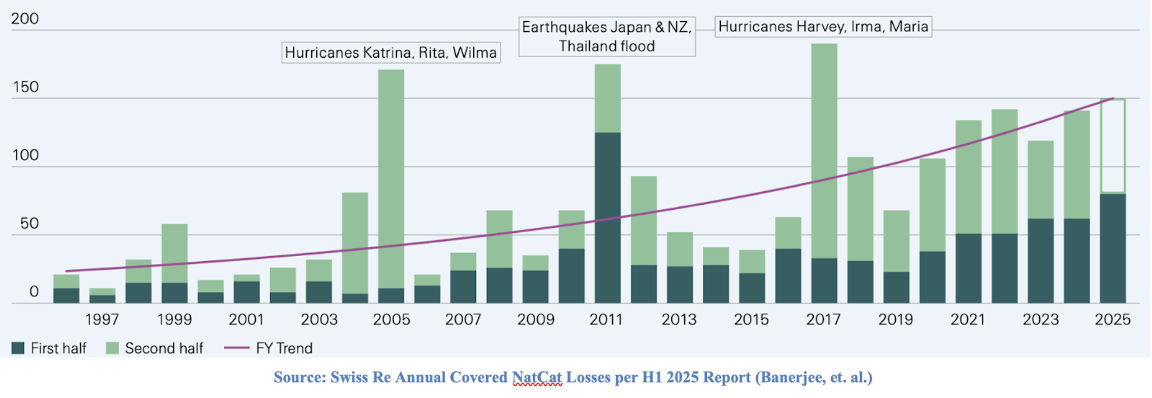
Energy is the backbone of climate adaptation for extreme events. Heat waves, wildfires, and winter storms become more frequent, unpredictable, and extreme. Households depend on it to stay cool during extreme heat and warm during volatile winters. More volatility means higher physical risk for the grid, greater uncertainty for utilities, and an urgent need for infrastructure upgrades. The scale is staggering: billion-dollar weather disasters have increased from an annual average of nine events (1980–2024) to 23 events in just the last five years, yet a $500 billion investment gap remains to harden U.S. grid infrastructure against climate impacts.
Nonlinear climate impacts make geography critical for grid planning: some communities will face greater energy burdens, higher outage risks, and more severe shocks than others. This creates winners and losers across U.S. regions and income groups, intensifying the need for equity in the energy transition.
Classical Economic Solutions Don’t Fit the U.S. Context
Economists often argue that carbon taxes or emissions trading systems are the most efficient tools for climate mitigation. But in the U.S., carbon pricing must navigate a decentralized policy system, strong veto players, and competing state interests. The result: carbon pricing remains limited, sector-specific, and less ambitious than optimal policy would require nationwide.
This political reality demands alternative approaches. Local governments can use the Social Cost of Carbon (SCC) to guide policy and investment priorities. Tools like Internal Carbon Pricing make carbon costs visible in corporate decision-making, aligning business incentives with decarbonization without requiring congressional action.
Behavioral insights are equally critical. People don’t always act rationally, even when it’s cost-effective. Policies and programs must meet people where they are, using immediate incentives, simplified processes, and social influence to accelerate the adoption of energy-efficient technologies and support for large-scale renewable projects. Carbon capture, nuclear power, and other emerging solutions must gain public acceptance to achieve their potential. The most technically sound climate solution means little if communities reject it or if adoption barriers remain too high.
Economic modeling predicts that the costs of inaction will fall unequally. Under a business-as-usual emissions scenario, the poorest third of U.S. counties could lose 2–20% of income by the late 21st century, while some wealthier regions see gains. This geographic disparity underscores the need to prioritize funding for historically marginalized communities and why private capital benefits from public partnerships to deliver equitable outcomes.
Private Action and Local Policy: A Winning Combination
Private investment drives innovation and scales solutions, but it needs direction. Local governments provide that guidance — shaping electricity markets, defining project approvals, offering incentives, and setting building standards. This partnership ensures private capital flows toward decarbonization while protecting equity and delivering context-specific impact.
Financing decisions should be channeled toward four priority areas that can accelerate emissions reductions while supporting economic growth and ensuring an equitable transition:
1. Integrate carbon valuation into investment decisions
Local governments can adopt the Social Cost of Carbon, which estimates the future economic damage from each ton of CO₂ emitted, to evaluate energy projects and guide procurement. The SCC captures climate economics’ core challenge: we pay costs today while benefits — avoided damages — accrue over decades. Recent estimates place the SCC at $185 per ton, far higher than most current policies reflect, accounting for tipping points and disaster risks. Corporations and investors should use Internal Carbon Pricing to assess projects, account for transition costs, and inform long-term capital allocation. Valuing carbon ensures that financing flows to projects that deliver the highest emissions reductions per dollar spent.
2. Accelerate building efficiency and electrification through behavioral design
Buildings and commercial emissions account for almost a third of U.S. greenhouse gas emissions. Energy efficiency upgrades and electrification can dramatically reduce emissions while lowering energy burdens for low-income households. Yet the “energy efficiency gap”, where cost-effective improvements go unadopted, persists due to behavioral barriers such as inertia, loss aversion, and information overload. Programs must adopt behavioral approaches to close this gap: point-of-sale rebates, streamlined adoption programs, and messaging that leverages social norms help households overcome these barriers. Utilities and policymakers can deploy behavioral energy strategies — such as default enrollment, real-time feedback, and time-of-use pricing — to influence how consumers use electricity, shift demand, and accelerate the adoption of efficient technologies.
3. Strengthen grid resilience by fully integrating adaptation planning into operations
Extreme weather increasingly threatens grid reliability, hitting vulnerable communities hardest. Public-private partnerships and resilience-focused investment instruments can fund transmission upgrades, distributed energy resources, and climate adaptation technologies. Framing adaptation as both risk management and economic opportunity encourages private capital while improving equity and reliability.
4. Build public support for emerging decarbonization technologies
Carbon capture and storage, advanced nuclear power, and renewable energy expansion are critical for deep decarbonization but require public trust. Early community engagement and transparent risk governance ensure projects gain social acceptance and deliver local economic benefits. Integrating community stakeholder input from the start prevents opposition and ensures technologies don’t worsen regional inequities.
The Path Forward
The U.S. can achieve decarbonization without waiting for comprehensive federal climate legislation. By aligning private capital with local policy and channeling investment toward these four priorities, the country can cut emissions while supporting economic growth and protecting vulnerable communities.
Private action is powerful. When paired with strategic local policy and behavioral design, it can transform the U.S. energy system. For the private sector, this isn’t just a climate imperative. It’s a market opportunity that can drive innovation, create competitive advantages, and build a more resilient and equitable economy. The question is whether American businesses and investors will lead this transition, recognizing that the low-carbon economy is already here, and American competitiveness will grow through it.
메타데이터
- post_id
- 288ec91668ab
- slug
- funding-the-u-s-energy-transition-private-action-meets-local-policy-288ec91668ab
- url
- https://medium.com/@celions/funding-the-u-s-energy-transition-private-action-meets-local-policy-288ec91668ab
- canonical_url
- https://medium.com/@celions/funding-the-u-s-energy-transition-private-action-meets-local-policy-288ec91668ab
- author_url
- https://medium.com/@celions
- status
- ok
- fetched_at
- 2026-07-31 03:25:08