Episode 21: Cross Roads
Signal Dispatch : You must advocate for the path you believe in, because every meaningful career is built at a crossroads.
Episode 21: Cross Roads
Signal Dispatch : You must advocate for the path you believe in, because every meaningful career is built at a crossroads.
Some careers are built around a plan.
Others are built around a series of decisions made when the plan isn’t clear at all.
A degree. A new country. A research opportunity. A job offer. A choice between stability and uncertainty.
At each point, there is a crossroads.
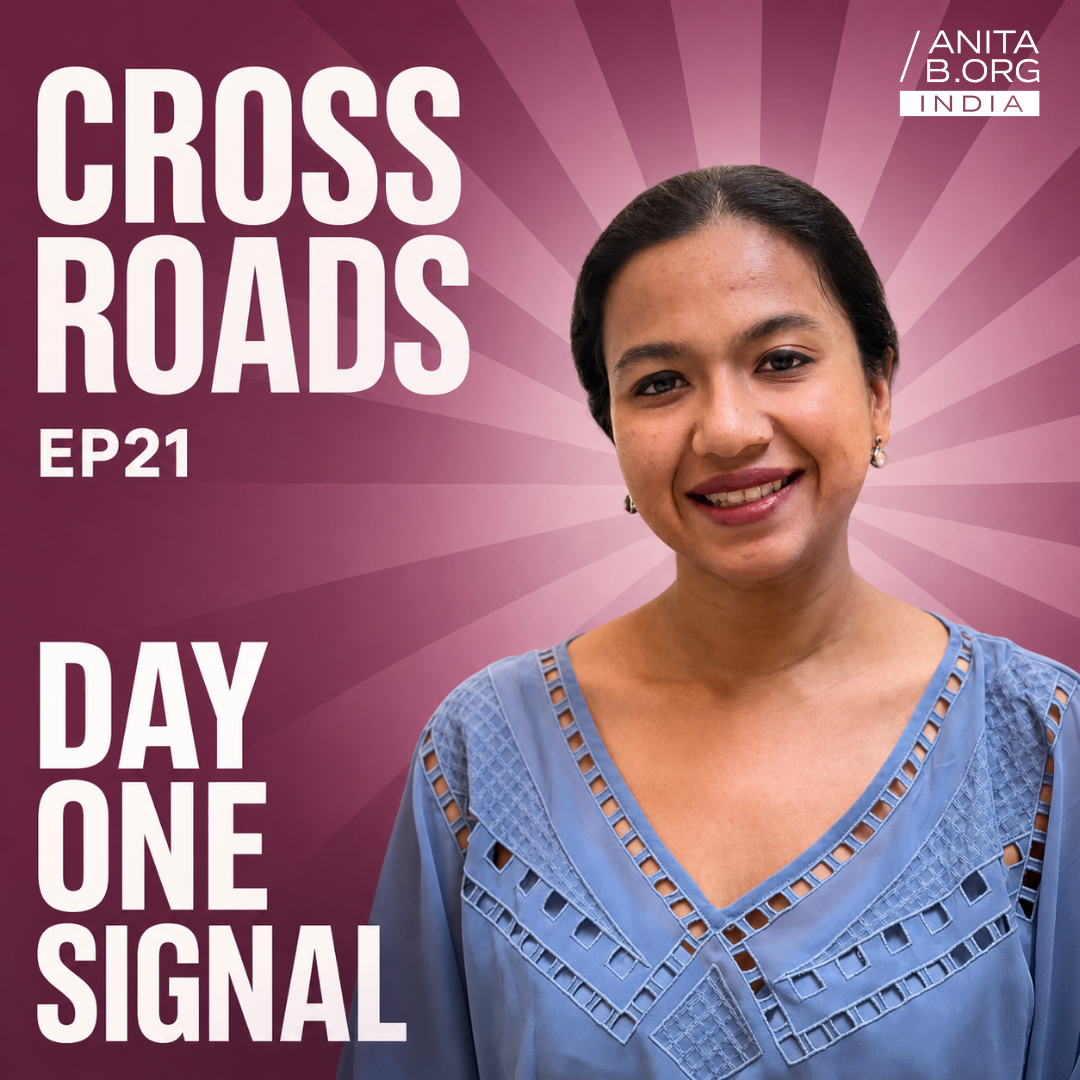
When I sat down with Damini Agarwal, CTO at Infinite Biomedical Technologies, I expected to hear about biomedical engineering, prosthetics, and her journey from research to commercialization.
Instead, I found a story about what happens when you repeatedly choose the path that feels more meaningful -even when the other path looks easier.
For Damini, the crossroads never really stopped. They simply changed.
And perhaps that is what makes her journey so interesting. There was never one grand decision that defined her career. There were several smaller ones, each asking the same question:
What do I actually want to do?
Crossroad One: Follow the Curiosity
Damini’s first career idea didn’t come from a career counselor or a five-year plan, It came from books.
As a schoolgirl, she loved reading Robin Cook’s forensic novels and became fascinated by forensic science. By classes 11 and 12, however, something else began to pull at her.
She loved biology.
She loved physics.
She loved circuits.
And she was increasingly curious about what happened when those things came together.
“I was more curious about the intersection of physics with the human body,” she explained.
That curiosity eventually led her to biomedical engineering at VIT. But even then, she wasn’t satisfied with staying within one discipline.
Her degree gave her the hardware and circuits she loved. What she felt was missing was computer science, in which she minored .
By the end of my undergraduate degree, I had a much clearer idea of what I wanted to explore: circuits that could pick up signals from the human body.
That clarity led her to Johns Hopkins.
And then came another decision.
She emailed Professor Nitish Thakor, a professor she didn’t know, while applying for graduate school.
His inbox, she later realized, was probably filled with thousands of emails.
But he responded.
That one response helped shape her admission to Hopkins, her research, and eventually her entry into the world of prosthetics.
Sometimes a career doesn’t begin with certainty.
Sometimes it begins with one email you almost don’t send.
Crossroad Two: Certainty or Possibility
By the time Damini finished her master’s at Johns Hopkins, the conventional paths were clear.
A PhD.
Or a job at one of the large, recognizable medical device companies.
There was also another option.
Infinite Biomedical Technologies — A much smaller company ; A much less predictable path.
And one that depended on an NIH grant being funded.
In other words, there was no guarantee.
Damini approached the decision almost exactly as you would expect an engineer to.
She made a pros-and-cons list.
The PhD was the easiest to eliminate. “I believed it was something I could return to later.”
The large company had obvious advantages: scale, resources, multiple technologies, and more opportunities to move around.
But the smaller company offered something the others didn’t.
She could take her own research and see what happened when it moved from the laboratory into the real world.
“How often do you get the chance to oversee your own research work through the commercialization process?”
That was the question that ultimately decided it.
The uncertainty remained. The grant still had to be funded. Her compensation depended on it. The path was anything but guaranteed.
But the opportunity was unique.
She chose IBT — the one she didn’t want to miss.
And nearly a decade later, that decision has taken her from research engineering to overseeing product development, quality and regulatory, production and manufacturing, while also contributing to international business development.
Looking back, the decision seems obvious.
At the time, it wasn’t.
That’s the thing about crossroads.
They rarely look meaningful while you’re standing at them.
The Moment the Work Became Real
Two weeks into her full-time role, Damini was in a clinic fitting the company’s technology onto a patient.
She remembers the first thought that came to her.
“Am I really the right person for this?”
It was an early encounter with imposter syndrome.
She was young, new.
And she was suddenly expected to take technology she had worked on and put it in front of a real person.
But then she realized something.
I had done the work.
I knew the technology inside out.
What I didn’t know was the clinical workflow.
So I learned that too.
I observed.
I asked questions.
I went back better prepared for the next patient fitting.
That experience became a pattern for the rest of her career.
She didn’t wait to know everything before stepping forward.
She stepped forward, identified what she didn’t know, and then went looking for it.
“I had to start somewhere,” she told me.
That might be one of the most useful lessons in her entire story.
Because the first time you do something new, you will probably feel uncomfortable.
You may even feel unqualified.
But discomfort isn’t always evidence that you’re in the wrong place.
Sometimes it is simply evidence that you’re learning.
Advocate for Yourself
The word that kept appearing throughout our conversation was advocacy.
The everyday kind.
Sending the email.
Asking the question.
Putting your hand up.
Telling your manager what you want to learn next.
Reaching out to someone who knows more than you.
Damini believes these skills are becoming just as important as technical ability because work is ultimately people-driven.
“You have to advocate for yourself,” she said.
And she has practiced that throughout her career.
When she wanted to understand something, she reached out to people who knew more than she did.
When she didn’t know an area, she sought out an expert.
When she wanted to expand her role at IBT, she spoke to management about where she wanted to grow.
And when she didn’t know something at all?
“Go look for the smartest person that knows the most. And ask them for help.”
There is something particularly refreshing about that answer.
In a world where people increasingly feel pressure to appear knowledgeable, Damini sees admitting what you don’t know as a strength.
“Accept that you don’t know enough about this.”
Then find someone who does- That isn’t weakness — It is how you grow.
Crossroad Three: Stay or Start Again
There is another question that naturally follows a career like hers.
After almost a decade at the same company, did she ever wonder whether she should leave?
Her answer surprised me.
She hadn’t spent those years actively looking for an exit.
Instead, she kept finding new things she wanted to learn.
And then she advocated for them.
She moved beyond research engineering into areas she initially knew nothing about — production, manufacturing, quality, regulatory, and eventually international business development.
The company supported that growth.
But Damini is very clear that it was a two-way relationship.
She demonstrated the initiative.
The organization created the space.
“As long as you communicate where you think your path should take you, the company works with you to get you there.”
That philosophy has shaped more than just her own career.
She described colleagues who have moved across functions because they expressed an interest in doing something different.
One colleague moved from embedded engineering toward the clinical side, eventually pursuing a master’s and becoming a clinician in the field.
That is what Damini believes a workplace can become when people are allowed to chart their own paths.
Not a ladder.
A landscape.
You don’t always have to leave an organization to grow.
Sometimes you have to ask it to grow with you.
When Recognition Doesn’t Match Impact
There is another crossroads that many people, particularly in India, understand well.
The difference between doing meaningful work and doing work that sounds impressive when you tell someone about it.
Damini has seen how people often associate professional worth with the name of the organization on your résumé.
A large company sounds important.
A recognizable brand sounds successful.
A niche company can sometimes require explanation.
Her own work occasionally gets reduced to something almost funny.
Someone once asked her mother about her daughter and referred to her work as essentially “making hands and legs.”
Damini laughed about it.
Because, in a way, that is exactly what she does.
She helps build advanced prosthetic technology.
But the point wasn’t the misunderstanding.
It was that she refuses to let someone else’s definition of importance determine the value of her work. “It’s almost impossible to please everybody around you.”
So she asks a simpler question:
Are you being true to yourself?
Are you happy with the decision you’re making?
If the answer is yes, the rest becomes noise.
That may be one of the hardest forms of conviction — to be able to know the value of your work even when the world doesn’t immediately recognize it.
Crossroad Four: Show Up
Damini’s relationship with AnitaB.org began with another seemingly small decision.
While studying at Hopkins, she saw an advertisement for the Anita Borg Memorial Scholarship for women in computer science or related fields.
Her degree was in biomedical engineering. She wasn’t sure she qualified.
But she noticed something important. It didn’t say she couldn’t apply.
So she applied. And she won.
That scholarship introduced her to the Women Techmakers network and eventually took her to the Grace Hopper Celebration, where she encountered thousands of women working across technology.
For someone accustomed to being one of only a few women in a research environment, the experience was transformative.
Years later, when she began spending more time in India, she attended an event and That meeting eventually led to further collaboration, and today she serves as a jury member for Grace Hopper Celebration India.
She described the journey as a “continuing circle.”
One opportunity rarely arrives alone.
It connects to another.
But you have to show up for the first one.
And sometimes self-advocacy is as simple as asking yourself:
Why not me?
Every Day Is Day One
When I finally asked Damini what her Day One was, she paused.
“Every day is a day one,” she said.
Every day brings something new to learn. to try.
But when she looked further back, she knew where that mindset began.
Her family.
Her parents and grandparents gave her the foundation to advocate for herself, keep moving forward, and question the limits she placed on herself.
She remembered being afraid to go on stage at school.
Her mother pushed her through the stage fright.
She remembered moments when she thought she wasn’t qualified or wasn’t good enough.
Her father would break down the reasons she believed that and show her the evidence that proved otherwise.
And then there was knitting.
She had knitted several scarves and was perfectly happy with that achievement.
Her father asked:
“Why are you stopping at a scarf? You should knit a sweater.”
It was a small comment. But it carried the philosophy of her entire life.
Why stop at the first thing you know you can do?
Why decide the limit before you’ve tested it?
Why let uncertainty make the decision for you?
Damini’s career has been a series of crossroads.
And at each one, she gathered information, asked questions, advocated for what she wanted, and chose.
Not always the easiest option.
Not always the most recognizable one.
But the one that made sense to her.
Perhaps that is what Crossroads really means.
Not that life keeps asking us to choose between two roads.
It is that every road becomes clearer only after we have the courage to take it.
And sometimes the most important decision isn’t knowing exactly where you’re going.
It is deciding that you won’t let someone else choose the direction for you.
메타데이터
- post_id
- 28a46eb29ab2
- slug
- episode-21-cross-roads-28a46eb29ab2
- url
- https://medium.com/@dayonesignal/episode-21-cross-roads-28a46eb29ab2
- canonical_url
- https://medium.com/@dayonesignal/episode-21-cross-roads-28a46eb29ab2
- author_url
- https://medium.com/@dayonesignal
- status
- ok
- fetched_at
- 2026-08-22 21:44:42




