Update — March 2026: Winners, Losers, and the “Technology‑Neutral” Future of Federal R&D
Since my February 25 post, the SBIR and STTR landscape has shifted from uncertainty to a defined — though not yet completed — path back…
Update — March 2026: Winners, Losers, and the “Technology‑Neutral” Future of Federal R&D
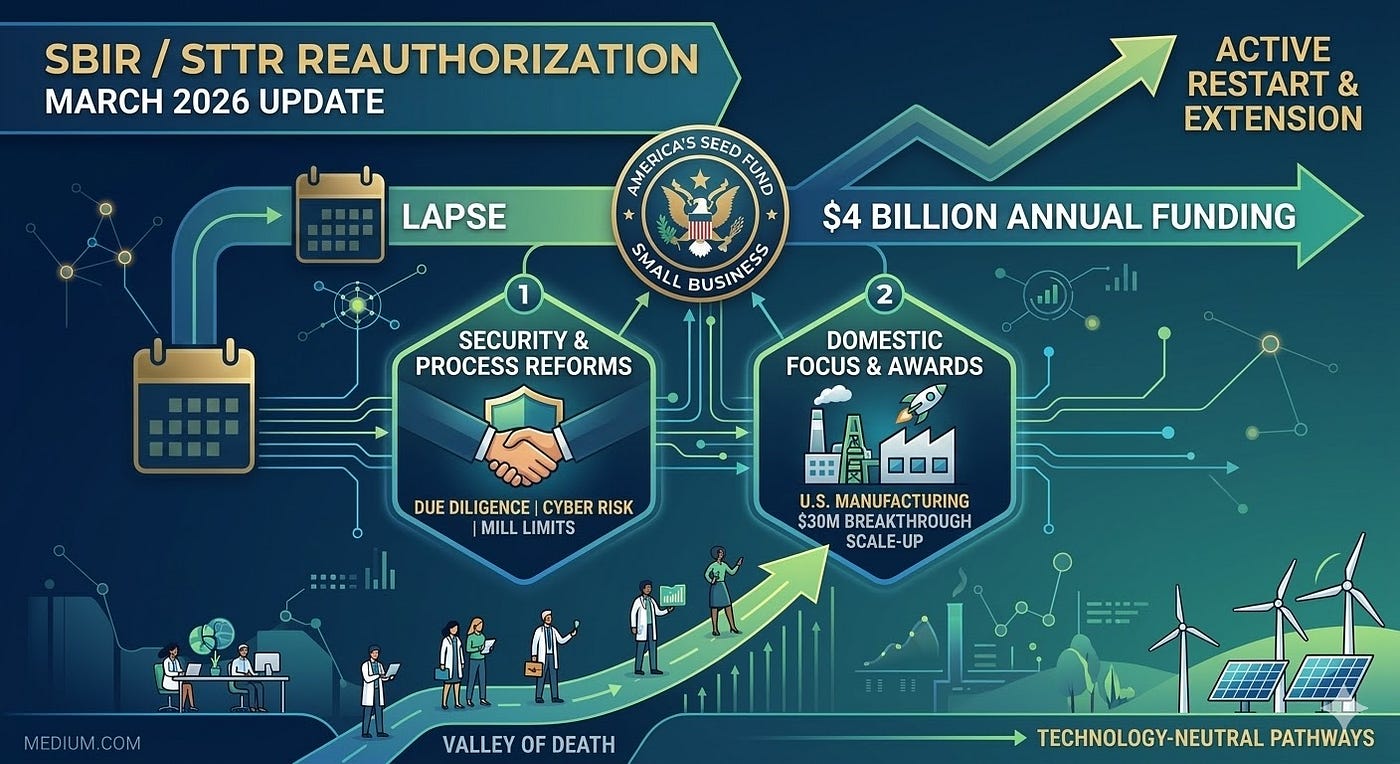
Since my February 25 post, the SBIR and STTR landscape has shifted from uncertainty to a defined — though not yet completed — path back. The Senate has unanimously passed the Small Business Innovation and Economic Security Act (S. 3971), a five‑year reauthorization that would extend SBIR and STTR through September 30, 2031, and the bill now awaits action in the House. (1)
For researchers and founders depending on “America’s Seed Fund,” the question is no longer if the programs return, but how they will operate once they do.
The Breakthrough: A Lifeline with New Conditions
The Ernst–Markey compromise behind S. 3971 would end a five‑month lapse that began on October 1, 2025 and restore roughly 4 billion dollars per year in non‑dilutive funding across participating agencies once enacted. Agencies have kept SBIR/STTR staff and draft solicitations warm; statutory authority is the missing piece. (2)
The bill also creates a new Strategic Breakthrough Award mechanism: large, milestone‑based Phase II packages that allow certain agencies to commit up to 30 million dollars over as long as 48 months, contingent on one‑to‑one matching from private or non‑SBIR public sources. This is intended to carry a small number of scale‑ready technologies across the “valley of death” from prototype to deployment or acquisition. (3)
The Insight: Reauthorization as Governance and Security Reform
S-3971 is as much about governance as it is about money. It directs agencies to set limits on how many proposals any one firm can submit — by year, topic, or solicitation — to curb high‑volume “mills” and free reviewer capacity for genuinely small, innovation‑driven companies. (4)
At the same time, it tightens research‑security expectations: agencies must apply more rigorous foreign‑ties due diligence and can deny awards based on ownership, affiliations, IP, and cybersecurity risk across firms and, in STTR, their research‑institution partners. For academic–industry teams, security posture moves from back‑end compliance to front‑end proposal design. (5)
The Strategic Shift: Where Federal R&D Is Pointing
These SBIR/STTR changes sit inside a broader realignment of federal R&D. Climate and energy incentives under the Inflation Reduction Act are now administered in a largely technology‑neutral fashion, tying benefits to emissions performance rather than naming specific technologies, which opens more space for geothermal, advanced nuclear, long‑duration storage, and carbon‑capture approaches that can document system‑level impact. (6)
In parallel, the CHIPS and Science Act continues to pull capital toward domestic manufacturing, favoring small firms that can move from lab‑scale prototypes to U.S.‑based production through foundries, contract manufacturers, or new facilities. Strategic Breakthrough Awards are designed to complement that agenda by backing a small set of high‑priority projects with large, multi‑year, co‑funded awards. (7, 8)
Universities, meanwhile, face ongoing pressure around overhead and demonstrable contribution to translation rather than purely discovery‑oriented roles, especially in mission‑driven portfolios like defense and energy. The most competitive SBIR/STTR‑linked efforts are likely to be those where academic partners are clearly integrated into commercialization pathways, not just attached for indirect cost coverage. (9)
The Bottom Line for the Research Community
From the vantage point of March 2026, the SBIR/STTR story is no longer about existential risk; it is about adaptation. The programs are on track to return for five years, but under a more selective, security‑sensitive, and scale‑oriented framework. (10)
For the research community, that translates into three imperatives: design projects around credible paths to domestic manufacturing or deployment, express climate and energy work in technology‑neutral performance terms where relevant, and treat research security — ownership, affiliations, IP, and cyber — as a first‑class design constraint rather than a late‑stage checklist. Teams that align with these pillars now will be best positioned as solicitations fully restart. (10, 11, 6)
Endnotes
- NSBA & Small Business Technology Council, “Senate Advances SBIR, STTR Reauthorization Plan with Support from NSBA, SBTC,” NSBA Advocate, March 3, 2026.6 https://www.nsbaadvocate.org/post/news-senate-advances-sbir-sttr-reauthorization-plan-with-support-from-nsba-sbtc
- “Senate Passes Bill to Renew Small Business Research Programs,” coverage of Senate passage of S. 3971 (e.g., Bloomberg Government / AZBio / MeriTalk), March 3, 2026.12 https://news.bgov.com/bloomberg-government-news/senate-passes-bill-to-renew-small-business-research-programs https://www.azbio.org/senate-passes-sbir-reauthorization
- Clean Energy Business Network (CEBN), “CEBN Applauds Senate Passage of Five‑year SBIR Reauthorization,” March 3, 2026.13 https://www.cebn.org/media_resources/press-release-cebn-applauds-senate-five-year-sbir-reauthorization/
- MNSBIR / NC SBTDC and similar SBIR/STTR program updates summarizing agency preparations during the lapse and anticipated restart.14 https://minnesotasbir.org/news/sbir-sttr-reauthorization-update-2025/
- Covington & Burling, Inside Government Contracts blog, “Is Congress Finally Reauthorizing SBIR/STTR — and What’s Changing?”, March 10, 2026 (Strategic Breakthrough Award size, duration, and matching requirements).9 https://www.insidegovernmentcontracts.com/2026/03/is-congress-finally-reauthorizing-sbir-sttr-and-whats-changing/
- GrantEngine, “SBIR Reauthorization: What Just Happened and What It Means for You,” March 8, 2026 (valley‑of‑death rationale and scale‑up focus).15 https://grantengine.com/sbir-reauthorization-what-just-happened-and-what-it-means-for-you/
- AZBio, “Senate Passes SBIR Reauthorization,” March 3, 2026 (proposal‑limit provisions and intent to curb ‘mills’).12 https://www.azbio.org/senate-passes-sbir-reauthorization
- 3971, Small Business Innovation and Economic Security Act, 119th Congress — bill text and official summaries on research‑security and foreign‑ties due diligence.1617 https://www.billsponsor.com/bills/850808/senate-bill-3971-congress-119 https://www.govinfo.gov/content/pkg/BILLS-119s3971cps/pdf/BILLS-119s3971cps.pdf
- McAllister & Quinn, “SBIR STTR Program Reauthorized | An Inside Look at the Changes to America’s Seed Fund,” February 24, 2026 (discussion of security and governance reforms). 18 https://jm-aq.com/small-business-innovation-and-economic-security-act-an-inside-look-at-the-changes-to-americas-seed-fund/
- Federal and expert summaries of Inflation Reduction Act clean‑energy tax credits emphasizing emissions‑based, technology‑neutral structures.19 Example overview: https://www.pertamapartners.com/funding/us-federal-funding-guide-2026
- CHIPS and Science Act implementation and associated federal analyses highlighting domestic semiconductor and advanced manufacturing incentives.19 Example roundup: https://www.businessofgovernment.org/blog/weekly-roundup-march-9-13-2026
- Association of American Universities (AAU), “Lawmakers Reach Agreement to Renew Small Business Innovation Research Program,” February 26, 2026 (SBIR context, research priorities).20 https://www.aau.edu/newsroom/leading-research-universities-report/lawmakers-reach-agreement-renew-small-business
- AAU, “New Report Recommends Congress Reinstate Key Small Business Innovation Programs,” January 15, 2026 (discussion of cost structures, institutional roles, and translation pressures).21 https://www.aau.edu/newsroom/leading-research-universities-report/new-report-recommends-congress-reinstate-key-small
Additional Reading
- https://www.quiverquant.com/bills/119/s-3971
- https://www.govinfo.gov/content/pkg/BILLS-119s3971cps/pdf/BILLS-119s3971cps.pdf
- https://jm-aq.com/small-business-innovation-and-economic-security-act-an-inside-look-at-the-changes-to-americas-seed-fund/
- https://sbtdc.org/blog/sbir-sttr-program-2026-news-and-updates
- https://grantengine.com/sbir-reauthorization-what-just-happened-and-what-it-means-for-you/
- https://www.azbio.org/senate-passes-sbir-reauthorization
- https://www.cebn.org/media_resources/press-release-cebn-applauds-senate-five-year-sbir-reauthorization/
- https://www.aau.edu/newsroom/leading-research-universities-report/lawmakers-reach-agreement-renew-small-business
- https://pmc.ncbi.nlm.nih.gov/articles/PMC6910624/
- https://pmc.ncbi.nlm.nih.gov/articles/PMC7266046/
- https://arxiv.org/abs/2209.06629
- https://pmc.ncbi.nlm.nih.gov/articles/PMC6458068/
- https://pmc.ncbi.nlm.nih.gov/articles/PMC10014693/
- https://www.nsbaadvocate.org/post/news-senate-advances-sbir-sttr-reauthorization-plan-with-support-from-nsba-sbtc
- https://www.nsf.gov/funding/opportunities/sbirsttr-phase-i-nsf-small-business-innovation-research-small-business
- https://pmc.ncbi.nlm.nih.gov/articles/PMC9125501/
- https://www.insidegovernmentcontracts.com/2026/03/is-congress-finally-reauthorizing-sbir-sttr-and-whats-changing/
- https://pmc.ncbi.nlm.nih.gov/articles/PMC7324194/
- https://pmc.ncbi.nlm.nih.gov/articles/PMC3644583/
- https://www.pertamapartners.com/funding/us-federal-funding-guide-2026
- https://www.aau.edu/newsroom/leading-research-universities-report/new-report-recommends-congress-reinstate-key-small
메타데이터
- post_id
- 28a88db1bccf
- slug
- update-march-2026-winners-losers-and-the-technology-neutral-future-of-federal-r-d-28a88db1bccf
- url
- https://medium.com/@robdunie/update-march-2026-winners-losers-and-the-technology-neutral-future-of-federal-r-d-28a88db1bccf
- canonical_url
- https://medium.com/@robdunie/update-march-2026-winners-losers-and-the-technology-neutral-future-of-federal-r-d-28a88db1bccf
- author_url
- https://medium.com/@robdunie
- status
- ok
- fetched_at
- 2026-06-21 12:17:11




