Professor Samerski on Schwejk
Prof. Stefan Samerski demonstrated how Hašek’s Schwejk unmasks power, through language, Lada’s iconic imagery, and the stage. Comedy as…
Professor Samerski on Schwejk
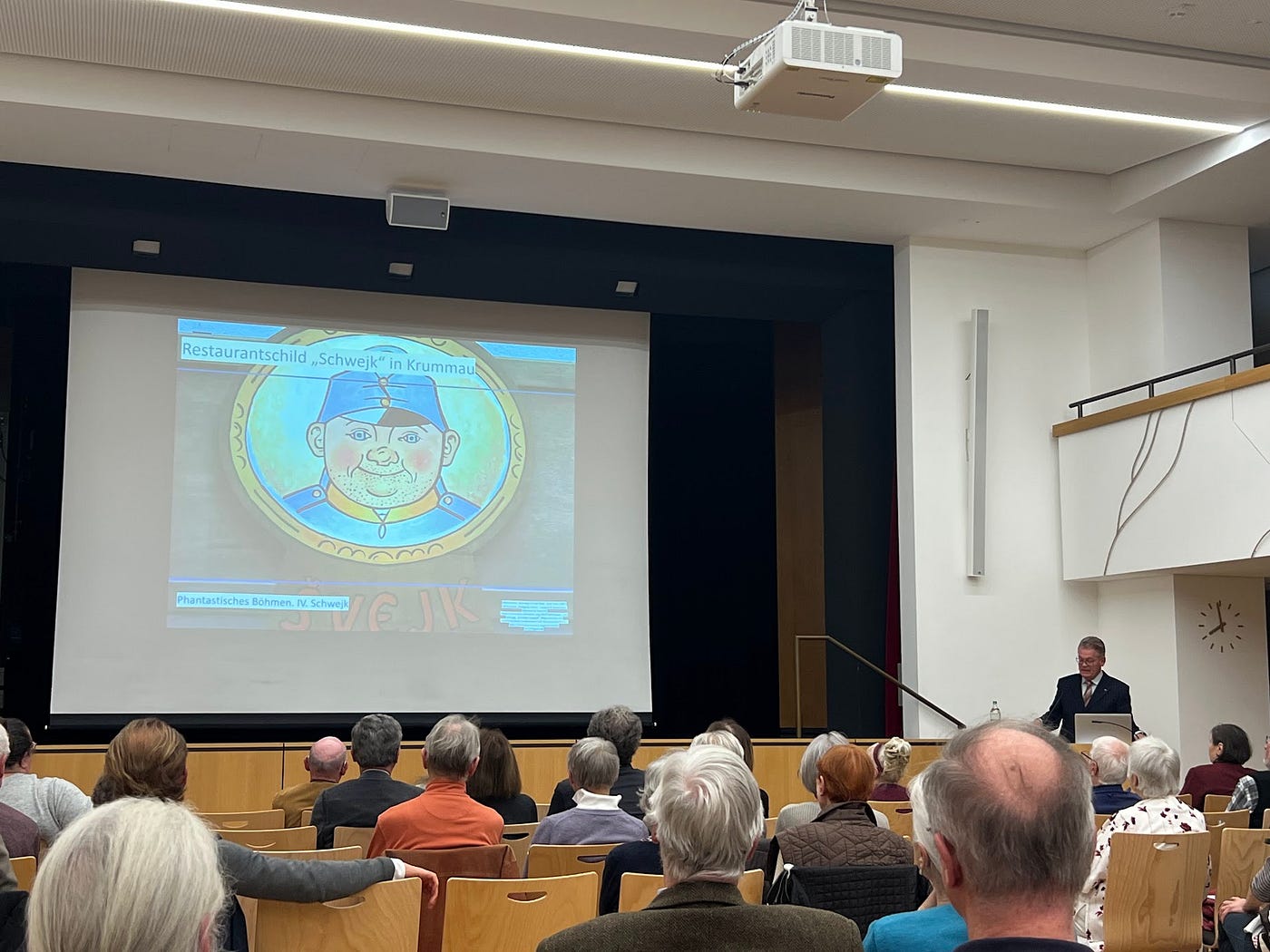
Prof. Stefan Samerski demonstrated how Hašek’s Schwejk unmasks power, through language, Lada’s iconic imagery, and the stage. Comedy as resistance, then and now.
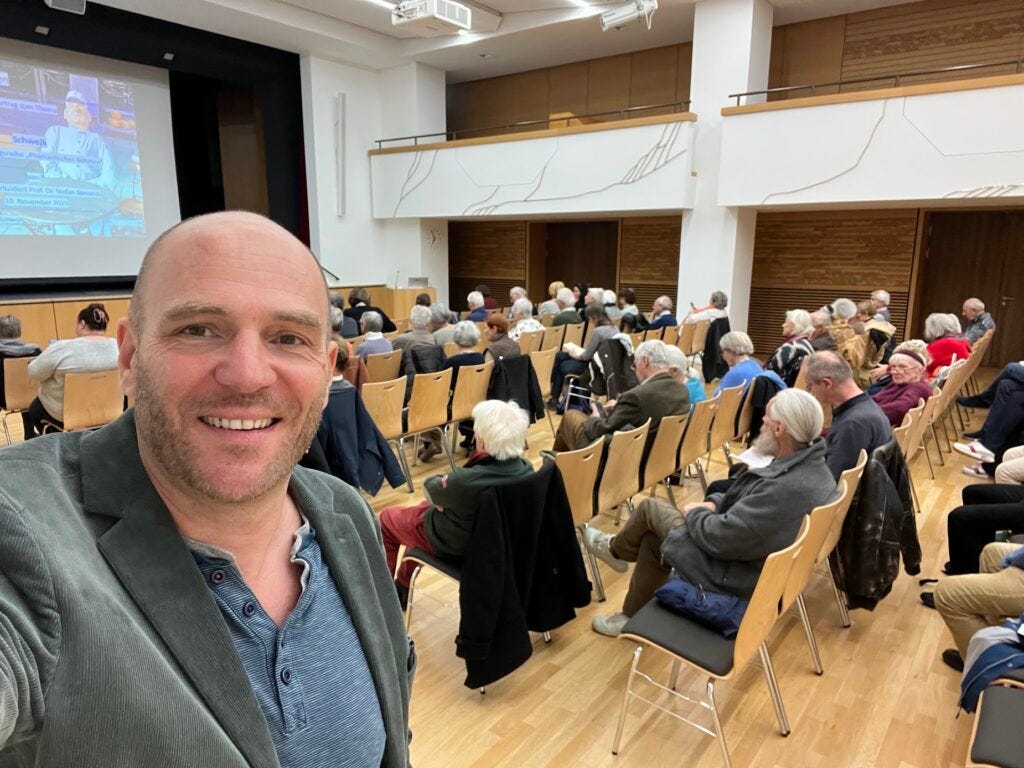
The Adalbert Stifter Hall at Munich’s Sudeten German House was filled to capacity. The atmosphere was both lively and reflective as Prof. Samerski opened with humour as a release valve for the absurdities of the world, those absurdities that find their unforgettable face in Schwejk.
From Television to Collective Memory
What struck the audience first was Samerski’s sense for the cultural tempo of Schwejk’s reception. With a few deft allusions, he conjured up television memories. Peter Alexander, Fritz Muliar, and the enduring screen adaptations that gathered whole families around the TV set. He reminded listeners of these “other media” that freed Schwejk from the printed page and placed him within the shared laughter of generations, laughter that transcends linguistic borders when translation captures the tone.
This Schwejk is simply indestructible.
Prof. Stefan Samerski
An affirmation of something comic, grotesque, and distinctive. And, as he noted, once again in high demand today.
Language as the Engine of Comedy
Samerski often begins with an apparently casual turn of phrase, only to lay bare the mechanism behind it. Language, he argued, carries the comedy, not merely action or setting. In recent German translations one can sense a deliberate attempt to capture the Czech tonal base, and this, he observed, determines whether Schwejk’s laconic irony truly comes across.
That Hašek drew his humour from oral performance, tavern talk, readings, anecdotes, and distilled it into literary form was presented not as curiosity, but as a poetic process of compression and transformation.
The Movement of the Character
A particularly strong segment traced the character’s evolution, from the “idiocy” diagnosed at conscription to the sly, peasant‑shrewd survivalist who brings the bureaucratic machine itself to a stuttering halt.
Far from being a stock fool, Schwejk emerges as an active figure who, by taking orders literally, exposes their senselessness. This aligns with Tucholsky’s image of the “little man” in the machinery of state who, quietly and unshaven, tells the truth. The reading illuminated how Schwejk achieves the power of anti‑war literature without becoming a battlefield chronicle.
Biography as Resonance, Not Reduction
Samerski touched on Hašek’s biography, Prague’s bohemia, Russian captivity, his zigzag politics, not as simplistic explanation but as a resonant backdrop to his poetics. The focus remained on the text itself, the early episodes with their anecdotal pull, the comedic precision sustained by the quiet undertone of the serious. One line lingered:
Without Lada, there would probably be no Schwejk.
Prof. Stefan Samerski
Hašek and the artist Josef Lada knew and valued one another. Lada’s round cap, broad face, and calm posture gave Schwejk the iconic physiognomy that readers recognize before the first line is read. His drawings are no mere adornment but a second narrative layer. They translate Hašek’s spoken humour into clear contours, condensing atmosphere, gesture, and rhythm, a caricature as distilled essence of a figure born in the tavern and destined for the stage.
Calendar, Canon, Carnival
The carnival date of 11 November served as more than a prelude, it mirrored Schwejk’s own technique, the inversion of order through literal obedience. What in carnival makes hierarchy slip becomes Hašek’s method. The earnest execution of nonsense that unveils nonsense itself. Samerski’s examples made this vividly clear, without thesis storms, but with shared understanding audible in the room.
Stage, Screen, and the Durability of Humour
In the second part, the focus widened to reception history, German theatre, TV adaptations, the steady afterlife of a character constantly reinvented. Whenever systems become over‑bureaucratized, the humour finds its audience, Schwejk is the perfect probe.
Between examples, one could note the building blocks of a comic poetics, literalism, over‑fulfilment, deflation, counter‑speech through precise obedience. Those who listened learned a technique of humour, those who laughed were its living proof. Thus the “school of wit” intertwined with a quiet seriousness, authenticating the novel’s anti‑war current.
Personal Note, Max Brod as Catalyst
A question lingered beyond the lecture:
How did Hašek become world‑famous?
Henry Ertner
Samerski did not address it, his focus lay on character, language, and performance, yet the evening offered threads to follow. For the German‑speaking world, the path leads to Max Brod, that mediator between Czech and German, critic and editor who early on brought Hašek, especially Schwejk, into the German feuilleton and onto the stage.
Studies of Prague Modernism show Brod as a cultural go‑between who anchored Czech literature in German discourse. Especially regarding Schwejk, his role as initiator is unmistakable. Thus we can see how a Prague tavern novel became world literature, Hašek’s text, Lada’s visual language, the stage as amplifier, and Brod’s gift for opening doors and transforming enthusiasm into public momentum.
Prof. Samerski and the Sudeten German Academy are already preparing the next lecture series for 2026. I am delighted to take part again, anticipation for the coming year has only grown stronger.
Deutsch https://www.henryertner.com/prof-samerski-ueber-schwejk/
English https://medium.com/@henryertner/professor-samerski-on-schwejk-28bcaa74e172
Česky https://medium.seznam.cz/clanek/henry-ertner-prof-samerski-o-svejkovi-207127
메타데이터
- post_id
- 28bcaa74e172
- slug
- professor-samerski-on-schwejk-28bcaa74e172
- url
- https://medium.com/@henryertner/professor-samerski-on-schwejk-28bcaa74e172
- canonical_url
- https://medium.com/@henryertner/professor-samerski-on-schwejk-28bcaa74e172
- author_url
- https://medium.com/@henryertner
- status
- ok
- fetched_at
- 2026-06-28 14:26:31