The Archive Journal
Fashion as a living record of who we were, who we are, and who we are becoming.
The Archive Journal
Fashion as a living record of who we were, who we are, and who we are becoming.
By Afshan Jawed Fatima

Fashion gets a bad rap in serious circles. It’s dismissed as surface-level, frivolous, the domain of vanity rather than intellect. But spend any real time studying it, and you start to see something different. What we wear is a record — of power, politics, identity, and technological change. It always has been.
Fashion as a Subject of Intellectual Discussion
Here’s a strange thing: fashion is everywhere. It fills museums, drives billion-dollar industries, and influences nearly every social interaction we have. And yet, for most of intellectual history, it has been barely acknowledged as a legitimate subject of study.
Part of the problem is definitional. Fashion, at its core, is what distinguishes the habits, manners, and dress of a given period or group. But those terms are slippery. Fashion shifts constantly — with time, geography, and taste — which makes it hard to pin down analytically. Even professional fashion writers have historically struggled to articulate what fashion actually is.

A few notable figures did take it seriously. Honoré de Balzac understood that the tiniest details of dress — the knot of a cravat, the way a cane was held — carried enormous social weight in bourgeois France. Charles Baudelaire wrote about the aesthetic pleasure of seeing a woman in contemporary costume rather than idealized nudity, suggesting that fashion was its own form of art. And Stéphane Mallarmé, the poet, actually edited a fashion journal called La Dernière Mode, covering clothing, travel, and cultural commentary.
But these were exceptions. When Thomas Carlyle published Sartor Resartus in 1831 — a philosophical treatise on clothes — he was working against a culture that viewed dress as a topic fit only for ridicule. Serious academics didn’t discuss fashion. It belonged to the feminine, the frivolous, the morally suspect.
That dismissal has never been intellectually justified. What people wear tells us how they understand power, identity, and belonging. The unwillingness to study it says more about academic bias than about fashion itself.
The Feminization of Fashion
Go back four or five centuries, and the relationship between men and fashion looks completely different from what we know today. The elite — male and female alike — competed through spectacle. Men were, quite literally, the peacocks: draped in vibrant silks, elaborate wigs, heavy jewellery, and ornate embroidery. A man’s wardrobe was a direct statement of his family’s power and wealth.
Then something shifted. Historians call it the “Great Masculine Renunciation” — a sweeping, relatively rapid change in which men collectively abandoned aesthetic expression as a domain. Out went the silks and the makeup. In came sobriety: dark, utilitarian fabrics; practical cuts; functional features like pockets. As men’s wardrobes became tools for public life and labour, the world of ornamentation and style was ceded almost entirely to women.

This wasn’t a neutral development. By associating fashion with femininity, the male-dominated culture of the 18th and 19th centuries effectively devalued it. What women wore became “decorative” rather than significant — a hobby, not a statement.
But the story reveals something important. If what men wear conveys authority, seriousness, and social standing — which it clearly still does — then clothing has never been trivial. We just chose to apply that logic selectively.
Female Opponents and Proponents of Fashion
It’s worth understanding why many women historically resisted fashion — because the resistance was often well-founded.
For centuries, a woman’s dress was not an expression of her own identity. It was a display of her family’s wealth — her father’s before marriage, her husband’s after. Her body functioned as a kind of walking ledger of conspicuous consumption. Under those conditions, dressing up wasn’t empowering; it was a form of subjugation dressed in fine cloth. Women who pushed back against the elaborate constraints of fashion — the corsets, the multiple layers, the restrictive silhouettes — were often, rightly, resisting a system that tied their worth to their appearance.

The shift came with post-modern fashion’s break from rigid cultural hierarchies. As dress became more individualized and less dictated by class convention, many women reclaimed it as a language. Clothing became armour, political statement, creative expression — something worn on one’s own terms rather than someone else’s.
The path forward is to detach fashion from its gendered history entirely. When style is understood as a gender-neutral medium rather than a feminine obligation, it loses its power to objectify and gains its power to express. That’s not a small distinction.
Why Fashion Wasn’t an Intellectual Discussion in the Victorian Era
The Victorian era was, by any measure, an age of enormous upheaval. The French Revolution had dismantled the old aristocratic order. The British Empire stretched across continents. Gold rushes were reshaping economies. The American Civil War was tearing a nation apart over the question of whether human beings could be owned as property.

Against that backdrop, fashion simply couldn’t break through as a serious subject of discourse. The intellectual priorities of the era were existential — questions of political legitimacy, economic dominance, racial justice, and national identity. A conversation about silhouettes or sleeve lengths was, understandably, not going to earn space in the same room.
This context doesn’t excuse the dismissal of fashion as intellectually worthless — it explains it. And it’s a reminder that what gets taken seriously in any era is inseparable from the politics of that era.
Lifestyle Influence on Fashion in the Victorian Era
The 19th century is the era of the corset, the bustle, and the bonnet. But Victorian fashion was also a product of rapid industrial and political change — more so than any previous period.
Queen Victoria’s own widowhood reshaped formal dress. After Prince Albert’s death, she wore black for the rest of her life, and mourning dress became elevated to new levels of social significance. Her court’s influence was enormous — commoners genuinely aspired to dress like royalty.

Mass production of sewing machines in the 1850s transformed who could access fashion. Synthetic dyes introduced new color possibilities. And the proliferation of fashion magazines opened the market of high fashion to ordinary consumers for the first time — the beginning of what we now recognize as mass-market style culture.
Britain’s imperial reach also shaped what people wore. As India became central to the British Empire, Indian textiles — silks, cottons, Kashmir shawls — flowed into British wardrobes. The Kashmir shawl became a status symbol, and stores like Liberty on Regent Street (opened 1875) built their reputation selling Indian fabrics, scarves, and jewellery alongside domestic goods.
Victorian fashion, in other words, was never just about aesthetics. It was a mirror of empire.
Victorian Era Fashion Capital: Paris
London might have had the Empire, but Paris had fashion.

French fashion’s roots run deep — back to Louis XIV, when the royal courts monopolized access to luxury goods. By the early 1670s, the creation of the fashion press had begun to bring those styles to a broader public. The French Revolution, interestingly, produced its own fashion politics: the sans-culottes movement (literally “without culottes”) rejected aristocratic dress as a political statement.
By the 19th century, Paris had consolidated its position as the global center of haute couture. The decisive signal came in 1846, when Charles Frederick Worth — British-born, often called the father of haute couture — moved to Paris to build his career. The message was clear: if you wanted to be a serious designer, you needed to be in Paris. Fashion shows were held there. The major magazines looked to Paris for authority.
London was powerful politically and economically, but it followed Paris when it came to style. That dynamic would persist well into the 20th century.
The Luminous Heritage of Bihari Chhapa
In Bihar, there is a textile tradition that does not begin with a sketch or a trend forecast. It begins with a belief.
Chhapa — from the Hindi word for “print” — is a hand block foil printing technique that produces shimmering silver patterns on fabric. For generations, it has been central to the bridal trousseau of the Bihari Muslim community, particularly for the Nikah ceremony. Its presence at a wedding is not decorative in the casual sense; it’s considered integral to the spiritual completeness of the occasion.
The tradition is rooted in reverence for Bibi Fatima, the daughter of the Prophet Muhammad, whose wedding garments are believed to have featured similar intricate craftwork. For modern brides, wearing Chhapa is a way of participating in that lineage — a thread connecting the present to the sacred past. The silver itself carried practical significance too: it was traditionally believed to deter insects from damaging stored fabric, and symbolically to repel negativity.

Technically, the process is meticulous. Artisans from the Rangrez community use hand-carved wooden blocks — often featuring floral motifs — to apply a specialized adhesive to the stitched garment. Thin leaves of silver (or, in contemporary practice, aluminum) are then pressed onto the pattern and hammered to adhere firmly to the fibers.
Chhapa has adapted over time. Originally confined to red and green, it now embraces yellows, violets, and pinks. Production has centralized in cities like Patna and Gaya, and the craft has found devoted followers among the Bihari diaspora in North America, Europe, and the Middle East.
What makes Chhapa worth understanding is what it represents in the broader story of fashion: a craft that is simultaneously technical, spiritual, cultural, and stubbornly alive — a refusal to let globalization flatten everything into the same mass-produced surface.
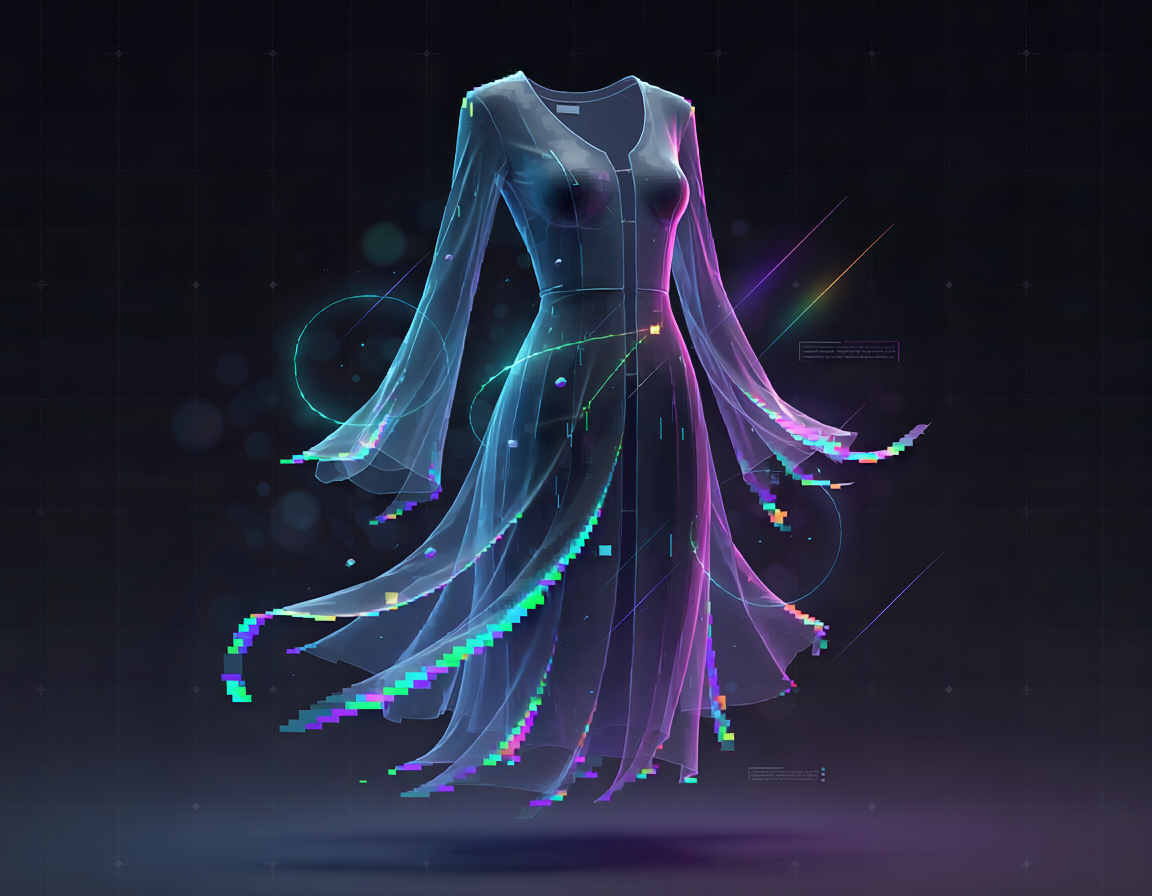
How Virtual Fashion Is Rewiring the Industry
At some point during the COVID-19 pandemic, physical fashion shows became impossible. Designers couldn’t travel. Buyers couldn’t gather. And yet, fashion kept moving.
In May 2020, the label Hanifa debuted a 3D collection on Instagram Live — rendered garments worn by digital models, designed to look and move like physical clothes. Shortly after, Helsinki Fashion Week became the first entirely online 3D fashion event, with attendees participating as virtual avatars in a digital environment. Balenciaga introduced clothing and accessories inside the game Fortnite.
These weren’t gimmicks. They pointed toward something structural: the fashion industry’s gradual shift toward total digitalization.
Virtual fashion — the creation of 3D garments, outfits, and accessories designed for digital environments like social media, gaming, and the metaverse — is distinct from “digital fashion” in a technical sense. It uses 3D software to build designs that exist in virtual space, often without any physical counterpart. Software like CLO3D and Vstitcher enables pattern drafting, draping, and sewing on digital avatars in real-time.

The environmental argument is compelling. When a designer can test and iterate a garment digitally before cutting a single piece of fabric, waste drops dramatically. Virtual prototyping reduces the carbon footprint of the development process. For an industry notorious for its environmental impact, this isn’t a minor benefit.
The challenges are real too. Virtual fashion requires significant technical infrastructure and specialized 3D modeling skills that much of the industry doesn’t currently have. Intellectual property theft and cyber-attacks are genuine risks. And the lack of a standardized virtual platform for collaboration fragments what should be a connected ecosystem.
But the deeper significance of virtual fashion is cultural, not technical. It performs the same social functions as material fashion — identity formation, status signaling, creative expression — while ignoring the physical constraints of wearability. You can design a garment that defies gravity, exists in multiple colorways simultaneously, or shifts based on the viewer’s angle. The only constraint is imagination.
That’s a genuinely new frontier. And it connects directly to everything that came before: the Victorian corset that shaped bodies for social display, the Bihari bride draped in silver foil, the Parisian couture house that dressed power. Fashion has always been about how we construct ourselves for the world. Virtual fashion is just the latest version of that impulse — executed, now, in code.

About the Author
Afshan Jawed Fatima is a fashion industry professional, educator, and the founder of The Archive Journal. Her background spans textile science and strategic design — a combination that informs her approach to fashion as both a technical discipline and a subject of serious intellectual inquiry. She is trained in classical pattern making, advanced draping, and 3D prototyping software including CLO3D, and holds expertise in fashion law and sustainable material science. The Archive Journal is dedicated to the next generation of fashion thinkers: those who understand that real innovation requires fluency in both the sketchbook and the spreadsheet.
메타데이터
- post_id
- 28bea73ffbfa
- slug
- the-archive-journal-28bea73ffbfa
- url
- https://medium.com/@afshanjawed06/the-archive-journal-28bea73ffbfa
- canonical_url
- https://medium.com/@afshanjawed06/the-archive-journal-28bea73ffbfa
- author_url
- https://medium.com/@afshanjawed06
- status
- ok
- fetched_at
- 2026-06-13 07:35:29