The Inspiration and Nemesis of Sherlock Holmes
Professor Moriarty: Machiavellian Monster
The Inspiration and Nemesis of Sherlock Holmes
Professor Moriarty: Machiavellian Monster
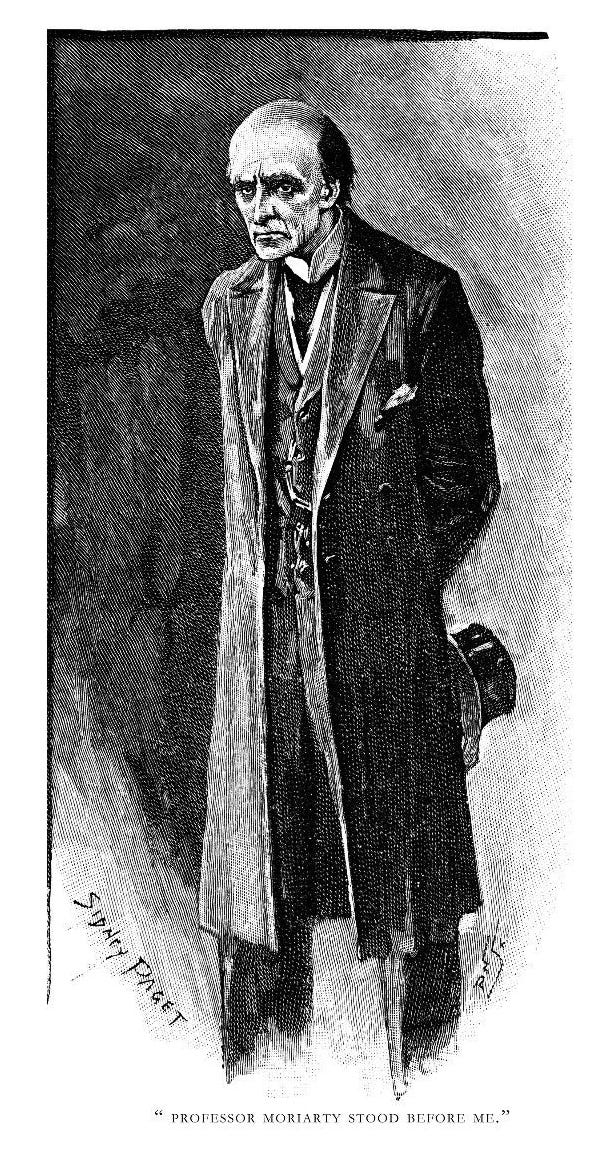
Professor James Moriarty, illustration by Sidney Paget, which accompanied the original publication of “The Final Problem” (1893) ( Wikimedia Commons)
“My horror at his crimes was lost in my admiration at his skill.” ― Sherlock Holmes
Is there a more iconic villain in all detective fiction than Professor James Moriarty, the archenemy and nemesis of Sherlock Holmes? In fact, I am sure he must be up there near the top in the list of all-time great villains and may even be at the top for many, and that includes me.
Yet, he hardly appears in the canon of Sherlock Holmes stories and was only created by Arthur Conan Doyle to kill off Holmes in Conan Doyle’s intended final story of Sherlock Holmes and Dr. Watson. Talk about Alpha and Omega, the beginning of Moriarty is his end as well. Yet what Conan Doyle does give us in his portrait of this mathematical genius gone awry is so very tantalizing that it undoubtedly makes us want more. But we only get a tiny bit more in retrospect.
When Holmes is brought back by public demand, Conan Doyle now recreates the ‘spider’ at the very center of a Machiavellian web of intrigue and crime. Moriarty is the hub through which most criminal enterprises of significance must pass, what we call the ‘mastermind’, as Holmes explains to his trusted companion,
“He is the Napoleon of crime, Watson. He is the organizer of half that is evil and of nearly all that is undetected in this great city, He is a genius, a philosopher, an abstract thinker. He has a brain of the first order. He sits motionless, like a spider in the center of its web, but that web has a thousand radiations, and he knows well every quiver of each of them. He does little himself. He only plans.” ― Arthur Conan Doyle, The Memoirs of Sherlock Holmes
And it is here that a vehement and visceral hatred towards Holmes by Moriarty truly begins. For Holmes has been thwarting Moriarty without him even knowing that such a ‘Napoleon’ of crime even existed. But Moriarty has been aware of Holmes for a considerable length of time. They only ever met twice in person. The first time is in Moriarty’s study, and the final time at the infamous Reichenbach Falls, where both fall to their deaths. Holmes is the fly that catches the spider this time.
Or maybe not. I always believed that modern TV drama had invented the idea of bringing a fictional character — who had died in the story — back to life, but I was wrong. Conan Doyle had already pulled that fast one. And we are so glad he did.
Conan Doyle was forced to bring Holmes back from his heroic death at the Reichenbach Falls. Moriarty was not so lucky. His memory was brought back, but not his body, and the stories are now in retrospect.
Holmes dies like a hero, in preventing Moriarty from developing his evil plans and webs of control by deliberately falling to his death in a final embrace with his archenemy. It is still one of the great titanic tussles in fiction. Two similar geniuses, yet one good and the other irredeemably evil, meet to decide the fate of Victorian society. It is order versus chaos. Each icon personifies a Jungian archetype. And a Titanic force. The battle at the Reichenbach Falls is elegiac.

The Reichenbach Falls (Wikimedia Commons)
I do not complain that Holmes returned, but I only wish Moriarty could have as well. But perhaps that would have been just a little too hard to believe. Or maybe Moriarty was just too dangerous to be in the public eye for too long.
And obviously, when you have created an icon of villainy, less is more. The status of Moriarty as a villain of unsurpassed genius and as the mastermind of mendaciousness is forever immortalized by such death at the hands of Sherlock Holmes, the greatest fictional detective in history. For Moriarty lives on in every movie that features a criminal mastermind. All are but derivatives of him.
Holmes is not original. His antecedents surely begin with Edgar Allan Poe and his invention of the modern detective story and the modern detective named C. Auguste Dupin. Dupin has idiosyncrasies and peculiarities similar to those of Sherlock Holmes, but not as pronounced or as obsessive.
The melancholy of Holmes feels so very Anglo-Saxon. These were surely the very solid and unique foundations that Conan Doyle built upon. Holmes is a complete character, whereas Dupin was an intriguing pencil sketch awaiting a proper portrait on a larger canvas.
But Moriarty was unique. Based on several contemporary men of science, he is so much more than them. When a mathematical — and scientific — genius turns on the Establishment of which he is a part, it is so rare. It is reminiscent of the rebellion of Satan in *Paradise Lost* (1667) by John Milton. Take another look at the portrait by Sidney Paget above.
“Better to reign in Hell, than to serve in Heaven.”
― **John Milton, **Paradise Lost
Moriarty is an extremely unpleasant and unlikeable character, yet charismatic as evil people so often are. His portrait by Sidney Paget for The Strand Magazine is, I think, a perfect encapsulation. He is not a young man in these stories, and the portrayal on TV by a young(er) man does not work for me.
He seems more aged than Holmes, and one thinks of The Picture of Dorian Gray by Oscar Wilde and that painting in the attic. The evil crimes Moriarty is involved in — even from a distance — feel as if they have affected even his body and his very skin. He looks damned and very unwell. Moriarty has become contaminated with the evil he is responsible for. Moriarty is the living picture of Dorian Gray.
“I could not rest, Watson, I could not sit quiet in my chair, if I thought that such a man as Professor Moriarty were walking the streets of London unchallenged.” ― Sherlock Holmes
Although his attire is immaculate, entirely business-like, and profoundly Victorian, he still presents a vision of fiendishness waiting to pounce when the opportunity arises. For all his bourgeois presentations and his cultured aspect, we must not forget this human being can be as brutal as any cold-blooded common or garden killer walking the streets of Victorian London. A highly educated Professor of Mathematics with the moral compass of Jack the Ripper.
He was the creation of Arthur Conan Doyle. One is always surprised when looking at such a genteel man as Conan Doyle that these stories of Sherlock Holmes are so very, very violent. The Reichenbach Falls is brutal in its life and death struggle. Perhaps this is another reason why they are still being read and adapted for a new generation. The violence has never left us.
Happy Birthday, Sir Arthur Conan Doyle.
메타데이터
- post_id
- 28d59f3f2858
- slug
- the-inspiration-and-nemesis-of-sherlock-holmes-28d59f3f2858
- url
- https://medium.com/@marcbarham/the-inspiration-and-nemesis-of-sherlock-holmes-28d59f3f2858
- canonical_url
- https://medium.com/@marcbarham/the-inspiration-and-nemesis-of-sherlock-holmes-28d59f3f2858
- author_url
- https://medium.com/@marcbarham
- status
- ok
- fetched_at
- 2026-06-09 15:37:30