How Indonesia’s Rp32T Bond Auction is Starving Local Businesses
Costly, illiquid, and squeezed. Why Indonesia’s Rp600T interest burden is unsustainable.
How Indonesia’s Rp32T Bond Auction is Starving Local Businesses
Costly, illiquid, and squeezed. Why Indonesia’s Rp600T interest burden is unsustainable.
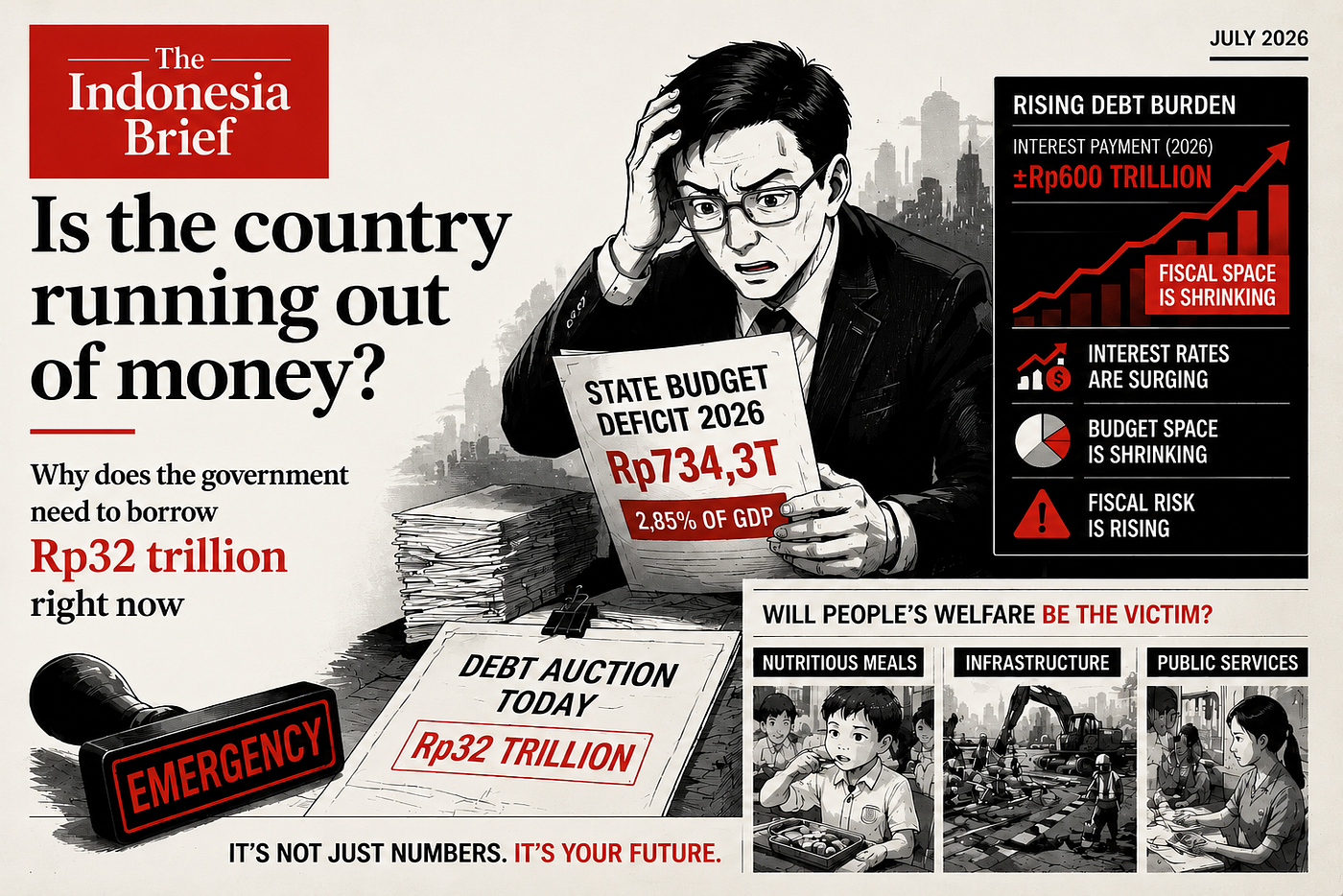
On Tuesday, July 7, 2026, the government officially set an indicative target of Rp32 trillion in its Rupiah-denominated State Securities (SUN) auction. This figure is not a routine transaction, but a direct manifestation of urgent gross financing needs driven by a fiscal deficit projected to widen to Rp734,3 trillion, equivalent to 2,85% of GDP. The auction utilizes a multiple-price method managed by Bank Indonesia, where bids are submitted through primary dealers and winning bidders pay exactly the yield they proposed. This mechanism forces the government to set highly competitive upper yield limits to attract liquidity amidst fierce competition with other monetary instruments.
Domestic Liquidity Crisis and Escalation of Credit Contraction
The allocation of net debt financing amounting to Rp832,21 trillion in the 2026 APBN directly absorbs the excess liquidity from the national banking system. The macroeconomic translation means funds that should have been disbursed as working capital credit to the real business sector are instead diverted to purchase SUN to bridge the fiscal gap. The Ministry of Finance through DJPPR officially recorded a controlled Semester I-2026 deficit at Rp196,5 trillion (0,70% of GDP). However, this official figure masks a structural liquidity crisis on the ground, where data regarding tight bank credit to MSMEs in Java and Sumatra goes unreflected in early-year fiscal surplus reports. The remaining liquidity is now concentrated solely within four major state-owned banks, while thousands of Rural Banks (BPR) experience credit contraction as they are systematically outmuscled by the sheer volume of state bond absorption.
Subsectoral Vulnerability and the Crowding-Out Effect
The fiscal crowding-out phenomenon generates critical vulnerabilities that hit specific sub-sectors disproportionately rather than evenly across the board.
First, Domestic Commercial Banking. These institutions are trapped in a dilemma between regulatory liquidity requirements and profitability, opting to absorb high-yielding SUN instead of disbursing productive credit. Their reliance on the spread between deposit rates and SUN yields has effectively paralyzed financial intermediation to the real economy.
Second, Labor-Intensive Manufacturing. The reluctance of banks to extend new credit forces manufacturing firms to delay expansion or halt production lines entirely. Seknas FITRA, which projects per-capita debt reaching Rp32 million, emphasizes that this debt burden ultimately squeezes consumer purchasing power, directly reducing domestic demand for manufactured goods.
Third, Securities Markets and Pension Funds. Pension guarantors are forced to lock their portfolios into long-term government bonds (FR0102 and FR0105) offering coupons up to 6,875%. While safe from default risk, this allocation freezes long-term funds that could otherwise finance green infrastructure or private green bond projects.
Macroeconomic Vicious Cycle: BI Rate Hikes and Erosion of Productive Fiscal Space
This crisis is triggered by the transmission of tight global monetary policy. Middle Eastern geopolitical tensions and hawkish signals from the Fed triggered massive sell-offs, weakening the Rupiah to the range of Rp17.709 to Rp17.981 per US Dollar. As a pre-emptive response, Bank Indonesia aggressively raised its BI Rate by 100 basis points in a short timeframe, breaching the 5,75% level. The direct consequence is that the government must offer long-term SUN coupons at the upper limit of 7,125% to remain attractive to investors, immediately triggering a swell in the interest debt budget to Rp599,44 trillion. A policy paradox occurs here: the government is actively expanding the deficit for priority spending, yet Bank Indonesia is simultaneously issuing high-yield Bank Indonesia Rupiah Securities (SRBI) that compete for the exact same domestic liquidity. This condition exposes a shocking historical statistic, where the ratio of interest burden to state revenue is approaching the 15% to 20% tolerance limit, ending a two-decade-long era of safe fiscal margins.
Paradox of Low Early Deficits vs Competitor Fiscal Discipline
Director General of Financing and Risk Management, Suminto, repeatedly asserts that Indonesia’s fiscal posture remains highly healthy, pointing to the Semester I deficit of only 0,70% of GDP driven by a 22,1% surge in tax revenue. However, this is a dangerous fiscal paradox: short-term tax revenue growth is being squandered to cover long-term debt interest, rather than financing structural transformation. While Indonesia is busy absorbing its own domestic liquidity to pay interest, the World Bank affirms Vietnam’s fiscal resilience, which has successfully lowered its interest-to-revenue ratio below 10% through spending discipline and external funding diversification. Vietnam has successfully utilized Foreign Direct Investment (FDI) to fund deficits without squeezing its domestic banks, a stark contrast to the Ministry of Finance’s domestic financing strategy that relies heavily on SUN.
Emergency Interventions and Long-Term Recovery Strategies
To halt the bleeding in fiscal space, the government has implemented three emergency actions. First, the slashing of the Free Nutritious Meal (MBG) program budget from Rp335 trillion to Rp268 trillion to curb unproductive spending. Second, the aggressive restriction of net foreign debt withdrawals, slashed by 69,39% to just Rp39,21 trillion, to isolate the APBN from exchange rate shocks. Third, a strategic plan to expand the SUN investor base outside the United States to break the dominance of traditional foreign investors who frequently execute sell-offs during market turbulence.
However, symptomatic treatment will not erase the structural root of the problem. The Indonesian Employers’ Association (APINDO) demands a total overhaul of the state financing architecture so the real sector stops being collateral damage in the government’s debt management. Long-term demands that must be met include:
- Restructuring of debt maturity profiles to avoid refinancing risk clusters of Rp833,96 trillion that compress the market in specific years.
- Diversification of Sharia financing instruments through the issuance of global Sukuk capable of attracting liquidity from the Middle East without relying on conventional interest rates.
- Reform of fiscal spending substance by shifting focus from direct operational expenditures to capital infrastructure spending with a high multiplier effect on GDP.
- Strengthening the rules-based fiscal framework that constitutionally limits the debt interest-to-revenue ratio at a strict 12% threshold.
- Optimization of proportional tax bases by eliminating misdirected tax incentives to ensure state revenue sustainability without perpetual borrowing.
The 2026 APBN financing crisis is not merely a technical issue of state financial accounting, but a crucial turning point that will dictate the trajectory of Indonesia’s economic sovereignty for the next two decades. The government cannot continue to fund priority spending deficits by asphyxiating domestic banking liquidity through high-interest SUN issuances; if this fiscal strategy is maintained, Indonesia will be trapped in a low-growth quagmire surrounded by a pile of internal debt that continuously erodes the foundation of national industrial competitiveness.
메타데이터
- post_id
- 28f07fd3f06d
- slug
- how-indonesias-rp32t-bond-auction-is-starving-local-businesses-28f07fd3f06d
- url
- https://medium.com/@theindonesiabrief/how-indonesias-rp32t-bond-auction-is-starving-local-businesses-28f07fd3f06d
- canonical_url
- https://medium.com/@theindonesiabrief/how-indonesias-rp32t-bond-auction-is-starving-local-businesses-28f07fd3f06d
- author_url
- https://medium.com/@theindonesiabrief
- status
- ok
- fetched_at
- 2026-07-16 14:44:18



